
It’s March. You’d mentally planned to be taking Step 1 in June. Your friends at other schools are already deep in dedicated.
Then your administration drops the email: because of clinical schedule shuffling / curriculum changes / board performance concerns, your Step 1 eligibility is being pushed back. Maybe by 2–4 months. Maybe longer.
Everyone’s group chat blows up with the same three reactions:
- “Are you kidding me?”
- “So… when do we actually take it now?”
- “What do we even do with all this extra time?”
You are here: stuck in limbo. Not quite in dedicated. Not fully in “just classes” mode. And you’re trying to figure out if this delay is a gift, a curse, or both.
Let me walk you through how to treat it as a strategic advantage instead of a slow-motion train wreck.
First: Get Concrete About the New Reality
Do not stay in the vague “we’ll see what happens” zone. You need details.
Ask (and if needed, politely push your administration for clear answers):
- What is the earliest date we’re allowed to sit for Step 1 now?
- Are there specific conditions (finish certain courses, pass NBME, etc.)?
- Does this affect clinical start dates or just exam timing?
- Will the school require a specific CBSE/NBME benchmark before clearing us to schedule?
You want actual dates and numbers, not hand-waving.
Once you have an approximate timeline, build a simple structure:
- “Now” to (T – 10–12 weeks): Extended prep / foundation-building phase
- Last 10–12 weeks before test: Traditional dedicated
If they delayed you by 3–4 months, good. You can use that extra window to fix the stuff that’s usually rushed or ignored: weak basic science, bad Anki habits, slow question reading, burnout.
Step 2: Decide Which Type of Student You Are (Be Honest)
You cannot use extra time wisely until you admit where you actually stand. Brutal honesty here saves months of wasted effort.
Ask yourself:
- How strong is my basic science foundation right now?
- Do you actually understand physio, path, pharm? Or did you cram to pass blocks?
- What’s my NBME/CBSE baseline, if you have one?
- Rough ranges:
- Below ~190 equivalent: foundational work needed
- 190–210: framework is there, but shaky
- 210–230: decent, need refinement and speed
- 230+: you’re in optimization territory
- Rough ranges:
- How’s my study system?
- Are you truly doing daily Anki?
- Do you have a Qbank rhythm?
- Or is everything chaos 3 days before exams?
Based on this, you fall into one of four groups. This is blunt on purpose:
| Profile | Baseline Strength | Main Priority |
|---|---|---|
| Foundation-Weak | Low NBME, shaky basics | Rebuild core concepts |
| Mid-Range | Passing but uneven | Clean up gaps & consistency |
| High-Achiever | Strong baseline | Refine, don’t overdo |
| Burned-Out | Any level + exhausted | Recovery + sustainable plan |
Once you know your profile, the strategy gets very specific.
Step 3: If Your Foundation Is Weak – Treat This as a Reset
If your practice NBME is low or you know you’ve been “passing but not learning,” this delay is probably the best academic gift you’ve ever gotten.
Here’s what to do.
1. Stop pretending more questions alone will fix this
I’ve seen too many students in this boat do 3,000+ questions and stay stuck because they didn’t understand the core material.
You need conceptual rebuild:
- Pick 1–2 main resources for content:
- Boards & Beyond or Sketchy + First Aid / Succinct review book
- If your school uses something like Firecracker/AMBOSS, that’s fine, just commit
- Work system by system:
- Cardio for 2–3 weeks
- Then pulm 1–2 weeks
- Then renal 1–2 weeks, etc.
Not binge-watching videos. Actual learning with notes or active recall.
2. Build a minimal daily structure
For the pre-dedicated months, something like:
- 1–2 hours: Content review (videos or notes, with active recall)
- 1–1.5 hours: Anki (new + reviews; no skipping)
- 20–40 UWorld/AMBOSS questions untimed, tutor mode, focusing on understanding, not scoring
Stop obsessing about percentages now. Right now the score is feedback, not judgment.
3. Fix one high-yield weakness per month
Make a list. For most weak-foundation students, this is:
- Biochemistry (enzymes, metabolism, inborn errors)
- Renal physiology
- Acid–base
- Neuroanatomy / brainstem lesions
- Microbiology systems thinking (what causes X symptom cluster?)
Pick one per month and attack it deliberately with:
- Focused video series
- Specific Anki decks or cards
- Targeted question blocks on that topic
By the time dedicated starts, you want to be out of “I have no clue what’s going on” territory for any major organ system.
Step 4: If You’re Mid-Range – Turn Inconsistency into a Weapon
You’re the classic 200–220 CBSE student. Not terrible. Not great. Your issue is never “I know nothing.” It’s “I know half of everything and forget the rest.”
With extra time, your job is to:
- Turn leaky memory into long-term retention
- Turn random studying into a machine
1. Go all-in on spaced repetition (properly)
If you’re half-using Anki, fix that. Daily, non-negotiable reviews. That’s your backbone.
Daily target:
- Reviews: clear your queue (even if that’s 300–400 cards)
- New cards: 20–40/day depending on your bandwidth
But here’s the key: make your own cards for your mistakes.
For every missed Qbank question, either:
- Tag the relevant pre-made card in your deck, or
- Make a 1–2 line card capturing the idea (“β2 agonists ↓ uterine tone – use in preterm labor”)
Your future score is basically proportional to how honest and consistent you are linking mistakes to cards.
2. Start doing timed blocks twice a week
Not every block. Only 2 per week at first. The rest can be tutor mode.
Purpose:
- Learn to read quickly
- Learn to commit to an answer
- Stop the “I’d get it right if I had more time” fantasy
After each timed 40Q block:
- Spend 1–2 minutes per question reviewing
- Write down patterns: “Missed 4 questions on endocrine pharm,” “Always misread lab values,” etc.
Every week, pick one recurring pattern and fix it.
Step 5: If You’re Already Strong – Do Not Burn Yourself Out Early
You’re sitting on a 230+ baseline, school delays Step 1, and your first thought is “I guess I should crank even harder and get a 260+ now.”
This is how good students implode.
Your goals with extra time:
- Maintain and solidify
- Smooth out blind spots
- Avoid peaking 2 months before you test
1. Downshift intensity, keep frequency
You don’t need 8–10 hour study days right now.
Think:
- 1–1.5 hours Anki
- 20–40 Qbank questions most days (mix tutor and timed)
- Targeted review on your weak areas 3–4 days a week
You should be able to feel like a human: gym, cooking your own meals, seeing a friend occasionally. If you’re living like you’re in week 4 of dedicated for 4 extra months, you’ll be a hollow shell by test day.
2. Rotate deep dives on narrow topics
At your level, the big systems are decent. But narrow, annoying topics can leak points:
- Inborn errors of metabolism
- Immunology nuance (complement deficiencies, cytokines)
- Rare vasculitides
- Renal tubular acidoses
- Weird pharmacology side effects (sodium channel blockers, TB meds, etc.)
Choose one “annoying” topic per week. Spend a focused 2–3 hours that week making it bulletproof. That’s how you convert 230s into 240–250 range.
Step 6: If You’re Burned Out – Recovery Is Not Optional
Some of you reading this are not thinking about scores. You’re thinking: “I literally cannot look at another UWorld stem without wanting to throw my laptop.”
If that’s you, the delay is not “extra study time.” It’s mandatory rehab.
And yes, this matters for your score. Fried brains do not test well.
1. Take a real break (not fake, guilty “breaks”)
I mean 7–14 days of:
- No Qbank
- Minimal or no Anki (you can pause decks; the world won’t end)
- Sleep until you’re actually rested
- Move your body every day
- Do non-medical things on purpose
You’re not weak for doing this. You’re protecting a multi-year investment.
2. Come back with a lower daily ceiling
If your default has been “max out every day until I crash,” change the rules:
- Hard cap on study hours/day (for this phase)
- One full day off per week from heavy study (light Anki only)
- One non-negotiable activity you enjoy built into each week
You’re training for a marathon, not a sprint. The delay just extended the race; adjust your pacing or you’ll fall apart at mile 20.
Step 7: Use the Extra Time to Tighten Your System, Not Just Your Knowledge
Content is only half of Step 1 performance. The rest is logistics and test craft.
Here’s where the delay can let you get weirdly strong.
1. Question strategy
You have time to experiment:
- Reading the stem first vs. last line first, see what works for you
- Underlining or mentally flagging keywords (age, time course, risk factors)
- Developing a 10–15 second approach to every question:
- What is being asked?
- What organ system?
- Is this path, physio, pharm, micro, or biostats?
You should not still be “figuring out your approach” in the last two weeks. Use this extra phase to lock it in.
2. Test endurance
You can gradually build up:
- Start with 40Q timed blocks
- Move to 80Q days (two blocks) once or twice a week
- In the last 6–8 weeks before the exam: full NBMEs and practice exams
Because you have more time, you don’t have to cram all the practice tests into a neurotic 4-week window.
Step 8: Align This with Your Actual Life (Clerkships, Projects, Etc.)
The delay doesn’t exist in a vacuum. It collides with:
- Research projects
- Clerkship orientations
- Family responsibilities
- Rent, jobs, whatever else you have going on
So do a 30-minute “life audit”:
- What obligations are fixed in the next 3–4 months? (call schedules, exams, weddings)
- What’s optional but important? (research, volunteering, tutoring)
- What can be deferred or trimmed?
Then deliberately choose your load.
If you’re weak academically, this is not the time to suddenly pick up three new research projects just because you’re “not in dedicated yet.”
If you’re strong and stable, you might actually use this delay to shore up a research gap or start USMLE-style reading groups. But that’s intentional, not reactive.
Step 9: Build a Simple Timeline From Now Until Test Day
Let’s make this concrete. Suppose they delayed you by 4 months and you expect dedicated to still be about 8–10 weeks.
You might sketch:
Now fill it in based on your profile:
- Foundation-weak:
- Phase 1: heavy content rebuild, light Qbank
- Phase 2: full Qbank momentum, less new content
- Mid-range:
- Phase 1: stable Anki + 20–30 Qs/day, fix big gaps
- Phase 2: mostly Qs, timed blocks, mixed topics
- High-achiever:
- Phase 1: maintenance mode, deep dives on narrow topics
- Phase 2: ramp Qbank, keep life balance
- Burned-out:
- Start with 1–2 weeks off
- Then adapt one of the above with reduced total hours
Add concrete check-ins:
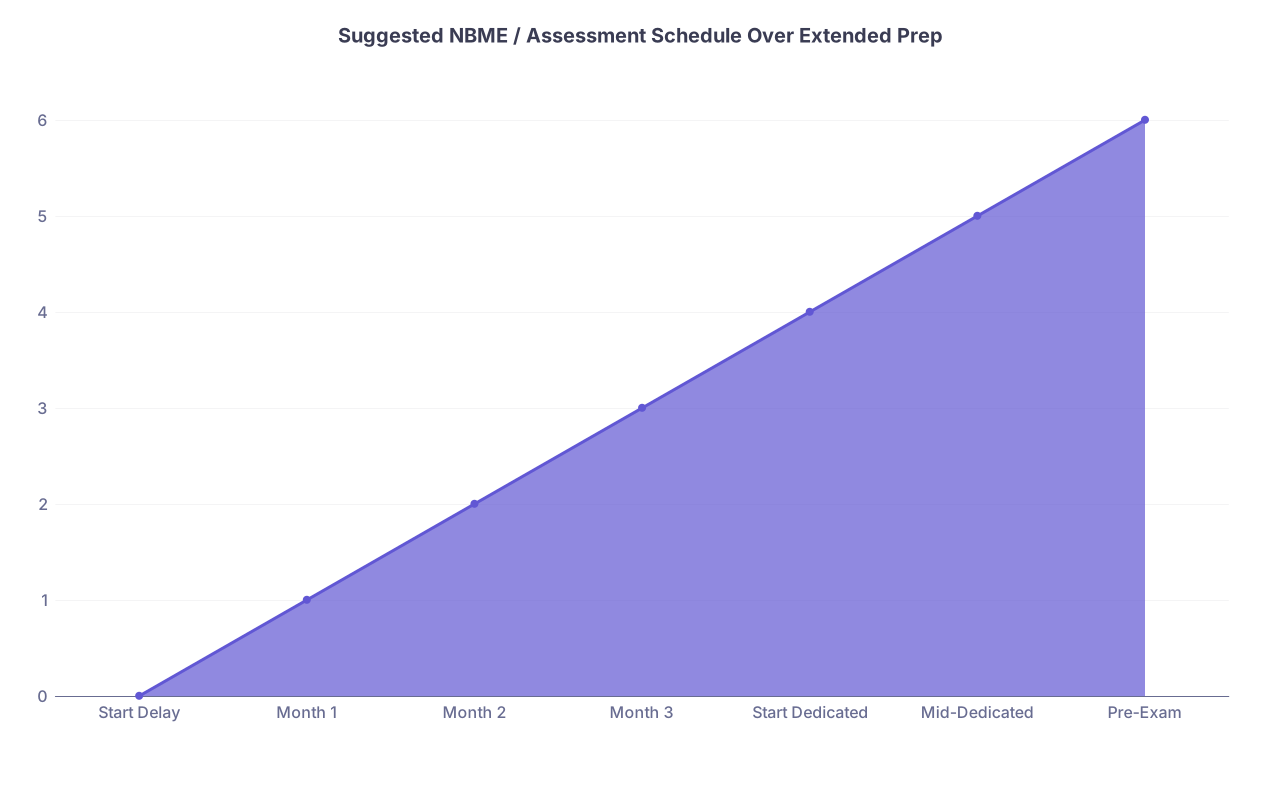
| Category | Value |
|---|---|
| Start Delay | 0 |
| Month 1 | 1 |
| Month 2 | 2 |
| Month 3 | 3 |
| Start Dedicated | 4 |
| Mid-Dedicated | 5 |
| Pre-Exam | 6 |
Translate that to something like:
- End of Month 1: Low-stakes self-assessment or school CBSE
- End of Month 2: NBME
- End of Month 3: NBME
- Then your standard 3–5 NBMEs during dedicated
The point isn’t the exact schedule. It’s that you’re spreading assessments across a longer runway instead of blindly working.
Step 10: Watch for the Two Big Failure Modes
When schools delay Step 1, I consistently see two ways students waste it:
Chronic “preparing to prepare”
- You spend months tweaking schedules, downloading resources, reorganizing Anki, but your actual daily output is tiny.
- Fix: Every day, track just 3 numbers:
- Anki reviews completed
- New Anki cards
- Questions done and reviewed
If those three are consistently low, you’re not actually studying.
Premature dedicated
- You start living like you’re in high-intensity dedicated for 3–4+ months.
- You get great at studying. Then plateau. Then mentally slide backwards by the time you actually test.
- Fix: Intentionally cap intensity early, and plan when you’ll flip the switch to true dedicated.
You’re not trying to “study the most.” You’re trying to peak at the right time.
FAQ (Exactly 4 Questions)
1. Should I add a second Qbank now that I have extra time?
Usually no. One high-quality Qbank (UWorld or AMBOSS) done carefully and reviewed well beats two Qbanks done sloppily. If you truly finish one with strong retention and still have months left, you can add a second for variety, but don’t dilute your learning early. The bottleneck is your review quality, not number of questions.
2. My classmates at other schools are already taking Step 1. Am I at a disadvantage for residency?
Not inherently. Program directors care far more about your score (or pass/fail performance plus clinical evals and Step 2) than whether you took Step 1 in May or August. The only way this delay hurts you is if you let it wreck your mental health or cause a weak performance. Used correctly, the extra time can actually strengthen your application.
3. How much should I worry about falling behind on Step 2 because of this delay?
Step 1 and Step 2 knowledge overlap heavily. If you build a solid base now, you’re not “losing” Step 2 time; you’re investing in it. The risk isn’t the delay itself. The risk is using the delay to cram low-yield details while neglecting core clinical reasoning. Focus on fundamentals and board-style thinking now and Step 2 prep later will be far easier.
4. What if my school ties Step 1 scheduling to a minimum CBSE score and I keep missing it?
Then you treat that CBSE like the exam before the exam. Break down your scores by system and discipline, pick the two weakest areas, and build 2–4 week mini-plans to attack them. Stop taking back-to-back CBSEs hoping for a miracle jump. Use each one to identify patterns, fix them deliberately, then reassess. If you’re truly stuck, seek structured help (tutor, academic support, peer who’s scored well) rather than just grinding more random questions.
Key Takeaways
- Do not treat a Step 1 delay as “dead time.” Treat it as a longer runway: rebuild fundamentals if you’re weak, systematize if you’re mid-range, refine and protect your energy if you’re strong.
- Pace yourself. The only thing worse than not having enough time is peaking three months early and hitting the wall before you test. Balance intensity with sustainability.
- Anchor everything in simple, trackable daily actions: Anki done, questions completed and reviewed, and one weakness at a time deliberately improved. Use the delay to make your process bulletproof, not just your content.