
It’s 7:42 p.m. You’re the last one still in the lab or office. The postdoc just emailed you asking for figures “ASAP,” your PI wants a draft of the abstract by Friday, and your Step 1 Qbank is screaming that you’re 432 questions behind your “daily goal.”
You took a research year thinking it would give you more time to study. Instead, you’re somehow doing full‑time work and trying to prep for one of the biggest exams of your career. And Step 1 is pass/fail now, which everyone pretends means “less pressure” but your anxiety disagrees.
You’re not wrong: this is a tough combo. But it’s doable if you stop pretending you have “full dedicated” and start running your life like a tight, boring, efficient system.
Here’s how.
1. Get Brutally Clear on Your Reality (Not Your Fantasy Schedule)
The first mistake I see: people plan like they have a full dedicated block. You don’t. You have a job plus an exam.
You need real numbers, not vibes.
Start with this:
- How many weeks until your Step 1 date?
- How many realistic study hours can you get on:
- Weekdays
- Weekends
- What’s your actual research workload:
- Fixed hours (e.g., 9–5 in lab)
- Fluctuating deadlines (abstracts, manuscripts, presentations)
Then compress this into something you can see.
| Day | Research Hours | Study Hours (Realistic) |
|---|---|---|
| Monday | 9–5 | 2 evening |
| Tuesday | 9–6 + meeting | 1.5 evening |
| Wednesday | 9–5 | 2 evening |
| Thursday | 9–7 | 1 evening |
| Friday | 9–5 | 1.5 evening or off |
| Saturday | 0 | 5–7 |
| Sunday | 0 | 4–6 |
If you do something like this, you see the truth:
You don’t have “plenty of time.” You probably have 18–25 hours/week, if you’re disciplined. That’s enough. But only if you stop lying to yourself about “catching up next week.”
2. Decide Your Priority Level: Pass vs. Strong Pass vs. Overkill
Step 1 is pass/fail now. Programs care a lot more about Step 2 and your clinical performance. But here’s the nuance nobody says clearly:
- If you’re aiming for competitive specialties (derm, plastics, ortho, ENT, ophthalmology, neurosurgery), you cannot look clueless about basic science. You don’t need a 260 (not even a thing anymore), but you need to pass comfortably and not have your later performance suggest Step 1 was a near-miss.
- If you’re going into less score-obsessed fields (FM, psych, peds), the exam still matters—but a safe pass is usually enough, as long as you don’t fail.
Your priority choice changes your strategy:
- Bare-minimum “safe pass” mode
Focus: UWorld once through, First Aid/Boards & Beyond/Sketchy for weak areas, consistent but not extreme schedule. - Stronger foundation mode
Focus: UWorld (maybe 1.5x), targeted review resources (B&B/Pathoma/Sketchy), more review of missed questions.
What you can’t do in a research year: pretend you’re going to do every resource people on Reddit flex about. You will drown.
Pick:
- 1 main Qbank (UWorld; add AMBOSS only if you realistically have time)
- 1–2 content resources (e.g., Boards & Beyond + Sketchy, or Pathoma + Sketchy Micro/Pharm)
- 1 reference book (First Aid or similar) for quick hits, not cover-to-cover reading
That’s it.
3. Build a Schedule That Respects Work First, Then Step 1
Your research year is not optional. That PI can tank your future letter. So Step 1 has to fit around that—intelligently.
Think like this: fixed structure first, then block out Step 1 like clinic time.
Example weekly template (adjust to your reality)
- Weekdays
- 06:30–07:30: Light review / flashcards / Anki (spaced repetition, not heavy lifting)
- 09:00–17:00/18:00: Research
- 18:30–20:30: Step 1 (Qbank + review)
- Saturday
- 09:00–12:00: Timed blocks (40–80 questions)
- 13:00–16:00: Review + videos for weak topics
- Sunday
- 10:00–13:00: Mixed block + review
- 14:00–16:00: Planning, light content review, Anki
Does that sound rigid? Good. You don’t have the luxury of vague plans.
To visualize the balance:
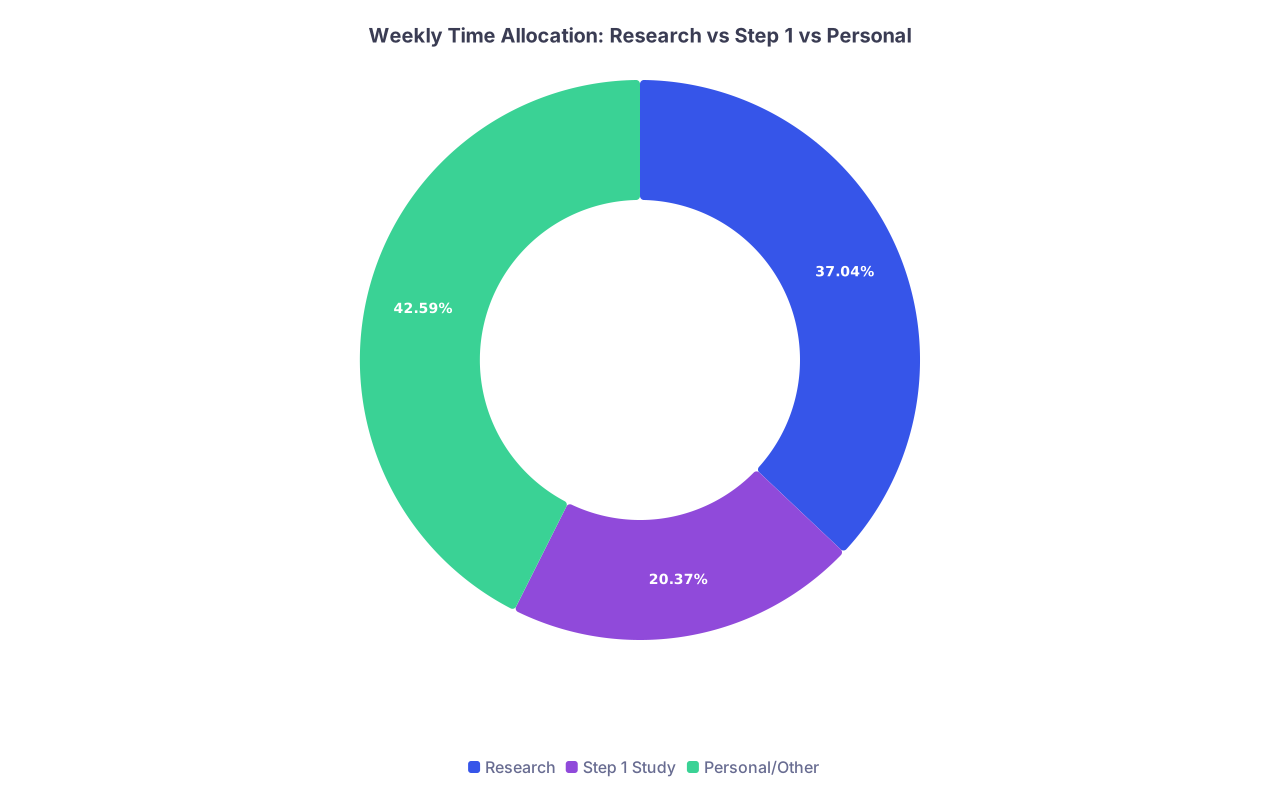
| Category | Value |
|---|---|
| Research | 40 |
| Step 1 Study | 22 |
| Personal/Other | 46 |
You want something in that ballpark, not 60 hours research plus “I’ll study when I can.” Because “when I can” becomes “almost never.”
4. Use the Right Kind of Study for the Time Block You’re In
Studying after a full workday is not like studying in dedicated. Your brain is cooked. You need to respect that.
Here’s how I’d split tasks:
Morning (freshest brain)
Short, focused tasks that compound over time:
- Anki/spaced repetition
- Reviewing yesterday’s highest-yield misses
- Quick 10–15 Qs untimed, just to warm up
You’re not doing 80-question blocks at 6 a.m. You’re doing maintenance work so your forget curve doesn’t murder you.
Evenings (tired brain, lower attention)
- 20–40 Qs timed or tutor mode, max
- Then deep review of those questions:
- Why you missed it
- What rule or concept you should have recognized
- One to two fact nuggets per question, not everything in the explanation
If you’re consistently falling asleep mid-review, you’re assigning the wrong tasks to the wrong time of day.
Weekends (this is where the heavy lifting happens)
This is your “mini dedicated” time:
- Full 40–80 question blocks, timed
- Subject-specific review: cardio phys during one session, micro the next
- Videos for weak systems (not background noise while you text; focused watching with notes)
Keep one half-day lighter every week. Burnout is real. Research + Step 1 is a marathon, not a two-week cram.
5. Control Your Research Job So It Doesn’t Swallow Your Study Time
You’re not powerless with your PI or research mentor, despite how it feels.
What screws people:
- Vague expectations (“just be productive”)
- Random late-night data requests
- Last-minute deadlines for abstracts/manuscripts
You fix this by being proactive, not reactive.
Have a real expectations conversation
Something like:
“I’m working hard on the project and I also have Step 1 scheduled for [date]. My plan is to study consistently in the evenings and on weekends. During the week, I’ll be fully present here from [X–Y]. In the 4–6 weeks before my exam, I’d like to slightly adjust my workload if possible. Can we plan around that together?”
Most reasonable PIs respect this. The unreasonable ones? You’ll still be better off having had the conversation, because at least expectations are on the record.
Batch your research tasks
Instead of constantly task-switching (which destroys time and energy), group:
- Data collection/experiments in specific time blocks
- Data cleaning/analysis in specific blocks
- Writing time separately
Why do you care as a Step 1 taker? Because task-switching all day leaves your brain fried at 6 p.m. Batching work is more efficient and preserves some gas in the tank.
6. Design a USMLE Study Plan That Fits a Research Year Pace
You’re not in dedicated. So your plan needs to be longer, slower, and more consistent.
Here’s a rough model that works well for many people:
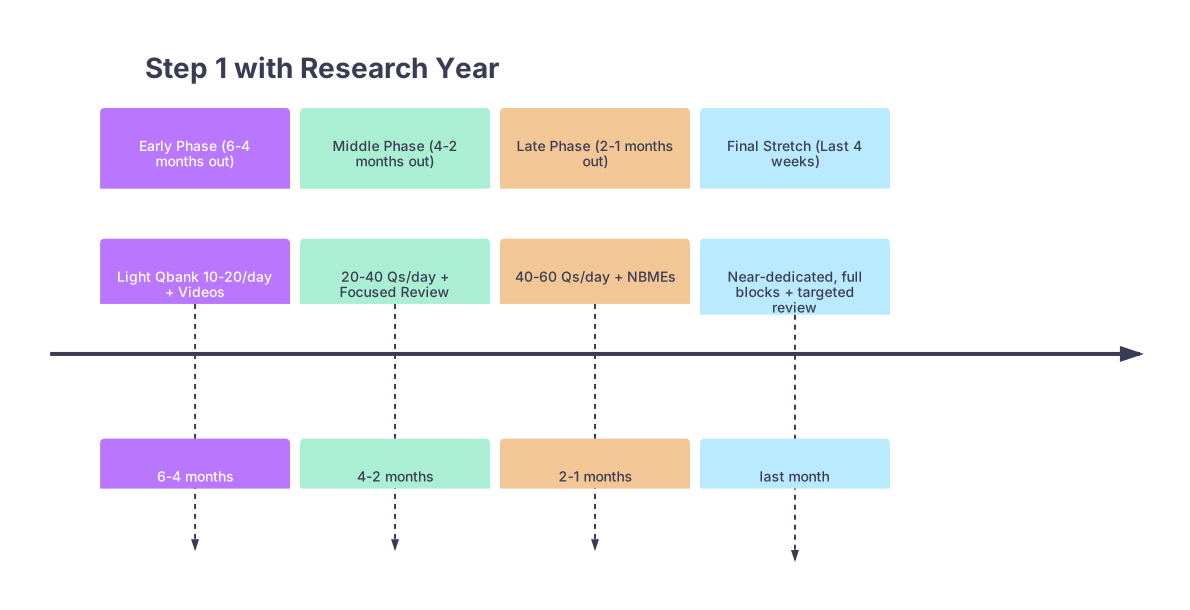
| Period | Event |
|---|---|
| Early Phase (6-4 months out) - Light Qbank 10-20/day + Videos | 6-4 months |
| Middle Phase (4-2 months out) - 20-40 Qs/day + Focused Review | 4-2 months |
| Late Phase (2-1 months out) - 40-60 Qs/day + NBMEs | 2-1 months |
| Final Stretch (Last 4 weeks) - Near-dedicated, full blocks + targeted review | last month |
Early Phase (5–7 months out from exam)
- 10–20 Qs/day on weekdays, 40–60 on weekends
- Slowly work through Boards & Beyond / Pathoma / Sketchy
- Heavy emphasis on understanding, not speed
Goal: finish maybe 30–40% of your Qbank and build a solid base.
Middle Phase (3–5 months out)
- 20–30 Qs/day on weekdays, 60–80 on weekends
- Increase mixed blocks (not just subject-based)
- Start integrating more test-style review and time pressure
Goal: 60–70% of Qbank done, first NBME to see where you stand.
Late Phase (1–3 months out)
You probably want a lighter research workload here. Try to pre-negotiate:
- Fewer experiments
- More analysis/writing that you can schedule flexibly
- Fewer new projects
Study side:
- 40–60 Qs/day most days
- NBMEs every 2–3 weeks
- Patch weak spots with short, targeted content (not starting new massive resources)
The final 2–4 weeks, if your PI allows, you want something close to:
- 4–6 hours/day study on weekdays
- 6–8 hours/day on weekends
Not everyone can get that. But you should at least ask.
7. How to Use Qbanks and NBMEs Without Wasting Time
Here’s where people on research years kill their chances: they treat explanations like novels and think volume alone = success.
I’ve watched people spend 40 minutes on a single question because they read every line of every explanation section. That’s not learning; that’s anxiety-driven stalling.
For UWorld (or your main Qbank)
For each question:
- If you got it wrong: determine the one primary reason you missed it.
- Didn’t know the fact? → Flashcard it.
- Misread the question? → Note the pattern.
- Knew it but waffled? → Confidence pattern issue.
- Capture 1–2 key takeaways only.
- Add concise Anki cards for recurring themes. Not paragraphs. Short prompts.
Aim:
- 40 Qs = ~1–1.5 hours to do
- 2–2.5 hours to review deeply
- If it’s taking 5–6 hours, you’re trying to learn all of medicine from the explanations. That’s not the job.
For NBMEs
Treat them like dress rehearsals, but don’t worship every score:
- Do them timed, exam-like.
- Review:
- Wrong answers
- Guesses that were right (you got lucky; learn that concept properly)
- Questions where you changed from right to wrong
Track yourself over time:
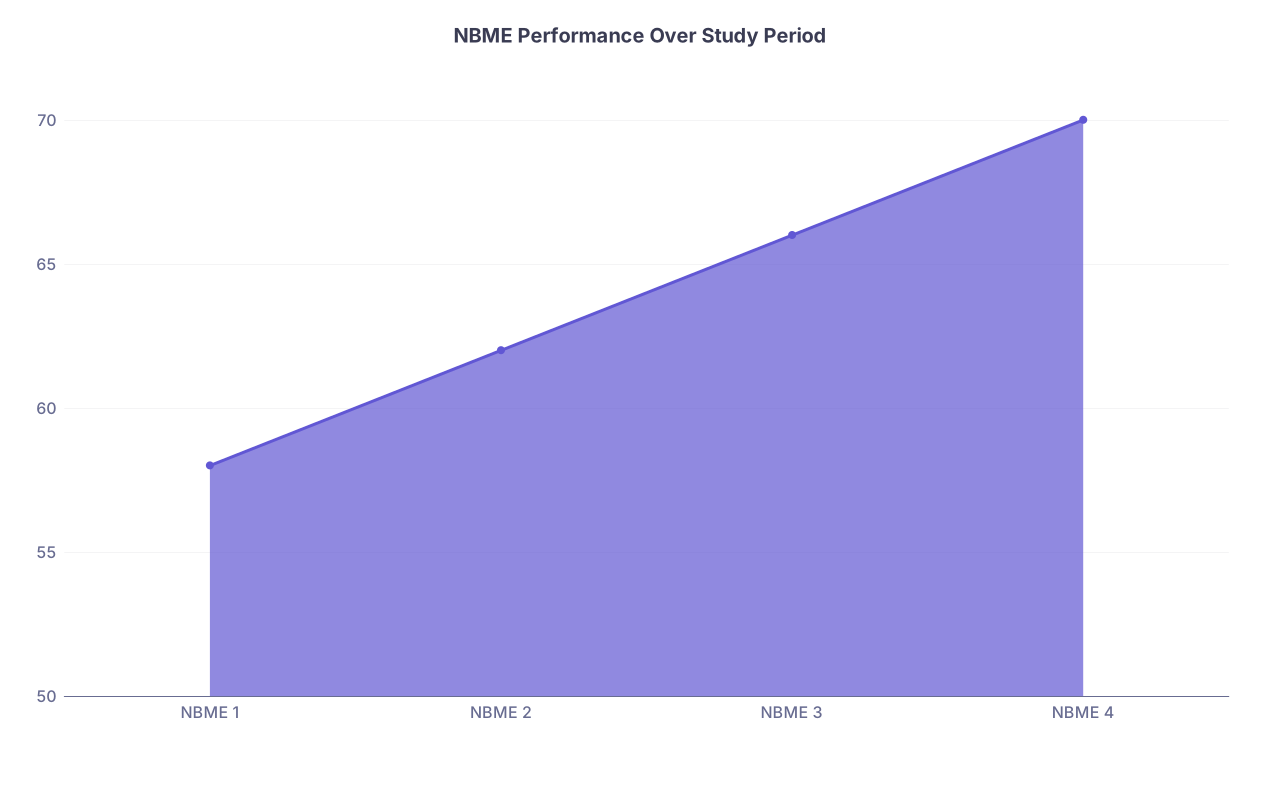
| Category | Value |
|---|---|
| NBME 1 | 58 |
| NBME 2 | 62 |
| NBME 3 | 66 |
| NBME 4 | 70 |
You want a consistent upward trend, not perfection. Remember: your goal is to pass with margin, not win a trophy.
8. Protect Your Energy: Sleep, Commute, and Mental Bandwidth
You’re running two full-time cognitive jobs at once. That’s not sustainable if you treat sleep as optional.
Blunt truth: if you’re routinely sleeping 4–5 hours/night and studying in a fog, you’re not working hard—you’re working dumb.
Minimum standards I’d hold you to
- 6.5–8 hours of sleep most nights
- One real break block daily (no Step, no research)
- One hobby or outlet you touch at least once per week (gym, walk, gaming, whatever)
Also, weaponize “dead time”:
- Commute: Anki audio, short concept review, or nothing (mental reset).
- Waiting for experiments to run: low-cognitive tasks like making or editing flashcards, skimming key tables.
9. Avoid the Classic Traps Research-Year Step 1 Takers Fall Into
I’ve watched this movie too many times. The same mistakes come up over and over:
“I’ll study more when work gets lighter.”
Work rarely gets lighter. Another project appears. Someone quits. There’s always an abstract deadline. Build study around baseline workload, not fantasy future conditions.Starting 5 different resources, finishing none.
Pick a tight, boring set of tools and actually finish them. Completion beats collection.Delaying NBMEs “until you’re ready.”
You’ll never feel ready. Do the first one earlier than you want (even if it stings). That data lets you fix your plan before it’s too late.Not moving your test date when clearly needed.
If your NBMEs are disaster-level and the exam is 3 weeks away, you don’t just grind harder and hope. You talk to your administration, your PI, and push the date if you reasonably can.Letting research creep into nights and weekends indefinitely.
Occasional crunch weeks happen. But if your PI expects you to be available 24/7 forever, your Step 1 will suffer. You need boundaries, even if they’re gradual.
10. Example 12-Week Plan for Someone on a Busy Research Year
Let’s make this concrete. Say:
- You’re 12 weeks out.
- You work 9–6 most days.
- You can reliably give 2 hours on weeknights, 6 hours Sat/Sun.
That’s roughly 22 hours/week of study.
Here’s a simple breakdown:
Weeks 12–9 (Foundation tightening)
- 20 Qs/day on weekdays (100/week)
- 60–80 Qs each weekend (160–180 total)
- Total weekly: ~260–280 Qs
- Add:
- 3–4 hours/week of targeted video (weakest system)
- Daily Anki (30–40 min)
Weeks 8–5 (Full push)
- 30–40 Qs/day on weekdays (150–200/week)
- 80–100 Qs each weekend (160–200)
- NBME at week 8 and week 6
- Targeted review blocks on low-scoring systems
Weeks 4–1 (Quasi-dedicated)
- Try to shift research to 80–90% effort instead of 110%. Ask for:
- Work from home days
- Fewer new tasks
- 40–60 Qs/day most days
- Weekly NBME or practice exam
- Focus on consolidating, not adding tools
Is this aggressive? Yes. Doable? For many people, yes—if they’re structured and honest about energy.
FAQ (Exactly 3 Questions)
1. Should I delay Step 1 until after my research year so I can study full-time?
Maybe. If your school allows flexible timing and your foundation is weak, delaying to align Step 1 closer to clinical start or after the research year can help. But there’s a tradeoff: the farther you are from your basic science courses, the more you’ll have to relearn from scratch. If you’re already several months into your research year and haven’t started at all, pushing back could be reasonable—as long as you use the extra time wisely and not as a procrastination excuse.
2. Is UWorld alone enough to pass Step 1 while I’m working full-time?
For many students with a decent preclinical foundation, UWorld + a quick reference (First Aid / similar) + spaced repetition is enough for a solid pass. If your school’s basic science teaching was weak or your grades were marginal, you’ll likely need at least one structured content resource (Boards & Beyond, Pathoma, Sketchy Micro/Pharm) layered on top. The key is doing questions well and actually learning from your misses, not just hitting some magical question count.
3. What if my PI is not supportive of me studying for Step 1?
Then you treat it like any bad attending situation—you stay professional, protect yourself, and find workarounds. Document your hours and responsibilities. Be very efficient during the workday so you can justify hard stop times (“I’ve completed X, Y, and Z; I’ll pick up A and B tomorrow”). If the dynamic is truly toxic, loop in your medical school research director or dean’s office early, not when you’re already burned out and 3 weeks from your test date. You still need to pass Step 1. No paper or poster is worth a failed board exam.
Key points:
- You’re not in dedicated. You’re working a job. Your Step 1 plan has to reflect that reality: smaller daily chunks, longer timeline, ruthless consistency.
- Pick a minimal set of resources, commit to a Qbank-centered strategy, and align what you study with the time and energy you actually have.
- Protect your sleep, set boundaries at work, and use weekends and the last 4–6 weeks strategically. The goal isn’t perfection—it’s a safe, confident pass without setting your life on fire.