How Poor Sleep and Diet Sabotage the Last Month of Step 1 Study
It is 11:47 p.m., three and a half weeks before your Step 1 exam.
Your UWorld block from two hours ago went badly. You tell yourself: “I have to make up ground. I cannot afford to sleep.” So you microwave leftover pizza, crack open another energy drink, and convince yourself one more block at midnight is dedication, not desperation.
You are about to make the move that quietly ruins more Step 1 scores than any “low yield” topic ever has.
I am going to be blunt: the most common mistakes I see in the last month of Step 1 prep are not about content, resources, or question banks. They are about students blowing up their sleep and diet in the very phase when their brain’s performance matters most.
You can know First Aid cold and still underperform if your sleep and diet are wrecked. I have watched it happen. Smart, hardworking students who did 5,000+ questions walk out of the exam thinking, “Why did my brain feel slow? Why did I miss things I know?”
Because they treated their nervous system like a garbage disposal in the last four weeks.
Let us prevent you from becoming that story.
The Myth That Kills Scores: “I’ll Sleep After Step 1”
Three dangerous sentences dominate the last month of Step prep:
- “I’ll sleep after Step 1.”
- “I’m behind; I can’t afford a real night of sleep.”
- “Everyone is miserable and exhausted. This is normal.”
No. It is common. Not normal. And not smart.
Your brain in the last month is doing three things nonstop:
- Consolidating memory
- Integrating connections between topics
- Running high-load problem solving every single day
All three are brutally sensitive to poor sleep.
What actually happens when you cut sleep
You know the theory from preclinical neuro. But here is what it looks like in real people, doing real UWorld blocks:
Performance drop shows up before you feel “tired.” I have seen students insist they “feel fine” after a week of 5–6 hour nights, while their block performance quietly drops 7–10 percentage points. They only notice when they view the trend line.
Attention span tanks. On day 3–5 of poor sleep, students start rereading stems. 2–3 times. Missing key negatives. Failing to track “except” questions. They call it “anxiety.” A lot of the time it is simply sleep debt.
Mental stamina crashes early. Instead of fading at question 60–70 (normal), they hit a wall at question 20. Then they try to fix a physiological problem with more caffeine and more hours. Wrong direction.
Short-term memory misfires. That subtle table in kidney physio you reviewed yesterday? Gone. You did not “forget” it. Your brain never consolidated it because you traded deep sleep for another Anki session.
The worst part: chronic sleep restriction feels “normal” after a week. Your brain adapts your perception before it recovers your performance. That is why so many students swear they are functioning “fine” when their numbers say otherwise.
Sleep Debt vs Question Bank FOMO: The Trade You Must Not Make
Let me be specific about the mistake.
You will be tempted, sometime in the last 30 days, to:
- Cut sleep from 7–8 hours down to 5–6 “just for this week”
- Add a late-night question block after 10 p.m.
- Push wake-up earlier, bedtime later, and fill the in-between with “just more content”
This looks like “grinding.” It is actually exchanging high-quality cognition for lower-quality study time.
You do not want more hours sitting at a desk. You want more brain power per hour.
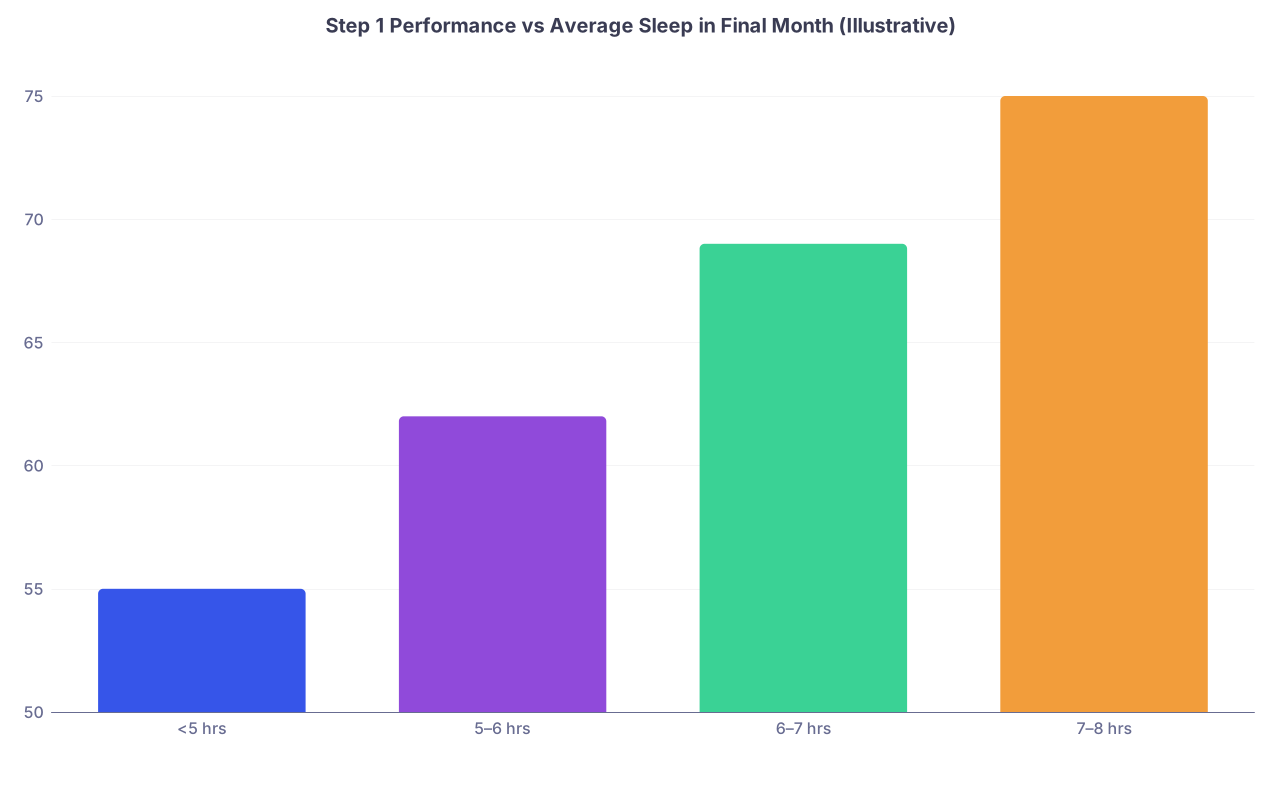
| Category | Value |
|---|---|
| <5 hrs | 55 |
| 5–6 hrs | 62 |
| 6–7 hrs | 69 |
| 7–8 hrs | 75 |
I am not giving you real NBME data here, but this pattern is exactly what I have watched informally:
- Students under 6 hours a night almost always underperform relative to their NBME peak
- Students in the 7–8 hour range are the ones who say, “The test felt like my practice blocks”
You do not want the test to feel harder than your practice. If you wreck sleep, it will.
The fake “extra time” illusion
When you cut from 7.5 hours to 5.5, you “gain” 2 hours. Here is how that actually plays out:
- Those 2 hours are during low-cognition periods (late night, already tired)
- The next day, your entire 10–12 hour study day runs on 80% brainpower
- You make more mistakes, remember less, and need to reread more
So you did not gain 2 hours. You destroyed the quality of 10–12.
That trade might feel tolerable two months out. In the last month, when you are trying to refine and integrate, it is game-losing.
The Crash Diet: Junk Fuel in a Demanding Exam Phase
Now let us talk about the part everyone shrugs off with a laugh: diet.
I have watched this pattern so many times it is almost boring:
Week -4 to -3:
“I’m trying to eat reasonably, cooking once or twice a week.”
Week -3 to -2:
“I don’t really have time. I’m doing frozen stuff but it’s fine.”
Week -2 to -1:
DoorDash, coffee, and whatever is left in your fridge. Your blood sugar looks like a cardiology question stem.
Nobody thinks diet will hurt them “that much.” They are wrong.
What a garbage diet does during your last month
You are demanding three things from your body:
- Stable energy across 8–10 hours of study
- Reliable focus for 40-question chunks
- Emotional regulation when UWorld humbles you
A poor diet quietly sabotages all three.
Here is the pattern I see with high-junk, high-sugar, caffeine-heavy diets:
Blood sugar spikes and crashes: Croissant + sugary latte at 8 a.m. → hyperfocused for 30 minutes → brain fog by 10:15 → reaching for more coffee or snacks instead of fixing the root cause.
Afternoon comas: Big takeout lunch (greasy, heavy, high fat) → you sit down to do a 1 p.m. block and your brain feels like it is moving through syrup.
Caffeine dependency and rebound: Three coffees before noon → wired and anxious → crash in late afternoon → poor sleep that night → repeat.
This is not about aesthetics or “clean eating” for Instagram. This is about stable glucose and a nervous system that is not constantly yanked around.
The Dangerous Combo: Poor Sleep + Poor Diet → Exam-Week Disaster
Sleep and diet problems are bad on their own. Together, they are multiplicative.
Sleep debt does this:
- Raises baseline cortisol
- Increases hunger and cravings for quick carbs
- Reduces impulse control (“Screw it, I’ll just order burgers”)
Bad diet does this:
- Causes more energy volatility
- Makes you reach for more caffeine
- Worsens sleep quality and duration
You get stuck in a loop: bad sleep → bad food → worse sleep → more caffeine → constant low-level anxiety → worse questions → more panic.
By exam week, your actual knowledge has plateaued or dropped. But your anxiety about your score is way higher. So you double down on the same self-sabotaging pattern.
I have had students hit their best NBME two weeks out, then free fall in the last 10 days because they got spooked, torched their sleep, lived on energy drinks and fries, and walked in on exam day feeling like a shell of themselves.
Their Step 1 score did not represent their knowledge. It represented how well they managed physiology under stress.
The “Heroic” All-Nighter: How People Throw Away Months of Work
Let me be absolutely clear:
If you pull a near-all-nighter (or sleep 2–3 hours) in the last 72 hours before Step 1, you are actively donating points to the curve.
Your hippocampus does not care that your exam is tomorrow. It will not form memories properly without sleep. Reading First Aid at 3 a.m. the night before Step 1 is not “commitment.” It is panic.
I have actually seen this:
- Student is tracking at a strong level on NBMEs.
- Week of the exam, they decide they “need one last big push.”
- They start adding late-night review sessions, cutting sleep from 7 hours to 4–5. Night before exam, they sleep poorly (too wired, too much caffeine, too anxious).
- On exam day, they misread stems, fall behind on timing, and come out saying, “I knew this stuff; I just couldn’t think straight.”
They are right. They did know the content. They just sabotaged their brain in the 3 days it needed to be most stable.
How to Protect Sleep in the Last Month (Without Being Soft)
You are not in a spa. You are grinding for a major exam. I am not suggesting you light candles and take bubble baths every night.
I am saying there is a bare minimum for sleep hygiene that you ignore at your own risk.
Non-negotiables I push on my own students
Set a hard cut-off time for studying.
Something like: “No new content after 9:30 p.m.” Past that, only light review (Anki mature cards, very short pass through notes) if you feel calm.Aim for 7–8 hours in bed, not “time asleep” perfection.
You lie down at 11, alarm at 7. Even if you wake up once or twice, your total time is adequate. Chasing 9–10 hours and stressing when you get 7 is pointless. The danger is dropping into the 5–6 hour range consistently.Kill screens 30–45 minutes before bed.
If you insist on something, make it non-medical and low-stress. Not r/step1, not NBME score threads, and not Discord doomscrolling about people’s study schedules.Caffeine curfew.
No new caffeine after 2–3 p.m. in the last month. You are not special. You are not immune. That 5 p.m. cold brew will be in your system at 11.Protect the final 3 nights like your actual exam.
This is where students implode. The last 3 nights, your priority order flips:Sleep > marginal extra review.
If your choice at 10:30 p.m. three days before the exam is:
“Another 30 pages of biochem” vs “Being fully functional on test day”
You already know the right answer. Act like it.
How to Keep Your Diet from Wrecking Your Brain
You do not need a nutrition degree. You need to avoid the obvious landmines.

Here is the core principle:
Stable, boring fuel beats exciting, chaotic fuel.
Aim for meals that are:
- Moderate in size
- Contain some protein
- Not dripping in grease
- Not pure sugar bombs
If you want structure, think like this:
- Breakfast: something with protein + complex carbs (eggs + toast; yogurt + oats; peanut butter + banana).
- Lunch: not a food coma. Avoid huge heavy meals. Half-bowl sizes are fine.
- Dinner: moderate, not at 11 p.m., not ultra-greasy.
Snacks: nuts, fruit, yogurt, string cheese, hummus + crackers.
Not: 4 cookies, then “just one more” coffee.
The realistic exam-season meal strategy
You are busy. So simplify:
- Pick 2–3 easy meals you can rotate. Eat them on autopilot.
- Batch-cook once or twice a week. Basic chicken + rice + frozen veggies destroys takeout nutritionally and costs less.
- Keep “emergency sane food” around: protein bars that are not candy, apples, microwavable brown rice, canned beans.
| Situation | Better Choice | Sabotaging Choice |
|---|---|---|
| Quick breakfast | Greek yogurt + fruit | Pastry + sugary latte |
| Study snack | Nuts or cheese stick | Candy or cookies |
| Lunch between Qs | Rice + protein bowl | Large greasy burger + fries |
| Late craving | Banana + PB | Chips + soda |
Perfection is unnecessary. Avoid the consistently terrible patterns.
The Last Week: Where Strong Students Panic and Self-Sabotage
If there is one part of your timeline where sleep and diet matter disproportionately, it is the last 7 days.
This is the week where:
- Your NBME scores are mostly set
- Your knowledge base is largely fixed
- Your brain’s functional state becomes the limiting factor
This is also when I see:
- Students suddenly adding new resources out of fear
- Dramatic schedule changes (waking up 2 hours earlier “to simulate test day”)
- Energy drink and caffeine intake doubling
- Bedtimes shifting later as anxiety climbs
This is the exact opposite of what you should be doing.
Your job in the last week is not to become a new version of yourself.
Your job is to preserve the best version of your recent self.
A saner last-week structure
You do not need my whole schedule, but you should follow these principles:
- No drastic changes to wake time or sleep duration
- No new high-volume resources (no “I’ll watch 60 hours of videos this week”)
- Taper slightly on heavy question volume in the final 2–3 days
- Keep meals and timing as close as possible to what you will do on test day
And absolutely:
- No heroic 2 a.m. cram sessions
- No experimenting with new supplements, new energy drinks, or random pills because some forum post said it “kept me sharp”
You are not a lab rat two nights before Step 1. Do not test anything new on yourself that you have not already used successfully in practice exams.
A Quick Reality Check: What Actually Moves the Needle vs What Feels “Hardcore”

| Step | Description |
|---|---|
| Step 1 | Last Month of Prep |
| Step 2 | Protect Sleep |
| Step 3 | Stabilize Diet |
| Step 4 | Increase Hours |
| Step 5 | Add New Resources |
| Step 6 | Higher Quality Thinking |
| Step 7 | Lower Quality Thinking |
| Step 8 | Choices |
Here is the mistake:
- Students think “hardcore” = more hours, more resources, more suffering.
- They underestimate how much brain quality beats brain time in this phase.
The students who quietly protect their sleep and keep their diet sane look less dramatic. They are not posting 16-hour schedules in group chats. They are not bragging about 3 a.m. Anki streaks.
They are just walking into the exam with a nervous system that can actually use what they spent months learning.
FAQs
1. What if I am already behind? Can I really afford 7–8 hours of sleep?
You cannot afford to pretend that chopping sleep will save you. If you are behind, your only chance of catching up is to have your brain working better, not longer-but-dumber. You can tighten your schedule, cut lower-yield resources, and be more ruthless with distractions. But going from 7–8 hours to 5–6 will erode the quality of everything else. At best, you stay in the same place while feeling more miserable. At worst, you tank your performance right before the exam.
2. Is it OK to use caffeine heavily in the last month?
Moderate caffeine is fine. Dependence and escalation are not. If your baseline is 1–2 coffees per day, stay close to that. Do not start stacking energy drinks on top of espresso shots. The real red flag: you are using caffeine to override obvious signs of exhaustion instead of adjusting your schedule and sleep. Remember: anything that ruins your sleep is sabotaging your score, no matter how “productive” it feels in the moment.
3. What if my sleep is bad because of anxiety, not because I am staying up to study?
First, stop making it worse by adding late-night studying and caffeine. Then treat your pre-sleep window as part of your exam prep: consistent bedtime, no Step 1 content or score discussions in the hour before bed, dim lights, and some simple wind-down routine (shower, light reading, stretching). If your brain is ramped up, give it less stimulation, not more. And do not catastrophize one bad night. A single rough night will not break you. A chronic pattern of shortened, fragmented sleep over weeks will. Guard against the pattern, not the occasional off night.
Key points to walk away with:
- Trading sleep for extra study in the last month is usually a net loss, not a gain.
- A chaotic, junk-heavy diet drives energy crashes, anxiety, and worse cognition when you need stability most.
- The last week is not for reinvention or heroic cramming. It is for preserving the brain you have built so it can actually show up on test day.