
You do not need to finish every question bank for Step 1. In fact, chasing 100% completion across multiple banks is one of the fastest ways to waste time and burn yourself out.
Let me be blunt: “I did all 10,000 questions” is a flex, not a strategy. Programs do not care how many random questions you clicked through. They care how you performed on the exam. And the data we do have about Step 1 performance tells a very different story from the QBank-maximalist culture you see on Reddit and in group chats.
Let’s separate myth from reality.
The Myth of “Finishing All the Questions”
The dominant narrative in med school right now goes something like this:
- You must complete all of UWorld Step 1.
- Then you should do Amboss, Kaplan, or AMBOSS on top of that.
- The more questions you do, the better your odds.
I’ve watched plenty of students internalize that as: “If I’m not doing 80–120 questions per day and racing toward 100% of multiple banks, I’m falling behind.”
Here’s the problem: nearly none of that is based on actual evidence. It’s based on:
- Survivorship bias (“I did 2x Qbanks and passed” – and the people who failed aren’t posting);
- Misunderstanding correlations (“high scorers did lots of questions” vs “lots of questions made them high scorers”);
- And plain old anxiety.
What the data actually supports
We don’t have randomized controlled trials of “UWorld vs UWorld+Amboss vs Kaplan+Boards&Beyond.” But we do have:
- Consistent survey data from schools and tutoring groups that correlates:
- UWorld percentage correct (not number done) with Step scores;
- Number of thoughtful, timed, mixed blocks with better performance.
- Internal analyses from companies (yes, they publish some of this) showing:
- Doing a single, complete pass of one high‑quality QBank with review outperforms fragmented, half‑finished use of multiple banks.
And anecdotally? The pattern is boringly consistent:
- Students who crush Step 1:
- Usually finish most or all of one strong QBank (often UWorld).
- Review questions in depth.
- Use explanations to link back to resources.
- Students who underperform:
- Bounce between 3–4 resources.
- Obsess over completion instead of comprehension.
- “Do questions” but cannot explain why each option was right or wrong.
So yes, questions are critical. Finishing everything is not.
Quantity vs Quality: The Ugly Truth About “More Questions”
Let me spell out the uncomfortable reality: after a certain point, extra questions have sharply decreasing returns.
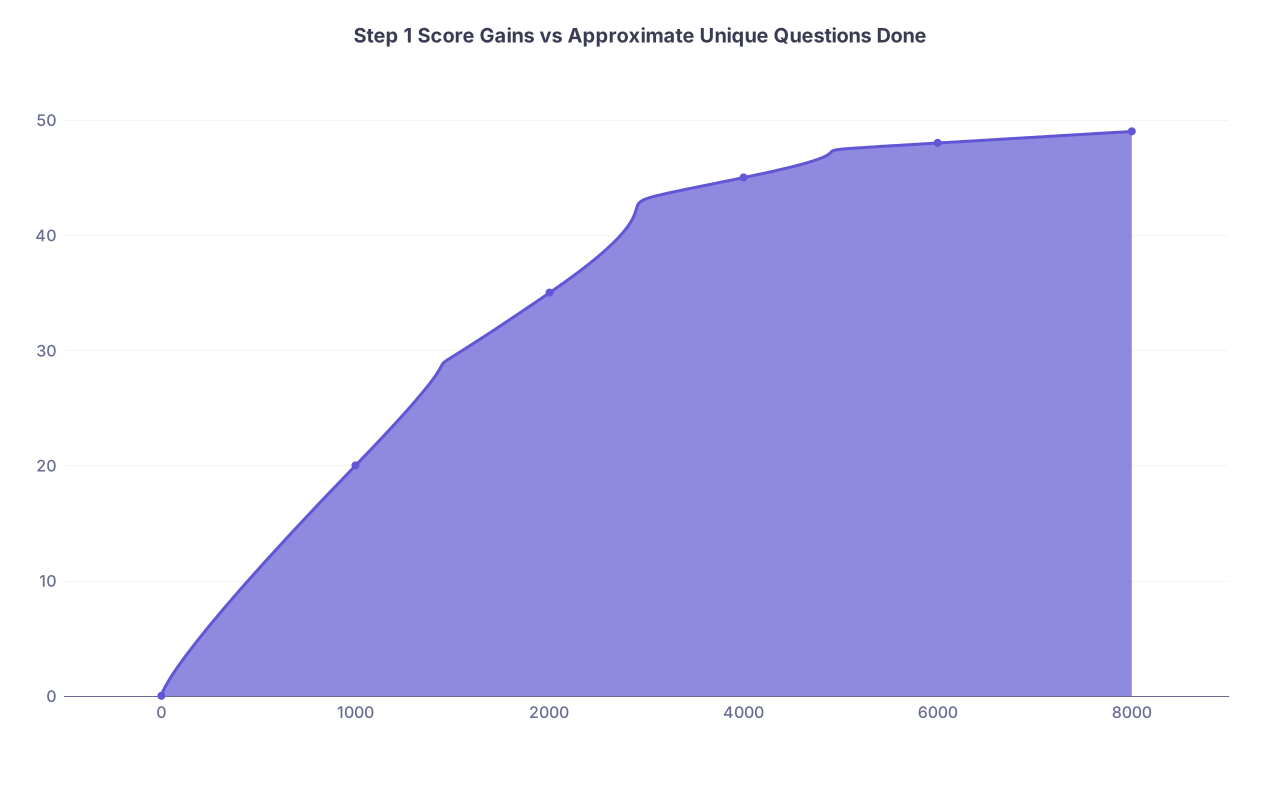
| Category | Value |
|---|---|
| 0 | 0 |
| 1000 | 20 |
| 2000 | 35 |
| 4000 | 45 |
| 6000 | 48 |
| 8000 | 49 |
Those numbers are illustrative, but the pattern is real: big gains early, then a slow flattening. Here’s why mindlessly chasing more and more questions backfires.
1. Mindless repetition does not equal improved reasoning
Completing questions teaches you patterns of clinical reasoning if:
- You do them timed and mixed (mimicking the exam);
- You review thoroughly;
- You reflect on why you missed things and how to patch the hole.
If instead you:
- Do them untimed while half‑distracted;
- Immediately check answers without thinking;
- Skim explanations and move on;
…you’re mostly building speed at recognizing UWorld’s writing style, not mastering pathology or pharmacology.
I’ve seen people blow through 4,000+ questions and still say things like:
“I know I’ve seen this before but I can’t remember the mechanism.”
Translation: they trained recognition, not understanding.
2. Extra banks often duplicate concepts, not learning
Amboss, UWorld, Kaplan, NBME… these aren’t separate universes. They all ask about:
- Same immunodeficiencies;
- Same cardiomyopathies;
- Same renal pathologies.
Past a certain point, you’re paying (and sacrificing time) to see slightly rephrased versions of the exact same concept. If you didn’t understand nephrotic vs nephritic after 50 questions, doing it 150 more times in a different QBank doesn’t magically fix that. Sitting down with Pathoma or your notes for an hour probably does.
3. Completion obsession wrecks your time allocation
Here’s how the completion‑addicted schedule often looks:
- 6–8 weeks dedicated:
- 6–7 hours/day “doing questions” (3–4 blocks);
- 0–1 hour/day of focused review;
- “I’ll review more later, I just really need to hit 100%.”
By week 4, they’re behind, they’re panicking, and they’re skimming everything.
Now compare with a student who doesn’t worship completion:
- 2 timed, mixed blocks/day (40–80 questions depending on stamina);
- 3–5 hours/day deep review of those blocks;
- Target: finish most of UWorld, but not at the cost of understanding.
Guess which one tends to perform better on NBME practice exams?
Spoiler: It’s not the 10,000‑question hero.
What Actually Predicts Strong Step 1 Performance
Step 1 (even as pass/fail) still tests the same thing: integrated understanding + exam skill. Not number of checkboxes in a QBank dashboard.
Let’s strip it down.
1. Your NBME practice exams, not your QBank percentage
NBME forms are repeatedly the best predictor of actual performance. They’re written by the same organization that writes Step 1. So if you want an objective reality check on whether your study strategy is working, it’s not “How many questions have I done?” — it’s:
- What are my NBME practice scores doing over time?
- Where are they low by subject and system?
- Am I closing those gaps?
If your goal is passing comfortably and your NBMEs are consistently above the passing threshold with margin, doing another 2,000 random neuro and biochem questions for no targeted reason is mostly comfort theater.
2. Depth of review, not breadth of exposure
Here is where most people lie to themselves.
They say, “I review my questions.” What they actually do:
- Re‑read the explanation;
- Nod at the educational objective;
- Maybe screenshot an image;
- Then next block.
Real review looks like:
- Writing down the concept in your own words;
- Explaining to yourself why each wrong answer is wrong;
- Connecting the finding back to your “core” resource (e.g., First Aid, Boards and Beyond);
- Making 1–3 Anki cards or notes for new or important concepts.
It is slower. It feels less productive. The dashboard does not move as fast. But your scores do.
3. One primary QBank done well beats three done badly
Here’s the part nobody marketing multiple subscriptions will say plainly: you do not need three full banks.
For the average student aiming to pass Step 1 solidly or even to be in the top tier, a very strong strategy looks like:
- One major, high‑quality QBank as the foundation (yes, UWorld is the usual);
- NBME practice exams spaced out thoughtfully;
- A solid primary content resource (FA, Pathoma, Sketchy, Boards & Beyond, etc.);
- Some targeted supplemental questions only if you have time and clear weak areas.
The high‑achievers I’ve seen typically do:
- 1 full pass of UWorld (sometimes 1.2x with incorrects);
- Maybe 25–50% of another bank for variety in the last weeks;
- Heavy emphasis on NBMEs for calibration.
Not 100% of three separate 2,000‑question platforms.
A Rational QBank Strategy (That Doesn’t Require Finishing Everything)
Let’s get concrete. If you’re a typical MS2 planning dedicated, here’s a sane, evidence‑aligned approach that doesn’t worship question counts.

Step 1: Pick your primary QBank and commit
Do not spread yourself thin right away. Choose:
- Primary: UWorld (or AMBOSS if you strongly prefer it).
- Secondary (optional, later): Amboss, Kaplan, or USMLE‑Rx for extra practice only after you’ve used your primary bank well.
Trying to “equally” do both from day one leads to duplication and incoherence. Your brain needs repetition and reinforcement, not chaos.
Step 2: Define success as mastery per block, not completion %
For your primary QBank:
- Default: timed, random/mixed, 40‑question blocks (or 20 if you’re early and fragile).
- Goal per block:
- Understand every question deeply;
- Be able to teach yourself the concept behind it.
If you hit 60–65%+ on UWorld timed/mixed and those percentages slowly climb, you are not “behind” because you haven’t hit 100% completion. You’re doing it right.
Step 3: Let NBME scores drive your decisions about “more questions”
Before dedicating weeks to a second full QBank, ask two hard questions:
- Are my NBME scores where they need to be?
- Do I see specific, consistent weak subjects or systems?
If the answer to #1 is “yes, I’m clearly above passing with margin” and #2 shows only a few soft spots, you do not need 2,000 extra generic questions. You need:
- Targeted reinforcement (e.g., renal phys refresh with extra questions only in renal);
- Maybe 10–20 subject‑specific blocks;
- Focused content review.
If your NBME scores are borderline, your issue may be foundational content gaps, not “not enough exposure to QBank question style.”
But What About People Who Did Everything and Scored Great?
Yes, you know someone who:
- Did 2 full passes of UWorld;
- Finished all of AMBOSS;
- Took 8 NBMEs;
- And ended up with a ridiculous Step 1 score.
Here’s what you’re missing when you copy them blindly:
- They likely had strong baseline knowledge from coursework.
- They probably reviewed questions obsessively, not just clicked fast.
- They might have had more stamina, fewer outside obligations, or a better prior test‑taking record than you.
High performers often overkill resources not because they are necessary, but because they have the bandwidth and perfectionism to do it. That does not make it the standard.
The actual logic needs to be reversed:
- They scored high;
- They also happened to finish lots of questions.
That does not mean “finishing lots of questions caused their high score” in a simple linear way. That’s first‑year epidemiology: correlation ≠ causation. You know this.
| Strategy | Qs Done | Typical Outcome Pattern |
|---|---|---|
| One primary bank + deep review | 2000–3000 | Solid pass, often strong performance |
| Two banks, shallow review | 4000–6000 | Mixed; many still weak in basics |
| Primary bank + NBMEs + targeted extras | 2500–3500 | Good calibration, efficient prep |
| Dashboard‑obsessed, rushed review | 3000–8000 | Burnout, plateaued NBME scores |
This table isn’t a randomized trial; it’s the pattern you see over and over when you talk to enough students honestly.
The Dark Side: Burnout and Diminishing Returns
Let’s talk about what almost nobody factors in when they preach “finish every QBank”: your brain isn’t a machine. You don’t get infinite focused hours.
There is a real, measurable cost to:
- Doing 100+ questions daily for weeks;
- Skimping on sleep to hit arbitrary completion targets;
- Turning Step 1 prep into a punishment treadmill.
What happens over time:
- Your review gets lazier.
- Your retention drops.
- You start missing basic questions you used to get right.
- Your NBME scores stagnate or even fall despite more questions.
I’ve seen students pull a 20‑point drop on practice exams late in dedicated because they were simply cooked. Their solution? “I guess I need more questions.”
No. They needed fewer, better‑reviewed questions and recovery time. But the QBank‑completion culture turns rest into guilt.
So, Do You Really Need to Finish Every Question Bank?
No. You need enough high‑quality, well‑reviewed questions to:
- Build exam‑style reasoning;
- Expose your weak spots;
- Confirm on NBMEs that you’re safely above the bar.
For most students, that means:
- One primary full(ish) QBank done thoughtfully;
- NBMEs to track progress;
- Optional, targeted use of a second bank if you truly have time and a clear purpose.
Not three finished banks. Not every last question. Not worshiping the completion percentage.

| Step | Description |
|---|---|
| Step 1 | Start Dedicated |
| Step 2 | Choose Primary QBank |
| Step 3 | Do Timed Mixed Blocks + Deep Review |
| Step 4 | Take NBME |
| Step 5 | Identify Weak Areas |
| Step 6 | Targeted Content + Qs |
| Step 7 | Maintain, Review, Rest |
| Step 8 | Optional Targeted Second Bank |
| Step 9 | Scores Safe? |
| Step 10 | Extra Time Left? |
The Bottom Line
If you skimmed everything else, take this:
- Finishing every question bank is not only unnecessary, it’s often counterproductive. One strong bank + NBMEs + deep review beats three banks of shallow clicking.
- Judge your Step 1 readiness by NBME scores and your ability to explain concepts, not by a QBank completion percentage. Your dashboard isn’t your destiny.
- Extra questions are only useful when they add targeted, well‑reviewed practice. After that point, you’re just feeding anxiety, not your score.