
NBME practice exams did not suddenly become useless the day Step 1 went pass/fail. The scoring scale changed; human cognition did not.
The myth floating around right now is simple and wrong: “Since Step 1 is pass/fail, NBME practice scores don’t matter anymore. Just hit a rough threshold and you’re fine.” Students parrot this to each other in group chats like it’s gospel. It is not.
Let me walk you through what the data and patterns actually show—and what’s just wishful thinking dressed up as “new era” advice.
What “Predictive” Actually Means Now
Before the scoring change, predictive meant: “Does my NBME score correlate with my Step 1 three‑digit score?” That question is dead.
The new question is different:
- How well do NBME practice exams predict passing vs failing?
- How well do they reflect content readiness, which still matters for:
- Surviving clerkships
- Doing well on Step 2 (which is now the real gatekeeper)
- Not burning out when the content load spikes
The NBME self‑assessments were never magical. They were just well‑constructed, USMLE‑style questions, pulled from the same psychometric DNA as the actual exam. Changing Step 1 to pass/fail did not break the item-writing pipeline.
What changed is how people misuse the scores.
I see two equally bad camps now:
- Camp 1: “Score doesn’t matter. Just vibe check it. If it feels okay, you’re ready.”
- Camp 2: “You still need to hit old cutoffs or you’re doomed.”
Both are wrong. The reality sits uncomfortably between them.
What Limited Data We Have Actually Shows
No, there is not a neat, publicly available NBME-to-pass-probability converter for the new era. The NBME and NBOME do not hand that out.
But we do have:
- Historical correlations between NBME and real Step 1 scores
- Program‑level reports and de‑identified data shared at conferences
- Anecdotal but consistent patterns across cohorts at multiple schools
Combine those and you get something like this: NBMEs are still strongly predictive of who is at high risk of failing, less important for predicting “how high above pass” you’ll land, because no one cares about the exact number anymore.
To make this concrete, here’s a simplified, conservative approximation based on pre‑P/F data, adjusted for the current passing standard (which hovers around what used to be a 194).
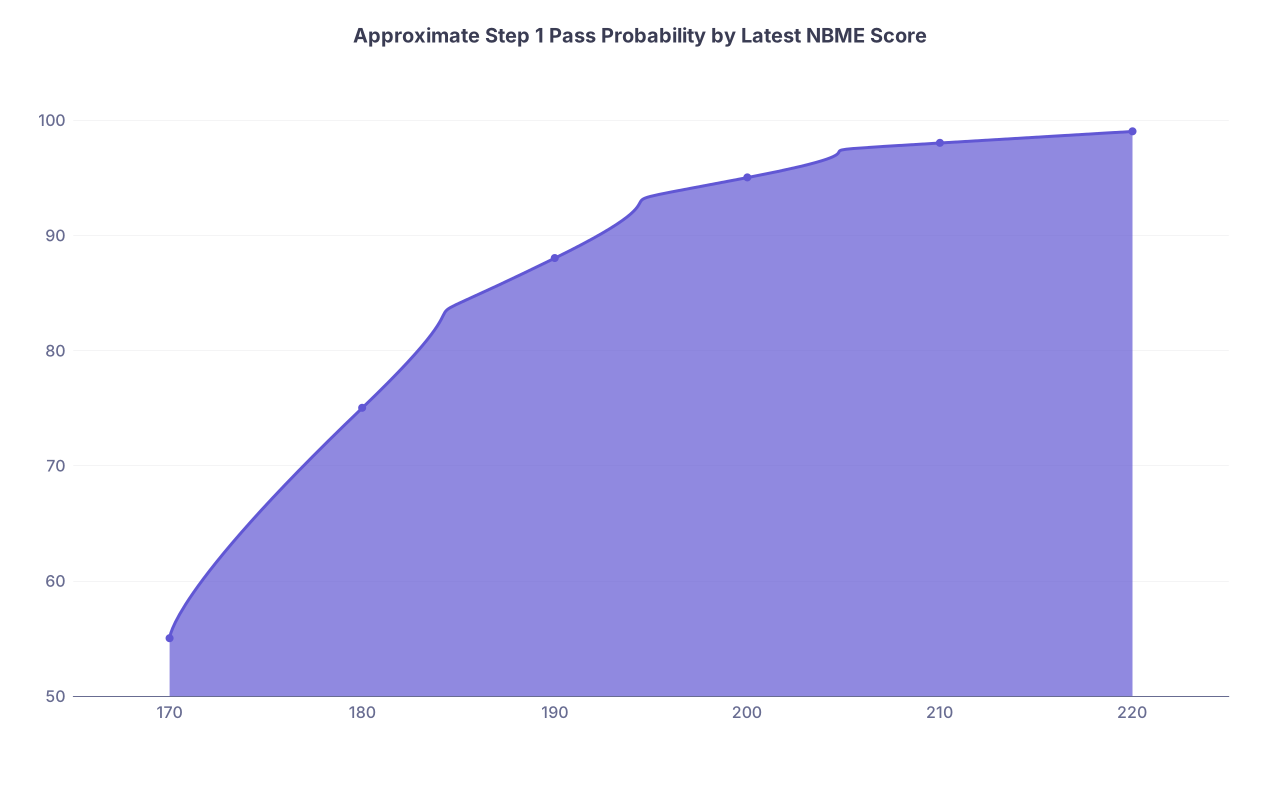
| Category | Value |
|---|---|
| 170 | 55 |
| 180 | 75 |
| 190 | 88 |
| 200 | 95 |
| 210 | 98 |
| 220 | 99 |
Does this look familiar? It should. Because the relationship between practice performance and real performance has not fundamentally changed. What’s changed is what happens after you pass.
If you’re sitting at:
- 150–175 on NBMEs around 1–3 weeks out → you’re high risk.
- 180–195 → borderline; outcome depends a lot on trend and test‑day performance.
- 205+ → your chance of failing is very low if that score reflects multiple recent NBMEs.
Could an individual outlier with a 180 NBME crush Step 1 and pass safely? Of course. But you’re not planning your life around outliers.
The Biggest New Myth: “Once You’re Above Pass, Scores Don’t Matter”
This one is seductive because it sounds comforting. You hear:
“As long as you’re above ~60–65% correct on NBMEs, you’re fine. No need to push higher. Step 1 is just a checkbox now.”
Here’s why that’s naïve.
First, percent correct is not directly equivalent across forms or years, but students like it, so let’s talk in rough terms. At most schools, I see this pattern:
| Latest NBME % Correct | Approx Risk Category | Comment |
|---|---|---|
| < 55% | High risk | Strong fail risk or barely scraping by |
| 55–60% | Borderline | Pass possible, fragile foundation |
| 60–65% | Probable pass | Still content gaps that will hurt later |
| 65–70% | Low risk | Reasonable mastery for Step 1/early clerkships |
| > 70% | Very low risk | Excess margin; more about security than necessity |
The myth is: “Anything 60%+ is equally good.” That’s false for three reasons.
1. NBME scores reflect how you think, not just what you know
If your performance is hovering right above the pass line, you’re not just “barely good enough” for Step 1. You’re also:
- Prone to misreading complex stems
- Struggling to integrate multi-system questions
- Vulnerable to fatigue across a full‑length test
Those weaknesses don’t magically evaporate once you pass. They follow you into:
- Shelf exams
- Step 2 CK
- Daily clinical reasoning
I’ve watched students who “just wanted to pass Step 1” end up crushed by Step 2 because they never fixed the underlying issues—only cared about clearing a single bar.
2. Step 2 is now your real score report
Residency programs can’t rank you by Step 1 anymore. So they lean harder on:
- Step 2 CK score
- Clerkship grades
- Narrative comments
Guess what predicts Step 2 better than anything else?
No, it’s not “grit” or “more Anki.” It’s baseline Step 1‑level knowledge and reasoning.
If your NBMEs show you’re skating the edge of pass, you’re not just at risk for Step 1. You’re setting yourself up for a rough Step 2 trajectory. Not because you’re not smart, but because you’re building on a weak foundation.
3. “Just enough to pass” leads to complacency
Students who treat NBME thresholds as binary—“above this, done”—stop improving exactly when they most need feedback. Once they hit an arbitrary safety number, they:
- Stop reviewing wrong questions in depth
- Ignore weak subjects (“I hate renal, but it’s good enough to pass”)
- Shift to pure memorization
And then they’re surprised when the actual exam feels harder than their last practice and they underperform even relative to their NBME.
What NBME Scores Still Do Well (And What They Don’t)
Let me be very clear on this.
NBME practice exams still do well at:
- Identifying students at high risk of failing
- Highlighting system‑level weaknesses (e.g., micro, renal phys, endocrine)
- Mirroring test‑taking strain over multiple blocks
- Giving a trend over time that matters far more than any single snapshot
They are much less useful for:
- Predicting exactly how far above the pass line you’ll land
- Serving as a “score goal” for bragging rights (because no one will see your Step 1 score)
- Micro‑managing 2–3 point swings between forms
The dangerous misunderstanding is to assume that because the score reporting changed, the NBMEs are now only useful as a “yes/no” gate. That’s lazy thinking.
They’re still one of the few tools that are:
- Close in style and difficulty to the real exam
- Standardized enough that trends are meaningful
- Tied to long‑validated psychometrics
UWorld self‑assessments? Helpful, yes. But historically noisier than NBME when mapped to real outcomes. UWorld is great for learning. NBME is better for prediction and diagnostic clarity.
How to Actually Use NBME Exams in the Pass/Fail Era
Let me spell out a sane way to integrate them, since bad advice is everywhere.
1. Use multiple NBMEs and look at trend, not an isolated score
If you take one NBME, freak out, and cancel your test, you’re misusing the tool. Patterns matter more than any single day’s performance.
A typical pattern I’ve seen in successful students:
- NBME 1: 185 (6–8 weeks out)
- NBME 2: 196 (4 weeks out)
- NBME 3: 205 (2–3 weeks out)
- NBME 4: 210+ (7–10 days out)
Is that overkill? Maybe. But the upward trajectory is what tells you your study system is actually working.
2. Treat < 190–195 (or < ~60% correct) as a red flag, not a death sentence
If your latest NBME is in the danger zone:
- Do not pretend it’s fine because “Step 1 is just pass/fail.”
- Also do not spiral and declare yourself doomed.
Use it as a hard signal that you need to:
- Tighten your content review
- Fix strategy problems (timing, reading stems, changing answers)
- Consider moving your exam if you’re close to your date and not improving
The point is adjustment, not panic.
3. Above ~205–210? Stop obsessing. Start consolidating.
If your last couple of NBMEs are above roughly 205–210 (or consistently > 65% correct), you are not getting much marginal benefit from chasing a higher practice score. The returns shrink rapidly.
At that point, your NBME job is done. Focus on:
- Shoring up your weakest subjects
- Managing burnout and sleep
- Keeping test‑day strategy sharp
This is where I’ve watched too many students waste 2–3 extra weeks chasing an imaginary NBME score goal “just to feel safer,” only to show up burned out and underperform relative to their recent practice.
One More Ugly Truth: Schools Are Still Watching
Another lie students tell each other: “Nobody cares how you did on Step 1 anymore, only whether you passed.”
Not quite.
Plenty of schools track internal metrics:
- Your NBME practice performance
- Your in‑house comprehensive exams
- Early clerkship evaluations tied to basic science application
They’re not sending those to residency programs in a neat PDF, but they are using them to:
- Identify at‑risk students
- Decide who needs remediation
- Write dean’s letters that quietly hint at performance issues
I’ve read those MSPEs. Phrases like “required additional time to meet foundational knowledge expectations” do not appear out of nowhere. They often follow a rocky Step 1 prep trajectory.
So no, you don’t need a 250‑equivalent on NBME forms. But pretending the underlying performance doesn’t matter because the final score is pass/fail is willful blindness.
Where Students Go Wrong With NBME Interpretation
Let me call out a few patterns I keep seeing:
Cherry‑picking your best form: You took NBME 25, 26, 27, and 28. Scores: 192, 198, 203, 196. You only talk about “I had a 203.” Reality: you’re unstable around the pass line. That’s not “safe.”
Overreacting to single drops: You go 205 → 201 and suddenly decide your whole plan is broken. Small fluctuations happen. Look at 2–3 exams, not one.
Treating percent correct like gospel: “I got 63% on NBME 30 and 65% on NBME 31, I improved 2%!” Different forms, slightly different scales. Roughly similar performance. Don’t micromanage decimals.
Ignoring question review: The value of NBME is not just the score. It’s the wrong answers. If you’re not dissecting every miss and every lucky guess, you’re leaving most of the benefit on the table.
So, Are NBMEs Still Predictive?
Yes. In the ways that actually matter.
They’re still one of the best tools you have to:
- Predict whether you’re likely to pass or fail Step 1
- Gauge how robust your knowledge base is heading into clinical training
- Anticipate how steep your climb will be for Step 2 CK
What they’re not anymore is a scoreboard for status or a perfect crystal ball for your exact exam performance. And that’s fine. Because residency directors will never see your Step 1 number again.
What they will see is what happens after: clerkships, Step 2, narrative comments.
If you treat NBME scores as “irrelevant” because of pass/fail, you’re not beating the system. You’re walking into the next phase underprepared and pretending that’s strategy.
Key points:
- NBME practice exams still strongly predict pass vs fail and reflect real content readiness, even in the pass/fail era.
- Using them as a binary “just above pass is fine” tool is lazy; trends, margins, and weaknesses still matter—especially for your Step 2 future.
- Aim for stable, upward‑trending NBMEs with a comfortable margin above pass, then stop obsessing about tiny score changes and focus on consolidation, not perfection.