
What actually changed for you when Step 1 went pass/fail—your chances, or just your illusions about how this game works?
Everyone celebrated when Step 1 went pass/fail. Less pressure. More wellness. Fewer broken souls staring at First Aid at 3 a.m.
Then MS2s started hearing something else on the wards:
“Step 1 doesn’t matter anymore—just pass and you’re fine.”
And right behind it:
“Actually, now everything matters more.”
And right behind that:
“Well, nobody really knows; it’s all vibes.”
That last one is wrong. We actually do know quite a bit. Program behavior leaves fingerprints, and the data—NRMP charts, program director surveys, and match outcomes—point in a very specific direction.
Let’s break the myths the way they should be broken: by looking at what programs actually do, not what anxious group chats say.
Myth #1: “Step 1 Is Pass/Fail, So It Barely Matters Now”
This is the most common and the most dangerous myth.
No, Step 1 is not “just a checkbox.” It is a high‑stakes, binary gate.
Here’s the unromantic truth: when the score went away, the risk of failing got more important, not less.
Before:
– A 215 vs 250 could change your specialty options.
– A 205 might limit you, but at least you were in the game.
Now:
– Pass = you exist.
– Fail = giant red flag, often fatal for competitive specialties.
Programs may not see a number, but they very much see fails. Many auto-filter any fail on any USMLE exam unless there is something truly exceptional to offset it. I have sat in meetings where someone said, “We have enough applicants without a fail; why take on the risk?”
So what changed?
The floor became absolute.
Before, there was a gradient of “meh” scores. Now, there’s simply “safe” and “radioactive.”Schools quietly tightened internal policies.
A lot of schools now require you to pass Step 1 before starting certain clerkships. Fail once, and your schedule, graduation date, and letters can all get disrupted. That matters more than you think.You lost your early “screening exam” to prove test‑taking ability.
Programs used Step 1 to predict whether you’d pass boards on time. With that gone, every signal about board performance becomes more important. Step 1 is still one of those signals—just in a more binary way.
If you walk around saying, “It’s pass/fail, I just need to scrape by,” you’re misunderstanding the new game. You need to pass decisively. Not for a number. For your own risk management.
Myth #2: “Step 2 CK Is the New Step 1, So Step 1 Prep Doesn’t Matter”
No. This is lazy thinking dressed up as insight.
Yes, Step 2 CK is now the primary standardized score that programs use to stratify applicants. The NRMP Program Director Survey already showed rising emphasis on Step 2 before Step 1 went pass/fail. After the change, that trend didn’t reverse.
But saying “Step 2 is the new Step 1” ignores a nasty detail: Step 2 performance is heavily dependent on Step 1 foundation.
You cannot coast through basic science, cram to barely pass Step 1 using random question banks, then suddenly transform into a 260+ Step 2 CK scorer. That fantasy dies the moment you’re 12 hours into a surgery call, trying to read on your “day off.”
The same pathophysiology, pharmacology, and biostats that you should be mastering for Step 1 become:
- The difference between “vague” and “crisp” clinical reasoning on the wards
- The difference between average and elite Step 2 CK scores
- The difference between weak and strong clerkship performance (which directly drives your letters and grades)
Step 1 prep now does three things for you:
Solidifies core concepts that make every clerkship easier. The students who took Step 1 seriously are the ones who can explain why that septic patient’s lactate is high while they’re also being pimped about vasopressors. The shortcut crowd just memorized “treat with norepi.”
Builds your test‑taking process before the “real” scored exam. Anyone who has taken both will tell you: Step 2 CK is not magically easier—it’s just more clinical. You don’t want your first serious testing system (timing, review strategy, question approach) to start during M3.
Gives you headroom for life to happen during clinical year.
Step 2 prep during M3/M4 happens in the middle of call, night float, and emotional burnout. If your Step 1 foundation is bad, Step 2 prep becomes a rescue mission instead of an optimization plan.
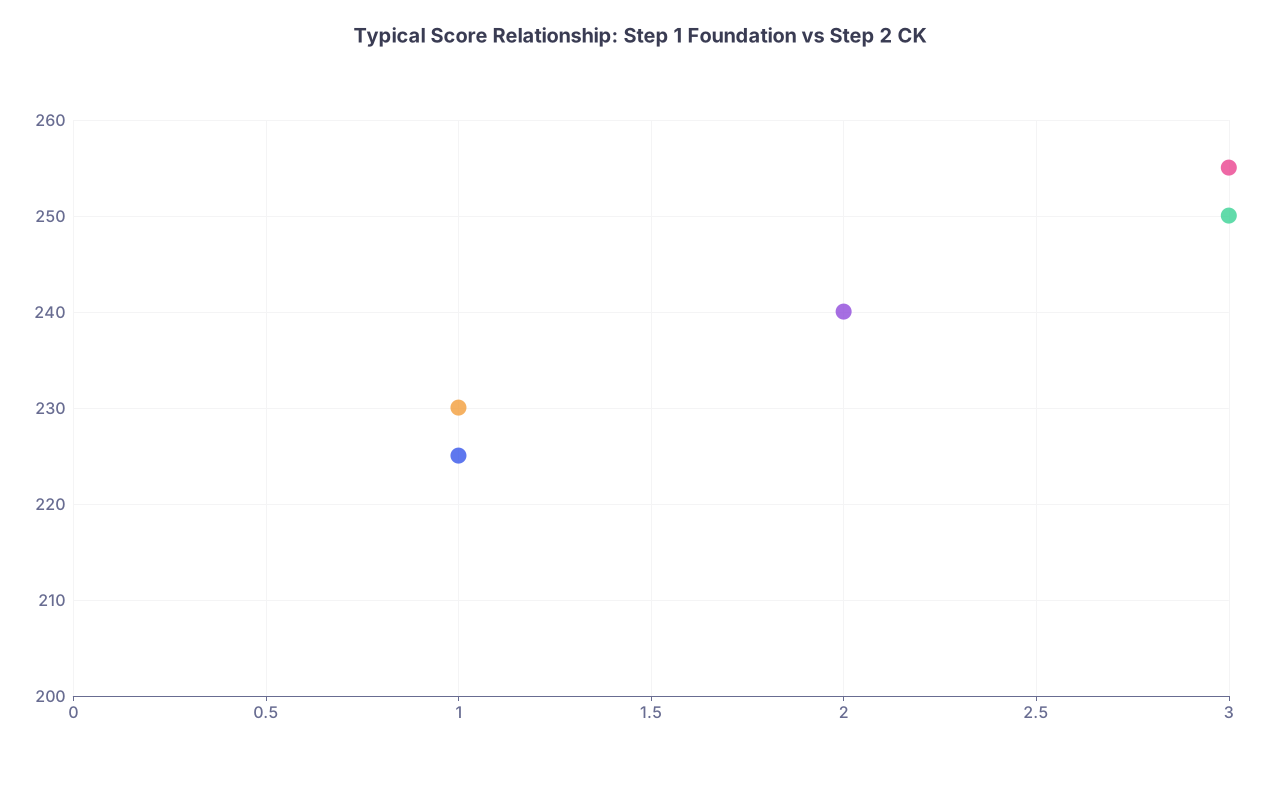
| Category | Value |
|---|---|
| Student A | 1,225 |
| Student B | 2,240 |
| Student C | 3,250 |
| Student D | 1,230 |
| Student E | 3,255 |
(Interpretation: stronger Step 1‑level foundations tend to correlate with higher Step 2 outcomes; the exact numbers aren’t the point, the pattern is.)
So yes, Step 2 CK is the new numerical gatekeeper. But your Step 1 prep is the scaffolding under that score. Trashing the scaffolding because the inspector now looks at a different metric is how buildings—and careers—collapse.
Myth #3: “Program Directors Don’t Care About Basic Science Anymore”
They do. They just don’t say “basic science” out loud.
Look at what PDs actually rate highly in the NRMP Program Director Survey:
- Clerkship grades
- Class ranking
- Step 2 CK score
- Sub‑internship performance
- Letters of recommendation
None of that explicitly says “good at glycolysis.” But how do you think you earn top grades, strong letters, and high Step 2 scores?
You show up as the student who:
- Understands why the patient’s sodium is low
- Gets the mechanism behind that drug interaction
- Can reason through weird lab patterns without guessing
Every time your attending thinks: “This student actually gets it,” you’re cashing in on Step 1‑type knowledge, just disguised as “clinical reasoning.”
I’ve heard more than one PD say some version of:
“We can teach clinical workflows. We can’t teach them basic physiology from scratch.”
The signal they lost (your Step 1 number) has to be replaced by something. They’re inferring your brain from:
- How your letters describe your reasoning
- How you perform on shelves and Step 2 CK
- Whether your transcript looks like you barely survived or thrived
So no, they’re not scanning for “Top quartile in biochemistry.” But they are selecting for people who clearly didn’t sleepwalk through their preclinical years hoping pass/fail would hide it.
It doesn’t hide it. It shifts where the weakness shows up.
Myth #4: “Wellness Means You Should Chill on Step 1”
This is where the narrative gets twisted.
The Step 1 pass/fail change was partly about wellness, yes. But people turned that into a moral story: if you care too much about Step 1, you’re somehow anti‑wellness.
That’s nonsense. There’s a huge difference between:
- Not destroying yourself over a 3‑digit score that no longer exists
vs - Using “wellness” as cover for mediocrity and poor preparation
Let me be blunt:
The least “well” people I see are the ones who under‑prepared for Step 1, barely passed, then spent the rest of med school in constant anxiety because Step 2, clerkships, and their specialty choices felt permanently out of reach.
You know what actual wellness looks like in this context?
- You took Step 1 seriously enough that you passed solidly, the first time.
- You understand the material well enough that clinical life feels challenging, not catastrophic.
- You’re not scrambling to patch gaping knowledge holes while also working 80-hour weeks.

Wellness isn’t “study less.”
Real wellness is “design your studying so future you isn’t constantly on fire.”
Step 1 studying can absolutely be more humane now:
- You can focus on understanding instead of cramming obscure minutiae.
- You can build daily sustainable habits instead of a 10‑week all‑nighter sprint.
- You can choose resources for clarity, not just for high‑yield buzzword density.
But dialing it down to “Eh, it’s pass/fail, I’ll wing it” is not wellness. That’s denial dressed up as self‑care.
Myth #5: “Research, ECs, and Networking Now Matter Way More Than Exams”
This myth is half true and mostly misused.
Yes, when Step 1 lost its score, relative weight shifted to other factors. But people stretch that into “USMLE doesn’t matter, it’s all about research and connections now.” That’s delusional.
Look at PD survey data and you’ll see a clear pattern: failing boards or having weak board performance is an automatic filter at many programs. Lack of research? That hurts for certain specialties, but it’s not an auto‑reject nearly as often.
Here’s the uncomfortable hierarchy for most competitive specialties:
| Factor | Typical Role in Selection |
|---|---|
| Step exam failures | Often automatic screen-out |
| Step 2 CK score | Major stratifying variable |
| Clerkship grades | High impact, especially core ones |
| Research in specialty | Important but less than exams |
| Leadership / ECs / volunteering | Tie-breakers, story-builders |
You can be the president of five interest groups and have three posters at subspecialty conferences. If your transcript shows a Step 1 fail and an average Step 2 CK, you are starting every conversation from a defensive crouch.
Some realities:
- Research helps differentiate among academically solid applicants. It does not rescue you from test disasters.
- Networking can help you get a look, especially for away rotations and letters. It cannot magically erase institutional policies about board performance.
- Holistic review is real—but it is not infinite forgiveness. Programs are under pressure to match residents who will pass the boards. Your exam history is evidence.
So yes, do research if it aligns with your goals. Yes, build relationships. Yes, create a cohesive narrative.
But do not kid yourself: the fastest way to shrink your universe of options is to treat Step 1 and Step 2 as secondary to your CV decoration.
Myth #6: “You Shouldn’t Use ‘Old School’ Step 1 Resources Anymore”
I hear this one a lot:
“First Aid is dead.”
“Pathoma is outdated now that it’s pass/fail.”
“Boards and Beyond is overkill; just do Anki and UWorld.”
Calm down.
Did some Step 1 prep culture go too far, obsessing over obscure minutiae just for score-chasing? Yes.
But the core resources that were good before are still good—because the exam did not suddenly stop testing basic mechanisms, it just stopped giving you a 3‑digit number.
What’s changed is not whether you use high‑yield step‑style resources, but how aggressively you grind them and why.
Before, the goal was: “Squeeze every last point out of this exam at any cost.”
Now the smarter goal is: “Use these resources to build a deep, flexible understanding that will carry into clerkships and Step 2.”
Some of you are making the opposite mistake: abandoning structured resources entirely because “my school is pass/fail and Step 1 is pass/fail.”
That’s how you end up on surgery in M3, not understanding shock, guessing through questions, and watching your shelf scores flatline.
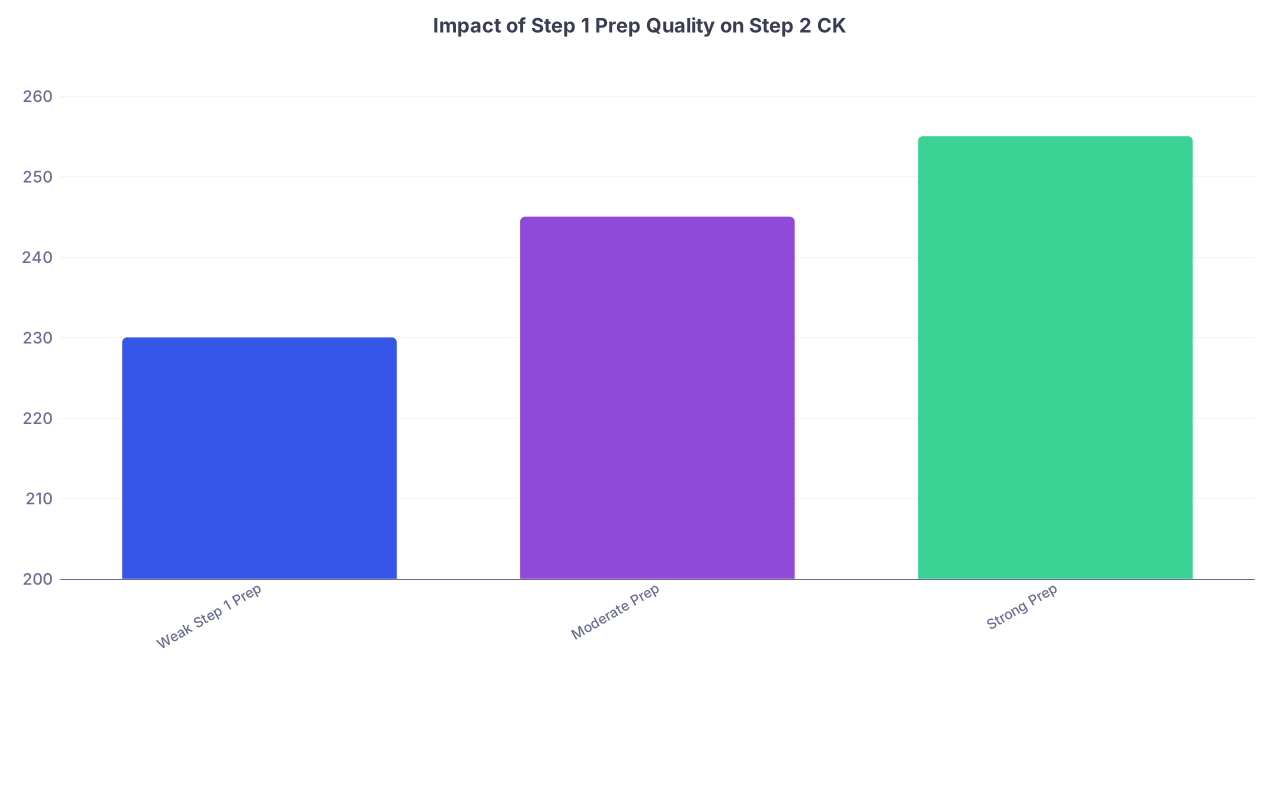
| Category | Value |
|---|---|
| Weak Step 1 Prep | 230 |
| Moderate Prep | 245 |
| Strong Prep | 255 |
What still makes sense:
- A solid, concept‑focused run through something like Pathoma / Boards & Beyond / equivalent during preclinicals
- One serious pass of UWorld (or a similar high‑quality Qbank) used as a learning tool, not just a score predictor
- Integrating school exams with board‑style thinking, not memorizing one‑off lecture slides
What no longer makes sense:
- Destroying your mental health trying to memorize 500 micro details to chase a nonexistent 260
- Treating every point of minutiae as life and death
- Spending 12 hours a day during dedicated purely on esoterica instead of consolidating core systems
Use the right tools. Scale the insanity level back. Don’t burn the entire toolbox because the yardstick changed.
Myth #7: “Because It’s Pass/Fail, You Can Fix Everything Later”
No, you probably will not.
The fantasy goes like this:
“I’ll just do what it takes to pass Step 1, then I’ll really turn it on for Step 2 once I’m in my groove clinically.”
Reality tends to look more like:
- You limp through Step 1 with gaps in cardio, renal, endocrine, pharm.
- You hit clerkships and you’re constantly behind, so your mental energy goes to basic survival.
- Shelf exams feel like Step 1 but with patients, and you realize those “temporary” gaps are still there.
- By the time you start serious Step 2 CK prep, you’re reteaching yourself half of preclinical content under time pressure.

The students who “suddenly crush” Step 2 don’t come from nowhere. They’re usually the ones who:
- Treated Step 1 as foundational, even without the score pressure
- Used questions early and often
- Cared more about understanding mechanisms than memorizing bullet points
You can recover from a mediocre Step 1 foundation. People do. But it’s inefficient and stressful. And if you think you’ll magically develop discipline and time once clinical duties ramp up, you’re in for a rude awakening.
Front‑loading serious understanding into your Step 1 era is not overkill. It’s how you buy future breathing room.
What Actually Matters More Than You Think
Let’s strip this all down.
In the pass/fail Step 1 world, these things matter more than most students realize:
A clean, first‑time Step 1 pass
Not “barely scraping by,” but a pass that reflects real understanding. This is about risk, not prestige.Your preclinical foundation as a Step 2 multiplier
Every hour you invest in actual comprehension during Step 1 prep saves you hours of panic later.How Step 1 prep shapes your clinical performance
Your ability to shine on wards, on shelves, and in letters is glued directly to the quality of thinking you built before you ever wrote “Chief Complaint” on a note.Consistency across your exams
Programs now look at the board picture as a whole. “Passed Step 1 easily, strong Step 2, no failures” is a very different signal than “skated through Step 1, shaky shelves, uneven Step 2.”

| Step | Description |
|---|---|
| Step 1 | Preclinical Years |
| Step 2 | Step 1 Pass/Fail |
| Step 3 | Better Clerkship Performance |
| Step 4 | Higher Shelf Scores |
| Step 5 | Stronger Step 2 CK Score |
| Step 6 | More Competitive Residency Options |
The Bottom Line
Pass/fail Step 1 didn’t make the game kinder; it made it less obvious where the game is being played.
Three key points to walk away with:
Step 1 is still a high‑stakes gate. Failures carry more weight now because you no longer have a score to offset them. Treat the exam with respect, not panic.
Your Step 1 foundation is the silent engine of Step 2, clerkship success, and letters. The work you do now either compounds or haunts you for the next three years.
Program directors didn’t stop caring about knowledge; they lost one metric and doubled down on the others. Strong exams, solid grades, and convincing letters still come from the same place: you actually understanding the medicine.
You don’t need to worship Step 1. But if you ignore it, you’re not enlightened. You’re just setting future you up to clean up the mess.