
The advice “just memorize First Aid and you’re set for Step 1” has derailed more medical students than a bad night float schedule.
Not because First Aid is useless. Because people use it for the wrong job.
I have watched smart students—people who crushed undergrad, honors in pre-clinical—stall out in the 210–225 range or fail a dedicated NBME while clutching a color-coded, tabbed, practically worshipped copy of First Aid. Their mistake was simple: they treated a high-yield outline like a primary learning resource.
Let’s dismantle this myth properly.
What First Aid Actually Is (and What It’s Not)
First Aid is not a textbook. It is not a course. It is not a tutor. It is a curated, compressed index of what tends to show up on exams, with just enough context to jog your memory if you already understand it.
Used right, it’s powerful. Used wrong, it’s just organized hallucination.
Here’s the reality:
- It’s incomplete by design.
- It strips out nuance, mechanisms, and reasoning.
- It assumes you’ve already learned the material somewhere else.
The people who say “I basically just did First Aid and UWorld” leave out that they also paid attention in class, actually learned physiology the first time, and did months of question-based learning that built the scaffolding underneath those one-liners.
If you’re shaky on renal physiology and think drilling the 2-page FA renal section will fix it, you are lying to yourself. That’s not how the brain or the exam works.
, Content Learning (video/text), Consolidation (First Aid/Anki), Misc/Other](https://cdn.residencyadvisor.com/images/articles_svg/chart-role-of-different-resources-in-strong-step-1-prep-5609.svg "Role of Different Resources in Strong Step 1 Prep")
| Category | Value |
|---|---|
| [Question Banks (UWorld/AMBOSS)](https://residencyadvisor.com/resources/usmle-step1-prep/do-you-really-need-to-finish-every-question-bank-for-step-1) | 40 |
| Content Learning (video/text) | 30 |
| Consolidation (First Aid/Anki) | 20 |
| Misc/Other | 10 |
First Aid lives in that “consolidation” slice. Not the “build the foundation” slice.
The Evidence: Step 1 Isn’t a Flashcard Exam
The whole “just memorize First Aid” fantasy rests on a bad assumption: that Step 1 is mostly about regurgitating factoids.
That was already shaky even in the pre-pass/fail era. Now it’s just wrong.
What the data and question banks show:
- Step 1 questions increasingly emphasize mechanisms, multi-step reasoning, and integration across disciplines.
- UWorld, NBME, and AMBOSS questions overwhelmingly test your ability to apply concepts in new contexts, not recite a highlighted sentence.
- Score improvements track far better with high-quality question practice and feedback than with passive rereading of outlines.
When you do 40 questions of UWorld and actually review them properly, you are hitting:
- Concept recall
- Mechanism understanding
- Error analysis
- Pattern recognition
- Test-taking skill
Memorizing a First Aid page hits… single-pass recognition of decontextualized facts.
The difference shows up brutally on NBME practice tests. I’ve seen this pattern a lot:
- Student A: “I’m on my third First Aid pass”
- NBMEs stuck around a plateau, e.g., 205–215, tons of “I narrowed to 2 choices and guessed” comments.
- Student B: “I used First Aid only to check I wasn’t missing topics; main time in UWorld + videos + targeted notes”
- Scores steadily climb, fewer wild guesses, more “I knew this mechanism so I could eliminate 3 answers” comments.
Same book. Different role.
Why Memorizing First Aid Fails on Real Questions
Let’s get concrete.
First Aid might give you something like:
“Hyperacute transplant rejection – preformed anti-donor antibodies; type II hypersensitivity; widespread thrombosis of graft vessels; ischemia/necrosis; minutes to hours.”
Looks great. High yield. Clean.
Now Step 1 hands you:
A 45-year-old man receives a renal transplant. Within hours, urine output drops. Biopsy shows fibrinoid necrosis and neutrophils in small vessels. He had multiple prior transfusions. Which immunologic mechanism is responsible?
If all you did was chant “hyperacute – preformed antibodies – type II – thrombosis,” you might still miss it because:
- You never really internalized what “preformed antibodies” means in real patients.
- You never connected prior transfusions → sensitization → anti-HLA antibodies.
- You never practiced discriminating between hyperacute vs acute vs accelerated acute in vignettes.
That last 10–20%—being able to interpret the clinical story and histology—is where scores are made. And where pure First Aid memorization dies.
Same with pharmacology. First Aid will hit you with “doxorubicin – dilated cardiomyopathy – dexrazoxane is protective”. Great. But the question will be structured around:
- Timing of toxicity.
- Differentiation from trastuzumab cardiotoxicity.
- Which cardiac parameter is affected first.
That nuance comes from actually learning pathophysiology and practicing questions. Not from the table itself.
What the High Scorers Actually Do (Not What They Say)
People love to compress their narratives. “I just did First Aid” sounds efficient and almost mythical. It’s also usually incomplete to the point of misleading.
The real pattern looks more like this:
First pass: They used a primary resource (B&B, Pathoma, class notes, Sketchy, etc.) to build actual understanding. They learned why things happen, not just what happens.
Question-driven learning: They used UWorld or AMBOSS continuously, even pre-dedicated. Wrong answers became learning opportunities, not ego hits.
Targeted review: They used First Aid as a map and checklist. To be sure:
- “Have I actually seen all these glycogen storage diseases before?”
- “Do I understand this immunology pathway well enough that this First Aid diagram makes sense without explanation?”
Refinement: In dedicated, they circled back through First Aid/Anki not as the first line, but as the last pass. To tighten recall of details built on a conceptual base.
I’ve tutored people who swore they were “First Aid only” until you pry a bit and find out they watched all of Boards & Beyond and did 3,000+ UWorld questions. Yeah. No kidding they didn’t need to crawl slowly through FA.
Using First Aid as your only spine is like trying to become fluent in a language by memorizing a phrasebook while ignoring listening, speaking, or grammar. You’ll recognize a lot on paper. You’ll also fall apart in any real conversation.
The Cognitive Science Problem: Why Rereading Fails You
There’s another reason “memorize First Aid” is so seductive: it feels good.
Rereading a page you’ve already highlighted gives you the pleasant illusion of mastery. “Hey, I recognize that table now, I must know it.” That’s not learning. That’s familiarity.
Effective learning—especially for an exam like Step 1—comes from:
- Retrieval practice (forcing yourself to recall without cues)
- Spaced repetition
- Interleaving topics
- Active problem solving under realistic constraints
First Aid, on its own, does none of that unless you weaponize it correctly.
Mindless reading:
- Low retrieval load
- No spacing
- Pure recognition
- Overestimates your ability
Versus something like:
- Doing 40 timed questions
- Closing the book and writing out what you remember about cardiac murmurs
- Forcing yourself to sketch the glycolysis pathway from memory before checking the FA diagram
Those are ugly. Uncomfortable. But that’s where durable memory forms.
If your “study plan” is:
- Read 50 pages of First Aid a day
- Highlight / annotate
- Maybe watch a video as background
You’re basically doing the cognitive equivalent of watching people work out on YouTube and expecting to get stronger.
Where First Aid Actually Shines (The Right Way to Use It)
Now let me be fair: First Aid deserves its reputation as a critical Step 1 resource. When used in its proper role, it’s extremely efficient.
Here’s where it’s genuinely strong:
As a master topic list
You can treat FA like a syllabus of what exam writers think matters. If something is not anywhere in FA or in reputable question banks, odds are it’s low yield. That matters when you’re triaging your limited time.As a final-pass consolidator
Once you understand a topic from videos, lectures, and questions, a FA page becomes a compressed mental trigger. You flip through hematology and each phrase lights up a full mental model you already built.As an Anki backbone
Many of the strongest Anki decks (e.g., old Lightyear, later Zanki-based decks) are indexed to First Aid pages. Not because FA is complete, but because it provides a stable reference structure.As a gap detector
When you review an FA section and hit a topic that feels like complete nonsense—no recognition, no anchor—that’s a signal. That’s where you go back to a video/book and actually learn the thing.
The point: First Aid is powerful as a reference and organizer of knowledge you already earned the hard way. It’s terrible as the place you try to earn that knowledge from scratch.
The Pass/Fail Mirage: Why This Myth Got Even More Dangerous
Once Step 1 went pass/fail, another myth sprouted: “You don’t need to go that deep anymore. Just hit the high-yield FA facts and cruise to a pass.”
I’ve seen MS2s say this out loud. Often while sitting on a shaky grasp of basic physiology.
Two problems with that logic:
“Pass” is not easy if your foundation is thin
The content expectation of the exam did not suddenly collapse. The question style is still conceptual. You still have to sort through vignettes and avoid trap answers. Pure memorization buys you a false sense of safety at exactly the wrong time.Step 1 knowledge still matters for Step 2 and for real medicine
You cannot compensate for a hollow understanding of pathophysiology by magically grinding Step 2 questions. The people who are miserable on CK are very often the ones who treated Step 1 like a trivia contest.
Residency programs may not see your Step 1 score anymore, but they absolutely see the downstream effects: class ranking, Step 2 score, clerkship performance, letters that quietly say “solid but struggled with clinical reasoning.”
First Aid-only prep doesn’t just risk Step 1. It undercuts everything built on top of that.
A Simple Reality Check: How to Know If You’re Misusing First Aid
If you want a quick diagnostic of where you stand, try this:
- Pick a random system in First Aid. Say cardio.
- Close the book.
- On blank paper, write down everything you can recall about:
- Aortic regurg vs mitral regurg (murmur, causes, maneuver effects, pathophys)
- Stable vs unstable angina vs NSTEMI vs STEMI
- Effects of beta-blockers vs calcium channel blockers
Then open First Aid and see:
- Are you just recognizing terms you couldn’t produce a minute ago?
- Did FA feel like a fresh explanation, or a compact reminder of something you already own?
If it’s all recognition and no production, you’re in the danger zone. You’re mistaking familiarity with mastery. And Step 1 does not grade familiarity.

| Step | Description |
|---|---|
| Step 1 | Primary Learning Videos/Text/Class |
| Step 2 | Question Practice UWorld/AMBOSS |
| Step 3 | Review Explanations Understand Mechanisms |
| Step 4 | Targeted Content Review Fill Gaps |
| Step 5 | First Aid / Anki Consolidate & Map |
| Step 6 | NBMEs & Adjust Plan |
The point of First Aid is mostly in that late-stage consolidation node. Not at the very start.
Stop Worshipping the Book. Use It Like a Tool.
Let me be blunt.
If your Step 1 plan is “I’ll do a few thousand Anki cards and memorize First Aid cover to cover,” you are building a very pretty, very fragile house of cards. The second the exam asks you to reason instead of recite, it collapses.
What actually works, again and again:
- Build real understanding with decent primary resources.
- Hammer questions and learn aggressively from every wrong answer.
- Use First Aid as your map, your checklist, your index. Not your teacher.
You can absolutely get through Step 1 without reading every word of First Aid three times. You cannot get through it, comfortably, by reading only First Aid three times.

One Table for Clarity: How to Think About First Aid vs Other Resources
| Resource Type | Best Used For |
|---|---|
| First Aid | Mapping topics, consolidating details |
| Question Banks (UWorld/AMBOSS) | Building reasoning, exposing gaps |
| Video Courses (B&B, Pathoma, Sketchy) | Primary understanding, mechanisms |
| Anki | Spaced recall, detail retention |
| Class Notes/Textbooks | Extra depth for weak areas |
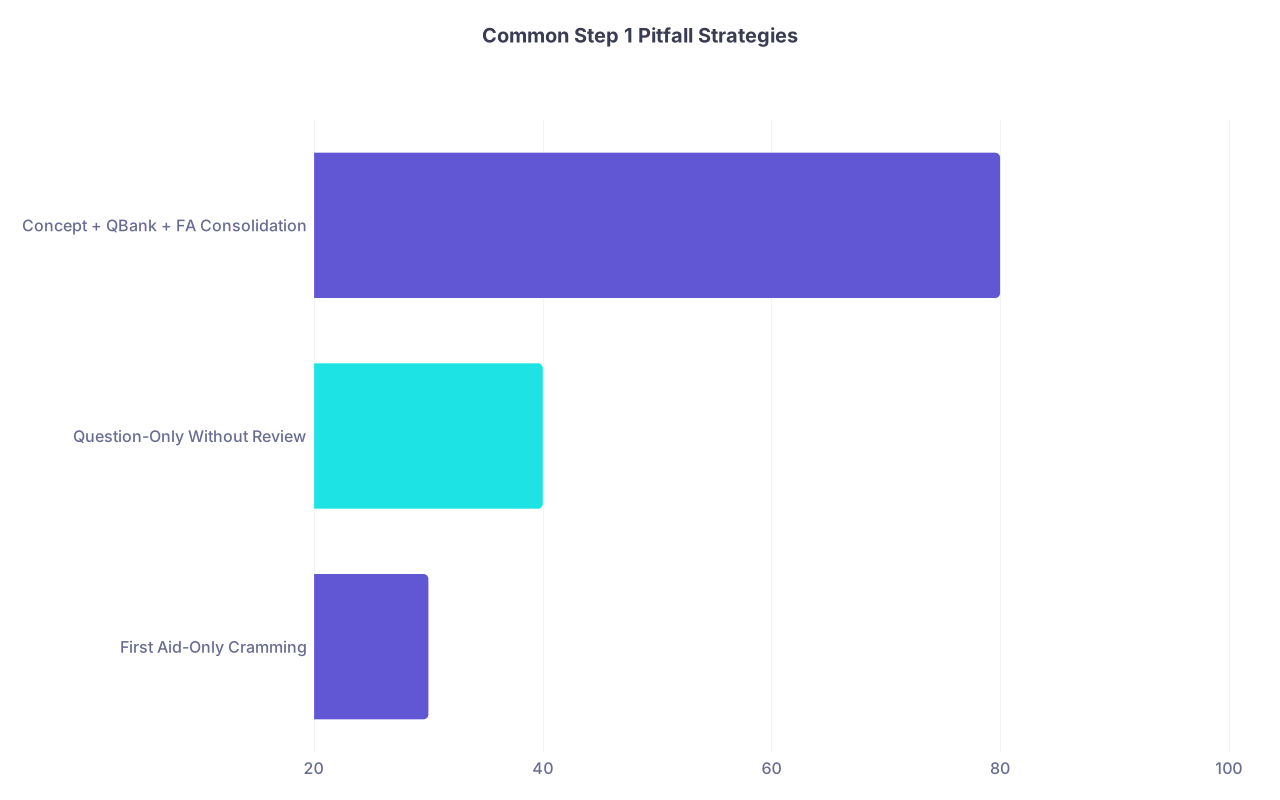
| Category | Value |
|---|---|
| First Aid-Only Cramming | 30 |
| Question-Only Without Review | 40 |
| Concept + QBank + FA Consolidation | 80 |
That last bar—concept + QBank + FA consolidation—is the pattern that actually holds up under pressure.
The Bottom Line
I’ll end this without fluff.
- First Aid is an outstanding reference and consolidation tool, but a terrible primary teacher. Treat it like a map, not the territory.
- “Memorize First Aid and you’re set” is a comforting lie. Step 1 tests understanding and application. You get that from real learning and question practice, not passive rereading.
- If you anchor your prep on mechanisms, questions, and active recall—and let First Aid sit in its proper supporting role—you’ll be fine. If you anchor on First Aid itself, you’re gambling with your exam, and the odds are not in your favor.