
The most harmful Step 1 myth isn’t about which Qbank to use. It’s that you need a perfect schedule.
You know the one: color‑coded, down to the hour, every page of First Aid assigned, every UWorld block pre‑planned from now until your test date. Looks amazing on Notion. Dies on contact with reality.
Let me be blunt: the “perfect” Step 1 schedule is fake productivity. Flexible systems beat rigid schedules. Consistently. And we actually have data, not just vibes, to back that up.
The Fantasy of the Perfect Step 1 Schedule
Walk into any library in February and you’ll hear some version of this:
“I’m starting dedicated in six weeks. I’ve got an 8‑week, 10‑hour‑a‑day schedule from Reddit. If I just follow it exactly, I’ll be fine.”
No, you won’t. Because you won’t follow it exactly. Nobody does.
Here’s what actually happens with rigid, hyper‑detailed Step 1 schedules:
- Week 1 you’re already behind by Day 3.
- By Week 2, you’re “re‑starting” the plan.
- By Week 3, you’ve given up on the plan and are now just doing random blocks and feeling guilty.
The problem isn’t your discipline. It’s that the plan assumes you’re a robot:
- No call shifts that run late
- No random required small groups or OSCEs
- No days when you get crushed by fatigue or anxiety
- No topics that take you longer than predicted
Educational psych research has been crystal clear on one thing for decades: humans are terrible at predicting how long real learning will take. Time estimates are fantasy. Feedback is reality.
And Step 1 is 90% about feedback.
What the Data Actually Shows About Step 1 Prep
Let’s cut through the folklore and look at what correlates with Step 1 success. Spoiler: “perfect schedule compliance” doesn’t show up anywhere.
Across multiple schools and internal datasets I’ve seen (plus what’s been published before Step 1 went pass/fail), the strong predictors look like this:
- Total high‑quality practice questions completed
- Quality and frequency of review of missed concepts
- Consistent, not heroic, weekly question volume
- Timely adjustment of strategy based on NBME performance
None of those require a rigid master schedule. All of those require adaptive planning.
To make the contrast clear:
| Factor | Rigid Schedule Approach | Flexible System Approach |
|---|---|---|
| Question goal | Fixed per day | Fixed per week |
| Topic coverage | Pre-assigned by date | Guided by performance gaps |
| Response to bad week | Panic / restart plan | Rebalance next week’s load |
| Tracking | “Did I follow today’s plan?” | “Did I hit my weekly targets?” |
The students who do best aren’t the ones who follow a script. They’re the ones who keep adjusting the script based on what their performance is telling them.
To make that visual:
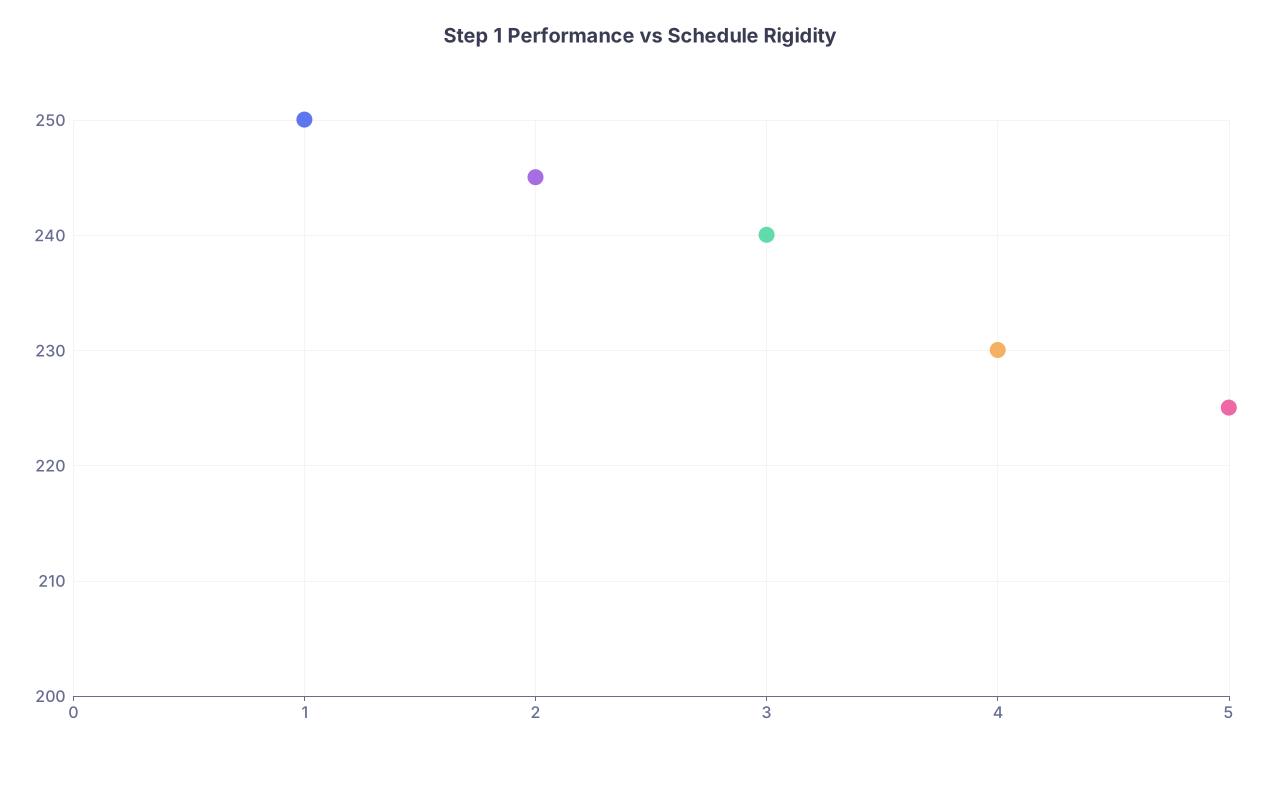
| Category | Value |
|---|---|
| Student A | 1,250 |
| Student B | 2,245 |
| Student C | 3,240 |
| Student D | 4,230 |
| Student E | 5,225 |
On the x‑axis imagine “1 = very flexible system, 5 = extremely rigid schedule.” You get the picture. The real top scorers almost never have “I followed my 96‑day schedule perfectly” as their story. It’s always closer to “I had a rough framework and adjusted constantly based on NBMEs.”
Why Rigid Step 1 Schedules Fail in Real Life
Let me walk through the three main failure modes I see every single year.
1. Zero slack, zero resilience
Most “perfect schedules” are fully booked: every day, every block of time, assigned. That looks efficient. It’s actually brittle.
One unexpected thing happens:
- Required ethics session that overruns
- Family issue
- You get sick Sunday and lose an entire “catch‑up” day
Now you’re two days behind on a schedule with no slack. So what do students do? Either:
- Start skipping review because “I have to stay on schedule”
- Compress things (“I’ll do 4 blocks tomorrow”) and burn out
Both options tank retention. Skipping review kills spaced repetition; cramming extra blocks when you’re already mentally shot kills quality.
2. Obsession with coverage, not mastery
The classic Step 1 spreadsheet mentality is “I must cover everything in time.” Coverage is an illusion.
You don’t need to “touch” every line of every resource. You need to master the highest‑yield 70–80% and be competent in the rest. That only happens when you:
- Spend more time on weak areas than strong ones
- Go back to the same topics multiple times
- Let performance (not your calendar) tell you what to study next
Rigid schedules do the opposite. They force equal time on nephrotic syndromes and obscure storage diseases because “that’s the plan.” That’s not smart studying. That’s box‑checking.
3. They destroy motivation
I’ve watched this play out too many times:
Week 1: “I only finished 50% of my plan, I suck.”
Week 2: “Now I’m even more behind, why bother?”
Week 3: “I’ll wait until dedicated to really go hard.”
Dedicated: You’re playing catch‑up with anxiety at 11/10.
Psychologically, humans can handle hard work. They can’t handle constant, self‑inflicted failure. A rigid plan makes it mathematically inevitable that you “fail” your own expectations frequently.
That’s a motivation killer, not a performance enhancer.
What Flexible Actually Looks Like (It’s Not Chaos)
“Be flexible” sounds like “do whatever you feel like.” That’s not what I’m arguing for.
You need structure. You just don’t need micromanaged structure.
Think in layers, like this:
Layer 1: Non‑negotiable weekly targets
Instead of “40 questions per day,” you set:
- 200–280 UWorld (or comparable) questions per week
- 1–2 NBME/CBSSA every 2–3 weeks during dedicated
- X hours of active review (Anki, incorrects, notes), not passive reading
Those are non‑negotiable. You hit the weekly question number. You do your scheduled NBMEs. You protect review time.
How you distribute within the week? That’s flexible. You’re human. Some days will be light; some days will be heavy. That’s fine as long as the week is solid.
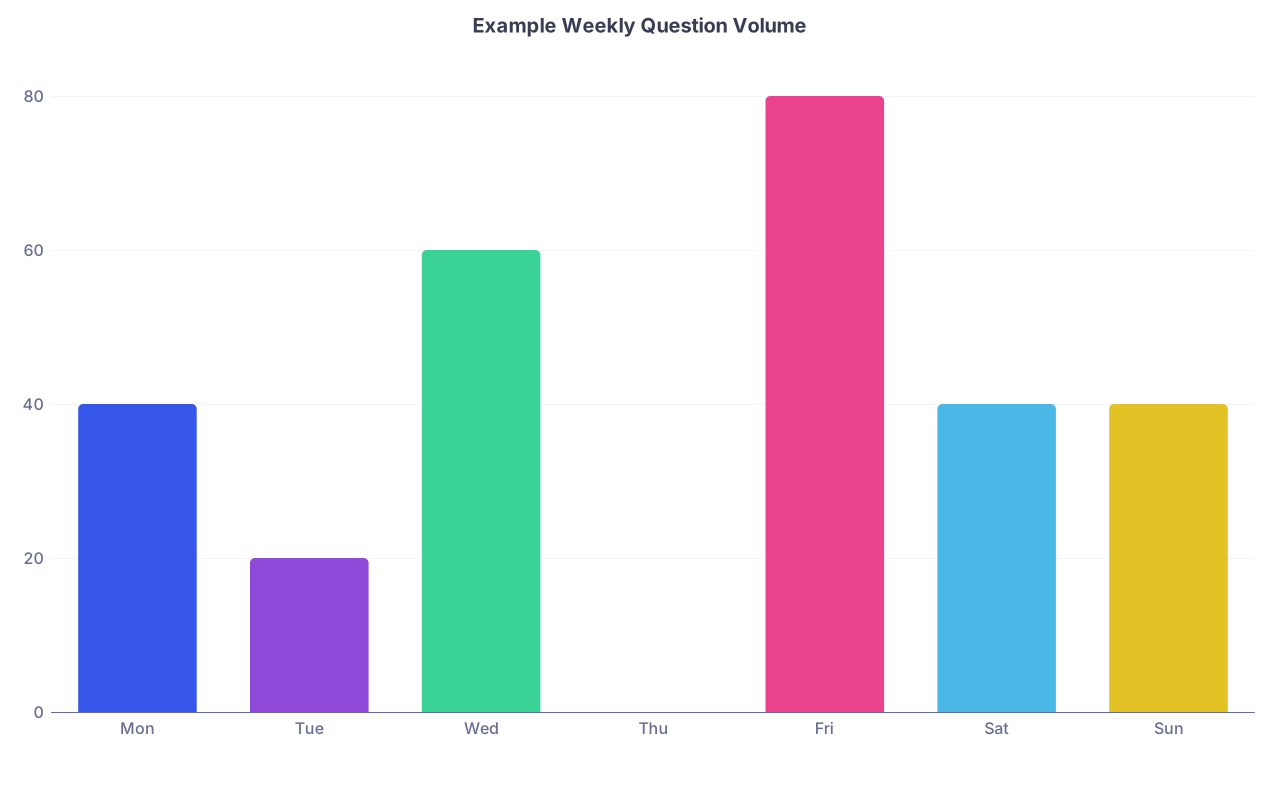
| Category | Value |
|---|---|
| Mon | 40 |
| Tue | 20 |
| Wed | 60 |
| Thu | 0 |
| Fri | 80 |
| Sat | 40 |
| Sun | 40 |
That student still hit 280 questions. Thursday was a disaster? No problem. They overloaded Friday. That’s resilience, not failure.
Layer 2: Topic selection guided by feedback
Instead of a pre‑planned “Renal Tuesday, Cardio Wednesday” schedule, you let your performance decide the order:
- Do a mixed block
- Tag incorrects by system
- End of day, tally which systems are consistently weak
- Next day’s “focus blocks” and review time go to those systems
Yes, you’ll still roughly “cover everything,” but you’ll spend more time where you’re actually bleeding points.
This is what strong test‑takers do instinctively in every domain, from the MCAT to board prep: they hunt their weak spots and camp there until those spots stop being weak.
Layer 3: A simple daily skeleton, not a minute‑by‑minute script
You do not need a 20‑line Google calendar per day. You need something this simple:
Morning:
- 1–2 timed, random blocks with full review
Afternoon:
- Targeted content/review based on misses
- Anki or spaced repetition for consolidation
Evening (optional/light):
- Light review, sketchy/boards videos, or rest
That’s it. The exact hours will depend on whether you’re in dedicated, on lighter rotations, or in full‑time pre‑clinicals. But the skeleton holds.
Here’s what a flexible dedicated week might look like vs a rigid one:
| Day | Rigid Plan (Hour-by-Hour) | Flexible System (Skeleton) |
|---|---|---|
| Monday | 8–9: FA cards, 9–11: Renal vids... | AM: 2 blocks + review; PM: Renal weak spots, Anki |
| Wednesday | 8–9: Pathoma heme; 9–11: Heme Qs | AM: NBME; PM: Deep review of NBME, build list of weak topics |
| Friday | 8–12: Micro; 1–5: Pharm | AM: 2 blocks + review; PM: Micro/pharm from this week’s misses |
Notice the difference? Rigid: topic first, performance second. Flexible: performance first, topic second.
Real Students, Real Outcomes
Let me give you two anonymized composites based on patterns I’ve seen repeatedly.
Student 1 – The Scheduler
- Came in with a strong pre‑clinical record
- Built a beautiful 10‑week study calendar
- Every day was planned: resources, pages, question counts
What happened:
- Week 2: Fell behind when they got sick for 3 days
- Tried to “catch up” by cutting UWorld review and rushing videos
- NBMEs flatlined around their first score
- Spent last 3 weeks constantly “behind” and anxious
Outcome: Passed, but plateaued. Felt like they worked non‑stop and didn’t see translation.
Student 2 – The System Builder
- Similar baseline academic strength
- Chose 250 questions/week during classes, 350–400/week during dedicated
- Weekly review blocks, NBMEs every 2–3 weeks once within 8 weeks of exam
What happened:
- Class weeks varied—but weekly question and review targets almost always hit
- When an exam week blew up study time, they rebounded the next week
- NBMEs gradually climbed; they adjusted plan every time they saw a pattern
Outcome: Strong pass, hit target range. Reported high stress at times, but almost no “I’m completely behind and doomed” spirals.
Those stories repeat. Every. Single. Year.
How to Build Your Own Flexible Step 1 System
Let me walk you through something concrete.
Step 1: Fix your weekly metrics
Decide, based on your timeline and baseline:
- Minimum questions per week
- Minimum dedicated review time per week
- How often you’ll take NBMEs once you’re within a couple months of the test
Write those down. Those are real commitments.
Step 2: Keep a one‑page “control panel”
Not a 15‑tab Excel monster. One page or whiteboard with:
- Total questions done
- Cumulative percentage correct (by system if your Qbank allows)
- List of top 3 weak systems at any time
- Next NBME date and last NBME score
When I’ve sat down with students teetering on the edge, almost none of them can answer this basic question quickly: “What are your worst 2–3 systems right now?” If you don’t know that, you’re not actually in control of your prep, no matter how pretty your schedule looks.
Step 3: Use NBME scores as brakes and steering, not judgment
NBMEs are for two things:
- Reality check of where you are
- Identifying what’s dragging you down
They are not:
- A morality test
- A confirmation that your schedule is “bad”
If an NBME comes back low in endocrine and neuro:
- Next 7–10 days: disproportionate time there
- Extra question blocks in those systems
- Focused review sessions targeting those misses
Then you re‑test, and your plan changes again.
Step 4: Protect slack like it’s high‑yield
Good prep has built‑in “mess‑up insurance”:
- 1 lighter day per week (half‑day or full day off-study)
- No assumption that every day will be 10/10 productivity
- Intentional recovery time before/after NBMEs

| Step | Description |
|---|---|
| Step 1 | Set Weekly Question + Review Targets |
| Step 2 | Plan Rough Daily Blocks |
| Step 3 | Do Qblocks + Review |
| Step 4 | Track Weak Systems |
| Step 5 | Adjust Next Days Topics |
| Step 6 | Nbme Every 2-3 Weeks |
| Step 7 | Update Targets + Focus |
That cycle—plan, execute, get feedback, adjust—is the real “perfect schedule.” It just doesn’t fit on a single PDF.
The Quiet Advantage of Flexibility: Mental Health
There’s one more piece nobody wants to admit: Step 1 isn’t just a knowledge test; it’s a mental endurance event.
Rigid schedules:
- Maximize the number of days you feel like you “failed”
- Encourage all‑or‑nothing thinking
- Make it very hard to mentally reset after a bad day
Flexible systems:
- Focus on salvage: “Yesterday was bad, but the week isn’t lost.”
- Reinforce control: “I can adjust this; I’m not trapped by a spreadsheet.”
- Allow you to intentionally rest without guilt because your unit of success is the week, not the hour
Students who go into Step 1 feeling like they’ve been failing their own plan for two months are not in a good headspace. And headspace matters. You will make better decisions during the exam if your prep didn’t train you to feel behind all the time.
To drive home how uneven but effective flexible progress can look:
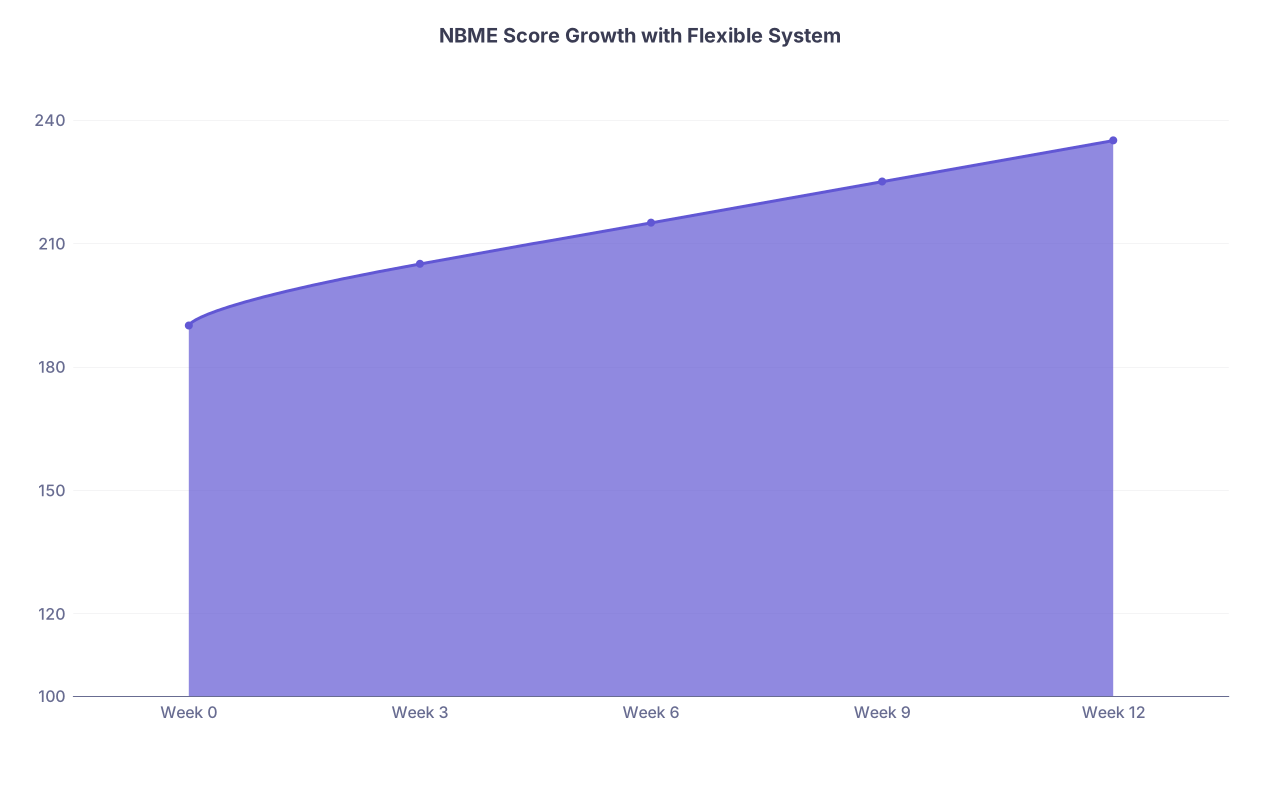
| Category | Value |
|---|---|
| Week 0 | 190 |
| Week 3 | 205 |
| Week 6 | 215 |
| Week 9 | 225 |
| Week 12 | 235 |
Notice: no huge jumps, no magic week. Just steady, adaptive improvement.
Two things to walk away with.
First: The “perfect” Step 1 schedule is a myth that survives because it looks comforting. What actually predicts success is consistent question volume, aggressive review of weaknesses, and willing course‑correction based on real performance—none of which require a rigid daily script.
Second: Flexibility isn’t laziness; it’s strategy. Build a system around weekly targets, feedback, and slack, and you’ll beat the pretty calendars every time.