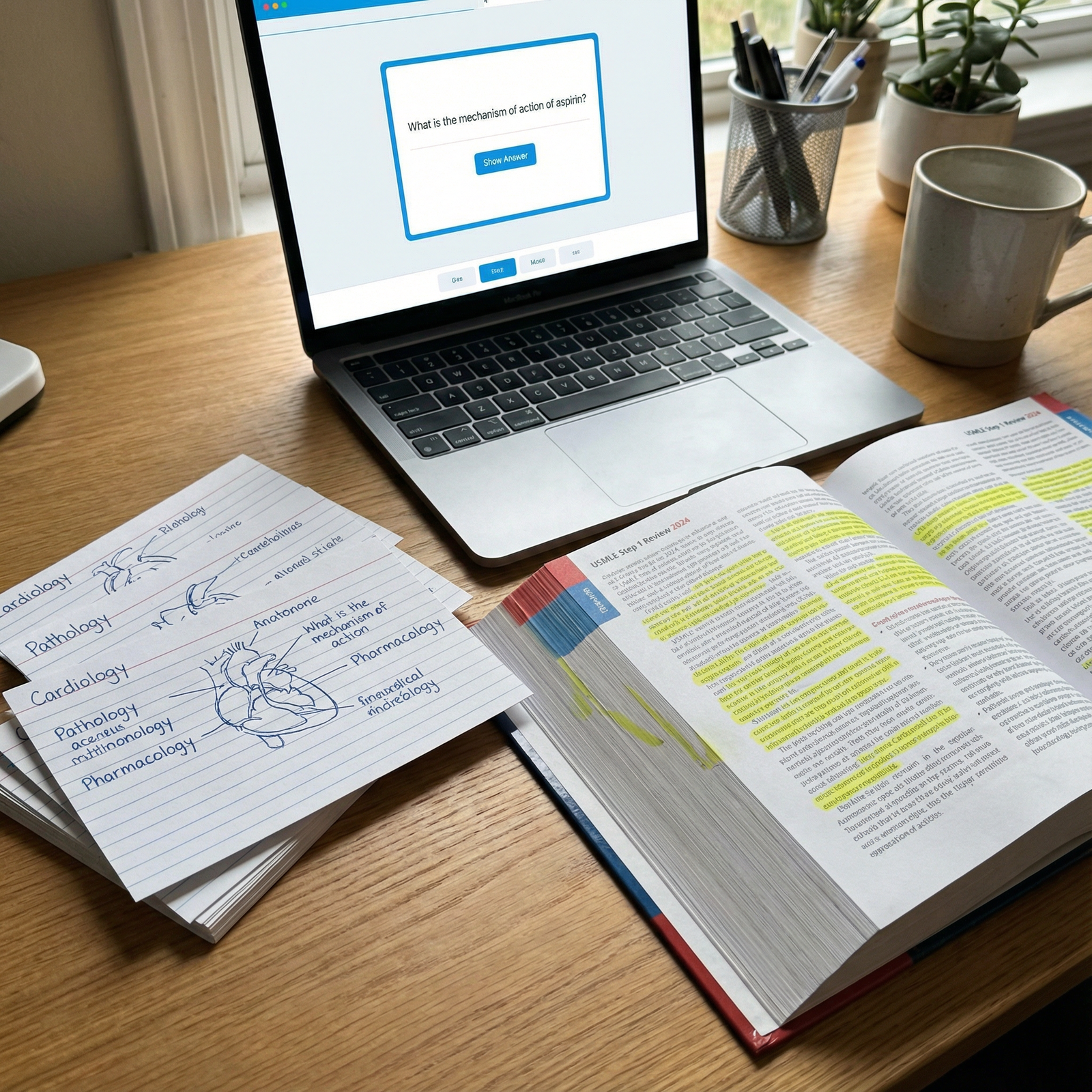
What if I told you the way most med students “study harder” for Step 1—endless rereading of First Aid and notes—is almost perfectly designed to feel productive while barely moving your score?
Let’s rip this apart properly.
The Big Myth: “I Just Need to Reread First Aid 5 Times”
You’ve heard it on your class GroupMe or in the library whisper network:
“My friend got a 250. She just read First Aid like 6 times and did some questions.”
No, she didn’t “just” do that. And no, rereading wasn’t what got her there.
Here’s the uncomfortable truth from decades of cognitive psychology research:
- Passive rereading is one of the least effective study strategies for long‑term retention.
- Active retrieval (recalling from memory) plus spacing (not cramming all at once) is consistently in the top tier.
- What feels “fluent” and familiar when you reread is often illusion of competence, not mastery.
The Step 1 world has finally discovered Anki and spaced repetition, but a lot of people are still half‑doing it and then blaming the method when their score plateaus.
Let me separate the science, the hype, and what actually maps to higher Step 1 performance.
What The Research Actually Says (Not Reddit Anecdotes)
We’re not guessing here. The spacing and retrieval effects are among the most replicated findings in learning science.
Rereading vs Retrieval: The Classic Trap
Many lab studies compare:
- Group A: Reread the material
- Group B: Study once and then repeatedly test themselves without seeing the text again
Over and over, Group B wins on delayed tests (days–weeks later), even if they feel less confident.
A well‑known study by Karpicke & Roediger (2008) did something exactly like this with text passages. Students who:
- Studied once and then just practiced retrieval
outperformed those who: - Repeatedly reread the material but did minimal retrieval
Students also thought rereading would help more. They were wrong. That part should sound familiar.
Step 1 is a delayed, high‑stakes recall exam, not a next‑day quiz. So the conditions that favor retrieval practice over rereading are exactly the conditions you’re in.
Spacing vs Massed Practice: Why Cramming Dies Fast
Spacing (studying the same material multiple times with gaps) is another monster effect:
- Cramming gives high short‑term performance that collapses quickly.
- Spacing gives lower immediate performance but dramatically better retention.
One meta‑analysis after another shows spaced practice outperforms massed practice for long‑term exams. That’s the whole logic behind tools like Anki: they algorithmically force spacing and retrieval together.
So if we’re being honest:
- Spaced retrieval is A‑tier.
- Rereading is C‑ to D‑tier for long‑term, complex exams like Step 1.
And yet many med students spend more hours rereading than doing retrieval.
How This Translates Specifically to Step 1
Let’s connect the science to what actually shows up on score reports.
Real Talk: What High Scorers Actually Do
No, not the sanitized “I just stayed consistent and believed in myself” nonsense.
Patterns I’ve seen repeatedly in 240–260+ students:
- Heavy use of question banks (UWorld at minimum) as active retrieval, not just passive explanations
- Spaced repetition decks (Anki, Firecracker back in the day, self‑made cards) done consistently
- Minimal pure rereading. More like:
- Quick skim to orient
- Then questions + Anki
- Then targeted reference to First Aid/Pathoma only to clarify gaps
Low scorers, or chronic plateau people?
- Massive time sunk into:
- Rereading First Aid cover to cover (multiple times)
- Rereading Pathoma like it’s a novel
- Staring at long typed notes they never test themselves on
- Very inconsistent or nonexistent spaced repetition
- Question banks done late, rushed, or passively
The difference is not “smart vs not smart.” It’s process vs comfort.
Does Anki Use Actually Correlate With Step 1 Performance?
There’s no giant randomized trial where half of med schools are banned from Anki. But we have converging lines of evidence:
- Multiple studies show spaced retrieval tools improve performance in medical curricula (NBME‑style questions, OSCE recall, etc.).
- Schools integrating structured retrieval practice into pre‑clinicals often report improved Step 1 averages after a few years. Not magic, but measurable.
- Informally but consistently: people who truly stick to a well‑designed deck + questions almost always outperform their baseline predictors (GPA/MCAT alone).
Correlation is not causation, sure. But when correlation lines up with extremely strong lab evidence + a clear mechanism, pretending it’s a coincidence is just denial.
Spaced Repetition vs Rereading: Where Each Actually Fits
Rereading is not completely useless. But you have to assign it to its proper role: groundwork, not the main engine.
What Rereading Is Good For
- Initial exposure. You cannot Anki what you do not vaguely understand. First Aid/Boards & Beyond/Pathoma give structure and integrate concepts.
- Big‑picture refresh. Fast skim to reconnect organ systems, not slow, highlight‑every‑line reading sessions.
- Clarification after confusion. You miss a UWorld question and realize you never fully understood the coag cascade? Reading a short focused section helps.
But rereading an entire chapter for the 4th time, without any attempt at active recall?
That’s mental cardio on a treadmill with no belt.
What Spaced Repetition Is Good For
- Long‑term retention of core facts. Drugs, bugs, step pathways, risk factors, associations. All the stuff you will forget if you “just understand it.”
- Protecting your investment. Every hour spent on a lecture or video decays rapidly without retrieval. Spaced repetition is the shield.
- Automaticity. When you see “HLA‑B27” you shouldn’t have to stop and think for 10 seconds. That speed is built by repeated, staggered recall.
But spaced repetition can be badly abused too.
The Dark Side of Spaced Repetition (And How People Screw It Up)
People fail with Anki and then say “spaced repetition didn’t work for me.” No. Your implementation didn’t work.
Common self‑inflicted wounds:
Card bloat from hell.
15,000+ low‑yield, word‑for‑word cards. You spend 2–3 hours/day reviewing and still feel behind. Of course you hate it.Screenshot decks with zero editing.
You’re basically flipping through digital flashcards that are just tiny pages of First Aid. That’s rereading with extra steps.Mindless clicking.
Saying the answer in your head? Maybe. Maybe not. But you’re still hitting “Good” on everything even when recall was shaky. That kills the algorithm.No connection to questions.
Doing Anki in a vacuum, not integrated with UWorld or NBME‑style questions, leads to isolated trivia knowledge that does not transfer to vignettes.
If that’s your system, then yes, rereading + questions might honestly beat your “spaced repetition.” Because what you’re doing is not genuine spaced retrieval. It’s app‑mediated autopilot.
How To Actually Combine Them For Step 1 Gains
Let me give you a sane, evidence‑aligned structure. No magic. Just mechanics that match how memory works.
Step 1: Use Rereading Strategically, Not Religiously
When you first start a system (say, cardio):
- Do a fast, comprehension‑oriented pass through a trusted resource (Pathoma, Boards & Beyond, or a solid lecture).
- Mark or note only the core concepts and high‑yield facts you know you’ll forget:
Murmurs, drugs, equations, classic disease presentations.
You’re not trying to memorize everything on the first pass. You’re trying to build a mental scaffold.
Then stop rereading. Move on.
Step 2: Turn The Fragile Bits Into Good Cards
Good cards:
- Test one clear idea.
- Force actual recall, not vague recognition.
- Are concise enough to review quickly.
Bad card:
“Describe the pathophysiology, clinical features, diagnosis, and treatment of nephrotic syndrome.”
Good cards (multiple):
- “Most common cause of nephrotic syndrome in adults in US?”
- “Nephrotic syndrome: key lab finding that predisposes to thrombosis?”
- “Nephrotic syndrome: mechanism of hyperlipidemia?”
You don’t need to make all of these yourself; premade decks like AnKing can be fine if you ruthlessly suspend cards you don’t care about and edit ones that are bloated.
Step 3: Let The Spacing Algorithm Do Its Job
This is where most people sabotage themselves. You must:
- Do your reviews every day (or close). Letting them pile up to 1,000+ is death.
- Answer out loud or in writing, not just “feeling” like you know it.
- Be honest with the buttons. If recall was slow, hit “Again” or the shorter interval, even if it hurts.
You’re trading short‑term ego comfort for long‑term exam performance. That’s the entire game.
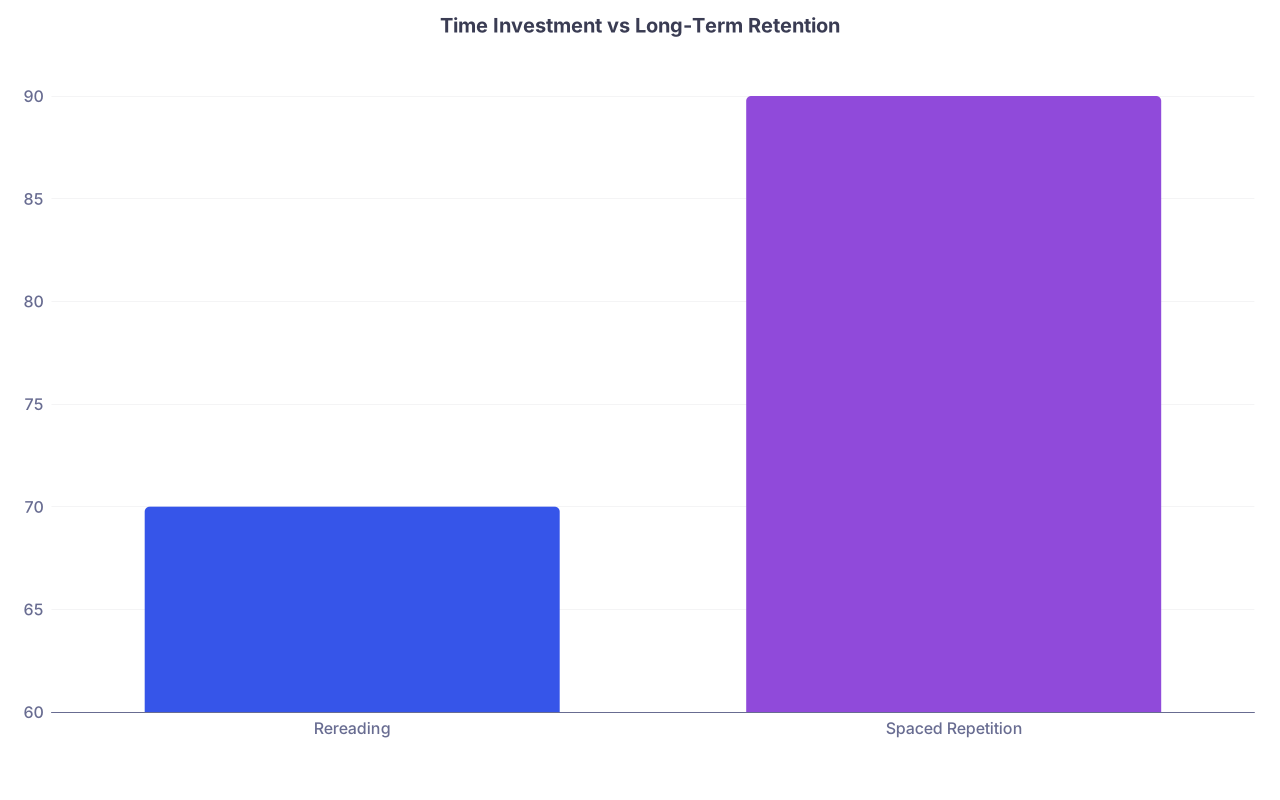
| Category | Value |
|---|---|
| Rereading | 70 |
| Spaced Repetition | 90 |
Think of that as: if both take similar study hours, spaced repetition simply buys you more durable retention for the same or less time.
Step 4: Use Questions As High‑Level Retrieval
UWorld and NBME forms are just advanced retrieval practice with context and reasoning layered on top.
Here’s the loop that actually drives Step 1 scores up:
- Do questions in timed or tutor mode (I lean timed early).
- For every question:
- Ask: What fact or concept did I actually miss or almost miss?
- If it is truly new or rusty, create or un‑suspend a relevant card.
- Very brief reread of the relevant First Aid/Pathoma page only if necessary to anchor the concept.
You’re using rereading like a reference manual, not a textbook.
Where Pure Rereading Fits (And Where It Does Not)
You do not need to swear off rereading like it is poison. Just stop lying to yourself that it is the core of your strategy.
Smart ways to use rereading near exam time:
- Short, fast passes of First Aid/annotated notes to reconnect everything you already know.
- Skimming tables and images you’ve already Anki’d, to strengthen pattern recognition.
- Reviewing very weak systems in 1–2 days, but layered with questions and rapid recall, not silent reading marathons.
Dumb ways:
- “I’m taking the exam in 3 weeks so I’m just going to read First Aid cover to cover twice.”
That’s not a plan. That’s anxiety with a highlighter.
Quick Comparison: What Actually Drives Step 1 Retention
| Feature | Spaced Repetition | Rereading Texts |
|---|---|---|
| Core mechanism | Active recall + spacing | Passive exposure |
| Short-term confidence | Often lower | Feels high |
| Long-term retention | Strong | Weak |
| Time efficiency | High if cards are pruned | Low after first pass |
| Best use case | Facts, associations, details | Initial exposure, overview |
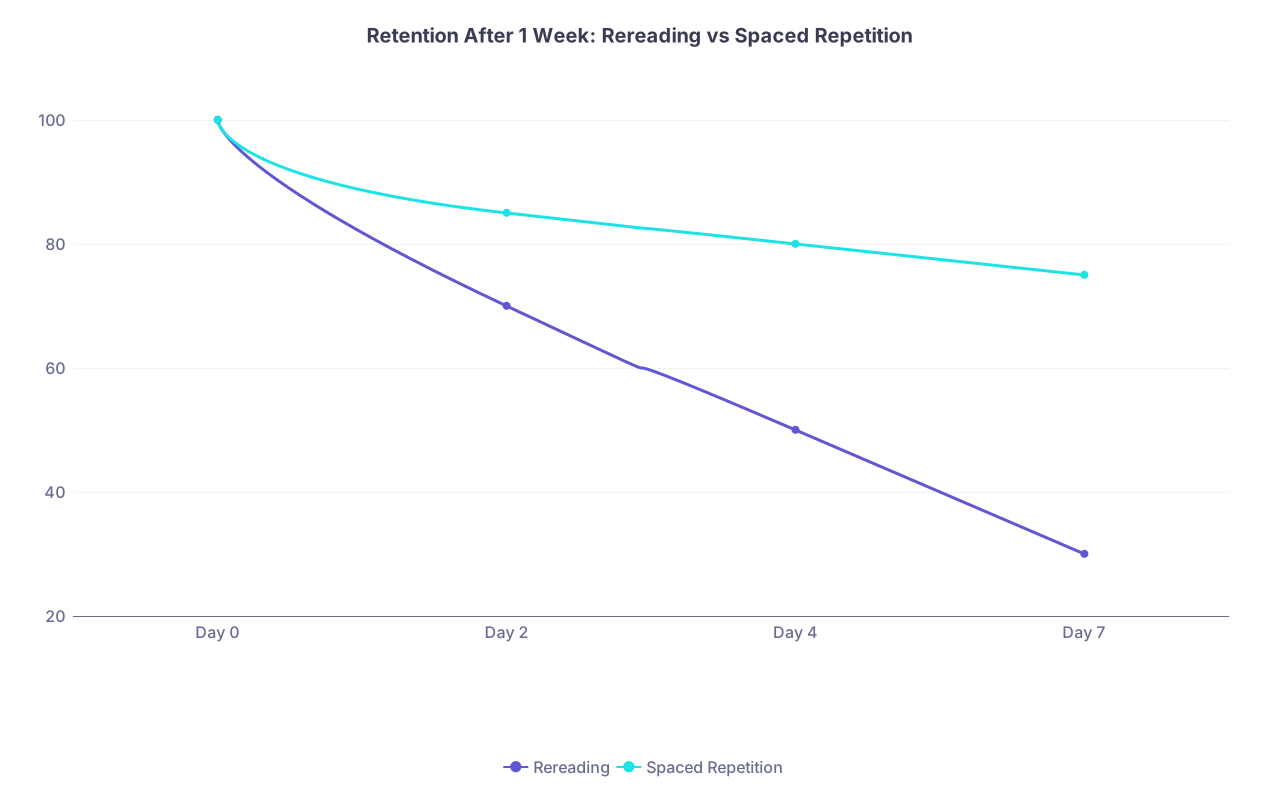
| Category | Rereading | Spaced Repetition |
|---|---|---|
| Day 0 | 100 | 100 |
| Day 2 | 70 | 85 |
| Day 4 | 50 | 80 |
| Day 7 | 30 | 75 |
Numbers are illustrative. The pattern is what matters: rereading falls off a cliff. Spaced retrieval degrades slowly.
Two Sample Study Days: Illusion vs Learning
Student A: “I Study All Day But Forget Everything”
- 9–12: Read cardio in First Aid. Highlight, maybe annotate.
- 1–3: Watch Pathoma cardio again.
- 3–5: Re‑read most of the same section to “really make it stick.”
- 7–9: 20–30 random Anki reviews, half‑heartedly.
Feels busy. Looks like effort. A week later, half of it is gone.
Student B: Less Time, More Score
- 9–10: Fast skim of cardio section in First Aid, 1× speed, just to reorient.
- 10–12: 40 cardio UWorld questions in timed mode.
- 1–2: Carefully review those questions, make 5–10 key cards or un‑suspend from AnKing.
- 2–3: Do 200–250 Anki reviews (across systems).
- 4–5: Targeted reread of 4–5 pages that felt weak (valve disease, arrhythmias, etc.), with active recall pauses.
Less rereading. More remembering.
Visualizing a Balanced Step 1 Prep Approach

| Step | Description |
|---|---|
| Step 1 | Initial Resource Pass |
| Step 2 | Identify Key Facts & Concepts |
| Step 3 | Create/Curate Spaced Repetition Cards |
| Step 4 | Daily Reviews with Honest Recall |
| Step 5 | UWorld/NBME Questions |
| Step 6 | Find Gaps and Misconceptions |
| Step 7 | Targeted Rereading Only |

So, What Actually Helps Step 1 Scores?
Let me be blunt:
- If you’re choosing between only rereading vs only high‑quality spaced repetition, spaced repetition wins for Step 1. Every time.
- In the real optimal plan, rereading is a supporting actor. Spaced retrieval and question banks are the leads.
- The students convinced they “just need one more pass of First Aid” are usually the ones stuck in the 210–230 band despite putting in massive hours.
You do not get extra points for suffering through the same paragraph six times.
You do get extra points for facing the discomfort of not knowing, forcing recall, and letting an algorithm hit you with that weakness five more times over the next month.
The exam is literally a giant spaced retrieval test. Study like you understand that.
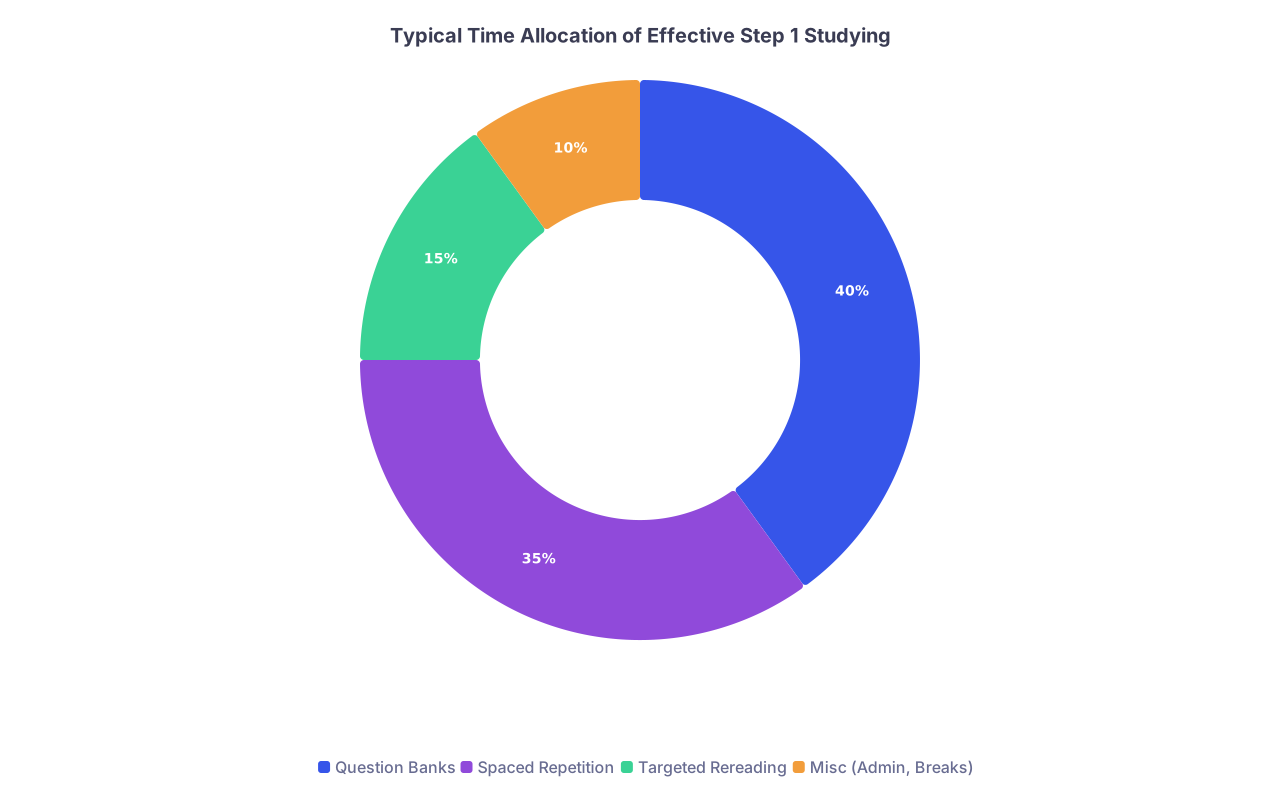
| Category | Value |
|---|---|
| Question Banks | 40 |
| Spaced Repetition | 35 |
| Targeted Rereading | 15 |
| Misc (Admin, Breaks) | 10 |