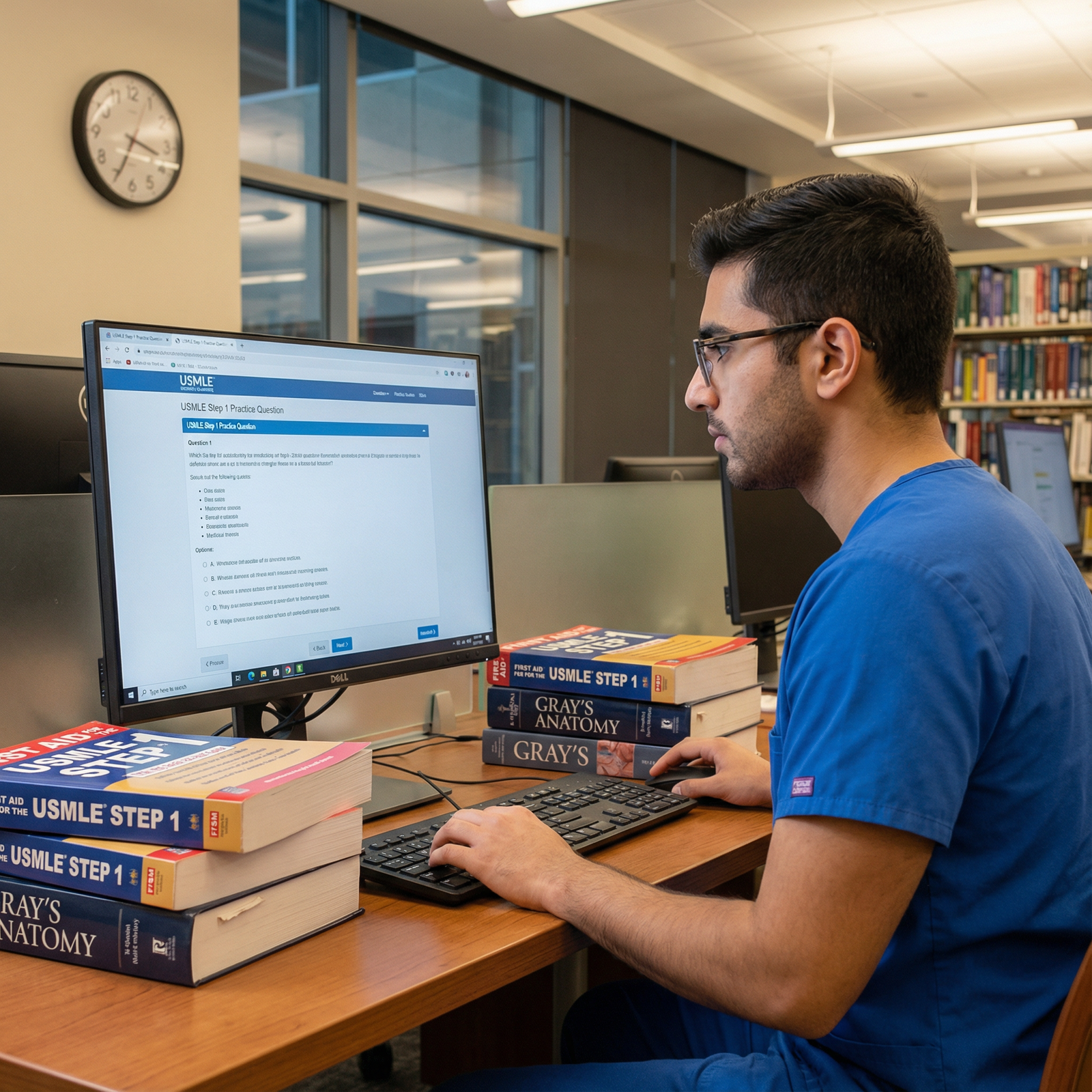
Step 1 Practice Tests: How They Can Transform Your Study Routine
Preparing for USMLE Step 1 is one of the most demanding phases of medical school. The volume of information, the pressure to perform, and the shift toward a pass/fail score have not reduced the exam’s importance—it still heavily influences how solidly you understand the foundations of medicine and how confident you feel entering clinical rotations.
Among all possible study strategies, well-structured use of practice tests is one of the most powerful. When used correctly, practice tests do far more than “check your score”—they shape your learning, sharpen your clinical reasoning, and help you build the psychological and physical stamina needed for test day.
This guide explores how Step 1 practice tests can transform your study routine, with specific, actionable tips you can implement immediately.
Why Step 1 Practice Tests Matter in Modern Test Preparation
1. Accurately Identifying Knowledge Gaps
You cannot fix what you can’t see. Practice tests act like a diagnostic tool for your learning.
How practice tests expose weaknesses:
- Subject-level gaps: You might feel “pretty good” about pharmacology until you see that you’re missing 40% of cardiac pharmacology questions or confusing autonomic drugs.
- System-level gaps: Performance breakdown by system (e.g., cardiovascular, renal, musculoskeletal) reveals where you need targeted review.
- Conceptual vs. memorization gaps: Are you missing questions because you forgot a specific enzyme, or because you never truly understood the underlying physiology?
For example, a medical student might feel comfortable with pathology after finishing a video series, but a practice exam may show consistent errors in renal pathology and glomerular diseases. That data points you directly to where your limited study time will yield the greatest gains.
Actionable tip:
After each practice test, categorize each missed question:
- Didn’t know the fact at all
- Misread the stem or missed a detail
- Knew the concept but misapplied it
- Got distracted by a tempting wrong answer
This classification tells you whether you need content review, test-taking strategy work, or better focus—not just “more studying.”
2. Familiarizing Yourself With USMLE Step 1 Exam Format
Even strong students can struggle if they are surprised by the exam format rather than the content.
Key format features practice tests help you master:
- Clinical vignette style: Long stems with relevant and irrelevant details, mimicking real clinical scenarios.
- Multiple-step reasoning: Questions that require you to move from symptom → diagnosis → mechanism → treatment → side effect.
- Best-answer selection: Often, more than one answer seems partially right; you must choose the single best option.
- Timed block structure: Typically 40-question blocks with a strict time limit.
When you regularly use realistic practice exams, you become desensitized to the length and complexity of the vignettes. The question style stops feeling foreign and becomes predictable, freeing up cognitive bandwidth for actual thinking.
Actionable tip:
Use at least one practice resource (like NBME practice forms or UWorld self-assessments) that mirrors the USMLE interface and pacing as closely as possible. Treat these as “dress rehearsals” for the real USMLE Step 1.
3. Enhancing Long-Term Retention and Recall Through Active Testing
Frequent testing is not just an assessment tool—it is one of the most powerful learning strategies available.
This is known as the testing effect: actively retrieving information strengthens memory much more than passively rereading notes or watching lectures. For a medical student facing thousands of facts, pathways, and associations, this effect is critical.
Why practice tests boost retention:
- Active retrieval: Forcing your brain to pull information without hints makes the memory more durable.
- Error-driven learning: Getting something wrong and then correcting it tends to produce very strong memory traces.
- Spaced reinforcement: When you do repeated practice tests over several weeks, you naturally revisit key topics multiple times.
Instead of cramming entire chapters of biochemistry, doing a block of 40 biochemistry questions and carefully reviewing them may produce more durable learning in less time.
Actionable tip:
Convert your missed questions into spaced review:
- Make Anki or flashcards from the concept tested—not just the specific fact.
- Tag cards by system/topic (e.g., “CV pharm – beta blockers”) so you can revisit them in a structured way.
- Revisit those topics within 24–48 hours for maximum retention.
4. Developing Time Management and Block Strategy
Time is one of the most unforgiving constraints on USMLE Step 1. You might know the material but underperform if you cannot answer efficiently.
Practice tests help you refine:
- Pacing per question (e.g., aiming for ~80–85 seconds per MCQ)
- When to mark and move on
- How to handle long vignettes without panicking
- End-of-block triage (quickly answering remaining questions without overthinking)
Working under timed conditions repeatedly builds your internal clock. You learn what “too long on a question” feels like and how to proceed without mentally spiraling.
Actionable tip:
During practice blocks:
- Note the question number and time at the 10th, 20th, and 30th question.
- If you’re consistently behind, practice strategic skimming: read the last sentence and answer options first, then scan the vignette focusing on relevant data.
5. Building Exam Readiness and Reducing Test Anxiety
Performance on test day depends not just on knowledge but also on your psychological state and stamina.
Repeated exposure to full-length or multi-block practice tests helps you:
- Normalize the feeling of being under time pressure.
- Build confidence in your process, even when you don’t know every answer.
- Develop endurance for sitting, focusing, and thinking for several hours.
By the time you reach your actual USMLE Step 1, you want test day to feel familiar—almost routine. Practice tests are how you build that familiarity.
Actionable tip:
Use at least 2–3 full-length simulations (e.g., NBME forms + multiple UWorld blocks in a day) to practice:
- Waking up at the same time as on exam day
- Eating the same type of breakfast
- Taking breaks similar to Prometric test center schedule
This reduces uncertainty, which is one of the main triggers of anxiety.

How to Incorporate Step 1 Practice Tests Into Your Study Routine
1. Start Earlier Than You Think You Need To
Many students delay practice exams, thinking they must “finish content” first. This often backfires.
Why starting early works better:
- Early practice tests give you a baseline to plan from.
- They reveal weak areas before you sink time into low-yield review.
- They help you learn how to think like the exam from the beginning.
You don’t need to score well on early tests—that’s not the point. Their value lies in the information they provide about your current level.
Suggested timeline (adapt as needed):
- Pre-dedicated (M1/M2):
- 10–20 question blocks 2–3 times per week, related to your current curriculum topics.
- 3–4 months before exam:
- Regular 40-question timed blocks several days per week.
- First NBME practice form to establish baseline.
- Dedicated study period (4–8 weeks):
- 1–2 blocks on most days.
- One longer multi-block exam day every 1–2 weeks.
- 2–4 NBME or self-assessment exams total before test day.
2. Schedule Practice Tests Intentionally
Randomly doing questions is better than doing none—but a structured plan is far more effective.
Blend different practice formats:
- Full-length or multi-block exams (e.g., NBME, UWorld self-assessments):
- Use these every 1–2 weeks in dedicated.
- Track your progress and adjust your study focus.
- Daily or near-daily blocks (30–40 questions):
- Timed and random blocks to simulate real exam conditions.
- Add some “tutor mode” blocks focused on new or particularly weak topics.
- Topic/system-specific quizzes:
- Great for reinforcing what you learned in the last 24–48 hours.
- Useful early in preparation or for targeted remediation.
Sample weekly pattern (during dedicated):
- Mon–Fri:
- 1–2 timed blocks (40 questions each) per day
- 1–3 hours of focused review of those blocks
- Saturday:
- NBME or 3–4 sequential blocks simulating exam conditions
- Sunday:
- Light review, high-yield notes, Anki, and rest
Adjust based on your energy, baseline score, and test date.
3. Review Is Where the Real Learning Happens
Completing questions is only half the work. Deep review is where you gain the most benefit.
How to review Step 1 practice questions effectively:
- Start with wrong answers.
- For each missed question, ask:
- What was the question really asking?
- Which clue(s) in the stem were key?
- What did I misunderstand or forget?
- For each missed question, ask:
- Then review guessed or lucky correct answers.
- If you clicked randomly between two choices and got lucky, treat it like a wrong question.
- Read all explanations (correct and incorrect choices).
- Understand why each distractor is wrong.
- Extract general principles (e.g., distinguishing similar pathologies).
- Summarize into notes or flashcards.
- Focus on patterns, associations, or algorithms:
- “For elderly patient with hip fracture + confusion after surgery, think fat embolism vs. PE and look for X/Y features.”
- Focus on patterns, associations, or algorithms:
- Link back to core resources.
- Cross-reference with First Aid, Pathoma, Sketchy, etc., and annotate or tag those sections.
Time budgeting:
Expect to spend at least as long reviewing a block as it took to complete it. A 1-hour block may require 1–3 hours of review, especially earlier in your prep.
4. Mix Question Formats and Sources Strategically
Different resources present questions in slightly different styles. Using more than one can help you avoid overfitting to a single style.
Common USMLE Step 1 practice resources:
- UWorld
- Highly regarded for realism and educational explanations.
- Best used as a learning tool, not just an assessment.
- AMBOSS
- Strong question bank with integrated library and helpful learning cards.
- Good for adding extra volume or reinforcing weaker subjects.
- Kaplan Qbank
- Often more detail-heavy; helpful for building foundational knowledge.
- NBME Practice Forms
- Best approximations of actual USMLE Step 1 style and scoring.
- Should be spaced throughout your preparation as major checkpoints.
How to mix formats:
- Early and mid-prep:
- Use UWorld/AMBOSS/Kaplan for daily blocks.
- Late prep (last 4–6 weeks):
- Emphasize NBME forms and UWorld self-assessments as your primary gauges of readiness.
- Use other banks for targeted reinforcement.
Getting Maximum Value from Every Practice Test
1. Treat Each Practice Session Like the Real Exam
Your brain and body learn from repetition of context. The more your practice sessions resemble the real exam, the smoother test day will feel.
Simulate real exam rules:
- No phone, no notes, no scrolling social media between questions.
- Strict timing—use the same or slightly shorter block times.
- Sit at a desk with an external keyboard and mouse, if possible.
This “serious” environment trains you to stay focused and reduces surprises at the Prometric center.
2. Simulate Full Exam Conditions at Least Twice
Beyond regular blocks, you should have a few days that closely mimic the full exam:
- Wake up as you plan to on test day.
- Eat the same type of breakfast/snacks you’ll bring.
- Complete several consecutive blocks (e.g., 6–7) with short, scheduled breaks.
- Use noise-canceling headphones or earplugs if you’ll use them on exam day.
This lets you test:
- Your physical stamina and posture.
- Your concentration across multiple hours.
- How your performance changes after fatigue sets in.
If your accuracy drops sharply in later blocks, you can train specifically for endurance—gradually extending the number of blocks you do in a day.
3. Track Your Progress and Adjust Strategically
Raw question volume is not enough. Intentional progress tracking helps you refine your strategy over time.
What to track:
- Scores on NBME forms and self-assessments, with dates.
- Percent correct per subject/system in your Qbanks.
- Common error patterns (e.g., misreading stems, rushing, overthinking).
Use a simple spreadsheet or notebook to log:
- Date
- Type of test (NBME 30, UWSA1, 40Q UWorld block)
- Score / % correct
- Main weaknesses identified
- Specific plan for next week
A clear performance graph is motivating—but even more importantly, it helps you avoid overreacting to a single “bad” day. Look for trends, not isolated data points.
4. Protect Yourself From Burnout: Integrate Self-Care
High-intensity test preparation can quickly become unsustainable. Practice tests are cognitively draining; recovery is part of performance.
Self-care strategies:
- Schedule lighter days after full-length exams.
- Use active recovery: light exercise, walk outside, stretching.
- Maintain basic sleep hygiene—practice tests are far less useful if you’re consistently sleep-deprived.
- Keep at least some social contact; isolation feeds anxiety.
Remember: the goal is to arrive at test day sharp, not exhausted. A sustainable, consistent schedule beats short bursts of extreme cramming.
5. Use Study Groups and Peer Discussion Wisely
Study groups can amplify what you gain from practice questions—if they are focused and efficient.
Effective ways to use groups with practice tests:
- Have each person do the same 20–40 question block independently, then:
- Compare which questions each person missed.
- Discuss reasoning, not just answers.
- Have the strongest person in each area “teach back” the concept.
- Create mini “case conferences” using challenging questions:
- One person reads the stem.
- Group talks through differential diagnosis and reasoning process.
Keep group sessions structured and timed; avoid turning them into venting sessions that consume your day.

Real-World Impact: How Practice Tests Change Outcomes
Many students credit practice tests as the turning point in their Step 1 preparation.
Consider a scenario similar to many real stories:
A second-year medical student started dedicated study with average scores on her first NBME form. Instead of panicking, she used the detailed breakdown to identify that her endocrine and renal physiology were lagging far behind other systems. She spent the next two weeks:
- Doing targeted UWorld/AMBOSS blocks in those subjects
- Reviewing all missed questions meticulously
- Creating focused Anki cards for recurring concepts
On her next NBME, she saw a significant jump in her score, with endocrine and renal moving from major weaknesses to near-average performance. By repeating this cycle—test, analyze, target, repeat—she steadily increased her performance until she was consistently in the passing (and then comfortable) range before exam day.
The key is not just taking practice tests, but learning from them deliberately and iteratively.
FAQ About Step 1 Practice Tests
1. How many practice tests should I take before USMLE Step 1?
There’s no universal perfect number, but a solid target for most medical students is:
- 2–4 NBME practice forms spread over the last 6–10 weeks.
- 2 UWorld self-assessments (UWSA1 and UWSA2) if possible.
- Ongoing Qbank blocks (often totaling 1–2 full passes of a major Qbank like UWorld).
Focus less on hitting a specific count and more on ensuring:
- You see enough questions to expose your weaknesses.
- You have time to thoroughly review each practice test.
2. When should I start taking full-length or multi-block practice exams?
- Baseline NBME:
- Many students take their first NBME 8–12 weeks before their planned test date, even if they haven’t finished all content review.
- During dedicated:
- Plan a full-length or multi-block exam day every 1–2 weeks.
- Last 2–3 weeks before Step 1:
- Space NBME forms and UWorld self-assessments so you have time to review and adjust between them.
Avoid taking a full-length exam in the final 48 hours before your real test; use that time for lighter review and mental rest.
3. How can I review practice test results efficiently without spending all day?
Efficient doesn’t mean rushed; it means structured. To streamline:
- Prioritize reviewing:
- Wrong answers
- Guessed answers that you got right
- For each, write a brief note:
- “Missed because misread age of patient”
- “Confused two similar diseases—need to review distinguishing features”
- Group patterns:
- If you see 5+ misses in the same system or topic, plan a focused mini-review session.
- Use high-yield summaries and core resources:
- Instead of deep-diving textbooks for every missed question, use First Aid, Pathoma, or your main resource to clarify the concept.
Most students find a balance at ~1–3 hours of review for each 40-question block, depending on familiarity with the content.
4. Can I rely solely on practice tests and question banks for Step 1 preparation?
Practice questions are central, but most students benefit from a combination of:
- Qbanks and practice tests (UWorld, AMBOSS, NBME, etc.)
- Core content resources (First Aid, Pathoma, Sketchy, Boards & Beyond, etc.)
- Active recall tools (Anki or another spaced repetition method)
If you find that you are repeatedly missing basic concepts, you likely need more structured content review in addition to question-based learning.
5. How do I know if my practice test scores indicate I’m ready to sit for Step 1?
While every situation is unique, some general guidance:
- Use recent NBME practice exams as your best predictor.
- Look at:
- Your most recent 2–3 NBME scores.
- Whether your scores are stable, rising, or falling.
- For the pass/fail Step 1 era:
- Most advisors recommend sitting for Step 1 when your recent practice scores are consistently at or above the passing threshold (based on NBME norms) with some margin of safety.
If your scores are fluctuating widely or consistently below passing, talk to your academic advisor or dean’s office about whether to postpone, adjust strategies, or revise your timeline.
By weaving practice tests into your study strategy—from early baseline assessments to late-stage full simulations—you turn your preparation into a targeted, data-driven process rather than a vague attempt to “cover everything.” With deliberate use of USMLE Step 1 practice tests, you’re not just chasing a passing score; you’re building strong, clinically relevant knowledge that will serve you throughout your medical career.