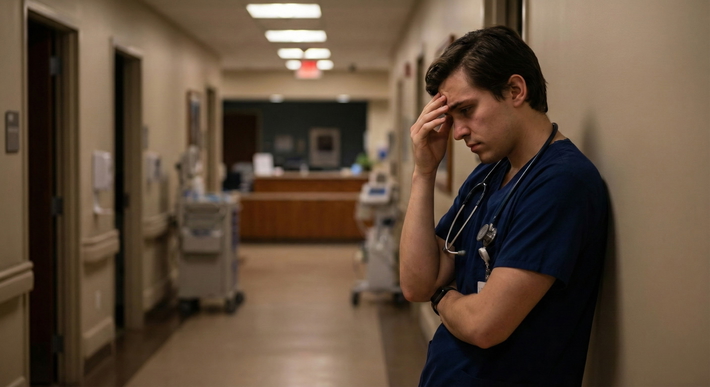
Burnout in medicine is not a character flaw. It is a structural, data-verifiable crisis baked into how we staff, schedule, document, and compensate clinical work. The numbers do not lie, and they have not improved nearly enough despite a decade of hand-wringing. If you are a student, resident, or early-career physician trying to pick a lane that will still feel sustainable at age 45, you need the actual patterns, not the lifestyle folklore.
This article is for educational purposes only. It is not financial advice, not legal advice, and not tax advice. Compensation figures vary by region, contract, and practice model; consult a qualified professional before making career or financial decisions based on any of the patterns discussed here.
Deconstructing the Burnout Epidemic: Data-Driven Realities in Modern Medicine
Let me break this down specifically. Major institutional surveys from Medscape, the American Medical Association, and the AAMC have tracked physician wellness with enough consistency that we can stop treating burnout as an anecdote. These instruments repeatedly return to the same three validated domains first codified by the Maslach Burnout Inventory: emotional exhaustion, depersonalization (that creeping cynicism toward patients), and a collapsing sense of personal accomplishment. When two of the three domains light up at high levels, the physician meets criteria for burnout. That is the metric. Not "I had a rough week."
Year after year the aggregate rate hovers between 40 and 60 percent across U.S. physicians, with sharp specialty-level variation. Medscape's large annual samples and the AMA's organizational surveys both show the same stubborn truth: the distribution is not random. High-acuity procedural fields and high-volume longitudinal fields both score poorly, but for almost opposite reasons. I have sat with these spreadsheets long enough to stop being surprised by the rank order. What still frustrates me is how slowly institutions translate the data into actual schedule and workflow redesign.
The methodology matters. Most of these surveys use multi-item Likert scales administered to tens of thousands of respondents, then stratified by specialty, career stage, gender, and practice setting. Response rates are imperfect, yet the directional signals remain stable across independent data sets. That stability is what allows us to move past "doctors are tired" into precise driver analysis. Emotional exhaustion tracks most tightly with hours and intensity. Depersonalization tracks with loss of meaning and autonomy. Low personal accomplishment tracks with the feeling that the system is grinding clinical skill into clerical output. Hold those three definitions in mind; they reappear in every section that follows.
The Surgical Subspecialty Burden: OR Demands, Culture, and Loss of Autonomy
Surgical culture still romanticizes the grind. The data does not. Neurosurgery, orthopedic surgery, cardiothoracic surgery, and general surgery routinely post some of the highest emotional-exhaustion scores in the entire house of medicine. Extreme procedural hours, relentless call, and the unforgiving nature of intraoperative decisions produce a specific flavor of clinical fatigue that primary care almost never sees.
I have watched junior attendings finish a twelve-hour spine case, take two more consults, then open the EHR at 11 p.m. to finish notes they could not touch between cases. That pattern is not rare. It is structural. Call schedules in many academic and high-volume private groups still operate on legacy models that treat sleep as optional. Intraoperative stress is not abstract; it is the continuous cognitive load of avoiding permanent neurologic injury or catastrophic bleeding while the clock and the room staff both apply pressure. Over years, that load converts into the emotional exhaustion domain of the Maslach inventory at rates that top most other fields.
Culture compounds the hours. Rigid hierarchy and a perfectionist ethos that equates any request for help with weakness delay the moment when early-career surgeons admit they are drowning. Delayed gratification is sold as a virtue, "just get through fellowship", yet the data shows the highest burnout spikes often hit in the first five years of independent practice, precisely when the protection of residency structure disappears and the full weight of RVU targets, malpractice exposure, and partner expectations lands. I have seen talented surgeons quietly reduce their operative volume or leave academic tracks entirely because the combination of physical depletion and loss of schedule control became unsustainable. That is not resilience failure. That is rational exit from a poorly designed system.
The chart above reflects recent AMA-aligned estimates. Neurosurgery's 64 percent is not an outlier; it is the predictable result of case length, emergency volume, and a training pipeline that selects for people willing to tolerate extreme delayed reward. Orthopedics and general surgery sit close behind for the same reasons, moderated only slightly by different call intensities and private-practice escape valves. Urology's slightly lower rate still sits well above many non-procedural fields. These numbers should end any remaining debate about whether "surgeons just love the OR too much to burn out."
The Primary Care Trap: Administrative Overload, EHR Fatigue, and Chronic Panel Demands
Primary care burns people out through a completely different mechanism: death by a thousand clicks and an endless panel of complex, under-resourced patients. Family medicine, internal medicine, and pediatrics post burnout rates that frequently match or exceed the surgical numbers once you stop measuring pure hours and start measuring clerical burden and loss of clinical agency.
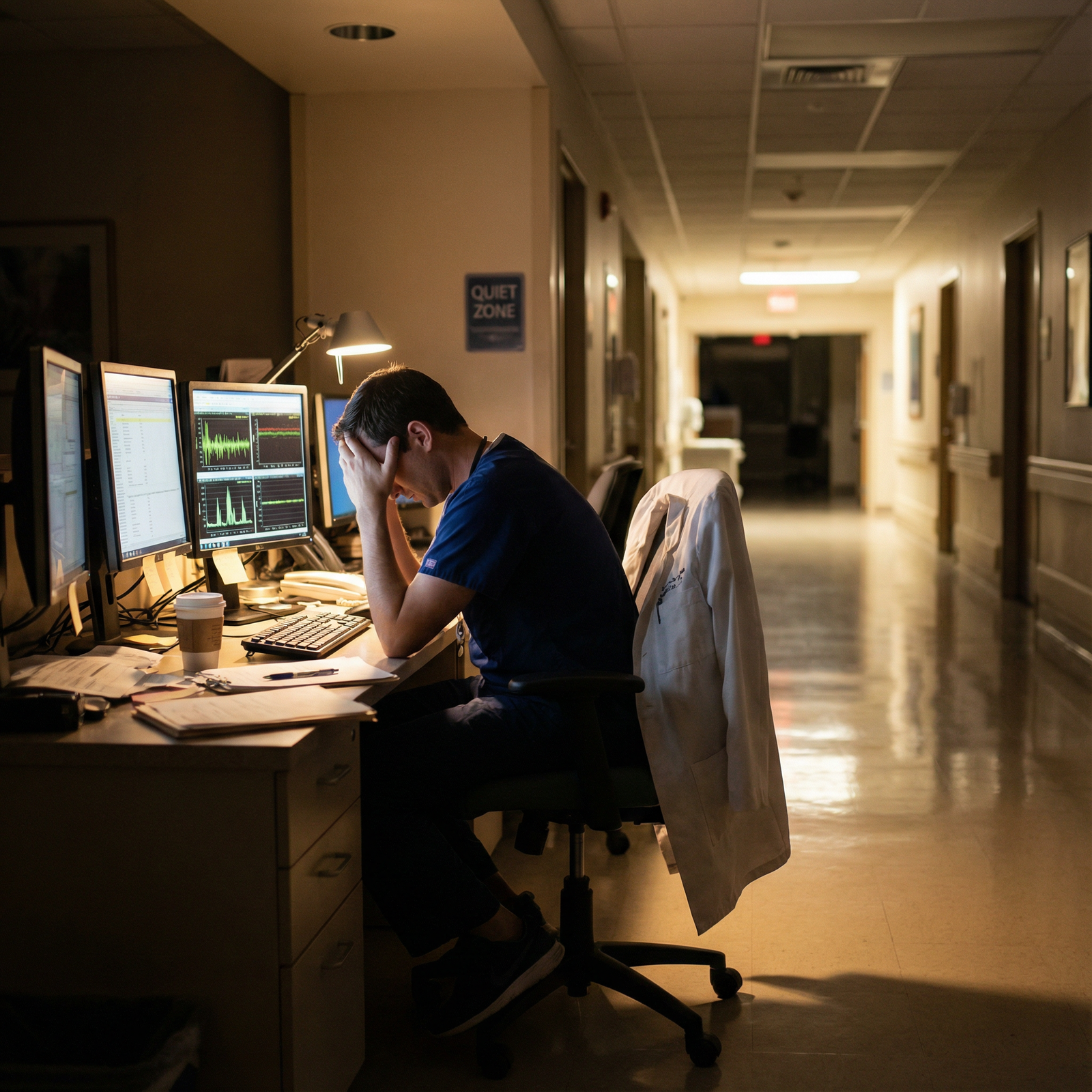
The "pajama time" phenomenon is now quantified. Multiple time-motion and EHR log studies show primary care physicians routinely spending one to two hours of personal time every night finishing documentation, inbox messages, and prior-authorization tasks that the clinic day never allowed them to complete. I have reviewed audit trails where the physician's last chart close occurred at 1:17 a.m. after a full clinic day that ended at 5:30 p.m. That is not dedication. That is unpaid overtime forced by broken workflow design and payment models that still reimburse face-to-face minutes far better than the cognitive work of coordinating multi-morbidity.
Panel demands make it worse. A typical primary care panel of 1,800-2,500 patients includes dozens of individuals with five or more chronic conditions, polypharmacy, social determinants that no fifteen-minute slot can address, and an inbox that refills itself overnight. The psychological toll is the chronic sense that you are always behind and never doing enough for any single patient. Depersonalization scores climb because the system converts the physician into a throughput machine. Low personal accomplishment follows when the doctor realizes most of the day was spent fighting the EHR and insurance rules rather than practicing medicine. Attrition data confirms the pattern: primary care has some of the highest rates of physicians reducing clinical effort or leaving the field before traditional retirement age.
Comparative Analysis: Surgical vs. Primary Care Burnout Drivers
Here is the clean contrast the data forces us to accept. Surgical burnout is driven by acute, high-stakes physical and temporal stressors, long continuous hours, unpredictable emergencies, and the bodily cost of standing in the OR under cognitive load. Primary care burnout is driven by chronic, low-grade administrative and cognitive stressors, EHR pajama time, prior authorizations, panel size that exceeds safe capacity, and the erosion of clinical decision-making by protocols and payers.
Control and autonomy fracture along the same line. Surgeons lose control of their schedules to the OR board, trauma call, and the expectation that complex cases run long. Primary care physicians lose control of their clinical scope to documentation templates, quality metric checkboxes, and prior-authorization bureaucracies that second-guess every expensive prescription or imaging study. Both groups experience autonomy loss; the texture differs.
Compensation models and liability fears amplify both vectors. RVU pressure pushes surgeons toward higher case volumes even when fatigue is already high, because the payment system still rewards procedural throughput. The same RVU logic pushes primary care toward shorter visits and larger panels, which directly feed the administrative overload. Malpractice anxiety sits heavier on the surgical side for obvious reasons, yet primary care carries its own chronic liability drag from missed diagnoses in high-volume settings. None of these incentives were designed with physician longevity in mind. They were designed for short-term productivity. The burnout data is simply the predictable long-term bill.
The grouped comparison is stark. Nearly three-quarters of burned-out primary care physicians point first at bureaucratic tasks. Nearly two-thirds of burned-out surgeons point first at sheer hours. Treat those as different diseases requiring different treatments.
Mitigation Strategies and Structural Intervention Pathways
Yoga, mindfulness apps, and wellness pizza parties are theater. They do not move the needle on population-level burnout scores, and continuing to fund them as the primary response is institutional malpractice. The data demands structural change.
For surgical services the highest-yield levers are OR scheduling reform, protected post-call time that is actually enforced, and reduction of unnecessary overnight call through better triage and advanced practice provider night coverage. Some departments have already cut emotional-exhaustion scores by redesigning block time and eliminating the expectation that every case finishes with same-day complete documentation. It works when leadership treats fatigue as a safety issue rather than a moral failing.
For primary care the evidence is equally clear: scribes or team-based documentation, aggressive inbox reduction protocols, and panel-size caps produce measurable drops in pajama time and burnout scores. Advanced practice providers functioning at the top of license, embedded pharmacists for complex medication management, and EHR optimization that actually removes clicks rather than adding them are not luxuries. They are the minimum required to keep the primary care workforce from further collapse. Institutions that treat these as cost centers rather than retention investments will continue to lose physicians and then act surprised.
Students and residents should treat the specialty-specific data as decision inputs, not destiny. Look past the lifestyle mythology. Ask residency programs for their actual call frequency, average EHR hours outside clinic, scribe availability, and faculty attrition rates. The programs that cannot or will not share those numbers are telling you something. Choose the specialty whose dominant stressors you are structurally equipped to tolerate, then choose the institution that has already started fixing those stressors. The alternative is joining the next cohort of burned-out statistics.
Burnout is not distributed equally. Surgical subspecialties and primary care both post high rates, yet the engines are fundamentally different: acute time and physical demand on one side, chronic administrative and cognitive demand on the other. Surgical burnout tracks hours, hierarchy, and intraoperative load. Primary care burnout tracks pajama time, panel overload, and bureaucratic erosion of clinical work. Superficial wellness programming fails because it never touches those drivers. Only systemic workflow redesign and honest institutional accountability change the curves. Use the data. Make the choice with open eyes.