
What happens when the “I can push through one more rotation” mindset quietly turns you into the unsafe doctor you swore you would never become?
You think you are just tired. You are not. You are cognitively impaired. Ethically compromised. And you will not notice it until something goes wrong.
Let me be blunt: ignoring sleep debt is one of the most common, most dangerous, and most preventable errors interns make in their work‑life balance. It masquerades as dedication. It is actually negligence—toward yourself and your patients.
The Myth That Destroys Interns: “I’ll Catch Up Later”
Every July I see the same pattern.
Fresh interns, still high from the white coat ceremony, say the same lines in the call room:
- “I can work on 4 hours. I did this in med school.”
- “I’ll catch up after this rotation.”
- “Everyone here is tired. I can’t be the weak one.”
That thinking is how sleep debt sneaks in and sets up permanent residence.
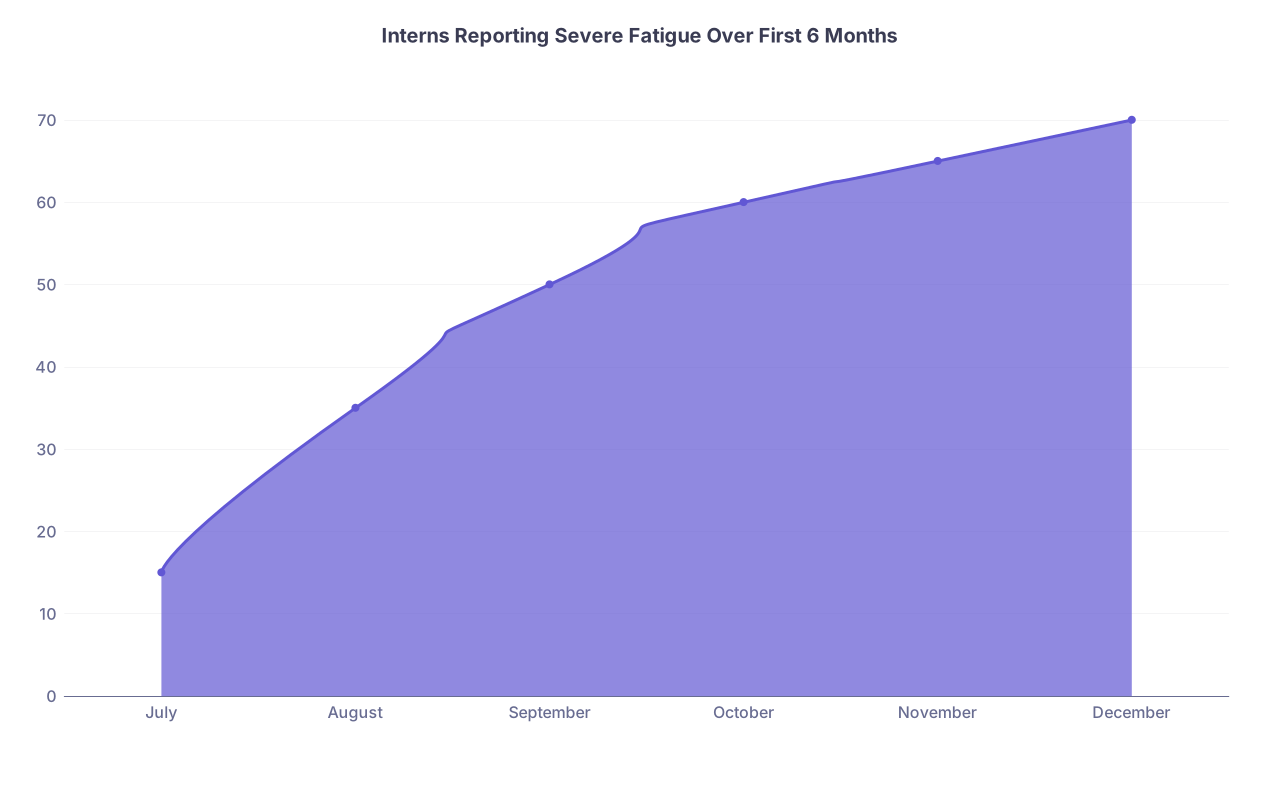
| Category | Value |
|---|---|
| July | 15 |
| August | 35 |
| September | 50 |
| October | 60 |
| November | 65 |
| December | 70 |
Here is the mistake: you treat fatigue as a feeling instead of a measurable impairment.
You know the literature. Cognitive performance after 17–19 hours awake is roughly equivalent to a blood alcohol level of about 0.05%. Stay awake 24 hours and you are around 0.1%. Yet you would never drunk‑round, drunk‑prescribe, drunk‑consent a patient. But you will do all of those sleep‑drunk and call it “being a good team player.”
You are not a hero for functioning on fumes. You are a liability.
The core myth: “I’ll pay this back later.” Sleep debt does not pay back cleanly. A week of 4–5 hour nights cannot be fixed with one weekend of 10‑hour sleeps. Your reaction times, executive function, and emotional regulation remain impaired longer than you realize.
And medicine punishes lagging cognition. Quietly. Then all at once.
How Sleep Debt Actually Damages You (Not Just “Makes You Tired”)
Do not reduce this to “I feel sleepy.” This is what you are really doing when you ignore mounting sleep debt.
1. You Become Bad At The Exact Tasks You Think You Are Handling
High‑sleep‑debt interns are not just slower. They are worse at:
- Medication calculations
- Cross-checking allergies
- Catching subtle vital sign trends
- Communicating clearly on the phone at 3 a.m.
Your brain starts defaulting to habits and shortcuts instead of deliberate thinking. That is when confirmation bias and anchoring errors explode.
I have watched an otherwise excellent intern:
- Miscalculate a heparin drip because they “had done it a hundred times” and did not recheck.
- Sign off on a potassium order without noticing the patient’s creatinine had tripled.
- Miss that a patient had already received a dose of insulin from the day team, and ordered another, because they were too tired to scroll back far enough in the MAR.
None of these felt like “big” mistakes in the moment. They felt like routine tasks. That is the trap: you feel normal enough to trust yourself while your accuracy is quietly deteriorating.
2. Your Emotional Fuse Gets Short—Then Disappear
Sleep debt does not just hit your attention. It wrecks your empathy and your temper.
You start:
- Snapping at nurses for “bothering you” with questions that are actually appropriate
- Getting irritated with patients who ask you to repeat explanations
- Feeling intense resentment when co‑interns sign out borderline‑sick patients
You rationalize it: “I’m just stressed.” No. You are sleep‑depleted and emotionally dysregulated.
From an ethics standpoint, this is serious. The duty of beneficence and respect for persons does not vanish at 3 a.m. But your capacity to live those values tanks when you are carrying a chronic sleep deficit.
3. Your Learning Curve Flattens Out
Big hidden cost: you think you are “grinding” and “absorbing everything,” but your ability to encode new information collapses with chronic short sleep.
You attend a noon conference you barely remember. You pre‑round but cannot recall physical exam nuances a week later. Teaching points from attendings evaporate.
That is not lack of effort. That is hippocampal function short‑circuited by sleep deprivation. You are spending your most valuable training year… not really learning as much as you think.

The Ethical Problem No One Wants To Say Out Loud
Work‑life balance for physicians is not just a wellness buzzword. It is an ethical obligation. And sleep sits at the center of that.
Sleep debt puts you squarely in conflict with:
- Non‑maleficence: You are more likely to cause harm by error.
- Beneficence: You are less capable of providing high‑quality care.
- Respect for autonomy: You may rush or poorly explain consent discussions due to fatigue.
- Professionalism: You show up emotionally unreliable and cognitively dulled.
You would never say, “I’m going to skip hand hygiene because I’m busy; it is part of the job.” Yet you will say, “I’ll just push through this week on 3–4 hours; that’s what internship is.”
Same logic error: normalizing risk because everyone else is doing it.
I have heard interns say, “But the ACGME duty hour rules protect us.” No. They “protect” you on paper. In reality, you can legally hit 80 hours/week averaged, with long calls, commute, charting at home, and early pre‑rounds that no one counts. Your actual waking hours balloon far beyond anything compatible with consistent, restorative sleep.
The moral failure is pretending that is optional self‑care instead of an integral part of safe practice.
Red Flags: When Your Sleep Debt Has Crossed The Line
You will not feel some dramatic milestone where you say, “Now I’m truly impaired.” So you need objective red flags.
If 3 or more of these are true most weeks, you are not just “tired.” You are in a danger zone.
- You regularly cannot recall details from morning signout that happened 1–2 hours earlier.
- You reread the same note or order screen multiple times and still cannot process it.
- You drive home and do not remember parts of the trip.
- You need caffeine just to avoid a headache, not for mild alertness.
- You fall asleep unintentionally (sitting at the computer, during conference, in the bathroom).
- You are more sarcastic, impatient, or detached with staff and patients than your baseline.
- You make more small documentation errors (wrong side, wrong time, incomplete plans).
- You feel mild vertigo or “brain fog” even on lighter days.
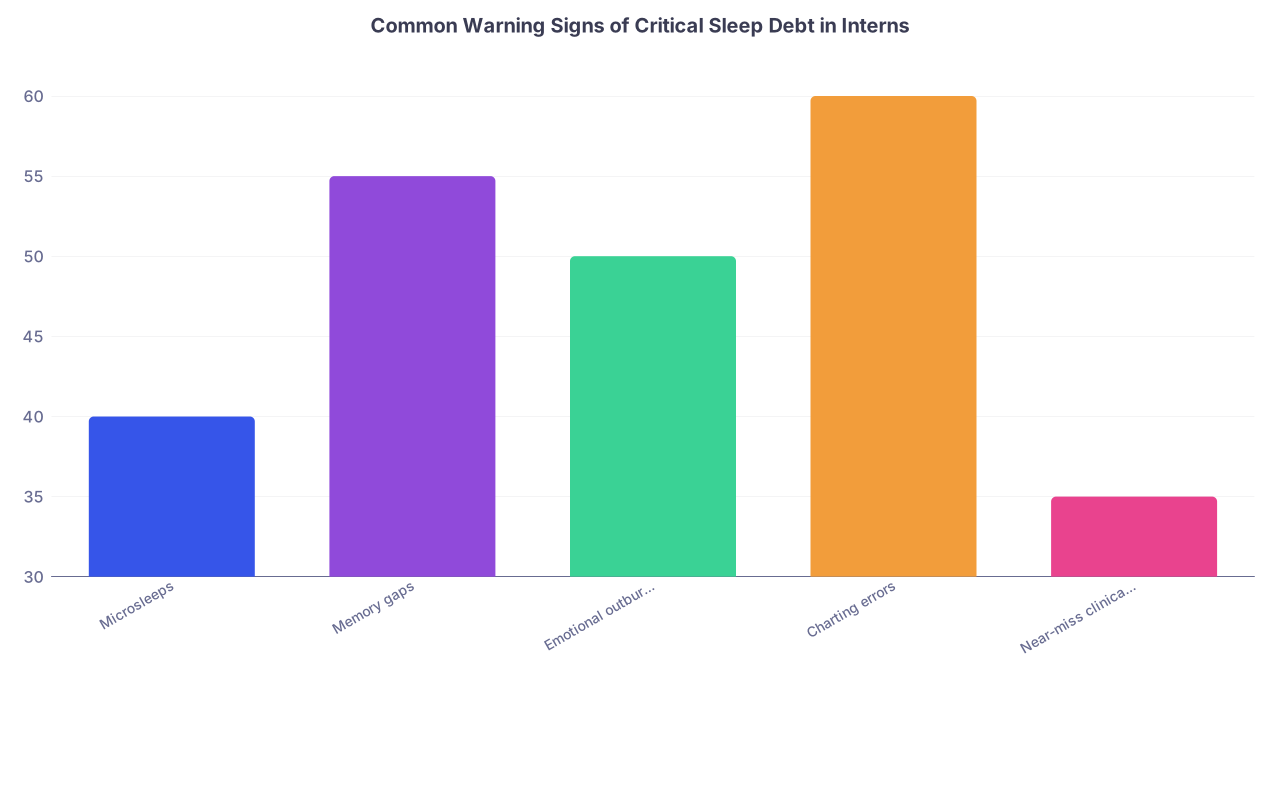
| Category | Value |
|---|---|
| Microsleeps | 40 |
| Memory gaps | 55 |
| Emotional outbursts | 50 |
| Charting errors | 60 |
| Near-miss clinical errors | 35 |
If you recognize yourself here and your response is, “That’s just internship,” you have already normalized dysfunction. That is the culture talking, not good judgment.
Work-Life Balance Does Not Start With Yoga. It Starts With Sleep
People jump to “self‑care” nonsense: gym memberships, mindfulness apps, journaling. Fine. But those are accessories. The foundation of work‑life balance in residency is simple and obnoxiously unsexy: protected sleep.
You will not meditate your way out of a 20‑hour awake period.
Let me be specific about mistakes I see interns make around sleep—and what to do instead.
Mistake #1: Treating Post‑Call as “Bonus Free Time”
Classic error: You walk out post‑call at 1 p.m. after being up most of the night. Instead of going directly home to sleep, you:
- Go to brunch with co‑interns
- Run errands “because this is my only free afternoon”
- Try to study for boards
- Doom scroll until 6 p.m. on your couch
Then you crash hard at 7 p.m., wake at 1 a.m., and your sleep schedule is wrecked for the next three days.
Better: Treat post‑call like jet lag triage.
- Go home. Darken your room. Sleep 3–5 hours.
- Set an alarm so you do not sleep until 10 p.m.
- Wake, light snack, low‑key activity, then regular bedtime closer to your usual night sleep.
You are not “wasting your day.” You are making the next week survivable.
Mistake #2: Stacking Extra Work On Top Of Long Rotations
Another trap: During ICU, wards, or nights, you decide this is the perfect time to:
- Start a major research project
- Take on extra moonlighting
- Agree to every committee your PD mentions
- Prep for a board exam like it is a dedicated study period
You try to grow your CV while your sleep is already collapsed. That is how people get seriously depressed, burned out, or physically ill by winter of intern year.
Pick one: either you are in survival mode rotation (goal: safe care + basic learning + baseline sanity) or it is a lighter month where you can layer extra projects. Do not pretend you can run both categories at 100% simultaneously without paying the debt somewhere.

Mistake #3: Wasting the “Easy” Sleep You Actually Have
Interns often throw away the sleep they could get.
Common self‑sabotage moves:
- Staying up late on golden weekends to “feel like a real person”
- Binge‑watching shows on call nights when there is a lull instead of taking a 30–60 minute nap
- Scrolling in bed for 45 minutes after getting home because your brain is “buzzing”
Your schedule will already steal large blocks of sleep from you. Do not donate the rest voluntarily.
Concrete guardrails that actually help:
- Hard cut‑off times: decide a non‑negotiable “screens off” time, especially on pre‑call nights.
- Use micro‑naps: a real 20–30 minute nap at 3 a.m. on a quieter night can salvage your brain for morning rounds.
- Do not swing your sleep schedule more than 2–3 hours between workdays and days off. Your circadian rhythm is already battered; do not make it chaos.
The “System vs Personal Responsibility” Trap
Yes, residency structures are flawed. Yes, duty hours and staffing could be better. But here is where interns make a subtle but dangerous error: using systemic dysfunction as an excuse to ignore the parts that are still under their control.
You cannot:
- Redesign the call schedule next week
- Magically staff another night float resident
- Rewrite your program’s culture solo
But you absolutely can:
- Stop bragging about how little you slept
- Refuse to volunteer for unnecessary extra shifts when your fatigue is mounting
- Admit to your senior or chief, “I am dangerously tired. I need a quick nap or backup on this admission.”

| Step | Description |
|---|---|
| Step 1 | End of Shift |
| Step 2 | Use time for personal tasks or light study |
| Step 3 | Prioritize 3 to 5 hour recovery sleep |
| Step 4 | Ask for ride or rest more |
| Step 5 | Return to work with caution |
| Step 6 | Slept less than 5 hours last night |
| Step 7 | On service again within 24 hours |
| Step 8 | Feel safe to drive and work |
The ethical move is not to suffer in silence and hope you do not hurt anyone. The ethical move is to acknowledge fatigue as a real clinical risk factor and treat it like any other risk.
“I do not want to seem weak” is not a justification that will matter much if fatigue contributes to a disastrous error.
Practical Guardrails That Actually Work
Let us talk concrete, not aspirational.
Set Minimum Sleep Floors, Not Ideal Targets
You will not always get 8 hours. But you can set a non‑negotiable floor. For example:
- “I do not allow myself to run below an average of 6 hours for more than 3 consecutive days.”
- “If I hit two nights of <5 hours, I will sacrifice optional plans on day three to recover some sleep.”
Not perfect. But far better than unconsciously sliding into 4‑hours‑a‑night as your new normal.
| Situation | Minimum Sleep Goal | Trade-off Example |
|---|---|---|
| Regular wards week | 6 hours/night | Skip late TV or social plans |
| ICU / heavy call week | 5 hours/night avg | Defer research and extra tasks |
| Post-call day | 3–5 hour nap | Reduce errands and social time |
| Golden weekend | 7–8 hours/night | Limit late nights to one |
Use Your Team—That Is Not Weakness
You are not the only one responsible for safety.
On a brutal night when you are clearly slowing down:
- Ask your senior to double‑check key orders for high‑risk meds (insulin, heparin, pressors).
- Swap a cross‑cover task if your co‑intern is currently more rested and you are at the edge.
- Say, “Can we quickly run through this plan together? I am really tired and do not trust my brain fully right now.”
That is professionalism, not fragility.
Protect the Commute Like It Is a Clinical Procedure
Interns dangerously underestimate drowsy driving.
Red flags you should treat like positive troponins:
- You find yourself blinking heavily at stoplights.
- You “snap back” and realize you zoned out on the highway.
- You cannot remember the last few turns you took.
You would never let a colleague scrub into a long case after three vodkas. Yet people will watch an intern, post 28‑hour call, pick up their car keys and say nothing.
If you are unsafe to drive:
- Nap at the hospital for 30–60 minutes before leaving, even if it delays you getting home.
- Ask a co‑resident for a ride; Uber/Lyft is cheaper than a crash.
- Programs: some will reimburse or support this. If yours does not, be the person who asks why.
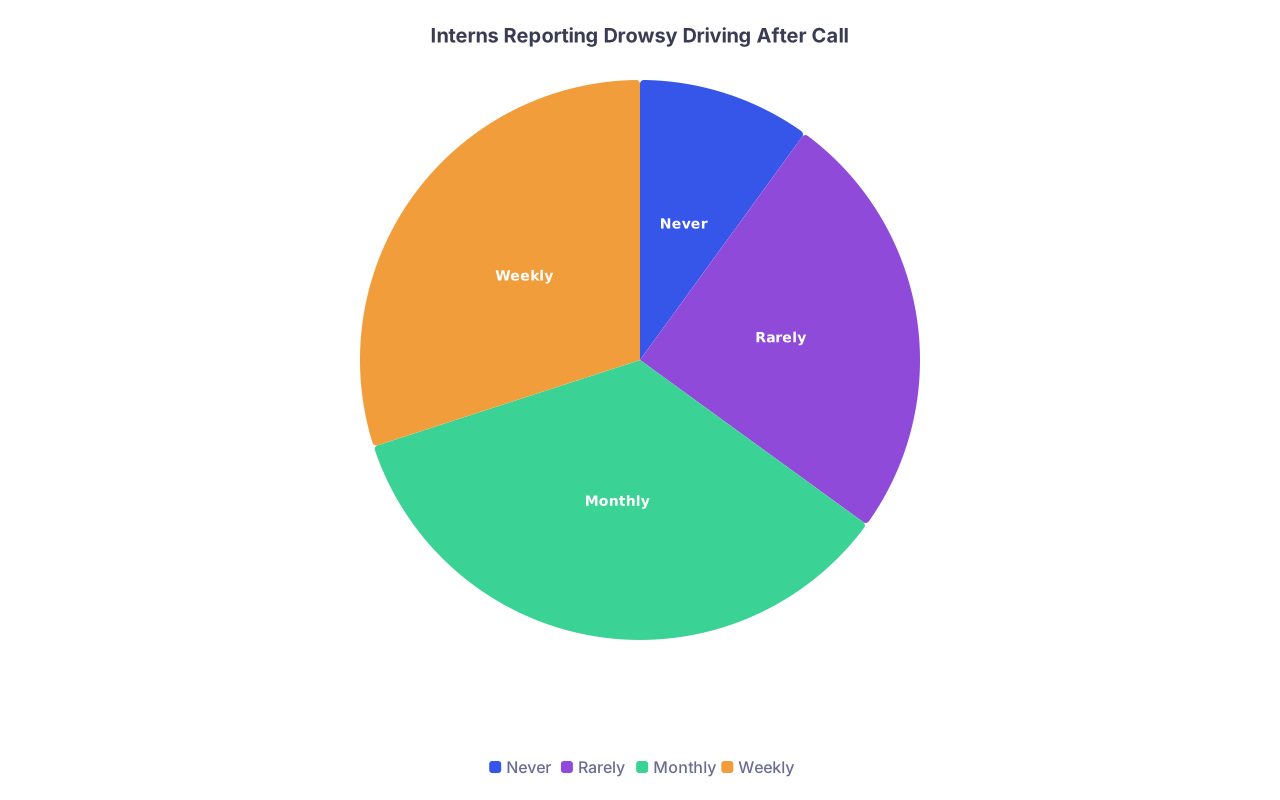
| Category | Value |
|---|---|
| Never | 10 |
| Rarely | 25 |
| Monthly | 35 |
| Weekly | 30 |
The Long-Term Damage You Will Regret Later
Short term, you feel tired. Long term, chronic sleep debt during training contributes to:
- Burnout that starts in residency and never fully recovers
- Persistent mood disorders (anxiety, depression)
- Cardiovascular and metabolic risk that shows up years later
- A warped relationship with work where suffering feels normal and rest feels guilty
Down the line as an attending, most people do not say, “I regret not reading one more article as an intern.” They say, “I regret how many years I accepted being exhausted, irritable, and half‑functioning as my baseline.”
And some, privately, will say, “I still think about that one case. I was so tired. I do not know if I would have missed it otherwise.”
You do not want to be in that group.