
You are not being a “team player” if you are quietly destroying yourself with endless extra shifts. You are being exploited—sometimes by others, sometimes by your own guilt.
Let me be blunt: the culture of reflexively saying yes to extra coverage is burning people out, compromising patient care, and eroding your long‑term career before you even realize what happened. I have watched good residents go from engaged and sharp to hollow-eyed and error‑prone in a single year because they could not or would not say one small word: no.
This is not just about work–life balance. It is about ethics, safety, and the difference between being reliable and being reckless.
The Seduction Of “Just One More Shift”
There is a predictable pattern. I have seen it in medical students, interns, attendings, nurses, and advanced practice providers:
- “Can you cover one more night? We are desperate.”
- “You are the only one I can ask.”
- “You do it so well; the team really trusts you.”
- “It’s just this weekend. Next month will be lighter.”
You tell yourself it is temporary. You rationalize: it is good money, it looks dedicated, your colleagues will remember you helped.
They will remember. But not the way you think.
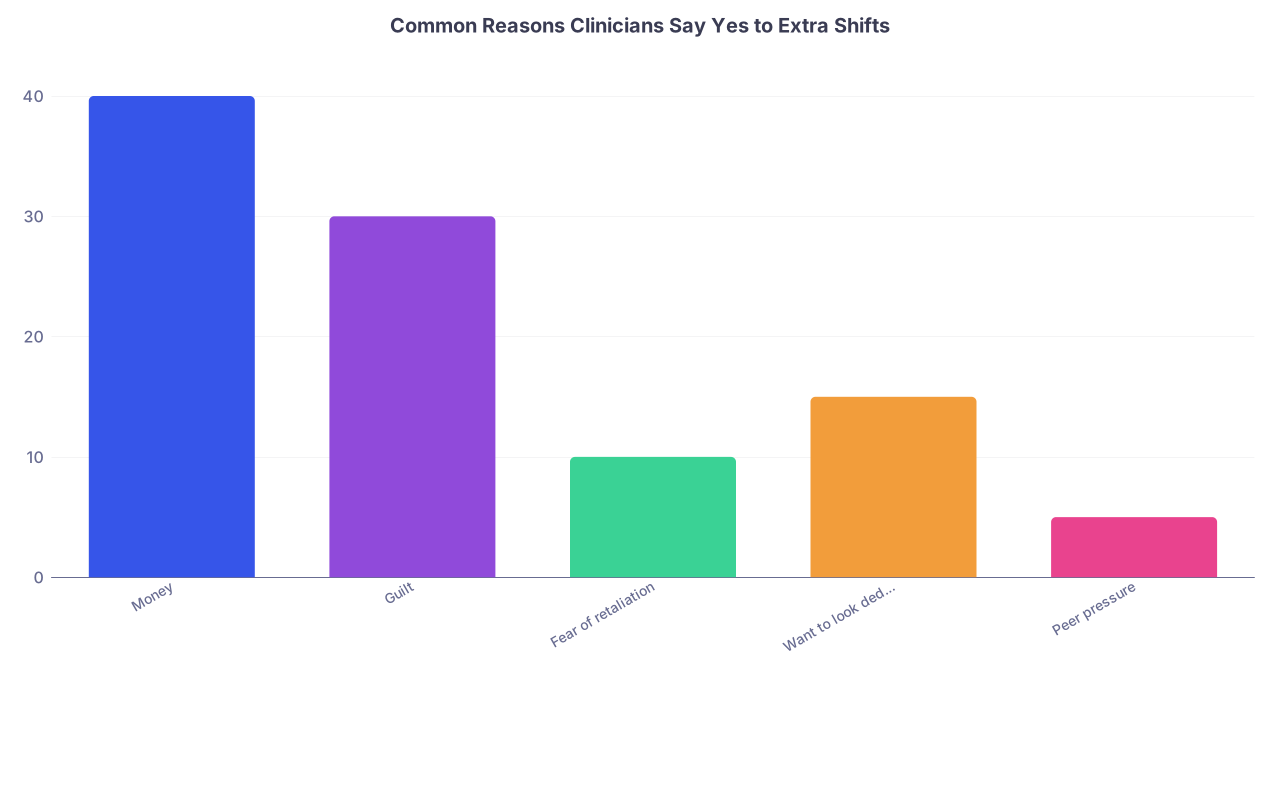
| Category | Value |
|---|---|
| Money | 40 |
| Guilt | 30 |
| Fear of retaliation | 10 |
| Want to look dedicated | 15 |
| Peer pressure | 5 |
The big early mistake is assuming:
- Extra shifts are neutral if you “feel okay.”
- Saying yes is always professionally rewarded.
- The main risk is just “feeling tired.”
All three are wrong.
Fatigue is cumulative. Reputation is shaped by patterns, not intentions. And the real risk is not your tiredness; it is your judgment under that tiredness.
I have heard an ICU fellow quietly say at 3 a.m., “I would never have admitted this patient to the floor if I was on normal rest.” That is the ethical gut punch most people ignore.
The Ethical Line You Are Crossing Without Noticing
Here is the piece almost nobody names out loud: saying yes to too many extra shifts is not just unwise. It can become an ethical failure.
1. You are degrading your clinical judgment
Sleep deprivation is not a character flaw. It is a performance‑limiting condition. After a certain point, it does not matter how “hard‑working” you are. Your brain is operating like someone mildly intoxicated.
There is data on this that should make you uncomfortable:
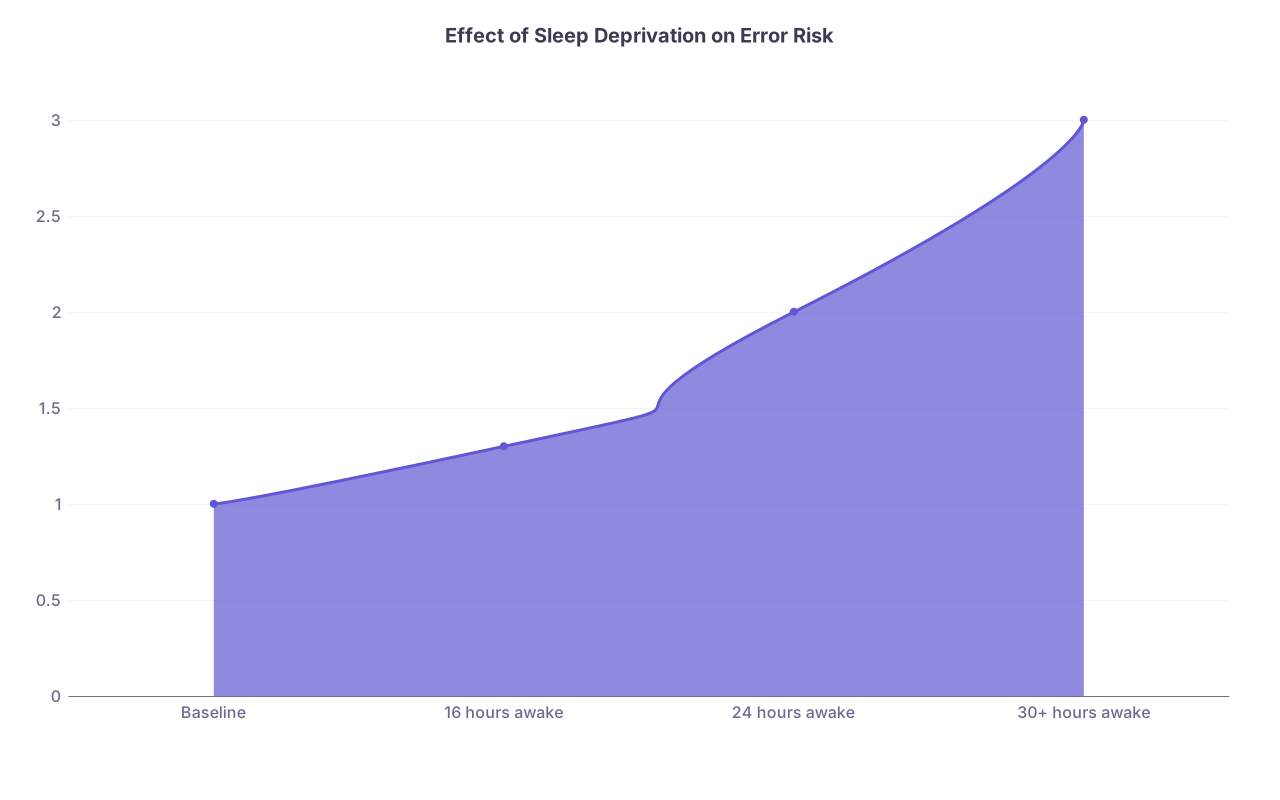
| Category | Value |
|---|---|
| Baseline | 1 |
| 16 hours awake | 1.3 |
| 24 hours awake | 2 |
| 30+ hours awake | 3 |
Those “just a bit slower” decisions? They are real. That second you hesitate on a critical lab. The order you mean to sign but forget. The med you intended to double‑check but did not because a nurse called you about something else. That is how serious errors are born.
If you knowingly put yourself into shift after shift in a compromised state, the question becomes uncomfortable: at what point are you choosing professional heroics over patient safety?
2. You are normalizing unsafe staffing
Hospitals and groups watch what you tolerate.
If leadership learns: “We can always plug gaps because people will pick up extra,” guess what happens to staffing models next year? The “hero” who always says yes trains the system to depend on overwork instead of adequate hiring.
You think you are rescuing your colleagues. Sometimes you are just shielding the institution from feeling the pain of unsafe staffing. And when systems do not feel pain, they do not change.
3. You are modeling dysfunction to juniors
Attendings: when you tell residents, “I picked up 7 extra shifts this month; that’s what it takes,” do not be surprised when they mirror that behavior. They think that is what success looks like. They learn that self‑sacrifice at all costs is the expectation.
Residents: when MS4s see you brag about working 90–100 hours “no problem,” you are teaching them to ignore their own limits. That is not mentorship. That is contagion.
The Psychological Traps That Keep You Saying Yes
You are not an idiot. So why do you keep agreeing?
Because you are falling into a set of predictable traps.

Trap 1: Guilt disguised as professionalism
The classic line: “If I do not cover, the patients will suffer.”
Notice the mental sleight of hand. You are quietly asserting that:
- You overworked and sleep‑deprived are better than
- A rested colleague from another team, a locum, or forcing the department to fix scheduling.
Sometimes coverage really is thin. But very often you are just taking on responsibility that belongs to the system.
A more honest statement: “If I do not cover, leadership will be forced to feel some discomfort and actually address the problem.”
Trap 2: Fear of retaliation
“I will be penalized if I say no.”
This fear is not always imaginary. Some chiefs do track who “steps up.” Some groups truly punish boundaries. But you need to sort real consequences from imagined ones.
- Explicit threats about evaluations or partnership.
- You are the only one consistently asked.
- People shame you when you decline.
That is a toxic environment. Staying and endlessly saying yes will not fix it. It will slowly erase you.
Imagined or exaggerated fears:
- “They will think I am lazy.”
- “I will not be seen as committed.”
- “What if they do not like me as much?”
Here is the hard truth: the people who truly respect you long‑term respect clear boundaries and consistency, not self‑destruction.
Trap 3: Identity wrapped in being “the reliable one”
Some of you get a hit of purpose from being the person everyone comes to: “You always help. You never say no. You are a rock.”
That sounds flattering. Until you realize you have trained everybody to bypass other options and go straight to you.
Ask yourself: if I stopped saying yes, who would I be? If that question makes you uneasy, you are not just covering shifts. You are propping up your identity.
Trap 4: Short‑term money, long‑term cost
Yes, the extra pay matters. Especially with loans, kids, or supporting family.
But I have watched too many people ignore the hidden price:
- Increased errors and the legal/emotional cost that follows.
- Health breakdowns that force unplanned time off.
- Marriages strained beyond repair.
- Burnout so severe they switch specialties or leave clinical work entirely.
| Choice | Short-Term Outcome | Long-Term Risk |
|---|---|---|
| Say yes to every open shift | Higher paycheck | Burnout, health issues, mistakes |
| Selective extra coverage | Some extra income | Sustainable performance |
| Routinely decline extras | Less immediate money | Better health, fewer errors |
That “one more” $1,000 shift can quietly grow into $50,000 of therapy, lost productivity, and permanent cynicism.
How Always Saying Yes Warps Your Career
Let me show you how this plays out over 3–5 years. Because the damage is not obvious in month one.
Reputation: not what you think you are building
You think you are building a reputation as:
- Dedicated
- Reliable
- Team‑first
And at first, you are.
Then the whispers start:
- “She is always here. She looks exhausted.”
- “His notes are getting sloppier.”
- “She is making more small mistakes lately.”
- “He seems burned out. Short with staff.”
I have heard faculty quietly decide not to recommend someone for leadership because “they take on too much; I am not sure they have judgment about limits.” That is how your yes‑to‑everything pattern gets rebranded as a liability.
Academic and professional stagnation
Extra shifts often cannibalize the time you swore you would use for:
- Research projects
- Teaching prep
- Quality improvement work
- Studying for boards
- Networking and conferences
A resident once told me, “I thought the extra moonlighting would help me get ahead. Instead, I dropped my Step 3 score, lost research time, and had nothing to show on my CV except ‘worked a lot.’” That is not uncommon.
The departments that promote people are usually not tracking “most shifts picked up.” They are tracking:
- Scholarship
- Leadership
- Quality outcomes
- Teaching
If your fatigue is erasing the energy for those, you are sabotaging your future for short‑term gain.
Home life: the slow erosion
I am not going to write a long sentimental paragraph about family. Let us be blunt:
- Kids notice.
- Partners keep score.
- Friends stop asking because you are “always working.”
The danger is not one bad month. It is a multiyear pattern of “just this next stretch is crazy,” over and over, while the people in your life quietly adjust around the reality that work always wins.
By the time you wake up to it, the resentment is not fixable with one lighter month.
Red Flags You Are Already Paying Too Much
You do not need a wellness committee to diagnose this. Start with these questions. If you are nodding to several, you are already beyond healthy limits:
- You cannot remember the last full day you had truly off, without charting or calls.
- You routinely sign up for extra coverage before you know your actual energy level that week.
- You are more irritable with nurses, techs, or your own family than you used to be.
- You make small, embarrassing mistakes—wrong dose typed but caught, notes with obvious errors, orders unsigned overnight.
- You have started saying things like, “It is only 24 hours; I can survive anything.”
- People have commented that you “look tired” so often it annoys you.
- You feel trapped: you do not see a realistic way to step back without everything collapsing.
That last one is the most dangerous. Feeling trapped is the breeding ground for burnout, moral injury, and eventual disengagement from the profession entirely.
How To Say No Without Burning Bridges
Let us get practical. You need scripts and structure, not vague advice to “set boundaries.”
Step 1: Decide your hard limits before you are asked
If you wait until you are put on the spot, guilt wins.
Define in advance:
- Maximum number of extra shifts per month.
- No‑go zones (e.g., post‑night float, post‑stretch of call, exam study weeks).
- Protected times (family events, birthdays, critical personal appointments).
Write it down. Treat it like a non‑negotiable clinical policy.
Step 2: Use short, firm, boring refusals
You do not owe a dramatic explanation. Over‑explaining invites negotiation.
Examples that work:
- “I cannot safely add more shifts this month.”
- “I am at my maximum for extra coverage right now.”
- “I have other commitments that I cannot move.”
- “No, I am not available to cover that night.”
Notice the structure: clear, brief, no apology for having limits.
If they push: “I understand you are short. I still cannot safely take that on.”
Step 3: Offer bounded alternatives only if you truly want to
If you want to help but not at the requested level, you set the boundary:
- “I cannot do a full 24‑hour call, but I can help with 4 hours in the evening.”
- “I cannot cover this weekend, but I could take an extra clinic half‑day next month.”
If that does not work for them, fine. You are not responsible for making every problem solvable.
Step 4: Document patterns, especially if you suspect coercion
If you feel subtle punishment for saying no, start keeping a simple log:
- Date, who asked, what they asked for, your answer.
- Any explicit or implied retaliation.
Why? Because if the situation escalates—unfair evaluations, exclusion from opportunities—that record protects you when you escalate to GME, HR, or leadership.
When Saying Yes Is Reasonable (And How Not To Let It Spiral)
I am not telling you to become rigid and selfish. Medicine requires some give.
There are times when saying yes is reasonable:
- A colleague has a real emergency (illness, death in the family).
- A true one‑off catastrophe: multiple people out, disaster circumstances.
- You are early in training and want some carefully chosen extra exposure.
The mistake is turning those exceptions into your baseline.
If you choose to help:
- Acknowledge it as an exception. Say it out loud: “I can take this one, but I will not be able to keep doing this regularly.”
- Log it for yourself. So when you feel pressured next time, you can remember how much you have already done.
- Balance it: if you pick up an extra shift this week, protect time later. Do not let the “next time” never come.

| Step | Description |
|---|---|
| Step 1 | Asked to cover extra shift |
| Step 2 | Say no firmly |
| Step 3 | Say no to reset expectations |
| Step 4 | Consider saying yes with clear boundary |
| Step 5 | Within your preset limits |
| Step 6 | Are you rested and willing |
| Step 7 | True one off or pattern |
Protecting Your Future Self (And Your Patients)
The bottom line: always saying yes is not sustainable, not heroic, and not ethically neutral. It is a slow leak of your clinical sharpness, your relationships, and your love for this work.
If you remember nothing else, remember this distinction:
- Being a good colleague means sometimes stepping up.
- Being a safe clinician means knowing when not to.
You do not earn extra moral credit for the notes you wrote at 2 a.m. while barely conscious. You only increase the odds that one of those notes will contain the mistake you never forgive yourself for.
Stop trying to out‑suffer the system. That is a game you will not win.
Today, do one concrete thing: look at your next 4 weeks of schedule and draw a hard line—on paper—through any days or nights you will categorically refuse to cover. Keep that in front of you. The next time the text comes—“Any chance you can pick up just one more?”—read your own line before you answer.
Hold that boundary. Your future self, your family, and yes, your patients, are depending on it.