
The fastest way to burn out before medical school is to copy what most premeds are doing.
You’re not just at risk of stress. You’re at risk of walking into medicine already exhausted, resentful, and hollowed out—and then telling yourself, “Guess I just wasn’t cut out for this.” That’s the real tragedy. Not that it’s hard. That people torch themselves doing it wrong.
Let me walk you through the 8 work-life mistakes I see premeds make over and over. These are the ones that quietly wreck your energy, your relationships, and eventually your motivation to even apply.
1. Treating Yourself Like a Machine, Not a Human
This is the classic “I’ll rest when I’m a doctor” fantasy. It’s also nonsense.
I’ve watched students brag about:
- Studying 12–14 hours every day
- Sleeping “fine” on 4–5 hours a night
- Doing Anki cards during meals and walking between classes
They think this proves dedication. It actually proves poor judgment.
Here’s what usually happens:
- Year 1–2: Feels powerful. “I’m built different.”
- Year 3: Chronic fatigue, irritability, grades start sliding, joy is gone.
- Year 4: Either a forced break, depression, or a personal crisis that wasn’t “supposed” to happen to them.
You are not a robot; you’re a biological system with hard limits. Ignore them and they will collect payment—with interest.
Key red flags you’re making this mistake:
- You don’t have a consistent sleep schedule
- You feel guilty any time you’re not studying
- Breaks are things that “happen to you” (scrolling on your phone until your brain melts) rather than things you plan
The fix is not complicated, but most people resist it because it feels “weak”:
- Non‑negotiable sleep window. Aim for 7–8 hours. Actually protect it. If you routinely cut into sleep, it’s not a time problem, it’s a priorities problem.
- Real breaks, not fake ones. A walk without your phone. A 20‑minute power nap. A meal without content. Not “half-studying” while also half on Instagram.
- One day each week that isn’t a grind. You still exist outside of school. If you don’t protect that identity now, it will be almost gone by residency.
If your entire identity is “productive premed,” you’re already halfway burned out. You just haven’t crashed yet.
2. Confusing Constant Busy-ness With Effective Progress
There’s a special kind of burnout that comes from working all the time and feeling like nothing’s actually moving.
That’s where a lot of premeds live.
They stack:
- 5 different clubs
- 2–3 volunteer positions
- Research
- Shadowing
- Tutoring
- “Maybe I’ll start a nonprofit?”
Then they wonder why they’re tired, unfocused, and weirdly empty.
Here’s the unpleasant truth: medical schools do not care how many random things you’ve touched. They care that:
- You can handle academic rigor
- You understand what medicine actually is
- You’ve shown sustained, meaningful commitment
Pile-on activity lists look impressive only to other anxious undergrads.
| Category | Value |
|---|---|
| Focused Deep Work | 25 |
| Meaningful Clinical/Service | 20 |
| Resume-Driven Filler | 30 |
| Mindless Screen Time | 25 |
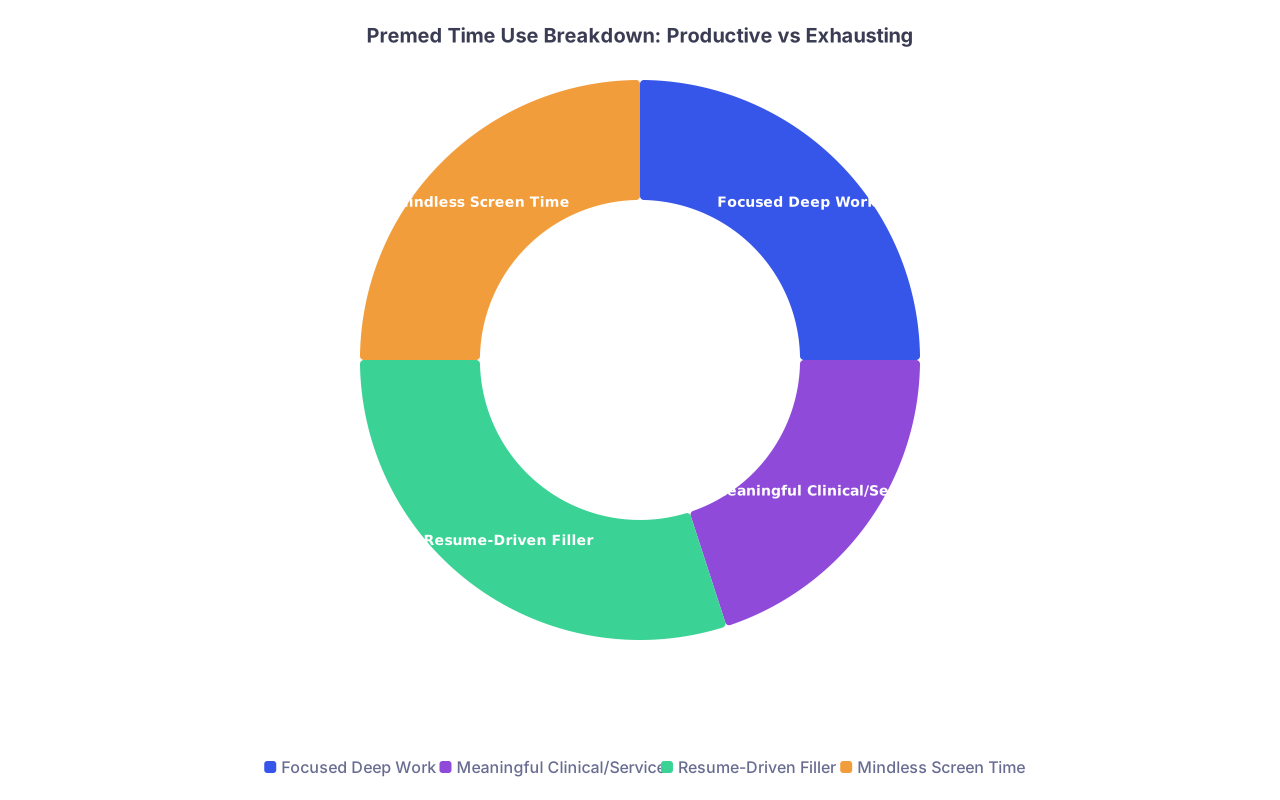
Look at that breakdown. That 30% “resume filler” is where a lot of your burnout hides.
To avoid this mistake:
- Cut ruthless. If an activity doesn’t give you either real meaning or real growth, drop it. “It might look good” is not a good enough reason.
- Pick 2–3 things to go deep on. Example: research + one clinical role + one service/leadership role you actually care about. That’s enough.
- Schedule focus, not hours. Three hours of real, undistracted work beats eight hours of scattered “studying” while sliding between apps.
Busy-ness is an ego drug. But it quietly empties you out.
3. Letting Premed Culture Define Your Values
Another mistake: outsourcing your values and ethics to the premed group chat.
You start out wanting to help people. To practice ethically. To be a decent human. Then you marinate long enough in:
- “Just do it for the application.”
- “No one actually cares why you volunteered; just get the hours.”
- “If you don’t grind 24/7 you don’t deserve med school.”
and suddenly you’re gaming everything. Shadowing becomes a box. Volunteering becomes a transaction. Friends are “networking.”
This destroys work-life balance from inside. Because if everything is transactional, then your rest also has to “earn its place.” So you stop letting yourself have any.
The ethical damage is real too. You are literally training yourself to:
- Fake interest
- Perform compassion
- See patients as career leverage
Bad habits in medical ethics don’t start on the wards. They start in undergrad.
To avoid this:
- Decide what kind of physician you want to become—now. Write it down somewhere private. Compassionate? Honest? Boundaried? That list should guide how you use your time.
- Say no to ethically gray shortcuts. Fudging hours, exaggerating roles, “creative” descriptions—this stuff chips away at you.
- Keep at least one activity that has nothing to do with your application. Something that’s just for you. That’s part of staying human.
If you sell out your values as a premed, you’ll have a hard time getting them back as a physician.
4. Treating Relationships as Optional or “Later”
Burnout isn’t only about work load. It’s about isolation. And premeds are remarkably good at isolating themselves in the name of “focus.”
I hear versions of this all the time:
- “I’ll see my family more once I’m in med school.”
- “I don’t really have time for friends this semester.”
- “Dating? That can wait until after Step 1.”
You are not a brain on a stick. You’re a person who needs connection. When you neglect that for semesters on end, weird things happen:
- Your stress has nowhere to go
- You start catastrophizing minor setbacks because there’s no one to reality-check you
- You lose the sense that your life has meaning outside your GPA and MCAT score

The most dangerous pattern: you “keep relationships” technically, but they all become shallow and one-way. You’re never fully present; you’re always half-studying in your head.
Avoid this trap:
- Schedule people, not just tasks. Call parents weekly. See a close friend regularly. Not “if I have time,” but built into your week.
- During those moments, actually be there. Phone face down. Laptop closed. Fifteen real minutes is better than an hour of distracted half-attention.
- Tell people your season is intense—but not permanent. That keeps you honest. If you’ve been “too busy” for three straight years, it’s not a season. It’s a lifestyle choice.
Medicine is relational work. If you starve your relational life now, you’ll take that deficit into residency—and patients feel that.
5. Copying Other People’s Study Habits and Schedules
One-size-fits-all study routines are one-size-fits-none.
You see someone on Reddit claiming:
- 6 hours of Anki
- 4 hours of content review
- 100 practice questions
every day, and you think, “Guess that’s what it takes.”
Then you try to copy them and wonder why you’re miserable and not improving much.
Here’s the mistake: you’re trying to live someone else’s life with your brain and circumstances.
Not the same.
| Type | Mistake Pattern | Burnout Risk |
|---|---|---|
| The Copier | Mimics others' schedules | High |
| The Crammer | Endless last-minute marathons | Very High |
| The Perfectionist | Rewrites notes endlessly | High |
| The Multitasker | Constant task-switching | Extreme |
Instead of blindly copying:
- Know your capacity. How many truly focused hours can you handle? For most people, 3–5 high-quality hours a day is actually very strong. The rest should be lighter.
- Protect your learning style, not your ego. If practice questions help you way more than rereading, lean into them—even if someone says “real grinders do X.”
- Design around your natural rhythms. If your brain is best 8–11am, that is sacred time. Don’t waste it on email, logistics, or low-value tasks.
Trying to force yourself into someone else’s template is a direct path to exhaustion and self-hate. You’ll think you’re “weak” when you’re actually just misaligned.
6. Refusing to Set Boundaries in Work and Volunteering
I see this constantly in clinical and volunteer roles:
- You agree to “help a bit more”
- Suddenly you’re covering extra shifts “just this month”
- That quietly becomes the expectation
You tell yourself it’s necessary to “show commitment.” What you’re actually showing is that you’re easy to exploit.
Premeds with no boundaries end up:
- Working late into the night on low-value tasks
- Doing unpaid admin grunt work that could be automated or shared
- Saying yes to every opportunity because they’re scared to miss out
That’s how your week gets filled with other people’s priorities.
Ethically, you can also slide into dangerous territory. If you never say no, you might find yourself:
- Doing tasks you’re not trained or authorized for
- Staying in environments that treat patients or staff poorly
- Accepting toxic behavior because “I need the letter of rec”
To avoid this:
- Decide your maximum weekly hours for any one role. Write it down before you start. When they ask for more, you have a pre-decided line.
- Practice one sentence: “I can’t take on more right now without compromising my other responsibilities.” That’s it. You don’t owe a whole TED Talk.
- If a place gets upset at basic boundaries, that’s a red flag, not a challenge. You’re not obligated to stay in unhealthy environments for the sake of your application.
Respecting your limits is not a luxury. It’s part of professional ethics. You will eventually be responsible for saying “no” in much higher-stakes situations.
7. Treating Mental Health as an Optional Upgrade
This one is brutal. Too many premeds think mental health is something they’ll “fix later” when things calm down.
Newsflash: things do not calm down. Not in med school. Not in residency. Definitely not after.
And the stakes only go up.
| Category | Value |
|---|---|
| Premed | 35 |
| Med School | 50 |
| Residency | 60 |
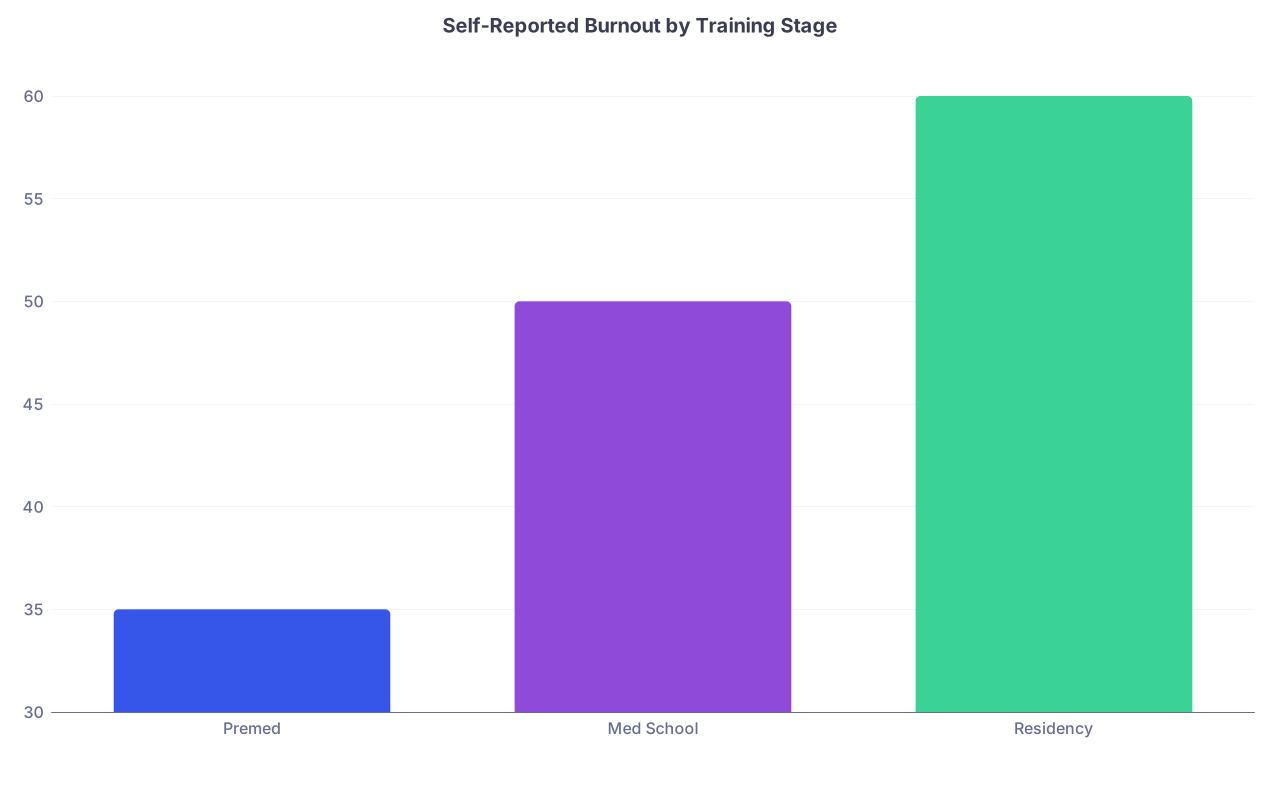
Those numbers are conservative, by the way. A lot of people don’t admit it until they’re falling apart.
Common premed mistakes around mental health:
- Calling constant anxiety “normal” because “everyone’s stressed”
- Using caffeine, sugar, or energy drinks as a primary coping strategy
- Ignoring early signs: dread every morning, emotional numbness, hopeless self-talk
- Treating therapy like a failure instead of a tool
You cannot out-grind untreated depression or serious anxiety. You will just shred yourself trying.
Healthier path:
- Label what’s happening honestly. “I’m not just stressed. I’m not okay.” That sentence alone can shift your decisions.
- Use campus or community counseling before you’re in crisis. Early support is infinitely easier than trying to climb out of a deep pit later.
- Tell at least one trusted person what’s actually going on. Hiding it doubles the load.
This is personal and ethical. If you get used to ignoring your own suffering, you will normalize ignoring other people’s too.
8. Believing Balance Is Something You’ll Have “Once You Get In”
The most seductive lie: “I’ll fix my life once I get into med school.”
No, you won’t. You will be the same person, with the same patterns, under more pressure.
If your current model is:
- Study until you collapse
- Cancel on people last minute
- Ignore your body until something hurts
- Say yes to everything out of fear
Med school won’t magically install new habits. It will just punish the old ones more aggressively.

| Step | Description |
|---|---|
| Step 1 | Premed Overwork |
| Step 2 | Chronic Stress |
| Step 3 | Early Burnout |
| Step 4 | Enter Med School Exhausted |
| Step 5 | Lower Resilience |
| Step 6 | Worsening Burnout in Training |
| Step 7 | Ethical Fatigue and Cynicism |
| Step 8 | Question Career Choice |
That loop is real. I’ve watched people go all the way around it and decide, 7–10 years in, that they hate a career they once loved.
You break that loop now, not later.
Ways to stop postponing balance:
- Run your life like you already are in a demanding career. Protect sleep. Protect one day off. Be intentional about relationships. Not “when things slow down,” but this semester.
- Drop the martyr narrative. You are not nobler because you’re suffering. You’re just more likely to quit.
- Define “success” to include being a reasonably happy, healthy human. If your only definition is scores and acceptances, your life will always feel off.
You’re building the foundation of your future practice right now. If the foundation is constant self-disregard, don’t be surprised when the structure cracks.
Quick Checklist: Are You Walking Into Early Burnout?
If you recognize yourself in most of these statements, you’re on the path:
- I feel guilty when I’m not studying, even if I’m exhausted
- My relationships have weakened in the last year because of “being busy”
- I have at least one activity I’m doing solely because I think it “looks good”
- I can’t remember the last time I took a full day truly off
- I’ve thought, “I’ll deal with my stress/mental health after I get into med school”
- I constantly compare my schedule and productivity to other premeds online
If that list hits a little too hard, good. That discomfort is your early warning system. Listen to it now, before your body forces you to.
FAQs
1. Isn’t some level of burnout just unavoidable if I want to be competitive?
No. High effort is unavoidable. Burnout is not. You can work very hard with sustainable habits—sleep, boundaries, focused study, real relationships—and be competitive without hollowing yourself out. What’s unavoidable is tradeoffs; what’s optional is self-destruction.
2. How do I know if I need professional help vs just “better time management”?
If you’re seeing signs like persistent hopelessness, loss of interest in things you used to enjoy, thoughts that people would be better off without you, panic attacks, or you just feel like you’re barely hanging on most days—this is beyond time management. That’s when you contact counseling services, your doctor, or a mental health professional. Early is better than late.
3. Won’t setting boundaries and doing fewer activities hurt my application?
Done intelligently, it usually improves it. Admissions committees can tell the difference between scattered, box-checking involvement and focused, meaningful engagement. A sane, stable applicant with deep commitment in a few areas is more compelling than a burned-out one frantically juggling ten shallow roles. You’re applying to be a future physician, not a professional extracurricular collector.
Two things to remember:
- You’re building patterns now that you’ll carry for decades.
- If the path to medicine requires you to erase your health and humanity, it’s the wrong path—not the wrong dream.