

The first year as an attending does not burn you out. Your lack of a system does.
You go from being supervised to being the name on the chart, the pager, the complaint, and the lawsuit. Overnight. If you try to “just handle things as they come,” the year will eat you alive. Clinically, ethically, personally.
So you build a quarterly review system. A rhythm. Every three months you step back, zoom out, and adjust. That is how you prevent overload instead of trying to “recover” from it.
Below is a structured, time‑anchored system for Attending Year 1. Quarter by quarter, then month by month and week by week, with very concrete “at this point you should…” guidance.
The Year at a Glance: Your Four Quarterly Themes
At the attending level you cannot optimize everything at once. You pick a focus each quarter and let some things be “good enough.”
Here is the outline of your year:
| Quarter | Primary Focus | Secondary Focus |
|---|---|---|
| Q1 | Survival & Structure | Baseline ethics & boundaries |
| Q2 | Efficiency & Delegation | Values in daily decisions |
| Q3 | Sustainability & Boundaries 2.0 | Relationships & feedback |
| Q4 | Consolidation & Growth | Long-term ethical practice |
We will walk this chronologically. But first, the backbone: your quarterly review ritual.
The Quarterly Review: Core Structure
Block this now: half a day off, every 3 months. Non‑negotiable. Use a real calendar, not your memory.
At each quarterly review you will:
Audit the last 3 months
- How many weeks did you feel overloaded (0–10 scale)?
- How many days off were sacrificed?
- When did you feel you came closest to crossing an ethical line (or watched someone else do it)?
Re‑set boundaries and systems
- What specific hours / days become “hard stops” for you this quarter?
- What tasks can be delegated differently?
- What commitments get cut?
Choose 1–2 realistic goals for the next quarter
- One work‑life balance goal
- One ethics / professional development goal
That is it. Anything more becomes fantasy planning.
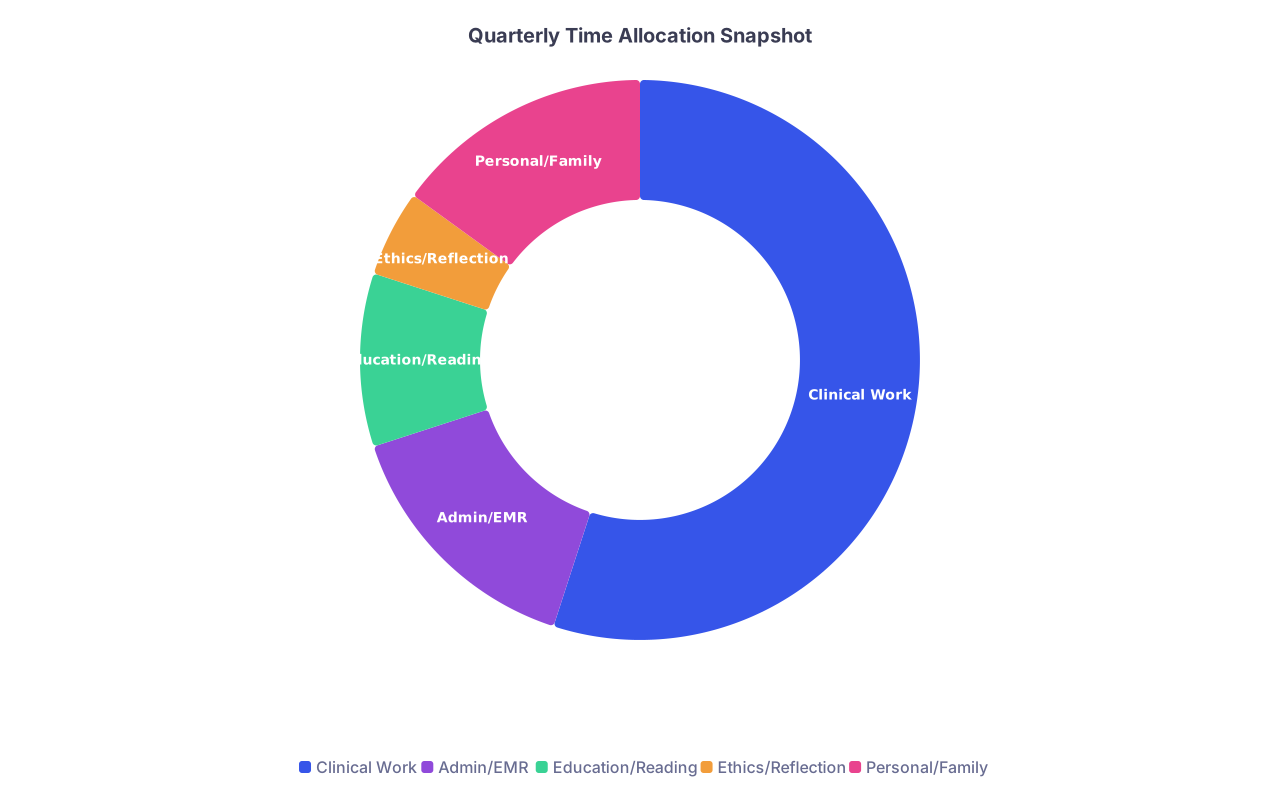
To keep it concrete, here is a simple workload vs. intentional time snapshot you should track:
| Category | Value |
|---|---|
| Clinical Work | 55 |
| Admin/EMR | 15 |
| Education/Reading | 10 |
| Ethics/Reflection | 5 |
| Personal/Family | 15 |
Each quarterly review, you write actual percentages for the last 3 months, then what you aim for in the next 3 months. If “Personal/Family” is under 10%, you have a problem. I have seen attendings operate at 2–3% for years. They look “fine” and feel hollow.
Quarter 1 (Months 1–3): Survive and Build a Floor
This is not the quarter to “optimize everything.” This is about preventing catastrophe while you are learning how to be the final call.
Month 1: Orientation Chaos and Minimum Viable Guardrails
At this point you should:
- Have your work schedule, clinic days, and call structure clearly visible in a single calendar.
- Know exactly who covers you when you are off and how handoff is documented.
- Set a minimum rest standard: an actual rule.
Example: “Post‑call, I do not pick up extra patient calls or sign orders from home. Period.”
Week 1–2 checklist
- Block:
- 1 weekly “admin hour” during the workday (not at 9 pm) to clear inbox and sign notes.
- One evening per week marked “untouchable” for personal time.
- Clarify:
- How to call risk management or ethics when an issue arises.
- Who your “go‑to” senior attending is for moral distress cases.
- Begin a micro‑journal:
- 3 lines a day max:
- One ethically tricky moment.
- One boundary that held or broke.
- One thing you would like to handle differently next time.
- 3 lines a day max:
Week 3–4: First protocol for overload
By now, the novelty is fading. Real fatigue appears.
At this point you should:
- Identify your first overload warning signs:
- Snapping at nurses.
- Charting gets sloppy.
- You start skipping explanations with patients “to save time.”
- Create a “stop and reset” script for yourself:
- “I am overwhelmed. I need 5 minutes to regroup before I see the next patient.”
- Use it. Out loud. With your team.
This is crude but essential: the first ethical failures of attendings often come from being rushed, not malicious. Overload shortens your fuse and your thinking.
Month 2: Tighten Workflow, Protect Evenings
By now patterns are visible. Your job is to tighten them without heroics.
At this point you should:
- Know your three biggest time sinks (e.g., inbox chaos, trying to do your own forms, writing novels in the chart).
- Have a default “evening shutdown time” on workdays.
Weeks 5–8: Concrete adjustments
- Inbox and EMR rules
- Check messages 2–3 times during the day in defined blocks.
- No “just one more quick look” after shutdown time.
- Delegation list
- Write down everything you are currently doing that someone else could do:
- Refill protocols with a pharmacist / nurse.
- Routine letters/forms with templates.
- Pre‑visit planning by staff.
- Pick one delegation improvement each week. Small but consistent.
- Ethics focus: consent under pressure
- Once per week, choose one complex consent conversation to do unhurried.
- Immediately after, jot 4 bullets:
- What the patient understood.
- What you glossed over.
- What you felt tempted to skip.
- How system pressure (time, admin) shaped that conversation.
This is not abstract ethics. You are looking directly at how overload warps your behavior.
Month 3: First Quarterly Review
Timing: Block a half‑day near the end of Month 3.
At this point you should:
- Have 8–10 weeks of experience and enough pain points to review honestly.
- Feel patterns of fatigue, not just random bad days.
Quarter 1 Review Agenda
Metrics (15–20 minutes)
- Count:
- Days off actually taken vs. scheduled.
- Average departure time from work.
- Number of days you brought work home.
- Rate last 3 months on:
- Overload: 0–10
- Ethical discomfort: 0–10
- Personal satisfaction outside work: 0–10
- Count:
Narrative review (30–45 minutes)
- Re‑read your micro‑journal highlights.
- Write one page:
- “Moments I almost crossed my own ethical line.”
- “Moments I protected a patient or trainee despite pressure.”
Decisions for Q2 (30 minutes)
- Choose:
- One boundary to strengthen (e.g., no charting after 8 pm, one full weekend per month fully off).
- One ethical habit to build (e.g., always pausing before overriding a nurse’s safety concern).
- Choose:
Capture the key changes on one page. That is your Q2 playbook.
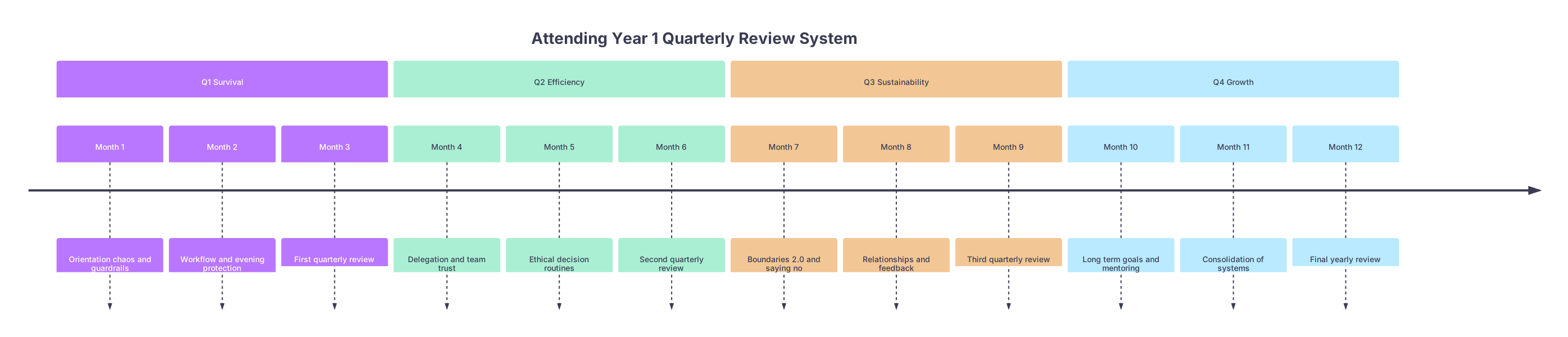
To keep this structured, map your year like this:
| Period | Event |
|---|---|
| Q1 Survival - Month 1 | Orientation chaos and guardrails |
| Q1 Survival - Month 2 | Workflow and evening protection |
| Q1 Survival - Month 3 | First quarterly review |
| Q2 Efficiency - Month 4 | Delegation and team trust |
| Q2 Efficiency - Month 5 | Ethical decision routines |
| Q2 Efficiency - Month 6 | Second quarterly review |
| Q3 Sustainability - Month 7 | Boundaries 2.0 and saying no |
| Q3 Sustainability - Month 8 | Relationships and feedback |
| Q3 Sustainability - Month 9 | Third quarterly review |
| Q4 Growth - Month 10 | Long term goals and mentoring |
| Q4 Growth - Month 11 | Consolidation of systems |
| Q4 Growth - Month 12 | Final yearly review |
Quarter 2 (Months 4–6): Efficiency and Daily Ethics
You are no longer “new.” Expectations rise. This is the danger zone: you feel competent enough to cut corners but not secure enough to say no.
Month 4: Delegation and Trusting the Team
At this point you should:
- Know the strengths of each nurse, APP, or resident you work with often.
- Start deliberately offloading tasks that do not require attending brainpower.
Weeks 13–16: Weekly delegation target
Each week, pick one task you routinely do that someone else could do safely with clear protocols. Examples:
- Refill protocols managed by nurse with your sign‑off rules.
- Standard work/school notes using templates staff can trigger.
- Routine pre‑op clearance forms with a scripted checklist.
Sit down with the relevant person and say explicitly: “I trust you with this. Here is how I want it done.” Then stop hovering.
Ethics angle: Overcontrol is also an ethical problem. When you hoard decisions, you create bottlenecks that delay patient care and burn out support staff.
Month 5: Build Ethical Decision Routines
You will not have time for a full philosophical debate at every crossroad. You need short ethical “scripts”.
At this point you should:
- Have felt at least a few serious ethical tensions:
- Family demanding “everything” for a dying patient.
- Administrators pressuring to discharge early.
- Productivity expectations conflicting with thorough care.
Weeks 17–20: Install 2–3 micro‑routines
Examples:
The “10‑second pause” before high‑stakes decisions
- Before signing off on a risky procedure or discharge, ask yourself:
- “If this goes badly, can I defend my reasoning to the patient and to myself?”
- If the answer is “not really,” you do not proceed yet.
- Before signing off on a risky procedure or discharge, ask yourself:
The “speak up once” rule for others
- When a nurse, resident, or therapist raises a concern:
- Force yourself to pause and ask 1–2 clarifying questions.
- Document if you override, with your rationale.
- This slows down mindless overrides driven by fatigue.
- When a nurse, resident, or therapist raises a concern:
The “no big surprises” policy with patients
- You never let a major outcome (ICU transfer, palliative focus, major surgery) be the first time a trajectory is discussed.
- Each clinic or inpatient visit, you share one clear sentence about trajectory: better, same, or worse.
Put these on a card or in your notes app. Use them intentionally for a month.
Month 6: Second Quarterly Review
By now, you know what your job actually is, not what orientation slides said.
At this point you should:
- Be able to list your top 3 overload triggers.
- Recognize patterns in when your ethical discomfort spikes (night shifts, certain colleagues, end of long weeks).
Quarter 2 Review Agenda
Compare Q1 vs Q2 metrics
- Overload score trend.
- Work hours at home trend.
- Frequency of feeling pressured to compromise care.
Map your “ethics pressure points”
- List 3 recurring situations where you feel pushed toward bad decisions:
- E.g., Friday afternoon discharges.
- “VIP” patients.
- Cases with family conflict.
- For each, write a one‑sentence boundary:
- “I do not discharge complex patients after 4 pm on Fridays unless safety conditions X, Y, Z are clearly met.”
- List 3 recurring situations where you feel pushed toward bad decisions:
Set Q3 focus
- Work‑life: Often this is where people finally admit, “I have to say no more often.”
- Ethics: Choose one domain for deeper work (e.g., end‑of‑life discussions, informed consent in your specialty, teaching professionalism).
Quarter 3 (Months 7–9): Sustainability and Boundaries 2.0
This is where your year either stabilizes or slides into chronic exhaustion. The goal now: durability.
Month 7: Saying No Like an Adult
By this point, extra committees, side projects, and “just one more clinic session” start appearing.
At this point you should:
- Have a default answer of “Let me look at my quarter goals first” before saying yes to new work.
- Know your maximum acceptable weekly clinical load.
Weeks 25–28: Practical boundary work
- Audit your commitments across:
- Clinical (extra clinics, extra OR days).
- Administrative (committees, task forces).
- Educational (lectures, mentorships).
- Drop or decline at least one thing this month. Verbally. To a real person.
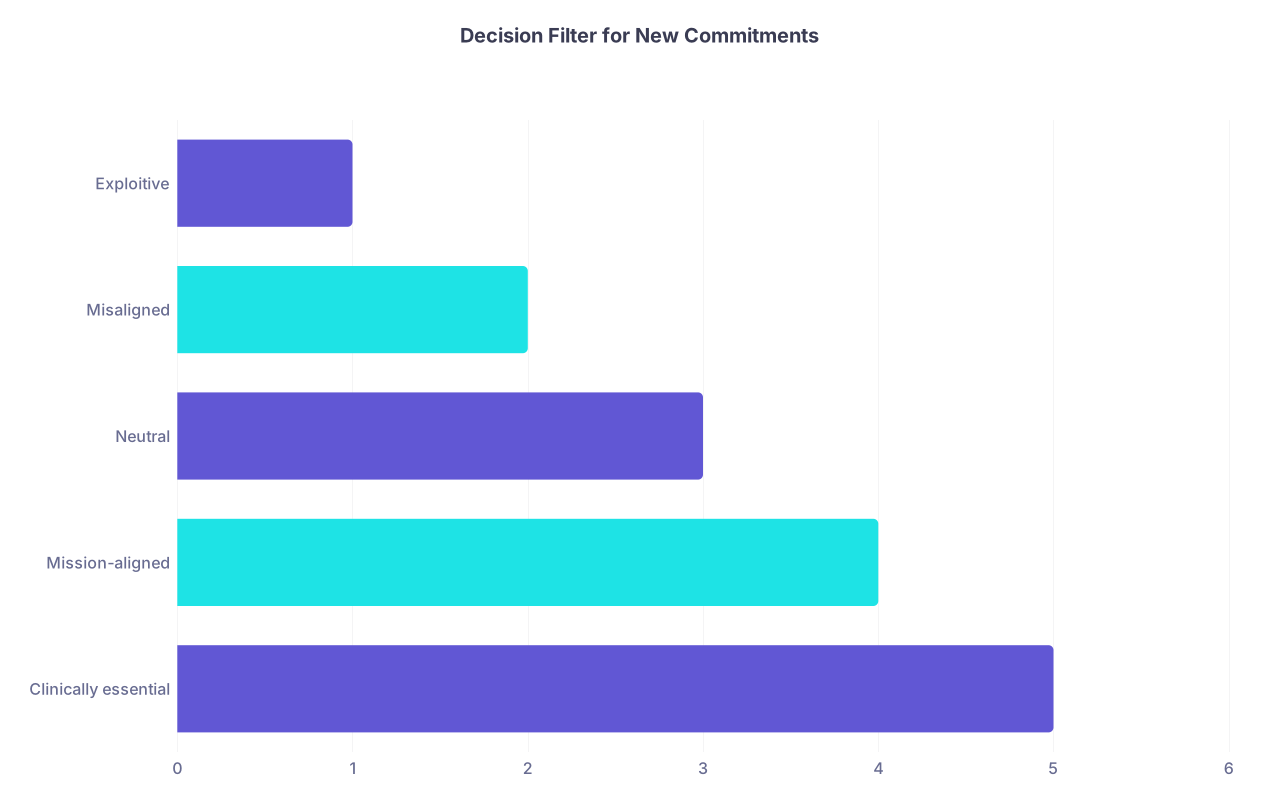
Use a simple decision filter:
| Category | Value |
|---|---|
| Clinically essential | 5 |
| Mission-aligned | 4 |
| Neutral | 3 |
| Misaligned | 2 |
| Exploitive | 1 |
Anything “neutral” or below that also consumes more than 1–2 hours/month is a candidate to decline.
Ethically, this matters: an overloaded, resentful attending is more likely to cut corners, ignore subtle patient cues, and model terrible behavior for trainees.
Month 8: Relationships and Feedback
Sustainable practice is not a solo sport. You need a small circle of people who will tell you the truth when you are drifting.
At this point you should:
- Have at least 1–2 colleagues you trust enough to ask, “How am I doing, really?”
- Have heard feedback from at least one trainee or nurse about your style.
Weeks 29–32: Build your feedback loop
Pick two people (a peer attending and a senior nurse / APP) and ask candidly:
- “When I am stressed, what do you see me do that is unhelpful?”
- “Have you seen me do anything that worried you ethically or professionally, even a little?”
Write down answers without defending yourself.
Also pick one trainee and ask:
- “What about my supervision or teaching has felt respectful and fair?”
- “Anything I do that feels rushed, dismissive, or confusing when you are under pressure?”
This is uncomfortable. Do it anyway. A quiet, frustrated team is a blinking red warning light for ethics and burnout.
Month 9: Third Quarterly Review
This review is about course correction for the long haul, not just patching leaks.
At this point you should:
- See clear patterns in when your boundaries fail.
- Have enough relational data (from feedback) to know how your style lands on others.
Quarter 3 Review Agenda
Trend review
- Compare Q1–Q3 on:
- Your overload score.
- Your off‑time protection.
- Your ethical discomfort in decision‑heavy weeks.
- Compare Q1–Q3 on:
System vs. self
- List:
- What is systemic (EMR friction, bad staffing, unrealistic productivity targets).
- What is self‑inflicted (overprepping, perfectionism in notes, ego about being the “hero” who never says no).
- List:
Plan one systemic push
- Choose one small, realistic system issue to address this quarter:
- Standardizing discharge planning to avoid Friday chaos.
- Proposing a template for high‑risk consent documentation.
- Moving a clinic start time by 30 minutes to prevent perpetual lateness.
- Choose one small, realistic system issue to address this quarter:
Personal adjustment
- Choose one habit to loosen (e.g., writing novels in notes) and one habit to tighten (e.g., always leaving work by a set time twice a week).
Quarter 4 (Months 10–12): Consolidation and Ethical Growth
You are no longer “new.” You are shaping the culture now, whether you want to or not. The question: what kind of attending are you becoming?
Month 10: Long‑Term Direction
At this point you should:
- Be able to imagine the attending you want to be in 5 years—clinically and ethically.
- See clearly what in your current pattern is incompatible with that vision.
Weeks 37–40: Vision and alignment
Spend one hour writing:
- “If I keep practicing exactly like this for 5 years, what will I be proud of? What will I regret?”
Then pick:
- One area of professional development to invest in:
- Formal ethics course.
- Communication workshop.
- Burnout/resilience CME with actual substance, not platitudes.
Align one concrete action this quarter with that development goal.
Month 11: Consolidate Systems that Work
Stop reinventing everything. Solidify the few systems that have actually helped.
At this point you should:
- Have 3–5 workflows that clearly reduced overload and ethical friction:
- Your admin hour.
- Your consent scripts.
- Your no‑after‑X‑pm charting rule.
- Your quarterly review ritual.
Weeks 41–44: System tune‑up
For each working system:
- Document it clearly (steps, timing, who is involved).
- Share at least one with:
- A junior colleague.
- Your clinic team.
Why? Because teaching and institutionalizing your systems increases the chance you will keep following them. Also, it subtly shifts the culture away from “just grind harder.”
Month 12: Final Yearly Review
This is your comprehensive debrief. Not as a feel‑good exercise, but as a rigorous assessment: did your quarterly review system actually prevent overload?
At this point you should:
- Have 4 quarterly review documents.
- Have enough data to say whether your work‑life balance and ethical clarity improved, got worse, or stayed flat.
Year‑End Review Structure
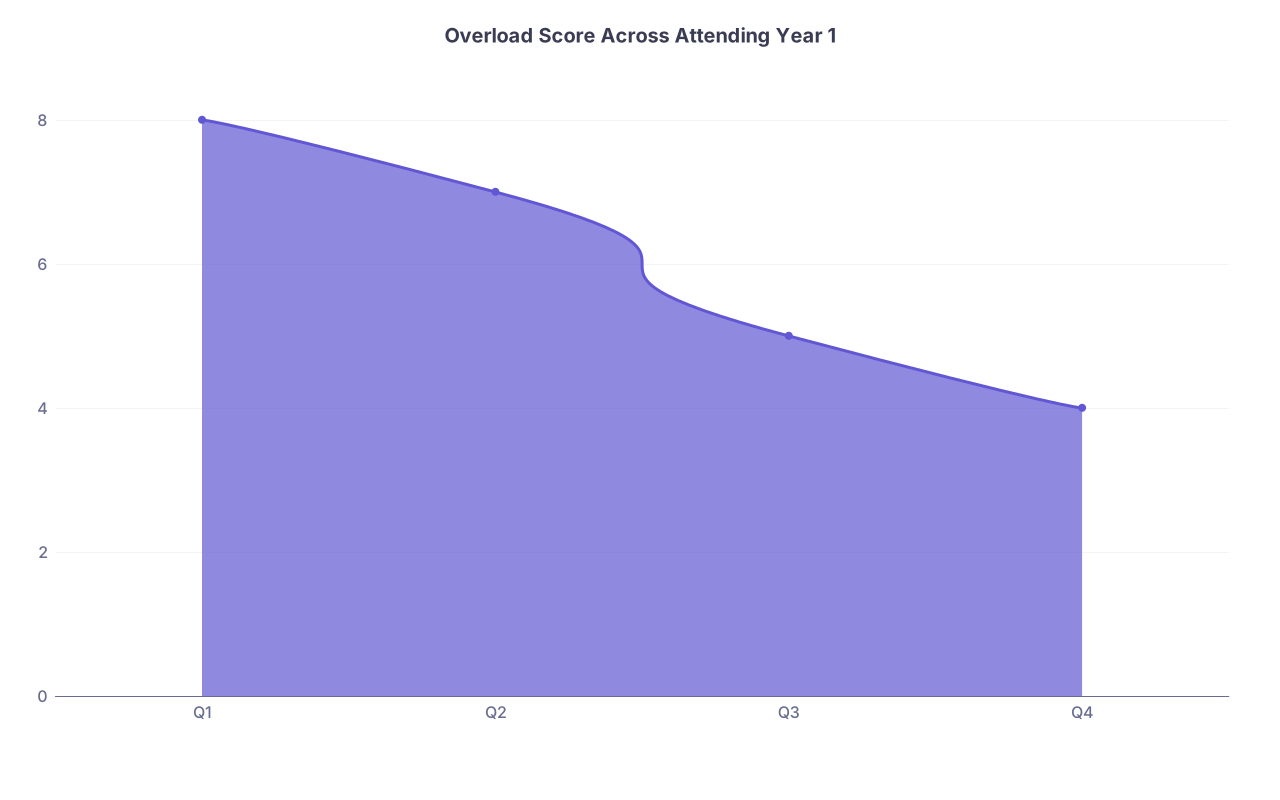
- Quantitative summary
- Plot your quarterly overload scores.
| Category | Value |
|---|---|
| Q1 | 8 |
| Q2 | 7 |
| Q3 | 5 |
| Q4 | 4 |
- Do the same for:
- Days off protected.
- Nights working from home.
- Instances of serious ethical distress.
Qualitative reflection
- Two one‑page reflections:
- “Moments I am proud of.”
- “Moments that still bother me.”
- Two one‑page reflections:
Plan Year 2
- Keep:
- Your quarterly review ritual.
- The 2–3 systems that most reduced overload.
- Drop:
- Quarterly goals that were consistently fantasy.
- Add:
- One new focus for Year 2 (e.g., teaching ethics to trainees, advocating for system changes).
- Keep:
To visualize how the pieces fit across the year, think of your routine like this:

| Stage | Activity | Score |
|---|---|---|
| Quarterly | Review and reset | 3 |
| Monthly | Block one reflection half day | 3 |
| Monthly | Adjust boundaries and systems | 4 |
| Weekly | Admin hour | 3 |
| Weekly | One protected evening | 4 |
| Weekly | Ethics micro reflection | 2 |
Weekly and Daily Maintenance: The Small Habits That Keep You Sane
Quarterly reviews fail without weekly and daily upkeep. This does not need to be elaborate.
Every Week (30–45 minutes total)
At this point in the year, you should have this rhythm:
10 minutes on Monday:
- Look at the week.
- Identify one high‑risk day for overload (packed clinic, OR, call transition).
- Pre‑decide one protective action that day (shorter notes, earlier stop time, backup coverage if needed).
20–30 minutes on Friday:
- Skim the week:
- One moment you were proud of.
- One moment you regret.
- 3‑line note on each. Done.
- Skim the week:
Every Day (5 minutes)
Before you leave work:
- Ask:
- “Did I do anything today I would not be proud to tell a mentor or my future self?”
- “Where did system pressure shape my choices?”
If yes, write 2–3 bullet points. This is raw material for your quarterly reviews. It is also your early warning system that you are drifting.
Two Things to Remember
- Overload is predictable. If you review quarterly, adjust monthly, and scan weekly, you catch it while it is still fixable.
- Ethics is not separate from work‑life balance. The more overloaded you are, the more likely you are to cut corners on consent, communication, and fairness.
Build the review system in your first attending year. Or the year will build its own system for you—and you probably will not like it.


