
The way most residents talk to their PD about burnout is backwards—and it backfires.
You are not just “sharing feelings.” You are making a professional disclosure to the person who controls your schedule, your evaluations, and your letters. Treat it like that and you can get real help without branding yourself as “the problem resident.”
I am going to walk you through exactly how.
Step 1: Get Clear On What You Actually Want
If you walk into your PD’s office with vague distress and no ask, you force them to guess. That is how you end up labeled “struggling” instead of “self-aware and proactive.”
Before you talk to anyone, answer three questions on paper:
What is actually happening?
- “I am tearful every day” is different from “I am working 90–100 hours a week and cannot keep up.”
- Be concrete: sleep, appetite, errors, thoughts of quitting, physical symptoms.
What do you think is driving it?
- Schedule intensity?
- Toxic attending?
- Chronic understaffing?
- Personal crisis outside of work?
- Underlying anxiety/depression finally cracked by residency?
What outcome do you want from this conversation?
Examples:- A temporary schedule adjustment (fewer nights for 4 weeks, clinic-only block, delay ICU).
- Protected time to see a therapist/PCP.
- Mediation or support for a problematic rotation or attending.
- Help accessing institutional resources (GME wellness, EAP, FMLA, medical LOA).
- Documentation that you sought help early in case things worsen.
If you cannot answer #3, do not book the meeting yet. You are not ready.
Write one sentence that captures your ask, like:
- “I want to stay in this program and practice safely, but I need a short-term modification and help connecting with mental health resources.”
- “This rotation is pushing me past safe limits; I need your help to redesign my role here so I am not unsafe for patients or myself.”
That sentence is your north star in the meeting.
Step 2: Decide What To Share (And What To Keep Private)
You do not owe your PD your full psychiatric history. You owe them enough information to:
- Understand there is a real problem.
- Know whether patient safety is at risk.
- Identify reasonable accommodations.
Think in three buckets:
Bucket A – Must share (for safety and trust)
If any of this is true now, say it plainly:
- You are making or almost making clinical errors due to exhaustion, distraction, or cognitive fog.
- You are having thoughts of self-harm or of not wanting to live.
- You are using substances to cope that might affect your clinical performance.
- You are so emotionally dysregulated that you cannot reliably care for patients.
These are not “image killers.” These are liability landmines if you hide them and something happens.
Bucket B – Helpful to share (for context)
This information helps your PD see the bigger picture without over-disclosing:
- “I am having panic attacks at work.”
- “My sleep is down to 3–4 hours and not restorative.”
- “I am crying in the call room most nights and dreading coming in.”
- “I am so emotionally blunted that I cannot feel empathy for patients.”
Bucket C – Optional / private details
These usually do not change the plan and can stay between you and your therapist or physician:
- Childhood trauma details.
- Exact diagnoses if you are not ready (you can say “a mental health condition”).
- Relationship drama, in detail.
- Every personal thought about quitting medicine forever.
You can say: “I am working with a therapist who feels this is burnout layered on top of an underlying anxiety disorder, which is being treated. I am stable but overwhelmed.”
That is enough.
Step 3: Choose the Right Time and Setting
Do not ambush your PD in the hallway between cases with “I am burned out and might crash.” They will react, not respond.
Aim for:
- A scheduled meeting: email or message saying you want to talk privately about “well-being and workload.”
- Protected time: not pre-morning report chaos, not post-call when you look wrecked.
- Private space: their office with the door closed, not the workroom where the chief can overhear.
A simple email template you can use:
Subject: Request for brief meeting
Dear Dr. [PD Last Name],
I would appreciate 20–30 minutes to discuss some concerns related to my workload and well-being. I value this program and want to address things proactively so I can continue to train safely and effectively.
Please let me know a time in the next week that would work for you.
Best,
[Your Name], PGY-[X]
Reads like a professional, not a crisis.
Step 4: Script Your Opening So You Do Not Ramble
You get about 60–90 seconds before your PD’s brain files you into one of two boxes:
- “This resident is falling apart and I need to manage them.”
- “This resident is self-aware, honest, and trying to solve a problem.”
Your first lines decide which box.
Use a three-part opening:
- Commitment to the program / patient safety.
- Clear statement of the problem.
- Statement of your goal.
Something like:
“I want to start by saying I am committed to this program and to taking good care of patients. Over the past 2–3 months, my workload and stress level have built to a point where I am experiencing symptoms of burnout—exhaustion, trouble concentrating, and feeling detached from patients. I am here because I want to address this early, before it affects patient safety or my performance, and I am hoping we can discuss some options.”
Or, if it is more severe:
“I am struggling with significant burnout and what feels like depression. I am finding it harder to function at the level I expect of myself. I have not made any serious errors, but I am worried I am getting close. I want to talk about how to keep patients safe and how I can get back to being fully effective here.”
You are not “weak” in this script. You are acting like someone taking responsibility.
Step 5: Present Facts, Not Just Feelings
PDs are trained to respond to data. They have heard “I am so burned out” a hundred times; half the time it is someone angry about scheduling.
Bring concrete examples:
- Time frame: “This has been building for about 8 weeks, worse the last 3.”
- Sleep: “I average 4 hours, with frequent awakenings.”
- Performance: “I have noticed slower notes, missing small labs, needing others to catch things I usually would not miss.”
- Behavioral changes: “Stopped exercising; no longer see friends or family; tearful most days.”
- Specific incidents: “Two nights ago I almost missed a critical potassium level because I was so mentally foggy.”
You are not building a legal case. But you are showing this is real, persistent, and measurable.
If you have filled out wellness surveys or have notes from your PCP/therapist (sanitized), you can selectively reference them:
- “My PHQ-9 was 17 last week with my PCP; we started treatment, and I wanted to bring you in the loop early.”
That tells your PD: you are already doing work; you are not dumping the whole problem in their lap.
Step 6: Frame It As a Shared Problem To Solve
You are not begging for mercy. You are collaborating on risk management: your health and patient safety.
Say this out loud:
“I see this as a shared problem—my well-being and the safety of our patients. I want to work with you on a plan that gets me back to full capacity.”
Then suggest practical options, not demands. PDs respond much better to, “Here are a few possible solutions; I would like your input,” than “This is killing me, you have to fix it.”
Examples you can propose:
- Short-term schedule adjustment
- “Could we explore a 2–4 week period with fewer overnight calls or a lighter rotation while I get established with treatment?”
- Protected mental health time
- “Is it possible to block a recurring appointment time once a week for therapy or psychiatry, and adjust my clinic templates accordingly?”
- Rotation or supervisor change
- “The combination of this ICU schedule and the supervisory style on this unit is pushing me over the edge. Could we discuss switching my next rotation, or having another attending as primary evaluator?”
- Formal leave (if you are close to collapse)
- “If a short adjustment is not enough, I am open to discussing a brief medical leave to reset and come back safe.”
The point: you come with ideas. You show you thought about the impact on the service. You are not just saying “I cannot handle it” and walking away.
Step 7: Watch Your Language—This Is Where Residents Hurt Their Image
There are phrases that instantly make PDs nervous. You can convey the same reality with more professional wording.
Here is how to translate:
| Avoid Saying | Say Instead |
|---|---|
| "I hate this specialty." | "I am questioning my fit with this specialty right now." |
| "I cannot handle this." | "My current workload exceeds what I can sustain safely." |
| "Everyone here is toxic." | "There are specific interactions and patterns on this rotation that are undermining my well-being." |
| "I am done. I want to quit." | "I have had thoughts of leaving, which tells me I need help now before I reach that point." |
| "I am broken." | "My current symptoms are not compatible with safe, sustainable practice unless we adjust something." |
You are not being fake. You are being precise. That precision protects your image.
Also avoid:
- Trash-talking colleagues or attendings in an emotional way. Focus on behaviors and effects, not personalities.
- Global statements like “This program does not care about wellness.” Point to specific mismatches: “The current rotation design allows no recovery time between 28-hour calls.”
Step 8: Prepare For Three Possible PD Reactions
Not all PDs are created equal. I have watched this play out many times.
1. The supportive problem-solver
They will:
- Thank you for coming early.
- Ask clarifying questions.
- Offer options on the spot or after talking to chiefs/GME.
- Normalize burnout as a systems issue, not a personal failure.
Your job:
Be honest. Accept reasonable help. Follow through. Keep them updated.
2. The anxious bureaucrat
They will:
- Worry about documentation and liability.
- Mention the need to involve GME / institutional wellness.
- Ask about formal evaluations or cognitive testing if they are really spooked.
- Say things like “We need to make sure you are fit for duty.”
Your job:
- Do not get defensive.
- Clarify: “I am seeking help early specifically so I do not become unfit for duty. I am open to whatever process keeps patients safe and allows me to continue training.”
- Ask: “Can you walk me through what involvement from GME would look like? I want to understand the steps.”
3. The dismissive minimizer
You might hear:
- “Everyone is burned out. This is residency.”
- “You just need to tough it out through this rotation; it gets better.”
- “If you cannot handle this, maybe this specialty is not for you.”
This is the worst-case scenario, but it happens.
Your job:
- Hold your ground, calmly.
- “I understand this is demanding. I am saying I have reached a point where I am concerned about safety. That is why I am coming to you early.”
- Re-state your ask.
- “I am asking for a time-limited adjustment and help accessing formal support. What is realistically possible?”
- If they refuse everything, escalate appropriately:
- “If we cannot make a change at the program level, I would like to speak with our GME office / ombudsperson about options.”
You do not need to threaten. Just be matter-of-fact. Programs are accountable to GME and ACGME. They know that.
Step 9: Involve Other Supports Strategically
You should not walk into this alone if you already feel unstable. Build a small support structure first.
People to consider looping in before or after the PD
- Trusted faculty mentor (not your PD):
- “I am thinking about talking to the PD about burnout. How would you phrase this?”
- Chief resident (careful: they are part of leadership):
- Can help with schedule reshuffles and give insight into how PD typically reacts.
- GME wellness office / EAP:
- Confidential resources that can guide what is reasonable to ask.
- Your physician / therapist:
- Can help you frame your condition and, if needed, provide a generic letter supporting adjustments or leave.
You can say to your PD:
“I have been working with Dr. X (my PCP/therapist), and they support my asking for a short-term schedule adjustment while we treat this.”
That signals seriousness and responsibility.
Step 10: Put The Plan In Writing (Briefly)
After the meeting, send a short email summarizing agreements. Not a transcript. A bullet-point recap.
For example:
Dear Dr. [PD],
Thank you for taking time to meet today to discuss my current burnout symptoms and workload. To confirm our plan:
- I will move from the ICU rotation to [Ward/Clinic] for the next 4 weeks to allow for more consistent daytime schedule.
- I will start weekly therapy on Wednesday mornings; my clinic template will be adjusted to accommodate this.
- We will reassess how I am doing at the end of the 4-week block and decide on next steps.
I appreciate your support in helping me address this early so I can continue to train safely and effectively.
Best,
[Your Name]
Why this matters:
- It prevents “memory drift” about what was promised.
- It shows you are organized and professional, not chaotic.
- It creates documentation that you raised concerns early if things worsen.
Step 11: Protect Your Long-Term Image While You Recover
Your reputation is not about never struggling. It is about how you handle struggle.
Over the next 4–12 weeks, do the boring, disciplined things that rebuild trust:
Show up reliably.
If a schedule change was made, be rock-solid on attendance and punctuality.Communicate proactively.
- Brief updates: “I am doing better with sleep and focus; therapy has started.”
- Or: “Symptoms are still significant; I think we may need to extend the current plan.”
Avoid oversharing with peers.
Residents talk. Do not turn this into a soap opera in the workroom. A simple, “I was really burned out, working on it with leadership and my doctor,” is enough.Invest in real treatment, not just venting.
- Therapy, medication if indicated, sleep hygiene, basic exercise.
- If substances are creeping in (nightly alcohol, benzos off-label, etc.), address this head-on with your clinician.
Document your own progress.
Quick weekly jot-downs:- Hours slept.
- Mood ratings.
- Concentration, error rates.
- Engagement with patients.
This is not for your PD. It is for you, and for your therapist or physician. But it can also inform future conversations.
Step 12: Know When To Pull the Emergency Brake
Sometimes burnout is not a bad week or a rough month. It is the point where you are a risk to yourself or others. At that point, your “image” is irrelevant compared to safety and survival.
Red flags where you should immediately:
- Tell your PD or another attending you trust.
- Contact your institution’s emergency mental health services.
- Step away from clinical work now, not next week.
Red flags:
- Active suicidal thoughts with any plan or intent.
- Intense thoughts of harming patients or colleagues.
- Using alcohol/drugs to get through shifts or withdrawal symptoms at work.
- Severe cognitive impairment: missing critical labs, meds, or imaging repeatedly.
- Psychotic symptoms (paranoia, hallucinations, severe disorganization).
In those situations, the right script is very direct:
“I am not safe to work right now. I need to step away immediately and get help.”
You may worry this will destroy your career. In reality, hiding until something catastrophic happens is far more damaging to both career and life.
Visual: A Simple Decision Path Before You Talk To Your PD

| Step | Description |
|---|---|
| Step 1 | Notice burnout symptoms |
| Step 2 | Clarify goals and desired outcomes |
| Step 3 | Contact therapist or physician |
| Step 4 | Plan PD conversation with support |
| Step 5 | Request meeting with PD |
| Step 6 | Have structured conversation |
| Step 7 | Implement plan and follow up |
| Step 8 | Contact GME or mentor |
| Step 9 | Impact on safety? |
| Step 10 | PD supportive? |
Quick Reality Check: What This Looks Like In Practice
A PGY-2 in internal medicine, 8 months into the year. Crushing ICU then nights, then wards. Snaps at nurses. Starts dreading every shift. Dry-heaving on the drive in. For 3 weeks.
What usually happens:
They say nothing. They doomscroll on call. They start making charting errors. One attending calls them “checked out” on an evaluation. Another writes “limited insight, resistant to feedback.”
What I have seen work instead:
- Resident talks to a therapist once, realizes this is sliding into major depression.
- Uses a scripted email, meets with PD, lays out 3 months of worsening symptoms, names concern about errors.
- Asks for: 4-week lighter clinic block; weekly therapy; delay of next ICU month by 3 months.
- PD agrees, brings in chief to adjust schedule. GME wellness consulted.
- Resident sticks with treatment, uses time to sleep, exercise, rebuild.
- Returns to ICU month improved. Ends year with strong evaluations and a known story in leadership: “handled a tough year responsibly.”
Same burnout. Very different outcome because of how the conversation was done.
Use Institutional Levers, Not Just Personal Grit
Institutions are finally being pushed (by ACGME, lawsuits, and public opinion) to treat burnout as a system problem. Use that.
You can ask your PD directly:
“What wellness and mental health resources does our GME office have for residents in this situation?”
And if your PD seems uninterested, go around, not against:
- Contact GME office directly.
- Reach out to resident ombudsperson.
- Look at ACGME Common Program Requirements (duty hours, fatigue mitigation); if your program is clearly violating them, you have leverage.
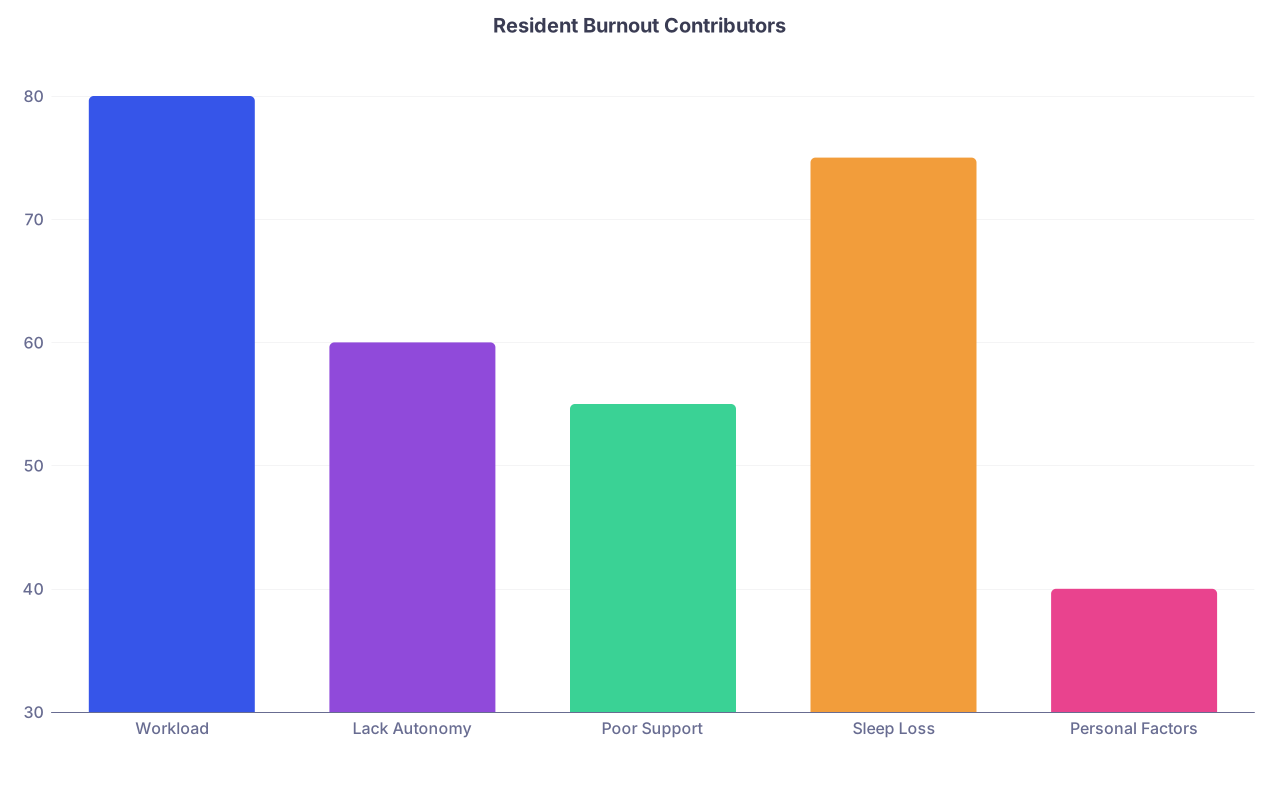
| Category | Value |
|---|---|
| Workload | 80 |
| Lack Autonomy | 60 |
| Poor Support | 55 |
| Sleep Loss | 75 |
| Personal Factors | 40 |
Most of this is not you being “weak.” It is you colliding with broken systems. The conversation with your PD is partly about adjusting you. But it is also a tiny forced feedback loop for the system.
The Core Moves You Need To Remember
Three main points:
Treat the conversation like a professional disclosure, not a vent.
Go in with a clear problem, concrete examples, and a specific ask.Use precise, safety-focused language that frames burnout as a shared problem to solve.
You are not confessing failure; you are collaborating on protecting patients and your training.Back the conversation with real treatment and follow-through.
Document, update, and show, over time, that you used the support to return to being the resident you want your PD to see.
Do that, and you can talk about burnout honestly without torching your image. In many programs, you will improve it.