
The Real Reason Some Residents Get Protected From Extra Call
It’s 2:17 a.m. You’re barely three hours into your “q4” call, your pager has not stopped screaming, and you are grinding through cross-cover admits while trying to stuff a granola bar into your mouth between rapid responses. You walk by the call room and see it: one of your co-residents is asleep, lights off, tucked in.
You know they were supposed to be on backup. Yet somehow, they never seem to get called in. They miss the worst admits. They’re mysteriously excused from that brutal post-night float clinic. And the explanation is always vague: “schedule issues,” “we need them for a project tomorrow,” “faculty requested them,” or the classic: “it just worked out that way.”
Let me tell you what really happens. Because program directors and attendings absolutely do protect specific residents from extra call. And it’s almost never for the reasons they say out loud.
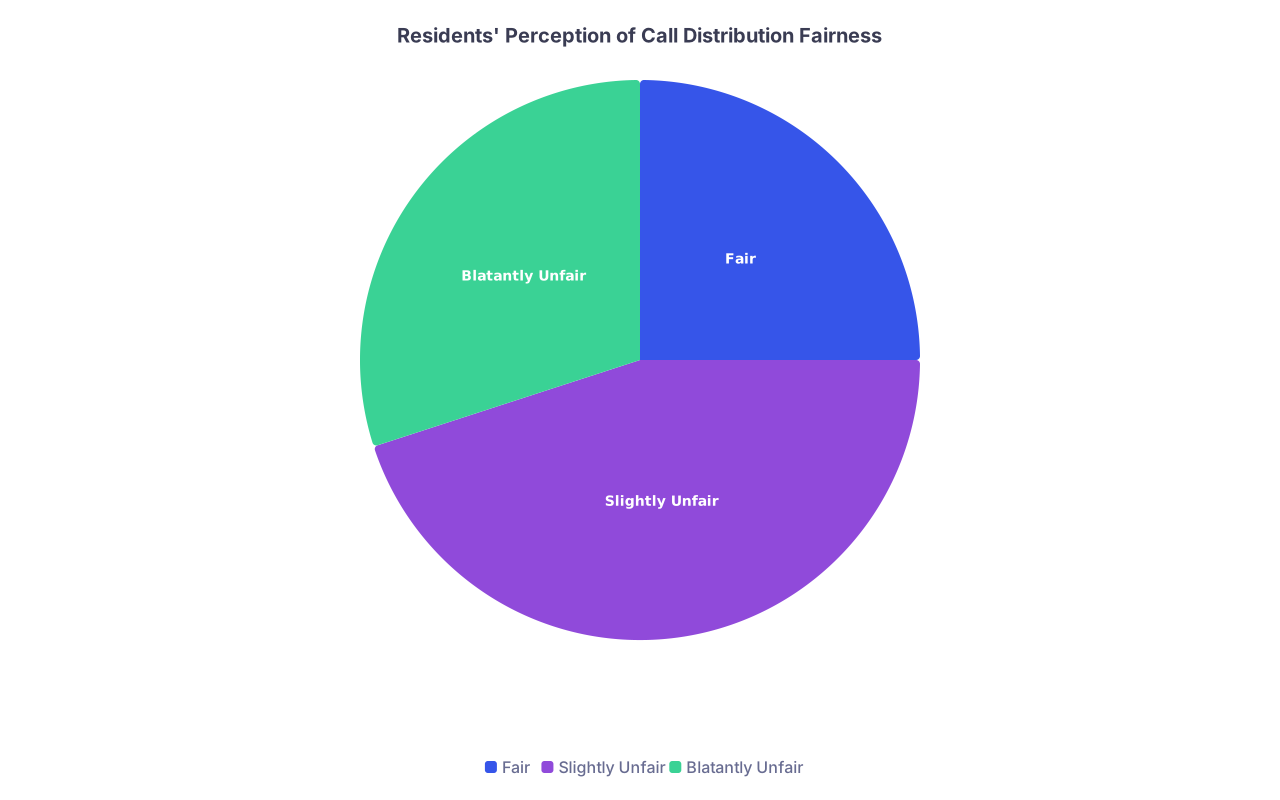
| Category | Value |
|---|---|
| Fair | 25 |
| Slightly Unfair | 45 |
| Blatantly Unfair | 30 |
The Official Story vs. The Real Story
On paper, call is democratic. Everyone rotates. Schedules are “generated by software.” Changes are “only for emergencies.” If you read ACGME policies, you’d think fairness was built into the DNA of residency scheduling.
Reality: call is political capital. And programs spend that capital where it benefits them most.
Here are the real buckets residents fall into when it comes to being protected from extra call. You’ll recognize these people from your own program.
1. The “Program Asset” Resident
This is the person who makes the program look good on paper and in meetings. And leadership knows it.
Think: the resident with five first-author publications with the department chair. The one presenting at ATS, ASCO, SCCM, or some other acronym that makes the chair smile. The resident who’s co-writing a grant with a big-name attending. Or the categorical IM resident everyone is grooming for Chief.
What happens behind the scenes?
Program director in the chief’s office:
“We cannot have Jamie post-call the day before their presentation.”
Or, more bluntly:
“Do not burn Jamie out. They’re our star.”
So Jamie gets:
- “Research afternoons” that magically land right after call.
- Exemption from last-minute backup call.
- Coverage when their paper deadline is coming up… quietly arranged by the chiefs.
The justification sounds noble: “We want to support scholarship.”
The truth: the program is investing in their return on investment. Jamie’s career success becomes another line on the brochure. “Our residents routinely match into top fellowships.” “Our residents publish in NEJM.” That’s leverage for recruitment, prestige, and money.
And if you think program leadership will sacrifice that to make sure everyone takes the same amount of extra call? They won’t.
2. The Faculty Favorite (and Why That Actually Matters)
There is always a resident the attendings love. Not “like.” Love.
They answer pages quickly. They know all the attendings’ coffee orders. They anticipate everything. They stay late to help with discharges they technically do not own. They show up to every optional conference. They are in photos on the residency Instagram page standing next to the PD.
This person gets protected. Because attendings go to bat for them. Constantly.
Conversation you’ll never hear but absolutely happens:
Chair to PD:
“Look, don’t overload Priya. I want her rested. We’re putting her name on that big paper, and I want to keep her here for fellowship.”
PD to chiefs afterward:
“Work around Priya’s schedule. Treat her carefully. We want her in our fellowship.”
And you feel it, even if you can’t prove it. Priya doesn’t get pulled to cover that sick night shift. She gets “preparation time” blocked off. Her call gets traded for her when there’s a coveted elective or visiting speaker. The chiefs “cannot find anyone else” when you ask to swap, but somehow they can when she needs one.
Is it fair? Not remotely.
Is it happening everywhere? Yes.
Faculty favorites are protected because faculty are loud about them. And chiefs do not want to fight their own attendings. Chiefs are trying to survive too.

The Quiet Power of “Fragility” and Risk Management
This part no one will tell you openly because it sounds ugly. But I’ve watched PDs, APDs, and chiefs do it for years.
There is a special kind of protection given to residents who are perceived as “high risk” for:
- Burning out badly
- Complaining to GME
- Failing rotation evaluations
- Triggering legal or accreditation problems if pushed too hard
Those residents often get shielded from extra call. Not out of kindness. Out of risk management.
You might have seen this pattern:
- The resident who had a documented mental health crisis early PGY-1.
- The one who had a major professionalism flag and now has everyone walking on eggshells.
- The PGY-2 who already failed Step 1 once and barely passed Step 2, with whispers about “struggling clinically.”
All of a sudden, they’re not on the “heavy” services as often. Their call schedule lightens. They’re rotated to ambulatory blocks or electives around tougher months. Extra call? Backup? They’re mysteriously always “already assigned” somewhere else.
The explanation is always: “We’re supporting them” or “We don’t want to overwhelm them.”
That’s partially true. But the darker reality: if that resident breaks, it becomes a program problem. ACGME problem. Legal problem. Wellness metrics problem. And PDs have no appetite for another ACGME citation about duty hours or resident fatigue.
So who fills the gap? You. The “stable” one. The competent one. The resident leadership believes “can handle it.”
The unspoken calculus goes like this:
“Alex is solid. They’ll be fine if they pick up 2–3 extra nights this block. Chris? If we push them, they might implode. Then we have a mess.”
So Chris gets protected from more call. Alex gets quietly loaded up.
The mistake many residents make is thinking this is about merit. It’s not merit. It’s perceived risk.
| Resident Type | Extra Call Likelihood |
|---|---|
| Research superstar | Low |
| Faculty favorite | Low |
| Perceived fragile | Low |
| Quietly competent workhorse | High |
| Mild complainer | Medium |
The “Workhorse Tax”: Punishing Reliability
If you’re the resident everyone can depend on, congratulations and condolences. You’re the one programs exploit without admitting it.
Workhorses are the ones who:
- Never say no directly.
- Always “help out” when the chief says, “I hate to ask you this, but…”
- Turn in notes on time, get great evals, and don’t escalate issues to GME.
People like you get punished with more responsibility and more call. Because you’re safe to burden.
Here’s the internal monologue you’ll never hear but absolutely drives decisions:
“Tyler is rock solid. If we put them on two extra nights, the patients will be fine, the notes will be done, they won’t blow up at anyone, and they won’t email GME. We owe them one, sure, but we’ll figure it out later.”
“Later” rarely comes. I’ve watched residents like that finish residency with the most call hours of their class. Nobody tracks the informal favors and screw-overs. There is no meaningful accounting of who actually did how much grunt work when schedule changes and “emergencies” are factored in.
By the way, this is where your personal ethics collide with program ethics. Because you want to be a team player. You don’t want to screw over your co-residents or leave patients uncovered. But if you never set boundaries, leadership will treat your goodwill as an infinite resource.
There is nothing “professional” about silently absorbing all the extra pain forever. That’s just self-neglect dressed up as virtue.
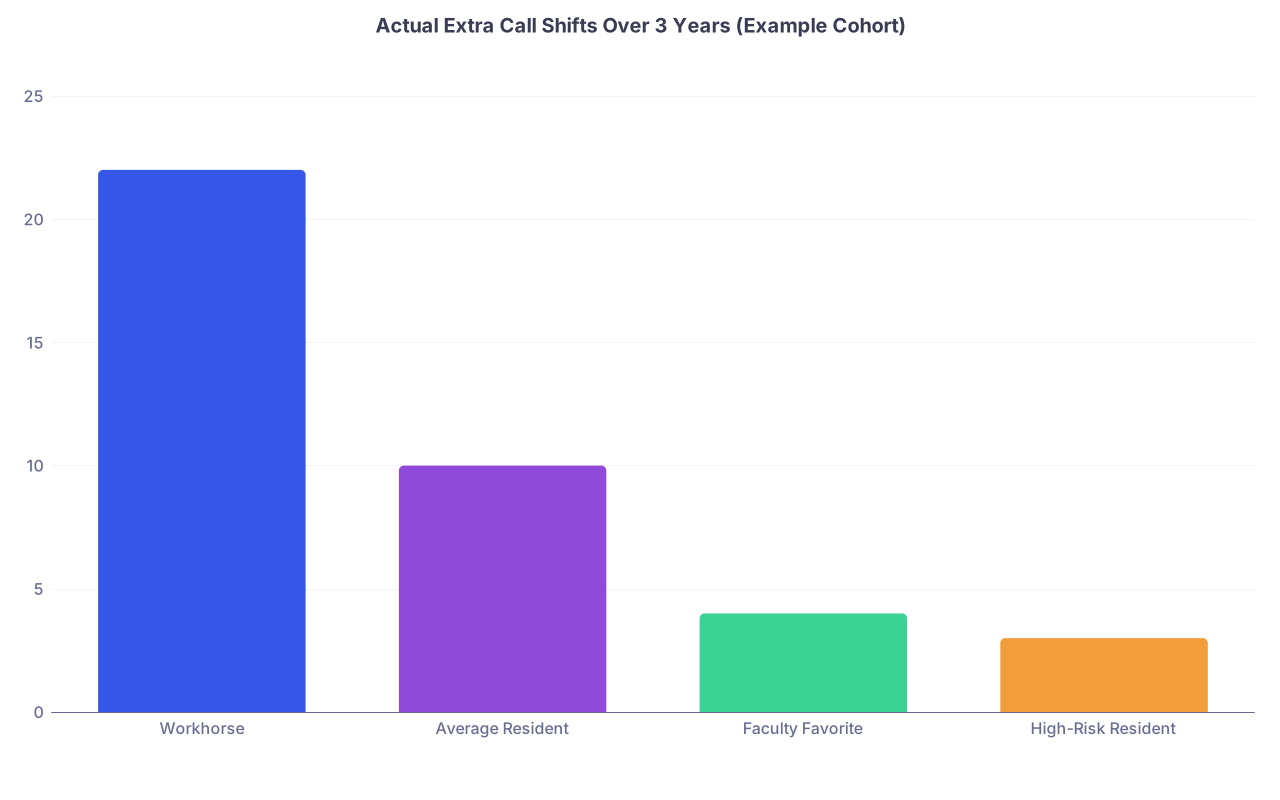
| Category | Value |
|---|---|
| Workhorse | 22 |
| Average Resident | 10 |
| Faculty Favorite | 4 |
| High-Risk Resident | 3 |
The Ugly Truth: Pregnancy, Parenting, and “Special Circumstances”
Let’s talk about another axis where call protection happens: pregnancy, new parents, and family crises. This one lives right at the intersection of ethics and resentment.
Here’s what I’ve seen repeatedly:
- Pregnant resident in third trimester gets pulled from nights and heavy call, or has schedules shifted to protect them from late pregnancy stress.
- New parent gets somewhat better scheduling for a stretch—fewer nights, more electives, less call around key times.
- Resident with a very ill family member gets soft protection from extra shifts.
Most of the time, this is appropriate and humane. It’s justified. It’s what decent programs should do.
The real ethical failure is this: programs almost always push the cost of that protection onto the least powerful people nearby—other residents. Instead of using moonlighters, locums, or adjusting service caps meaningfully, they quietly slide those calls onto whoever doesn’t scream.
You see why resentments explode, right?
Because if you’re the single resident with no kids, or the one whose family is overseas and can’t visit, you end up paying the “personal life tax” for others. The message becomes: “Your life is more expendable.”
Program leadership will say: “We have to be fair.”
But what they mean is: “We have to look reasonable, not spend more money, and not rock the boat with administration.”
The ethical model should be:
- Protect pregnancies, new parents, and family crisis residents.
- Spread the impact broadly and transparently.
- Use faculty coverage, hire moonlighters, or adjust service loads.
What actually happens in many places:
- Protect those residents.
- Quietly dump the extra onto the same dependable subset of co-residents.
- Never acknowledge the imbalance out loud.
And then everyone wonders why the “wellness lecture” doesn’t land.

| Step | Description |
|---|---|
| Step 1 | Service needs |
| Step 2 | Protect time |
| Step 3 | Assign extra call |
| Step 4 | Assign if needed |
| Step 5 | Reassign call quietly |
| Step 6 | Who can cover? |
How Chiefs Are Really Thinking When They Change Call
You need to understand chiefs. They’re not villains. They’re survivors in a bad system. But their incentives are not the same as yours.
Here’s the informal hierarchy running in the background of their brains when a call needs filling:
- Avoid pissing off the PD or chair.
- Avoid angering any resident who already went to GME once.
- Protect the residents leadership openly values (future chiefs, fellowship bound, big research names).
- Use the workhorses and “nice people” as shock absorbers.
- Keep the schedule grid technically compliant for duty hours on paper.
Notice what’s missing: “Perfectly equalize call.”
Equality is not the governing principle. Stability is. Minimum conflict is. Optical fairness maybe, but not actual fairness down to the last night shift.
So when you ask, “Why does it feel like I’m always the one getting screwed?”, you’re not imagining it. You’re likely sitting in one or more of these roles:
- Quietly competent
- Not a complainer
- Not a faculty pet
- Not dramatically high risk
- Not protected by obvious life events
You’re the ideal target.
What You Can Ethically Do About It
You cannot fix the entire system as a PGY-1, PGY-2, or even chief. But you’re not powerless either. Let’s talk strategy that doesn’t make you the martyr or the villain.
1. Keep Receipts
You do not need a manifesto. You need a simple, private log.
Date, extra call taken, reason, who requested it.
Do this for months, not weeks.
Why? Because when you finally say something, vague feelings carry no weight. A tight, factual pattern does.
“I’ve covered 5 unassigned calls in 3 months, and I’m concerned about burnout and fairness. Here are the dates.”
That hits very differently than “I feel like I’m always covering.”
2. Use Professional, Non-Emotional Language
Program leadership reacts poorly to emotional accusations. They do, however, respond to:
- Burnout risk
- Patient safety
- ACGME optics
- Reputation risk
So you do not say:
“This is unfair, and you’re protecting your favorites.”
You say:
“I’m noticing a pattern where I’ve absorbed X additional call shifts compared to my peers. I’m worried about fatigue and the impact on my performance and well-being. How can we re-balance this going forward?”
You frame it as a future-focused fairness and safety issue, not a personal attack. You’ll get further.
3. Learn to Say “Let Me Check and Get Back to You”
The chiefs’ favorite residents are the ones who always say yes. That doesn’t have to be you.
When someone asks you to cover last-minute call:
“Let me check my schedule and get back to you in 15 minutes.”
That pause is power. It gives you space to:
- Actually evaluate your bandwidth.
- Check how many extra calls you’ve already taken.
- Decide if you want to draw a line this time.
If the answer is no, you do not owe a confessional essay.
“Sorry, I’m not able to take that one” is enough.
4. Know When to Escalate – and When Not To
You escalate when:
- You’ve clearly taken a disproportionate hit over time.
- Your performance or health is slipping.
- You’ve already tried talking to chiefs and got brushed off.
You don’t run to GME the first time you’re asked to swap call. That destroys your capital immediately. But if you’re the one quietly drowning while others glide through, you have every right to use the channels that exist.
Use facts. Use your log. Stay calm.
What you do not do is accept permanent martyrdom because “that’s residency.” There’s a line between paying your dues and letting a broken culture erode your health and ethics.
The Ethics Nobody Wants to Talk About
There’s a reason this whole topic lives in the gray zone between “professionalism” and “survival.”
On the one hand, medicine is a team sport. Real emergencies happen. People get sick. Babies are born. Life implodes. Covering for each other is part of the deal.
On the other hand, systematically dumping pain on the same subset of residents while quietly protecting others for political or self-interested reasons? That is not “teamwork.” That’s exploitation.
And that’s where your personal ethics come in.
Ask yourself:
- At what point does saying “yes” stop being generous and start being self-harm?
- At what point does your silence implicitly endorse a system that treats some colleagues as more “valuable” than others?
- When do you speak up not just for yourself, but for the quieter intern who you can see is getting slotted into your old role as the backup punching bag?
You do not have to burn it all down to act ethically. But you also do not have to pretend this is all random or fair.
It’s not.