
Most residents are not “burning out.” They are being slowly eroded by a handful of bad habits they think are normal.
Let me be blunt. What is destroying residents’ mental health is rarely just workload or acuity or the system (though those are real). It is the quiet, daily choices you have been trained to see as “professionalism” that are, in fact, red flags. And if you do not catch them early, they calcify. They follow you into fellowship, into attending life, into your marriage, into your charting after your kids go to sleep.
You do not have as much room for error as you think.
This is a survival guide to the habits that quietly wreck residents’ mental health—especially the ones disguised as dedication, resilience, or being a “team player.”
1. Treating Exhaustion as a Character Flaw
The most dangerous sentence I hear from residents is: “I am just tired; it is fine.”
No, it is not fine. Fatigue is not a personal failing. It is neurobiology. And pretending you are above it is a red flag.
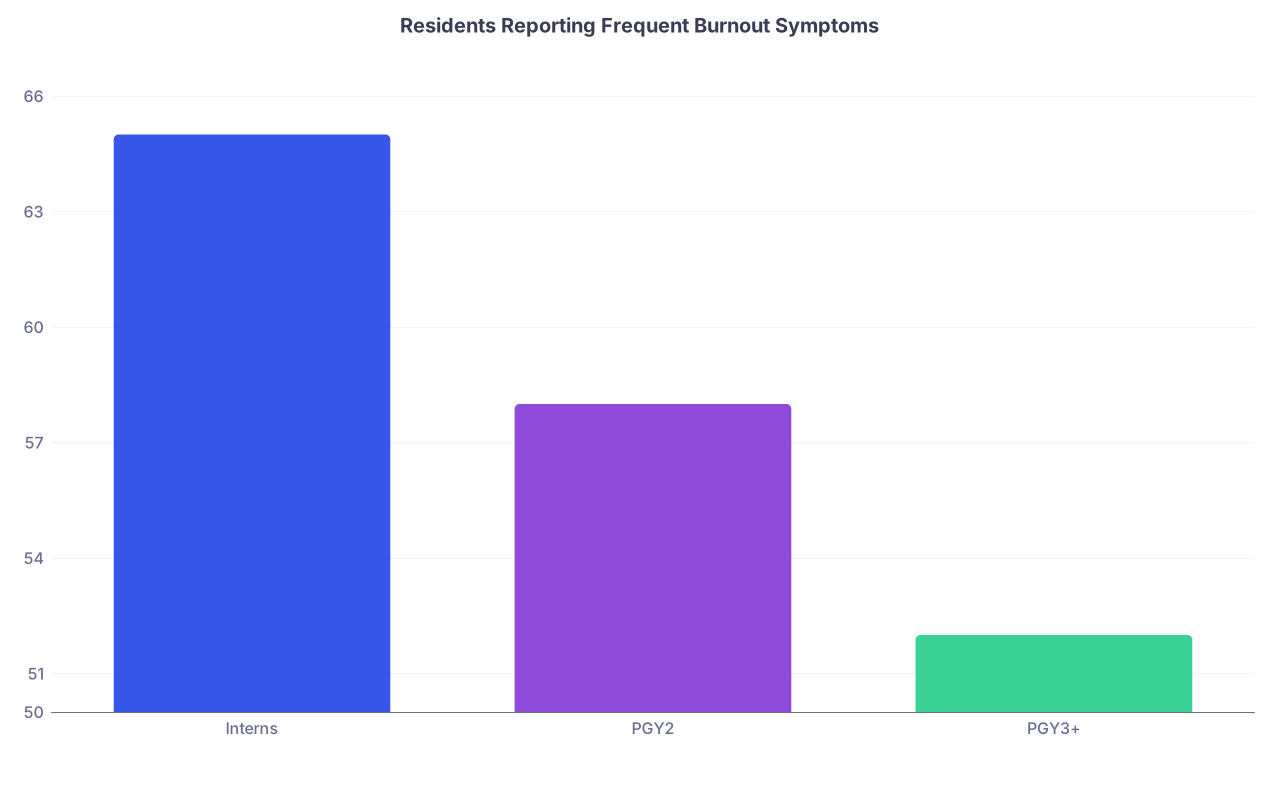
| Category | Value |
|---|---|
| Interns | 65 |
| PGY2 | 58 |
| PGY3+ | 52 |
The common mistakes here:
You brag about hours instead of boundaries.
The “I was on call 28 hours and then went straight to clinic” stories are not harmless war tales. They train your brain to associate sleep deprivation with pride and competence. That wiring is hard to undo.You “push through” warning signs.
Micro-errors in notes. Forgetting simple orders. Snapping at nurses. Feeling detached in family meetings. These are not quirks. They are cognitive side effects of exhaustion. If you ignore them, they become your new baseline.You think asking for help is weakness.
I have watched residents hide how wrecked they were because they did not want to look “soft” in front of an attending who trained back in the 90-hour-workweek era. That attending will not be there when you are in therapy at 35 trying to unknot this thinking.
How to not screw this up:
- Treat sleep like a medication. Dose, schedule, side effects. Protect it with the same seriousness as a heparin drip.
- Notice your own red-line signs: re-reading the same note 3 times, forgetting to eat, feeling numb with a crashing patient. Those are not background noise; they are boundary markers.
- Normalize simple phrases: “I am not safe to keep going without a short break.” “I need a quick pause to reset before I see the next patient.” These are not dramatic. They are adult.
If your program culture punishes basic human limits, that is not a reflection of your weakness. That is a program red flag.
2. Making Medicine Your Whole Identity
Confusing “being a good doctor” with “being nothing but a doctor” is a silent killer of mental health.
During orientation I once heard a chief say: “For the next three years, residency is your life.” Everyone nodded. I wanted to pull the fire alarm.
You are not a better resident because you erased the rest of yourself.
The identity trap
Residents slide into this one quietly:
You drop hobbies because “I cannot justify the time.”
The guitar gathers dust. The running shoes stay in the closet. The book pile grows. You tell yourself it is temporary. Three years later, you no longer remember what used to make you feel like yourself.You introduce yourself as “I am a pediatric resident” before you say your own name in your head.
That sounds small. It is not. If your only identity is your role, any criticism of your work feels like an attack on your worth.Every success and failure is magnified.
Good eval? You are finally a decent human being. Bad eval? You are defective. No middle ground. That volatility will exhaust you more than nights on call.

Practical course correction:
- Protect one non-medical identity thread at all costs. Musician, parent, runner, Sunday-morning-bakery-person. Does not matter. But it must exist, and it must not be optional.
- Talk about things other than medicine with co-residents. If every conversation devolves into “how many admissions,” you are just reinforcing the cult.
- When you fail—because you will—practice saying: “I handled that case poorly” instead of “I am a bad doctor.” One is behaviour. The other is identity. That distinction is the difference between growth and self-hatred.
3. Normalizing Emotional Numbing as “Professionalism”
You are not supposed to cry with every family. But you are also not supposed to feel nothing.
I hear residents say, half-joking, “The first time I saw a code I was shaken; now it is just another task list.” They say it like it is a sign of maturity. Sometimes it is. Sometimes it is a sign of shutting down.
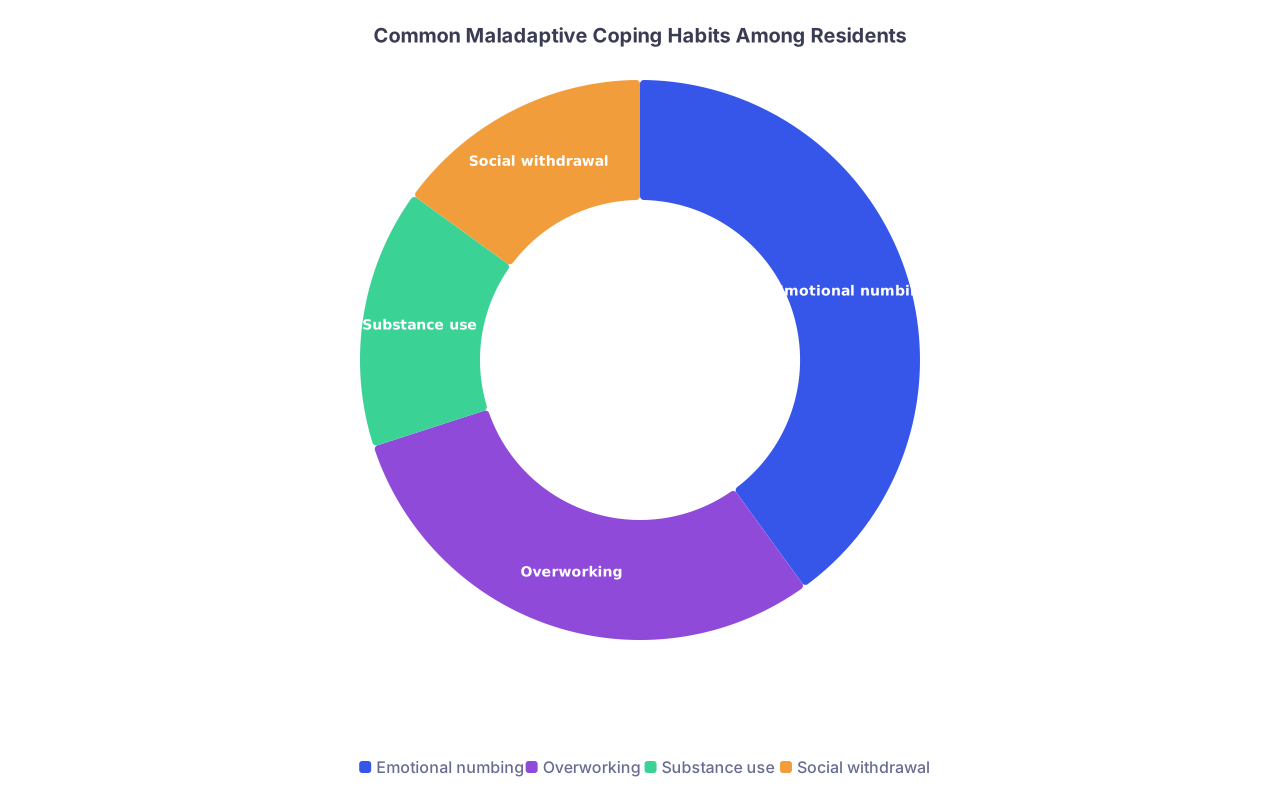
| Category | Value |
|---|---|
| Emotional numbing | 40 |
| Overworking | 30 |
| Substance use | 15 |
| Social withdrawal | 15 |
The red-flag pattern:
You avoid thinking about hard cases at all.
“I compartmentalize.” No, you offload and bury. You skip debriefs. You silence the discomfort with scrolling, drinks, or jokes about “dark humor” in medicine.You view empathy as a finite resource.
So you conserve it by blocking it. “If I let myself feel any of this, I will not function.” That is a belief, not a fact. And it becomes a self-fulfilling prophecy.You criticize colleagues who show emotion.
“He lost it in front of the family, that was unprofessional.” Sometimes yes. Often, it was human, and your discomfort is about your own emotional restriction.
Healthier alternative (that still works in real life):
- Build micro-debriefs. Two minutes with a co-resident after a code or a bad outcome: “That was rough. I am still thinking about X.” You do not need a 60-minute Schwartz Rounds every time.
- Allow small emotional signals. Tight throat, heavy chest, wanting to sit in your car for a few extra minutes. Pay attention. That is early warning, not weakness.
- Use ethics and values language, not only “burnout” language. Ask yourself: “Did I act in line with the kind of physician I want to be?” That reframes distress as moral information, not just “I am tired.”
When emotional numbness becomes the default, moral injury is not far behind.
4. Confusing Self-Sacrifice With Ethical Virtue
Many residents secretly believe: “If I am not suffering, I am not doing enough.” That belief will drive you straight into the ground.
This gets dressed up as medical ethics. “Patient first.” “Do what is best for the patient no matter what.” Noble on paper. Twisted in practice.
Typical pattern:
You skip meals because “I cannot leave my patients.”
Your glucose is 50, but at least the progress notes are signed.You stay late every single day “to help the team.”
Even when it means no sleep, no life, and building resentment that leaks into your tone with everyone.You think saying no is unethical.
Extra committee? Extra QI project? Another last-minute swap? You say yes and call it professionalism. It is not. It is people-pleasing in a white coat.
| Scenario | Healthy Response | Unhealthy Response |
|---|---|---|
| Post-call extra tasks | Help briefly, then leave on time | Stay 3 extra hours every time |
| Skipping meals | Step away for 10 minutes to eat | Go 10–12 hours with no intake |
| Extra research/QI offer | Accept selectively based on bandwidth | Say yes reflexively to everything |
| Coverage request on rare day off | Help occasionally with clear boundaries | Give up rest day repeatedly |
The ethical reality: A chronically depleted physician is not a moral victory. It is a patient safety risk. You are more likely to miss subtle exam findings, forget labs, misinterpret histories, snap at staff. That is not virtuous.
Ethically sound boundaries look like:
- “I can help for 20 minutes before I need to leave post-call.”
- “I need to grab food now. I will be faster and safer if I do.”
- “I cannot add another project right now and still care for my patients well.”
Your duty to patients does not erase your duty to preserve the clinician who cares for them. Those are linked obligations, not competing ones.
5. Toxic Comparison and the “Perfect Resident” Mirage
Residency magnifies insecurity. You are surrounded by high performers. Everyone has something impressive: first author, PhD, perfect Step scores, ridiculous procedural skills. Easy trap: measuring your worth against everyone else’s highlight reel.
I have watched entire cohorts quietly deteriorate under an arms race of externals: publications, letters from “name-brand” attendings, fellowships.
The subtle red flags:
You only feel good on days you look better than someone else.
Someone struggled more on rounds, you finally feel competent. That is a fragile, poisoned source of self-esteem.You constantly scan for what you lack.
“She already has three papers.” “He is so confident with families.” You ignore your own growth because you are too busy cataloging your deficits.Feedback becomes threat, not guidance.
Any constructive comment confirms your private fear: “I am the weak link.” You either shut down or overcorrect in unsustainable ways.
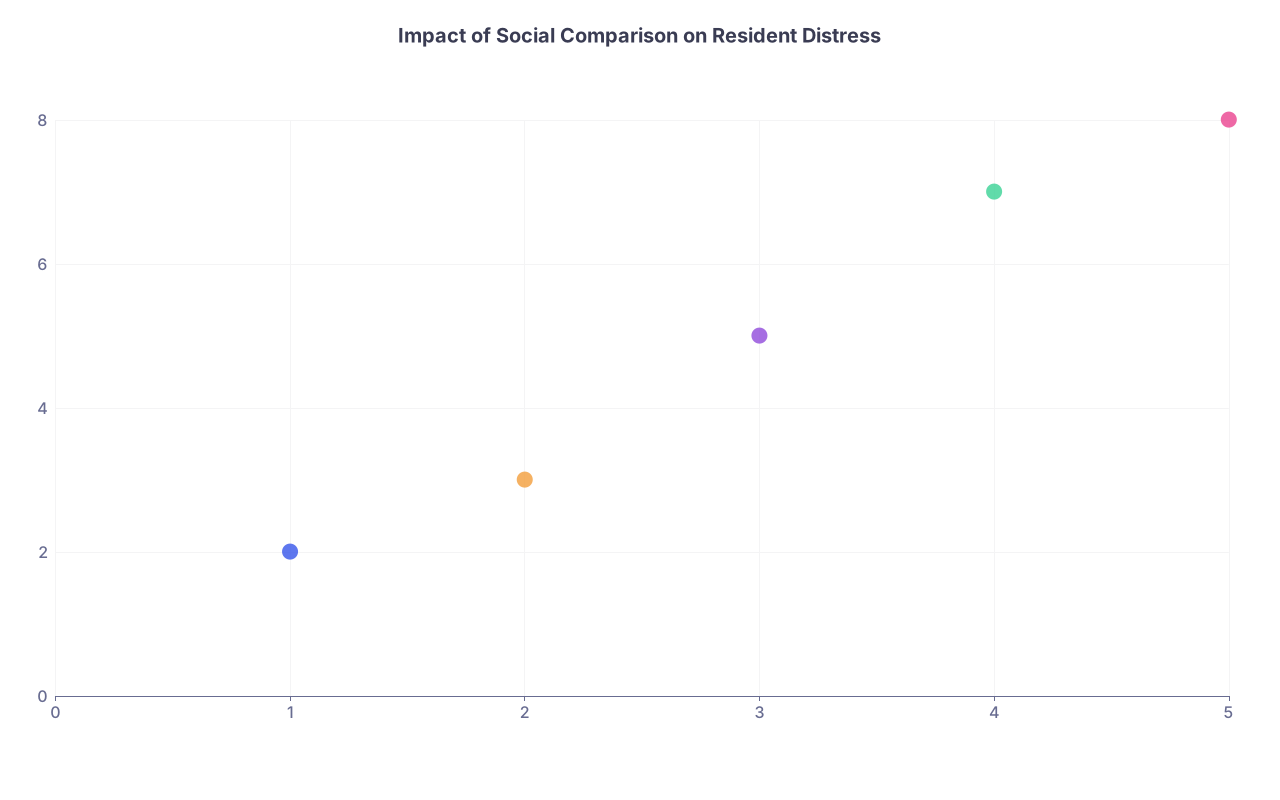
| Category | Value |
|---|---|
| Resident 1 | 1,2 |
| Resident 2 | 3,5 |
| Resident 3 | 4,7 |
| Resident 4 | 2,3 |
| Resident 5 | 5,8 |
(Think of x = intensity of comparison behaviour, y = distress level. The correlation is rarely your friend.)
Course correction:
- Define your own metrics. Three you control: preparation quality, communication with patients, professionalism under stress. Track those, not just scores and CV lines.
- Limit benchmarking. Once a quarter, fine—ask where you stand roughly. Daily self-ranking against co-residents? That is self-harm.
- Practice explicit self-recognition: end of the week, write down three concrete things you did better than a month ago. You need data to counter your brain’s habit of only logging failures.
If your mental health is tethered to always being the best, residency will break you. Because there is always someone better at something.
6. Avoiding Conflict Until It Becomes Resentment
Physicians are pros at avoiding direct conflict. You have been rewarded for being “easy to work with” your whole life. In residency, that often mutates into chronic self-silencing—and that eats away at mental health.
Red flags:
You say yes to everything, then vent in private.
You agree to extra shifts, unfair patient distributions, disrespectful comments. Then complain in the workroom. That is not conflict resolution. It is slow poison.You accept mistreatment as “just residency.”
Attending yells at you in front of a patient. Senior dumps scut work on you all month. You tell yourself, “This is how training is.” That belief is how abusive cultures persist.You never clarify expectations.
You stay anxious and over-function instead of asking direct questions: “What is your priority for sign-out?” “How do you prefer to handle disagreements on management?”

Healthier conflict habits (that do not blow up your evals):
- Use simple, neutral phrases:
- “I felt uncomfortable when X happened; can we talk about how to handle that next time?”
- “I am at capacity right now—what should I deprioritize if we add this task?”
- Document patterns, not one-offs. If an issue keeps recurring, write down specific dates and behaviours. It makes reporting or escalation more concrete and less emotional.
- Involve program leadership early for real toxicity. Waiting a year because you “do not want to be difficult” usually ends with you burned out and the toxic person untouched.
Avoiding all conflict does not keep you safe. It just keeps you voiceless.
7. Silent Moral Injury: When Your Values and Your Actions Diverge
This is the quietest and most corrosive red flag: acting against your own ethical compass so often that you stop recognizing yourself.
Examples I have actually heard on call:
- “We discharged that clearly unsafe patient because we needed the bed.”
- “We kept doing interventions that the family wanted but we all knew were futile.”
- “We documented a ‘thorough discussion’ that never really happened.”
One or two of these under pressure? Distressing but survivable. A steady stream, over months and years, with no language, no space, no shared acknowledgment? That is moral injury. And it feels different from burnout.
Burnout feels like: exhausted, depersonalized, low accomplishment.
Moral injury feels like: shame, guilt, anger, betrayal.

| Step | Description |
|---|---|
| Step 1 | Value conflict in patient care |
| Step 2 | No time or space to discuss |
| Step 3 | Repeat ethically gray situations |
| Step 4 | Justify actions to self |
| Step 5 | Chronic shame or anger |
| Step 6 | Moral injury - identity damage |
How to avoid this trap:
- Name the conflict explicitly. Even quietly to yourself: “What we are doing conflicts with my value of X.” That prevents silent internal erosion.
- Seek ethics consults not only for legal nightmares but for real gray zones. That is what they exist for.
- Debrief with peers about the moral layer, not just the medical one: “What bothered me was not the workload; it was feeling like I was lying to this family.”
Moral distress ignored turns into moral injury. And moral injury, left untreated, is one of the fastest routes to leaving medicine or staying in it while hating yourself.
8. Thinking You Are the Exception
The final, overarching red flag: believing all of this applies to “other residents,” but not to you.
“I am fine.”
“I can handle it.”
“I will rest after intern year / boards / fellowship applications / when I am attending.”
I have heard that progression from interns, then read their anonymous wellness survey a year later and seen: “I am not sure I want to be alive if this is the rest of my life.”
You are not immune because you are high achieving. You are more at risk. You will push harder, deny longer, hide better. That is how things blow up suddenly.

If you see yourself in several of these habits, do not dramatize it. Do not catastrophize. But do not ignore it.
Pick one lever to pull this month:
- Protect one regular non-medical activity.
- Set one explicit boundary at work.
- Have one honest conversation about how you are actually doing.
- Ask once, directly, for concrete support (coverage, schedule change, mental health resources).
Small, boring, consistent changes beat dramatic resolutions you abandon in a week.
FAQs
1. How do I know if what I am feeling is “normal residency stress” versus something more serious?
Red flags that it is beyond normal stress: persistent thoughts of not wanting to wake up, feeling hopeless most days, using alcohol or substances just to sleep or cope, losing all interest in anything non-medical, or colleagues saying “You do not seem like yourself lately.” If any of that is happening, you are past “just stress.” Get evaluated—by your physician, campus or hospital mental health, or an outside therapist if you want more privacy.
2. I worry that setting boundaries will hurt my reputation and evaluations. What is realistic?
If your “boundaries” are hostile or inflexible, yes, that can backfire. But calmly protecting basic needs—leaving on time post-call, taking short breaks, saying no to extra nonessential work when you are overloaded—is not unprofessional. The residents who quietly command respect are usually the ones who combine reliability with clear limits. Frame your boundaries in terms of providing safe patient care and sustainable performance; most reasonable attendings will respond well.
3. What if my program culture is genuinely toxic and dismissive of mental health?
Then pretending it is fine will not save you. Document patterns, find allies (co-residents, supportive attendings, program leadership not tied to the problem), and use institutional channels—GME office, ombuds, union if you have one. At the same time, protect your own exit options: keep your performance solid, update your CV, and, if needed, quietly explore transfer. You are not obligated to sacrifice your long-term mental health to “prove” you can tolerate a broken system.
4. Is it ethically acceptable to prioritize my own well-being when patients need so much?
Not only acceptable—it is ethically required. You have an obligation to provide competent, safe, compassionate care. Chronic self-neglect undermines all three. No patient benefits from a physician who is cognitively impaired by sleep deprivation, emotionally numbed, or secretly suicidal. Think long term: the patients you will see over a 30–40 year career need you intact. Protecting your well-being is not choosing yourself over patients; it is choosing the only version of you that can truly help them.
Remember:
- Habits that look like dedication—overwork, numbness, self-erasure—are often red flags, not virtues.
- You cannot out-tough biology, ethics, or identity. They will collect their debt eventually.
- Catch the quiet mistakes early, adjust course in small, concrete ways, and you vastly increase the odds that you finish residency as a physician who is not only competent—but still recognizably yourself.