
It’s 2:37 a.m. You’ve just walked out of a room where a patient coded and died. The intern is crying in the supply room. The senior is double-checking the orders. You go to the workroom, sit down, and open Epic.
You think you’re invisible right now. You’re not.
There are no cameras pointing at you, no formal evaluation open. But the program director is going to hear about this night. Not the details you’re obsessing over—what dose you chose, which lab you missed—but how you acted, what you said, how you held up, and who you checked on after.
This is what people outside the leadership circle never quite understand:
Program directors and faculty are constantly tracking your wellness and resilience. Quietly. Informally. In ways you do not see and do not control. And it absolutely affects how they rank you, promote you, and trust you.
Let me walk you through how it really works.
What PDs Actually Mean by “Wellness” and “Resilience”
Forget the posters and the pizza parties for a minute.
Inside the PD meetings, wellness and resilience get translated into a few blunt questions:
- Can this person function safely when they’re stressed and tired?
- Are they headed toward burning out, quitting, or becoming a liability?
- Do they recover after getting hit, or do they spiral?
- Would I trust them with my sickest patients at 3 a.m.?
Nobody is opening a PowerPoint titled “Resident Wellness Scorecard.” That’s not how this runs. It’s a pattern-recognition process. Over months. Across rotations. Through faculty gossip, nursing comments, and your own behavior.
And here’s the part no one says out loud: they are way more worried about the resident who looks “fine” and quietly deteriorates than the resident who cries once in front of them. The visibly upset person is easy to intervene on. The one who looks robotic, over-functioning, or “too tough” is what keeps a good PD up at night.
The Invisible Data Streams: How They Really Watch You
Let me break down the hidden channels where your wellness and resilience are being inferred. None of these look like “wellness evaluations” on paper—but that’s exactly what they are.
1. Nursing and Staff Comments (The Most Honest Feedback You’ll Never See)
PDs listen obsessively to nurses, techs, and unit clerks. Because they see you at your real baseline.
You might think your best-attending-facing self is what defines you. It isn’t. The 2 a.m. you, with three admits and a crashing patient, is what defines you.
Here’s what quietly gets reported up:
- “He snapped at the nurse when she called him.”
- “She always says ‘I’ll get to it when I can’ in this flat voice. Looks checked out.”
- “He seemed… off his game this month. Tired. Distracted.”
Sometimes it’s explicit: “I think he’s burned out.” Most of the time, it’s subtle: “Is everything okay with her? She seems different than last year.”
That small comment may become a five-minute conversation in the PD’s office. If there are multiple similar comments from different rotations, it is no longer random noise. It’s a pattern.
And resilience? Nurses have a good sense of that too. They notice who:
- Still says “thank you” on their tenth page.
- Decompresses without being mean, dismissive, or dark to the point of concerning.
- Comes back the next day after a brutal shift and still functions.
They tell us those stories too.
2. Informal Faculty Debriefs: The “How Are They Holding Up?” Question
Here’s a phrase that comes up all the time behind closed doors:
“How is she holding up?”
Not “How smart is she?” Not “Is he ready for fellowship?” That comes later. First: are you cracking?
After a rough rotation—ICU, trauma, night float—the PD will often pull the attending aside or send a quick email: “Hey, how did X do? Any concerns? How are they coping?”
This is where your resilience narrative gets built.
Signals we look at:
- Do you show insight? “Last week was rough; I talked to my co-resident and my advisor about it.”
- Do you show growth? “I was really shaken by that case but I think I handled the next one better.”
- Do you shut down? “They just seemed… emotionally absent. Doing tasks but not present.”
- Do you explode? “They took the code personally and were angry at everyone for days.”
I’ve seen residents sail through clinically but get flagged because faculty say things like, “She seems very brittle. Any setback hits her like a truck.” That’s resilience data, whether you like it or not.
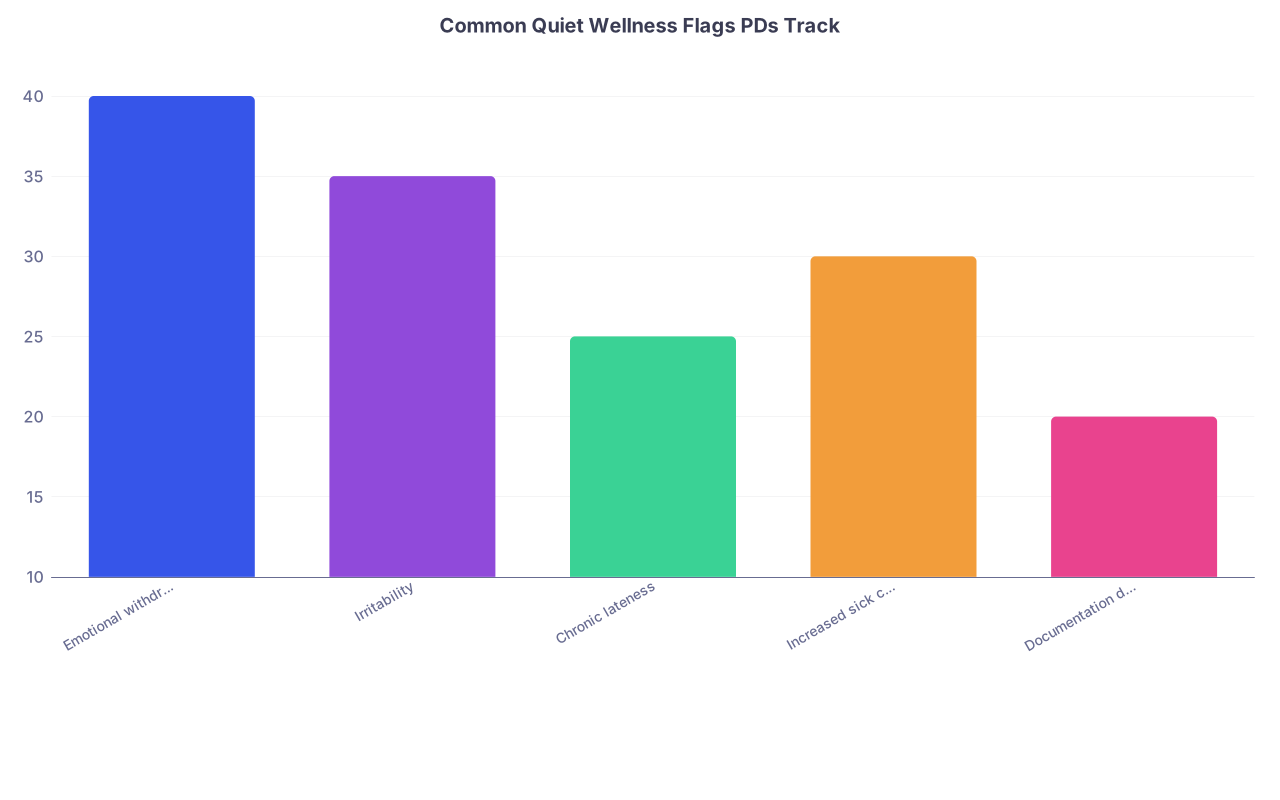
| Category | Value |
|---|---|
| Emotional withdrawal | 40 |
| Irritability | 35 |
| Chronic lateness | 25 |
| Increased sick calls | 30 |
| Documentation delays | 20 |
3. Attendance, Tardiness, and Sick Calls (Your Behavioral Vitals)
Programs track your absences more carefully than you think. Not because they’re obsessed with “face time,” but because changes tell a story.
Patterns that trigger hallway conversations:
- A resident who never used to call out now has three sick days in a month.
- Chronically late to sign-out after a big string of nights.
- Leaving exactly on the hour, every single time, after previously staying engaged.
Do some people abuse sick days? Sure. But PDs are usually more worried about the opposite: the resident who refuses to call out, dragging themselves in clearly unwell, physically or psychologically. That is how errors happen. That is how sentinel events happen.
Your wellness and resilience picture here is simple:
Are you able to recognize your own limits, before you endanger patients or yourself?
Residents who come to the PD and say, “I think I need one day off to regroup before I go back to nights” actually score higher on the resilience-trust scale than the ones who insist they’re fine while falling apart.
4. How You Behave After Bad Outcomes
Every program has kid-gloves protocols for formal debriefings now. That’s the public version.
The real assessment starts the minute the dust settles.
You have a bad code. A preventable error. A child death. A horrific trauma. Your reaction is being watched from multiple angles:
- Do you disappear?
- Do you become blame-focused and hostile?
- Do you pretend you’re unaffected, almost performatively “tough”?
- Do you ask for feedback and processing space?
The PD hears some version of this:
“After that code, he stayed to help with the family, then asked me later if we could debrief what went wrong. He was visibly upset but appropriate.”
or
“After the bad outcome, she was joking about it inappropriately. It felt like she was trying too hard to prove it didn’t affect her. Staff were uncomfortable.”
or
“He shut down. Minimal talking. Came in the next day and was a robot. I’m worried.”
Nobody expects you to be unbreakable. That’s a myth. The people we trust the most are the ones who process, adapt, and then keep functioning without becoming reckless or numb.
The Subtle Red Flags: Things You Think Don’t Matter (But Do)
Let me call out a few behaviors that scream “wellness problem” or “fragile resilience” to experienced faculty, even though residents often think they’re neutral.
1. Constant Self-Deprecation or “I’m the Worst” Jokes
Moderate insecurity is normal. The nonstop “I’m trash,” “I’m a terrible resident,” “I don’t belong here” humor? Faculty pick up on that.
To your peers, it reads as dark humor. To leadership, if repeated, it reads as:
- Possible imposter syndrome out of control.
- A self-concept that’s too fragile for increased responsibility.
- Higher risk of depression or disengagement.
They won’t write you up for it. But they absolutely log it mentally.
2. Social Withdrawal from Your Class
You stop showing up to anything optional. You avoid sign-out banter. You’re “too busy” for every group thing. Your co-residents start saying, “I don’t really know how he’s doing; he just goes home.”
PDs care deeply about this one. A resident isolated from their class has fewer buffers. Less support. Worse safety net when things go bad.
When chiefs say in a meeting, “We’re a little worried about her, she seems disconnected from the class,” the PD hears: elevated wellness risk.
3. The “Hyper-Competent But Dead-Eyed” Resident
Every program has one. Perfect notes. Perfect presentations. Efficient. Never complains.
And looks emotionally empty.
PDs don’t celebrate that. The good ones are uneasy about it. Because it can mean:
- Massive compartmentalization
- Burnout that has simply hardened over
- A functional shell around someone not processing anything
Residents are shocked when those people get pulled aside “for wellness,” because they assume only the visibly struggling get flagged. No. The emotionally absent get flagged as well.
How They Track You Over Time (And When They Decide to Intervene)
This isn’t about one bad week. Nobody cares that you were cranky once on a post-call day. We all have those days.
Programs see you like a trendline, not a snapshot.
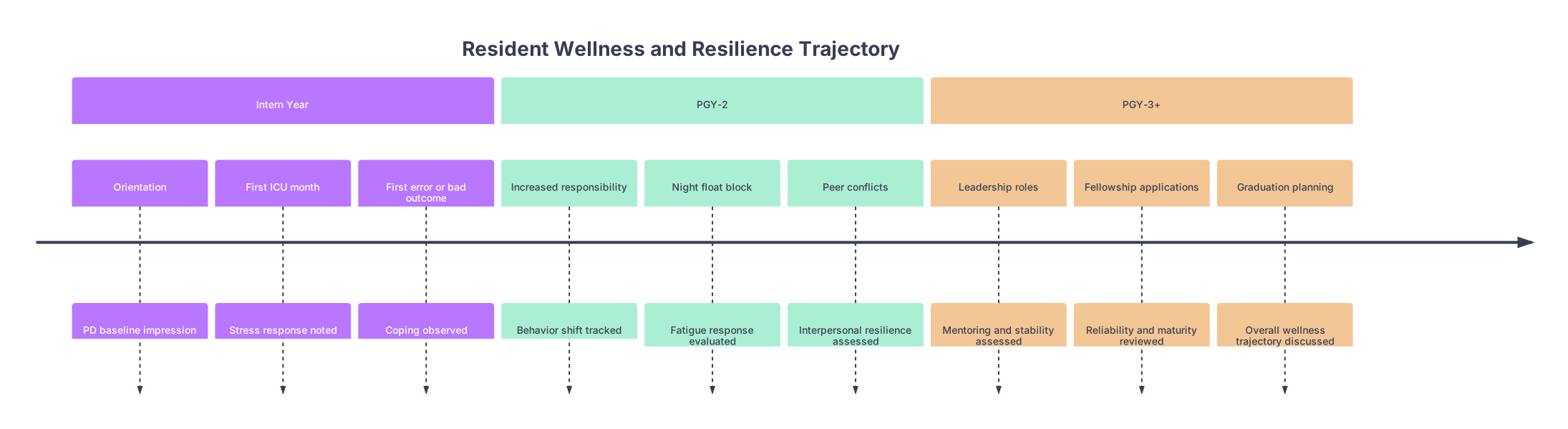
| Period | Event |
|---|---|
| Intern Year - Orientation | PD baseline impression |
| Intern Year - First ICU month | Stress response noted |
| Intern Year - First error or bad outcome | Coping observed |
| PGY-2 - Increased responsibility | Behavior shift tracked |
| PGY-2 - Night float block | Fatigue response evaluated |
| PGY-2 - Peer conflicts | Interpersonal resilience assessed |
| PGY-3+ - Leadership roles | Mentoring and stability assessed |
| PGY-3+ - Fellowship applications | Reliability and maturity reviewed |
| PGY-3+ - Graduation planning | Overall wellness trajectory discussed |
What triggers real action is:
- A clear worsening trend over 3–6 months.
- Multiple data sources: nurses + peers + attendings.
- A specific event where your behavior scared someone.
Then the PD moves from “quietly tracking” to “directly intervening.”
That intervention can look like:
- A “check-in” meeting that you think is casual but isn’t.
- Strongly encouraging therapy or the employee assistance program.
- Modifying your schedule: fewer nights, different rotation order.
- Rarely, pulling you from service or requiring fitness-for-duty evaluation.
And yes, they document. Not in a “black mark on your permanent record” way at first, but in a “we noticed a concerning trend and offered support” way. If you resist every attempt and continue to deteriorate, then it starts to affect promotion decisions, letters, and how hard they go to bat for you.
The Part You Don’t See: How Your Wellness Affects Your Career Opportunities
Let me be blunt. When PDs sit down to write your letters, select chief residents, or rank people for “dream opportunities,” they are not just asking:
“Who is the smartest?”
They’re asking:
“Who can handle the stress of fellowship X without decompensating?”
“Who has shown they recover after getting punched in the face by this system?”
I’ve watched PDs choose:
- The slightly less dazzling resident who had a steady, resilient trajectory for a competitive fellowship over the rockstar who had multiple near-meltdowns and constant interpersonal drama.
- The quiet, emotionally present intern who sought help early after a rough year as a chief over the charismatic but fragile resident who never acknowledged their limits.
You think resilience is some fluff category. It is not. It’s viewed as an actual clinical competence. Because medicine will break you in ways no exam can measure if you don’t have it.
| Attribute | Resident A (Trusted) | Resident B (Risky) |
|---|---|---|
| Response to mistakes | Owns, seeks feedback | Blames, deflects |
| After bad outcomes | Processes, returns | Withdraws or explodes |
| Uses support systems | Yes, early | No, or only in crisis |
| Attendance pattern | Stable | New changes, erratic |
| Peer reputation | Steady, reliable | “We’re worried” |
How to Show Healthy Resilience Without Performing
You don’t need to fake anything. In fact, fake “resilience” reads as brittle and performative. The people who try hardest to look unbothered are often the ones we worry about most.
Here’s what actually lands well with PDs and faculty.
1. Be Honest in Small, Controlled Ways
“I’m tired, this month has been rough, but I’m managing. I’ve been making sure to sleep post-call and I talked to my mentor about it.”
That kind of sentence checks multiple boxes in our heads:
- Insight
- Basic self-care
- Use of support without drama
Versus: “I’m fine.” Every single time. Dead voice. Shut down. That’s not strength. That’s a wall.
2. Use the Systems They Built—That’s Not Weakness
The wellness committee, the peer mentor, the confidential therapist they recommend—those exist because PDs have watched residents implode without them.
When you use these, PDs think:
“Good. They’re taking this seriously. Lower risk of catastrophic burnout later.”
They do not think: “This person is weak.” That’s what insecure co-residents say to each other at 1 a.m., not what good program leadership thinks.
3. Show Recovery, Not Invulnerability
You will get knocked down. You will cry. You will have days where you question why you chose this field at all. The difference between residents we trust and residents we worry about is:
Can you recover?
Recovery looks like:
- You had a terrible week. You talk about it. You readjust. Two weeks later, you’re functioning better.
- You made a mistake. You felt awful. You learned, ask for feedback, and your next similar case goes smoother.
That’s resilience. Not “I never struggle.” But “I struggle and then get back up without destroying myself or others.”
The Ethics Layer: When “Tracking Wellness” Crosses the Line
Let’s talk about the uncomfortable part.
There are programs that weaponize wellness tracking. They use concerns as a pretext to sideline residents they don’t like, to push someone out instead of helping them, or to label folks as “difficult” when they’re actually just advocating for themselves.
There are also programs that ignore obvious cries for help until there’s a catastrophic event, then suddenly decide they always “had concerns.”
Ethically, here’s what should be happening:
- Wellness concerns should trigger support, not punishment.
- Seeking help should never be held against you in letters, promotion, or references.
- Patterns of dangerous behavior (substance issues, aggression, repeated unsafe practice) should be addressed directly, not hidden under vague “wellness” language.
The best PDs are constantly walking a tightrope: protecting patient safety, protecting you from this system, and also protecting the program from legal and accreditation blowback. It’s messy.
You will sometimes feel watched and judged unfairly. Sometimes you will be. But here’s the quieter truth: many PDs are actually more protective of struggling residents than residents realize. They just cannot say everything they’re doing behind the scenes to keep you afloat.
How to Use This Knowledge Without Becoming Paranoid
The goal here is not for you to start acting like every word is being scored.
Here’s the mindset shift:
- Assume your behavior under stress is being noticed.
- Assume changes in your baseline (withdrawal, irritability, erratic attendance) will be discussed eventually.
- Assume asking for help is seen as a sign of maturity, not failure, in most sane programs.
Then live like a human being.
You don’t need to curate an image. You need to avoid two extremes:
- The martyr who never admits struggle and then explodes.
- The chronic victim who externalizes everything and never adapts.
You are allowed to be shaken by this work. You are allowed to be tired. You are allowed to cry in a stairwell. Resilience is what you do after that.
And yes—someone is always watching the after.