
The politics of asking for a mental health day in residency are far uglier than anyone tells you on interview day.
You’re sold “we care about wellness” on glossy slides. What you’re not told is how your text about needing a day off gets screenshotted, how your name gets floated at the CCC meeting, and how one badly-timed “I’m not okay” can follow you for the rest of residency.
Let me walk you through what actually happens behind the curtain when you ask for a mental health day—and how to protect yourself without destroying your credibility.
What Really Happens When You Ask for a Mental Health Day
Let’s start with the uncomfortable truth: your request does not live in a vacuum. It moves through a system. And that system has its own pressures, biases, and unwritten rules.
Here’s the chain I’ve actually watched play out in programs:
You send a message to the chief: “I’m really struggling today. I don’t feel safe to come in. I need a mental health day.”
The chiefs are stuck. They are residents, but they’re also middle management. They have:
- Holes in the schedule
- An overbooked service
- Angry attendings texting at 5:30 a.m.
- A program director who has already warned, “We can’t keep calling out last-minute; it’s not sustainable.”
So your message triggers a mini-emergency. Chiefs start scrolling the schedule. Who can be pulled from clinic? Who’s on an “easy” elective? Who owes a favor?
And then the politics start:
- “Is this their first time asking or the fourth?”
- “Are they generally solid or are they already on our radar?”
- “Is this right before an exam / after a hard stretch / after vacation?”
No one says, “Are they suicidal?” They say, “Can I trust them with a hard block next month?”
That’s the ugly part. Your mental health request gets interpreted not as a safety issue, but as a reliability data point.
And it doesn’t stop there. The chiefs may loop in:
- The chief of service (“We’re short again.”)
- The associate program director who “handles wellness.”
- The PD if this isn’t your first time.
Now your one private “I need help” has quietly become a mini case study: “How do we manage Resident X?”
The Unwritten Rules Program Leadership Actually Use
I’ve sat in rooms where this was discussed openly. No slides. No emails. Just frank talk.
Program directors—and even more so, chiefs—use a rough mental algorithm. It’s not in a handbook, but it’s very real:
- One-off, clearly situational mental health day
→ “Fine. They’re human. We’ll cover.” - Repeated last-minute calls on high-intensity rotations
→ “We have a pattern. We need to watch this.” - Vague, dramatic wording without follow-through care
→ “Are they manipulating the schedule?” - Clear, concrete concern with documented follow-up (therapy, PCP, EAP)
→ “They’re struggling but responsible. Let’s support them.”
Is this fair? Not always. But this is what happens when resident wellness collides with patient care, service coverage, and ACGME requirements.
Most programs are not malicious. They’re overwhelmed. But overwhelmed systems default to protecting the machine. And residents who use mental health language imprecisely or impulsively get labeled. Fast.
How Your Request Actually Gets Remembered
Let me be clearer: the single biggest thing that determines how your mental health day is received is your baseline reputation.
I’ve heard variations of this line so many times it might as well be printed on the door:
“Good residents get the benefit of the doubt. Marginal residents get ‘performance concerns.’”
So if you’re usually:
- On time
- Prepared
- Collegial
- Reliable about cross-coverage, notes, and follow-up
Then when you say, “I’m not okay to work; I need to step back for today,” people tend to believe you. They may grumble about coverage, but they don’t start whispering about “fitness for duty” immediately.
But if:
- You’ve been late repeatedly
- You’re behind on notes
- You’ve had attitude issues
- You’re already the subject of “we should keep an eye on them”
That same request becomes evidence. Another data point. “You see? This is what we’ve been talking about.”
Is that fair? No. But if you think fairness protects you, you’re not paying attention.
Your job is to understand the game you’re stuck inside—and then use that knowledge to protect both your sanity and your career.
The Language That Sets Off Alarm Bells (and What to Say Instead)
You’ll never hear this from your PD, but attendings and chiefs absolutely talk about “phrasing risk.”
Certain phrases in texts or emails flip switches:
Red-flag phrases that escalate quickly:
- “I can’t do this anymore.”
- “I’m at my breaking point.”
- “I’d rather die than go in today.”
- “I’m completely done.”
- “I don’t care what happens with this job anymore.”
I’ve watched those exact words turn a simple “I need time” into:
- An urgent wellness check
- Mandatory fitness-for-duty evaluations
- Involvement of GME, HR, and sometimes legal
Sometimes that’s exactly what’s needed. If you’re actively suicidal, you need that level of response. Full stop.
But sometimes a resident is venting. Or being dramatic at 3 a.m. on call. And they think they’re just “being honest.”
Leadership does not hear “honest.” They hear “liability.” And once that word appears in a written record, it lives in your file.
Safer, still honest phrasing when you’re not in immediate danger:
- “I am not in a mental state where I feel safe to provide patient care today.”
- “I’m experiencing severe anxiety/depression symptoms and I don’t feel clinically safe.”
- “I need to take a mental health day and I’m following up with my therapist/PCP.”
That tells them three things:
- Patient care risk is real.
- You’re using clinical language, not drama.
- You’re taking responsibility for getting help.
If you are in crisis, drop the filters and ask for emergency help. But if you’re not, choose language mechanically, not impulsively.
How Coverage Really Works (and Why Timing Matters)
Here’s another quiet truth: programs are much more tolerant of mental health days when they can cover you without setting fire to the schedule.
There are rotations where your call-out is relatively painless:
- Research blocks
- Electives
- Outpatient clinics with squeeze-in capacity
- Lighter ward months with stable censuses
Then there are rotations where one absence is chaos:
- ICU during winter surge
- Night float when there’s only one resident per unit
- Small subspecialty services (hemonc, transplant) with fragile coverage
- Trauma or busy surgical services
Same mental health need. Completely different downstream cost.
I’ve seen chiefs say, “If they’d asked yesterday, I could’ve fixed this. Asking at 5:45 a.m. while the attending is driving in is a disaster.”
Timing does not change whether you’re suffering. But it absolutely changes:
- How angry attendings get
- How chiefs talk about you later
- Whether your PD hears, “They’re struggling but trying,” or “They dumped this on us.”
When you can feel yourself sliding, don’t wait until you’re already at the breaking point and on the worst possible day. The earlier you speak up, the more humane the response tends to be.
Documentation, Paper Trails, and Your Permanent Record
Let me spell out something no one likes to talk about: GME and HR do not erase things.
If your situation escalates to:
- Formal leave of absence for mental health
- Fitness-for-duty evaluation
- Probation related to “professionalism” or “reliability” with mental health components
Those events generate documents. Those documents live in systems that are not entirely inside your control.
Now, that does not mean you should hide everything or never take leave. People take mental health LOAs and match into competitive fellowships. I’ve seen it.
But understand the tradeoff:
- Informal, one-off mental health days that never escalate
→ Often live only in chief texts and shift logs. They fade. - Repeated concerns with no follow-up plan
→ Push leadership to “formalize” something. That means documentation. - Clear, appropriate escalation into well-handled leave, with good recovery and performance afterward
→ Becomes a story of resilience, not a scarlet letter.
If you end up needing extended time off, you’re better off doing it deliberately with:
- An actual treating clinician
- A defined plan
- Clear communication about return-to-work expectations
than accidentally stumbling into forced leave because everyone panicked.
How to Ask for a Mental Health Day Without Torching Your Reputation
Let’s get practical. Here’s how residents who survive this dance handle it.
They manage three things carefully:
- Pattern
- Communication
- Follow-through
Pattern: If you’re taking multiple days over a few months, you need a bigger plan than “call out when it’s unbearable.” That’s not a sustainable system for you or the program.
Communication: You keep it:
- Direct
- Brief
- Focused on patient safety
- Not performative
Something like:
“Hi [Chief Name], I’m having severe psychiatric symptoms today and I don’t feel safe providing patient care. I need to take a mental health day. I’ve already contacted my [therapist/PCP] and I’m working on a longer-term plan. I’m happy to discuss this further with [APD/PD] if needed.”
Notice what this does:
- Flags a real problem
- Emphasizes safety
- Signals you’re not ignoring treatment
- Shows willingness to engage instead of hiding
Follow-through: This is where most people blow it. They take the day, then act like it never happened.
The residents who regain trust do this instead:
- They actually go to therapy, urgent care, or their PCP.
- They send a brief follow-up to the APD or PD: “I’m getting care. Here’s the plan.”
- On return, they show up on time, do their work, and don’t milk it.
Your goal is not to convince anyone you’re fine. Your goal is to show that you’re taking your own mental health seriously enough that they don’t have to police you.
The Ethical Tension: Patient Safety vs. “Toughing It Out”
There’s a brutal ethical tension here that residents feel every day.
On one hand: you know working while severely depressed, anxious, sleep-deprived, or dissociating is unsafe. For you and your patients.
On the other: you also know calling out will dump your work on a co-resident who’s just as fried as you are. And you’ve internalized the messaging: “We’re a team. We show up.”
Here’s the quiet consensus among the better program directors I’ve known:
- If you are a genuine danger to patients—can’t think, can’t focus, intrusive suicidal thoughts—you must step away. That is a duty.
- If you are deeply burned out but technically functional, they would rather you stay—but they also recognize that training built entirely on “gut it out” is how people end up in disaster.
So where do residents draw the line, in reality?
- They drag themselves in on many days they shouldn’t.
- They call out when the thought of touching a patient chart genuinely terrifies them.
- They delay getting care until they’re forced to.
That’s the silent moral injury you’re watching in real time.
Your ethical obligation is not martyrdom. It’s to avoid becoming the impaired physician you fear—and that sometimes means taking the hit of asking for help earlier than feels comfortable.
Power Dynamics: Who You Tell, and How
Not all listeners are equal.
There are roughly four tiers of people you might bring into this:
- Close co-residents / friends
- Chief residents
- Program leadership (APD/PD)
- Institutional structures (GME, HR, occupational health)
Most residents overuse (1) and wait far too long to involve (2) and (3). They avoid (4) entirely until it’s forced.
The smarter move is:
- Be more honest, more often, with chiefs and one trusted faculty member before you completely unravel.
- Use peers for emotional support, but don’t rely on them to solve structural problems.
- Don’t assume involving leadership automatically ends your career; often it does the opposite, because now they’re invested in you not crashing.
I’ve seen PDs fight for residents who were transparent, engaged in care, and serious about getting better. I’ve also seen them lose patience fast with residents who kept secretly calling out, disappearing, or playing games with documentation.
You don’t have to tell your darkest details. But you do need to give leadership enough to understand that:
- This is real.
- You’re not trying to game the system.
- You’re willing to do some work to get better.
Strategic Self-Protection: Build Credibility Before You Need It
Wellness isn’t just yoga and snacks. It’s also professional capital.
Residents who survive rough mental health periods without permanent damage tend to have one thing in common: a bank of trust they’ve built up already.
They:
- Volunteer occasionally for unglamorous shifts.
- Communicate early about issues (“I’m falling behind on notes; I need help prioritizing.”)
- Own their mistakes without defensiveness.
- Are kind to nurses, staff, and juniors—people whose opinions travel back to PDs.
So when they say, “I can’t be there today,” people believe them.
If you’re early in training, start building that bank now. Not to be fake, but because you will absolutely need people in power to assume good faith when you’re at your worst.
That’s not manipulation. That’s survival in a system that’s still catching up to the idea that physicians aren’t machines.
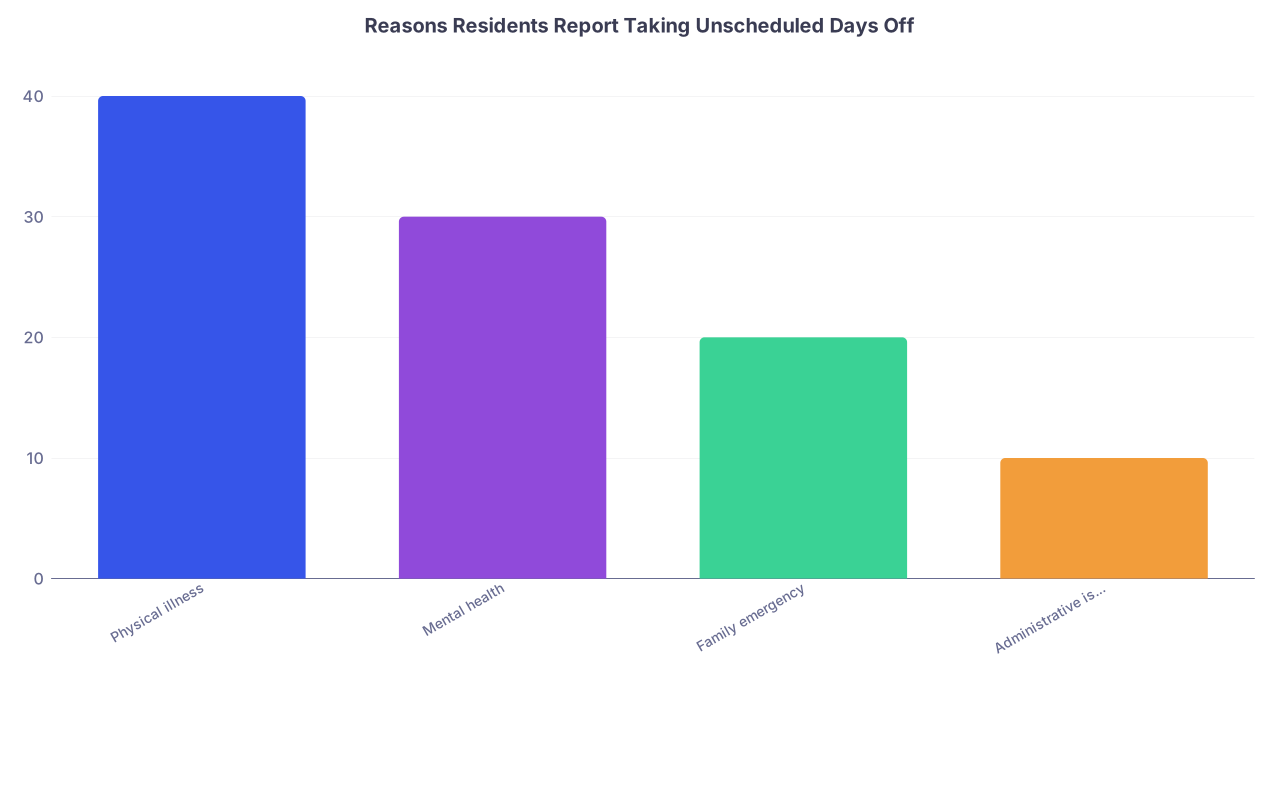
| Category | Value |
|---|---|
| Physical illness | 40 |
| Mental health | 30 |
| Family emergency | 20 |
| Administrative issues | 10 |

| Step | Description |
|---|---|
| Step 1 | Resident messages chief |
| Step 2 | Chief arranges coverage |
| Step 3 | Email note to APD or PD optional |
| Step 4 | Pattern noticed |
| Step 5 | Chief informs APD |
| Step 6 | Formal evaluation or leave |
| Step 7 | Monitoring and wellness referral |
| Step 8 | First time this year |
| Step 9 | Concern for safety |
| Situation | Safer Approach | Risky Approach |
|---|---|---|
| Not in crisis but overwhelmed | Brief message, safety-focused, mention seeking care | Vague “I can’t do this” rant |
| Recurrent absences | Loop in PD/APD, formal plan | Keep calling out last-minute |
| Returning after day off | Short follow-up, show engagement | Pretend nothing happened |
| Considering LOA | Planned with clinician + GME | Forced after chaotic episodes |
FAQs
1. Will asking for a mental health day ruin my chances at fellowship?
Not by itself. Programs and fellowships care about performance trends and professionalism, not a single day off. A well-handled mental health episode—with documented treatment and solid later performance—often becomes a story of growth, not weakness. Where people get burned is with chronic, unexplained absences, poor communication, and declining performance that’s never addressed.
2. Should I say “mental health day” explicitly or just “sick day”?
If this is a one-off and you’re not in crisis, “I’m sick and not able to come in safely” is often sufficient and protects your privacy. Once this becomes recurrent or serious, hiding the mental health component backfires. At that point, being explicit with chiefs/PD—at least in broad strokes—is smarter and gives them room to support you without assuming you’re being dishonest.
3. Can a program force me to get a mental health evaluation?
Yes, through “fitness for duty” pathways, especially if they believe patient safety or your safety is at risk. That usually routes through GME, occupational health, or an affiliated clinician. It’s uncomfortable and often feels accusatory, but it’s also how institutions protect themselves and, sometimes, protect you from being pushed beyond your limits.
4. How many mental health days is “too many”?
There’s no official number, but patterns matter more than raw counts. Three scattered days across a brutal year with clear communication and ongoing care? Most programs will tolerate that. Three last-minute call-outs on ICU nights over two weeks with vague explanations and no follow-up? That’s the kind that lands you on an agenda at the next CCC meeting.
5. What if my chief or PD is dismissive about mental health?
Then you go around them, not through them. Use institutional resources: GME office, ombudsman, employee assistance programs, or a trusted faculty advocate in another department. Document concerning responses in real time (dates, what was said). Programs are under heavy scrutiny on wellness and impairment now. A leader who’s blatantly dismissive is not just unkind—they’re a liability to the institution, and that gives you leverage.
Key points to walk away with:
- Asking for a mental health day lives inside a political system—your reputation, your wording, and your timing all shape how it’s received.
- Use clear, safety-focused, non-dramatic language and follow through with actual care; that preserves both your integrity and your professional future.
- Build trust early, ask for help before you’re completely shattered, and remember: protecting your mind is not selfish—it’s part of being a safe physician.