
The way programs say they handle burnout and what actually happens behind closed doors are two very different stories.
Let me walk you through the real one.
The First Thing You Need to Know: Burnout Is Managed Like Risk, Not Like Illness
Publicly, your institution talks about wellness, resilience, and “supporting trainees.” Behind the scenes, most programs manage burned-out residents the same way a hospital manages a potential malpractice claim: as a risk to the system.
Not because they are evil. Because the incentives are misaligned.
Your PD, APDs, and chiefs are quietly running three mental calculators the moment someone flags you as “struggling” or “burned-out”:
- Clinical risk – Are patients going to get hurt?
- Accreditation risk – Is this going to trigger ACGME problems?
- Program reputation risk – Will word get out that this program is unstable or unsupportive?
Your well-being is in there too. It is just not always first.
So when you show up crying in the work room, or you finally ask for help after months of white-knuckling it, here’s what actually happens.
How Burnout Usually Gets Noticed (Hint: Not the Way You Think)
Most residents think burnout gets “noticed” when they finally admit it. No. Programs almost always see the smoke long before you walk into the PD’s office.
Here’s how it really shows up.
Informal reporting: the whisper network
The first signs often come as quiet comments:
- “Hey, have you noticed Alex is snapping at nurses a lot lately?”
- “She’s always late to sign-out now; that’s new.”
- “He looks rough… he was nodding off in conference again.”
It’s the nurses, senior residents, and fellows who catch it first. They mention it to the chief. The chief mentions it to the APD. A mental note is made: watch this one.
You don’t see any of this, but a file has just been opened on you. Not necessarily in writing. Mentally.
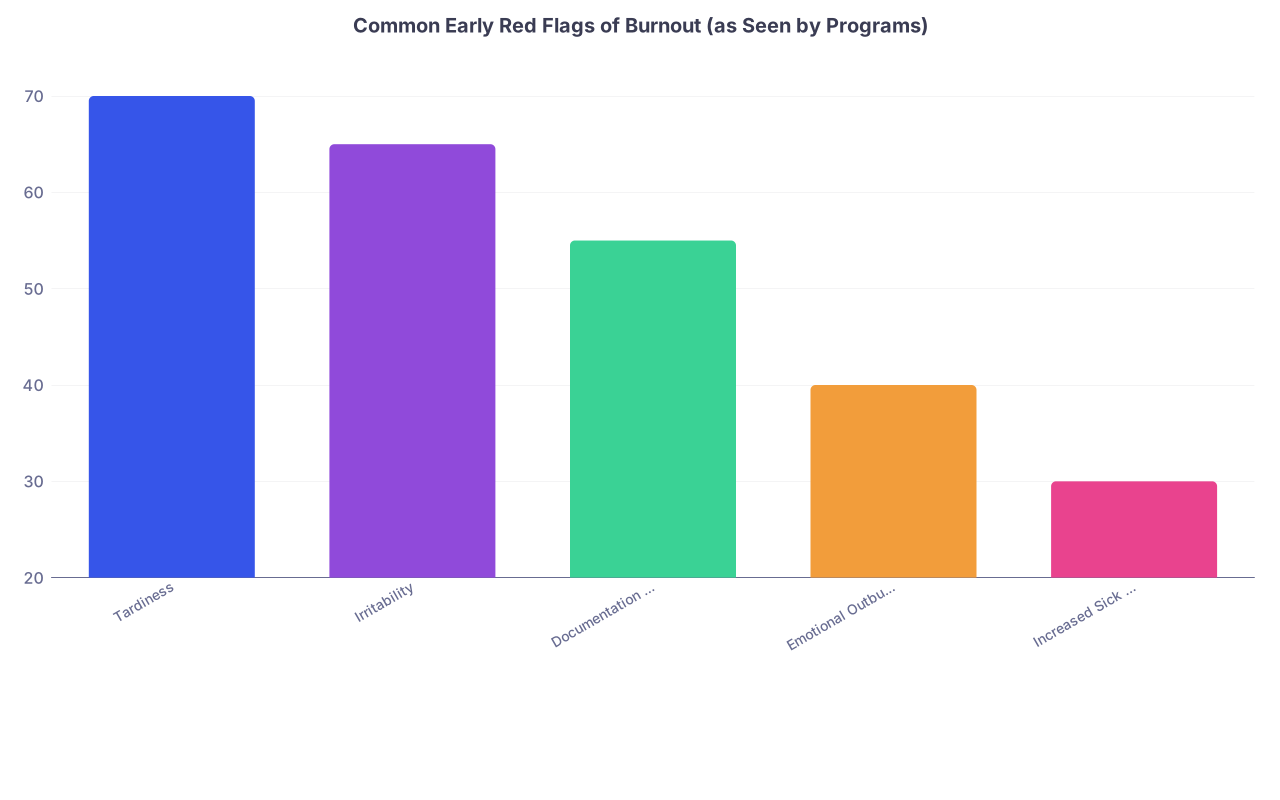
| Category | Value |
|---|---|
| Tardiness | 70 |
| Irritability | 65 |
| Documentation Delays | 55 |
| Emotional Outbursts | 40 |
| Increased Sick Days | 30 |
Those numbers roughly reflect how often I’ve heard these cited in faculty meetings over the years. Tardiness and irritability come up constantly. Hardly anyone says, “I think they’re burned out and suffering.” They say, “The team is struggling because of them.”
The framing already works against you.
The “Is this a one-off or a pattern?” phase
Next, your leadership watches. Quietly.
They look at:
- Your most recent evaluations
- Any prior professionalism concerns
- Your duty hour logs (yes, they actually pull them sometimes)
- Your recent patient safety reports
Then they ask around. “How’s Alex doing on nights?” “Anything concerning with her on ICU?”
If they hear: “Yeah, tired, like everyone else,” they drop it. If they hear: “Actually… we’ve been worried,” now you’re on the agenda for the next leadership meeting.
You won’t be in the room. But your name will be.
Behind Closed Doors: The Meeting Where Your Name Comes Up
Let me tell you what that conversation actually sounds like in a PD/APD/chief meeting, because I’ve sat through too many of these.
Someone opens with: “We need to talk about Alex. There have been multiple concerns.”
Then you get a rapid-fire rundown:
- “Chronically late to rounds.”
- “A couple of nurses reported she was dismissive when they escalated concerns.”
- “Documentation is always behind.”
- “She’s been crying in the call room.”
One of two narratives gets built in that room:
- The “good resident having a bad time” narrative
- The “problem resident” narrative
Your fate, support level, and how much grace you get largely depend on which of those boxes you’re placed in.
How they decide which narrative you get
Here’s the ugly truth: they rely on your reputation to date more than objective data.
If you’ve been known as:
- Hard worker
- Team player
- Not a complainer
…the room leans toward: “She’s burned out; we need to support her.”
If you’re already labeled as:
- Fragile
- Dramatic
- “Not that strong clinically”
…the room leans toward: “This is more of an ongoing performance issue; we need to address it.”
Same symptoms. Different story.
You’re not there to defend yourself. You don’t even know the meeting is happening. But this is where the program’s “approach to your burnout” gets decided.
The Playbook: What Programs Actually Do With a Burned-Out Trainee
Programs love structure and templates. Behind the scenes, most follow some version of a quiet playbook. They’ll never show it to you, but I will.
Step 1: The wellness/probing conversation
First, they send in someone “safe”: a chief, faculty mentor, or APD who’s known as “approachable.”
You’ll hear variations of:
- “We’ve noticed you seem more stressed lately. How are you doing?”
- “Any challenges outside of work we should know about?”
- “Do you feel like you’re burning out?”
This conversation has two purposes, and you need to understand both:
- Genuine assessment – Are you depressed, unsafe, at risk of harming yourself or patients?
- Documentation – Can we show, if asked, that we addressed this appropriately?
If you break down crying, they’ll push harder. If you minimize everything, they’ll document: “Resident denies significant distress; encouraged wellness resources.”
Neither is neutral. Everything that’s said can end up in some form of email or note after the meeting.
Step 2: The “soft” interventions
If you’re not an obvious acute safety risk, programs usually start with low-cost, low-visibility moves:
- Shifting you off the worst upcoming rotation (quiet schedule swap)
- Giving you a “research” or “elective” block sooner
- Encouraging (or strongly “suggesting”) counseling through the employee assistance program
- Telling chiefs to “keep an eye out” and “protect their time a bit”
Notice what’s missing? They rarely touch the real workload in a structural way. They often just move the deck chairs around the same sinking ship.
You get just enough breathing room to hopefully not fall apart completely. But not so much that coverage or the schedule collapses.
Step 3: Formalizing it – the remediation fork
If soft interventions fail, or if your performance is slipping in visible ways, things escalate.
The conversation shifts from “wellness” to “fitness for duty” and “remediation.”
This is where your case gets reframed from “burned-out human being” to “trainee not meeting expectations.”
You might see some or all of the following:
- A formal “letter of concern”
- A remediation plan with specific goals and timelines
- Required meetings with a mental health professional
- Closer supervision, sometimes with another resident or fellow “shadowing” you
And behind the scenes, PDs are thinking: If this goes bad, will the clinical competency committee and ACGME think we did enough?
That’s the lens.
What They Almost Never Tell You About Documentation and Your Record
You need to be crystal clear on this part. Programs care a lot about what makes it into your official record versus what stays “informal.”
Here’s how it usually breaks down.
| Type of Note | Where It Lives | Who Sees It Later |
|---|---|---|
| Verbal concerns among faculty | Email / memory | PD/APDs, sometimes CCC |
| Letter of concern | Program file | PD/APDs, CCC, rarely outside program |
| Formal remediation plan | Official program file | PD/APDs, CCC, sometimes future PDs |
| Fitness-for-duty evaluation | GME / Occupational Health | GME office, sometimes legal/risk |
Most of the whisper-network stuff never becomes part of any document you’ll see. But once you cross into formal remediation or fitness for duty territory, you are in a different world.
The PD now has to decide how much of this will shadow you into your next step:
- Will they mention it in your fellowship letter?
- In a future state license verification?
- If another PD calls them off-the-record?
They almost never say this out loud to you. But those decisions are being discussed without you in the room.
The Ethical Tension: Wellness vs. Service vs. Honesty
Let’s drag the ethical piece out into the light, because most programs keep it half-buried under “policies” and hand-waving.
Your program sits in a three-way ethical tension:
- Duty to patients: do not put a psychologically unsafe or exhausted resident on the front lines.
- Duty to you: do not chew up a human being and call it “training.”
- Duty to the system: keep the hospital staffed and the program accredited.
This is why decisions around burned-out trainees are so inconsistent. Different PDs weight these three duties differently.
I’ve seen three archetypes.
The “resident-first” PD
These PDs angle toward you first.
They’re the ones who say in meetings: “If she needs to go out for 3 months, we’re going to figure it out.” They’ll battle the hospital and sometimes their own faculty to protect a struggling trainee.
Programs like this tend to quietly take more leaves, more schedule rearrangements, more time-out-of-training. They pay the price in staffing headaches and political capital.
If you’re burned out in a place like this? You might actually get real help.
The “service-first” PD
These PDs see the hospital’s needs as immovable. You move around them.
They say things like: “We can’t just pull someone from ICU; we have no backup.” Or: “Everyone is burned out; this is residency.”
Their “support” often looks like platitudes and handouts to employee wellness, plus an unchanged call schedule. Their line in the sand is simple: as long as you’re not dangerous, you work.
If you’re burned out here, you’ll survive if you adapt. If you can’t, you will be framed as a performance problem.
The “image-first” PD
They’re focused on accreditation and reputation. Their nightmare is an ACGME citation or angry applicants tanking their reputation on Reddit.
They will loudly perform wellness initiatives—retreats, yoga, branded water bottles—while quietly coming down hard on anyone whose struggles risk making the program “look bad.”
If your burnout looks like quiet withdrawal, they will tolerate it. If it looks messy and public—outbursts, visible tears, complaints to GME—they will move fast to contain you.
Morally ugly, but extremely common.
When Burnout Crosses into “Is This Safe?” Territory
There’s a point where burnout is no longer a soft culture issue; it’s a reportable, legally sensitive one. That’s when you start seeing words like:
- “Impairment”
- “Fitness for duty”
- “Duty to report”
- “Patient safety concern”
Here’s what happens behind the scenes when someone thinks you’ve crossed that line.
The trigger
- A serious complaint from nursing or another physician: “Resident is unsafe.”
- A patient safety event linked to your fatigue, inattention, or errors.
- You say something alarming: “I don’t care if this patient dies,” or “Sometimes I think they’d be better off without me here.”
This goes straight past normal wellness channels and into GME leadership, risk management, sometimes legal.
The response
You may be:
- Pulled from duty immediately
- Sent home pending evaluation
- Required to undergo a formal evaluation (psychiatric, occupational health, or both)
Behind closed doors, PD, DIO (Designated Institutional Official), and sometimes risk management have urgent conversations.
The agenda is no longer “How do we support this resident?” It’s “How do we protect patients and the institution while not abandoning this resident?”
They are also trying to protect themselves if later someone says: “You knew this resident was impaired and let them work.”
That’s the harsh calculus.
How Much of This Follows You?
You want the real answer, not the brochure: some of it can follow you longer than you think, but it depends heavily on how the story is framed.
Programs are obsessed with “the narrative” when they talk about you to others.
There is a big difference between:
- “They struggled in PGY-2 with burnout, took three months off, got treatment, came back, and performed well. We fully support them.”
and
- “There were ongoing professionalism issues. We had to place them on remediation. The resident never fully met expectations.”
Same burnout. Different spin. Massive impact.
Fellowship PDs, hiring committees, and even state medical boards listen closely to the first few words out of your PD’s mouth. They’re asking, between the lines:
- Is this someone who will crumble and become a problem?
- Or someone who faced something hard and came out stable?
That’s why, for your future, how you handle the later part of your burnout episode matters just as much as the initial collapse.
If you engage, accept help, improve, and don’t burn bridges, many PDs will genuinely go to bat for you later. Even if things got pretty dark.
If you escalate into legal threats, refusal of help, or ongoing disruption? Programs remember. And they do not keep that to themselves when someone calls off-the-record.
How to Survive This System Without Getting Crushed
You cannot fix the system yourself. But you can play it smarter. Here’s the insider strategy I wish more trainees knew.
1. Don’t wait until you’re visibly falling apart
Once you become “the resident everyone is talking about,” your autonomy drops. Decisions shift to: about you, without you.
If you feel the slide—chronic dread, emotional numbness, real thoughts of walking away—talk to someone early:
- A trusted faculty mentor (not necessarily your PD)
- A chief who’s not in your direct line of evaluation
- A therapist completely outside the hospital system
Early conversations let you keep control of the narrative:
“I’m noticing I’m heading toward burnout and I want to address it before it affects patient care.”
That sentence lands very differently than, “I can’t do this anymore.”
2. Control what gets framed as “wellness” vs “performance”
The same behavior can be packaged as either:
- “A wellness/mental health challenge they worked through,” or
- “Ongoing professionalism and reliability problems.”
You tilt the balance by:
- Responding to feedback without getting defensive in front of faculty
- Showing up on time and prepared as much as physically possible
- Being honest about limits before you drop a major ball
You do not need to be superhuman. You do need to avoid the impression that you don’t care.
3. Use allies strategically
Every program has faculty who are known to be resident advocates. You probably already know who they are.
Loop one of them in early. Say: “I need your advice. I’m burning out and I’m worried how this will be perceived.”
Those people are often in the room when your name comes up. If they have a clear, reasonable story from you beforehand, they can redirect the narrative:
“This is not a professionalism problem. It’s burnout on a malignant rotation with no support. We need to help, not punish.”
You want those words said when you’re not there.
4. Keep your long game in sight
If you need to step out, take a leave, repeat a year—very few careers are actually destroyed by that. But how you behave during the process matters.
Programs remember:
- Who took responsibility where appropriate
- Who engaged fully in treatment and remediation
- Who came back stronger and didn’t trash the program publicly
You’re allowed to be angry. Just be strategic about where you vent it.

| Step | Description |
|---|---|
| Step 1 | Early Concerns |
| Step 2 | Informal Monitoring |
| Step 3 | Soft Wellness Support |
| Step 4 | Formal Meeting |
| Step 5 | Remediation Plan |
| Step 6 | Remove from Duty |
| Step 7 | Fitness for Duty Evaluation |
| Step 8 | Return to Baseline or Extend Plan |
| Step 9 | Performance Decline? |
| Step 10 | Patient Safety Risk? |
That’s the playbook. You’re living somewhere on that flowchart, whether you realize it or not.
FAQ: The Questions Residents Ask Me Quietly
1. If I tell my PD I’m burned out, will it automatically go in my permanent record?
Not automatically. Many PDs keep early wellness conversations informal. It starts impacting your “record” once there’s formal remediation, leave of absence, or clear fitness-for-duty concerns. But assume emails and meeting notes exist. Don’t say anything you wouldn’t want paraphrased later, but don’t let that stop you from being honest about safety-level issues.
2. Can burnout alone get me pushed out of a program?
Burnout in itself, when acknowledged and addressed, almost never leads to outright termination. What gets people pushed out is a pattern of unaddressed performance problems, repeated unsafe behavior, refusal to engage with help, or serious professionalism issues layered on top of burnout. There’s more tolerance than you think for “I struggled and then I did the work to get better.”
3. Should I take a leave if I’m completely exhausted, or will that ruin my career?
A well-structured leave with honest documentation and a solid return-to-work story is far less damaging than staying, imploding on service, and accumulating safety events and horrible evals. Many fellows and attendings have quiet gaps in their timeline. The key is: work with the program, not against them, and come back with visible improvement.
4. Is therapy outside the hospital really confidential, or can my program find out?
If you seek therapy completely outside the institution and don’t bill through the hospital’s system or use mandated referrals, your program typically has no access to those records. What they see is what you disclose or what’s mandated through any formal fitness-for-duty pathway. For purely personal therapy you initiate independently, treat it like any other private health care: you control who knows, unless you’re in a formal evaluation process tied to your training.
Key points to walk away with:
Programs manage burned-out trainees as a mix of human beings and institutional risk, and the balance depends heavily on your PD’s values and your existing reputation. Most of the real decisions about you happen in rooms you’re not in, based on narratives you only partially control. Your job is to enter those narratives early, with allies, and shape the story so that your burnout becomes a chapter you recovered from—not the defining label that follows you for years.