
The way faculty really talk about residents who protect their off-days would surprise you. It’s not what’s written in wellness newsletters. It’s what they say behind closed doors, in the workroom, during rank meetings, and in those quick “should we make this person chief?” side conversations.
Let me walk you through what actually happens.
The Myth vs. The Backroom Reality
Publicly, every program will chant the same mantra: “We value wellness, we encourage residents to take their off-days, we care about work–life balance.” It’s in the brochure. It’s on the website. It’s what the PD says at interview day.
Then the doors close.
The whiteboard goes up for call schedules, the census jumps, the fellow calls in sick. Suddenly, the “culture of wellness” is colliding with the “culture of get it done or the service collapses.” And that’s where faculty really form their opinions about how you handle your off-days.
Here’s the uncomfortable truth: residents who insist on their off-days are not automatically seen as lazy, selfish, or unprofessional. But they are watched closely. The reaction depends on three things:
- Your baseline work ethic
- Your judgment about when to bend and when not to
- How you communicate boundaries
Most residents get this wrong. They either martyr themselves and never say no, or they weaponize the rules and act like the contract is a shield against any flexibility. Both extremes get you quietly torpedoed.
Let’s break it down.
How Different Types of Faculty Really Think
You are not dealing with a single “faculty brain.” You’re dealing with factions.

I’ve sat in those rooms. I’ve heard the comments. Here’s the pattern.
The Old-School Workhorse
These are the people who trained before duty hour rules had teeth. They worked 36-hour calls routinely, logged nothing, and still often believe fatigue is a character test.
How they see residents who protect off-days:
If you’re a grinder on your on-days—efficient, proactive, own your patients—they respect you even if you say, “No, it’s my day off.” They’ll grumble, but they’ll also privately say, “At least when they’re here, they work.”
If you’re average or sloppy when on service, and then rigidly protective of off-days? They label you quickly: “9-to-5 resident,” “contract-watcher,” “clock puncher.” That sticks. It comes up during promotion, fellow letters, and chief decisions.
Classic line I’ve heard:
“He’s fine, but always quoting duty hours and vanishing on the dot. Not someone I’d want on my service if things went south.”
Notice: the problem isn’t that you care about your time off. It’s that you haven’t banked credibility through your performance.
The Modernist / Wellness Advocate
They believe in boundaries. They’ve seen burnout eat people alive. They’re often the ones pushing for more backup systems and mental health supports.
How they see residents who protect off-days:
If you articulate your needs like an adult—“I can’t come in; I’m at my limit. Happy to swap or help plan coverage another time”—they see you as healthy and mature.
If you hide behind email, dodge texts, or act like a victim of the system every time coverage comes up, they get cynical fast. These are the people who helped design wellness policies. When they see you weaponize those policies without pulling your weight, they feel played.
I’ve heard versions of:
“She’s very clear about needing time off, which I respect. But she doesn’t always step up when the team is in trouble. That worries me for fellowship.”
The Program Director
The PD is not thinking just about your day off. They’re thinking in systems. They balance resident wellness, ACGME compliance, patient safety, and political pressure from upstairs.
Their internal calculation about you looks like this:
| Factor | You Protect Off-Days Well | You Never Protect Off-Days |
|---|---|---|
| Perceived Reliability | Depends on on-service work | High short term, low long term |
| Burnout Risk | Moderate | Very high |
| Leadership Potential | Moderate–High if thoughtful | Initially high, then drops |
| Future Letter Strength | Strong if nuanced | Damaged if burnout occurs |
Key point: PDs prefer someone who can say no strategically over someone who never says no and then implodes. The resident who burns out creates more headaches than the one who is occasionally firm about a protected day.
The Hospital-Facing Faculty
These are your service chiefs, quality officers, the ones dealing with length-of-stay metrics and admin. They care about whether the wheel keeps turning.
If you’re known as the resident who always says no to coming in on a day off, they accept it—if you’re rock-solid on scheduled days. For them, it’s a math problem: do we function when you’re here, and do you avoid causing crises when you’re not?
What they absolutely hate: residents who try to “protect” off-days by leaving chaotic, unfinished work for the cross-cover because “I was going to be off anyway.” That’s how you get labeled as unsafe, not just boundary-aware.
The Real Line Between Healthy and Problematic
Here’s the secret: the behavior (protecting off-days) is neutral. Faculty judge the pattern around it.
They’re tracking these questions:
- Do you bust it on the days you’re scheduled?
- Do you hand off cleanly before you’re off?
- When things are on fire, do you ever flex?
- Do you communicate early, clearly, and directly?
- Are you consistent, or do you use “wellness” selectively when convenient?
Let’s take two residents. This is the kind of comparison people actually make in workroom gossip and evaluation meetings.
| Aspect | Resident A | Resident B |
|---|---|---|
| On-service work | Efficient, anticipates, owns pts | Disorganized, always behind |
| Hand-offs | Detailed, anticipates issues | Rushed, incomplete |
| Off-day behavior | Says no but offers alternatives | Disappears, minimal communication |
| Crisis response | Has flexed a few key times | Never flexes, even once |
| Reputation | “Healthy boundaries, strong” | “Not a team player, bare minimum” |
Both “protect” their off-days. Only one is respected for it.
Concrete Scenarios: What Faculty Actually Say
Let me walk you through how these conversations really sound.
Scenario 1: The Backup Text
Senior calls you on a Sunday at 6 a.m.:
“Hey, our night float called in sick. Can you come in and help cover?”
Resident Response A:
“Sorry, I can’t. It’s my day off, and I’ve already made plans. I’m back on tomorrow and can stay late the rest of the week if needed.”
Resident Response B:
“I’m actually out of town / not in a place where I can safely come in. I’m happy to help sort out coverage or trade later in the week if that’s useful, but I can’t physically come in today.”
Faculty perception:
- Response A reads as “my brunch matters more than the service.”
- Response B reads as grounded and adult. Boundary + collaboration.
I’ve heard attendings say verbatim:
“I do not mind that they said no. I mind how they said no.”
Scenario 2: The Messy Friday
You’re post-call Thursday, off Friday, back Saturday. Service is heavy. It’s 10 a.m. Thursday, you’re tired, and you start half-assing sign-outs because you just “need to get out.”
You think: “Whatever, the day team will deal with it, I’m off tomorrow.”
By Saturday, two things have happened:
- Cross-cover got slammed with issues you could have predicted.
- The attending has learned that every time you’re leading into a day off, the floor gets chaotic.
Now when you “protect” your day off, what they feel isn’t “healthy boundary.” It’s “abandonment pattern.”
I’ve watched attendings write this in evals: “Routinely lightens effort before off-days, leading to avoidable problems for cross-coverage.”
You can talk wellness all you want. That line will poison your reputation.
Scenario 3: The Chronic Yes-Resident
Other side of the coin. You never protect your off-days. You always say yes. You’re proud of being “the reliable one.”
Fast forward to the middle of PGY-2:
- You’re more irritable.
- You start making small but scary mistakes.
- Your notes get sloppier.
- You’re visibly checked out with patients.
Now what do faculty say?
“We need to protect this resident from themselves. They don’t set limits. They’re burning out. They’re a risk.”
And in rank/fellowship rooms:
“He’s super dedicated but doesn’t know how to say no. I’m worried how he’ll handle fellowship hours.”
The myth is that saying yes all the time makes you a hero. The reality: many faculty see it as poor judgment and emotional immaturity.
The Ethics Angle: You vs. The Patient vs. The System
Let’s talk ethics, not Instagram wellness quotes.
You have duties to:
- Patients
- Colleagues and the team
- Yourself as a human being
- The profession’s sustainability
Protecting off-days is ethically legitimate. In some cases, it’s ethically necessary. A fatigued, resentful resident seeing extra patients is not “moral.” It’s unsafe.
But ethics isn’t a blunt instrument. There’s a difference between:
- Saying no after a 13-day stretch when you’re clearly at risk of harming patients if you keep going, vs.
- Saying no reflexively on a light week because you don’t want to be inconvenienced.
Faculty do not spell this out, but they feel it acutely. Residents who use wellness language to justify avoidance lose moral credibility fast. Residents who say, “I’m not safe to work more right now,” and actually have a track record of working hard otherwise—those are taken seriously.
The internal ethical calculus most senior faculty are doing (even if they’d never phrase it like this) is:
“Does this resident’s pattern of behavior suggest they are balancing their obligations thoughtfully, or are they using policies as a shield?”
Your answer to that question is what they judge—not the single “no” to coming in on a Sunday.
How to Protect Your Off-Days Without Getting Smoked Politically
You want the blunt playbook? Here it is.
1. Be undeniably good on your on-days
You don’t earn the right to strict boundaries by asking nicely. You earn it by being so competent and reliable when you are scheduled that no one can reasonably question your commitment.
That means:
- Anticipating patient issues.
- Writing clear notes and orders.
- Protecting your cross-cover with good hand-offs.
Then, when you say, “I need this day off,” most attendings think, “Fair. They carry weight when they’re here.”
2. Never let your off-day start early in your behavior
You are not off the day before your off-day.
The night before, the afternoon before—your job is to leave things cleaner, not messier, because you’re not there tomorrow. That’s what professionals do.
I’ve seen faculty audibly sigh with respect when a resident says on rounds: “I’m off tomorrow, so I’ve made sure all dispo things are set and called the families that might get news while I’m away.”
You think that doesn’t come up in your end-of-rotation eval? It does.
3. Be direct and honest when you say no
Don’t over-explain. Don’t lie. Don’t dramatize.
“I’m not available to come in today. I’m at my limit and need the time off. I’m back on tomorrow and will give you everything I’ve got.”
That’s it. Clean. Firm. Adult.
Faculty hate two things more than “no”:
- The guilty disappearing act (not answering messages until it’s too late).
- The theatrical monologue about how the system is broken every time you’re asked for help.
You’re not the first tired resident they’ve met.
4. Occasionally flex—strategically
The resident who never, ever flexes loses respect. The resident who flexes selectively in true emergencies earns it.
I remember an attending talking about a resident like this:
“She almost always protects her off-days, which I actually like. But once, when we had that code disaster and the night float’s car broke down, she came in for four hours to stabilize things. That told me everything I needed to know about her.”
That one gesture bought her enormous goodwill. Which then protected her boundaries for the rest of the year.
5. Align your words with your actions
If you talk wellness constantly, but then you:
- Agree to every extra shift,
- Answer every 2 a.m. non-urgent text,
- Take on projects and never say no,
Faculty don’t think “so dedicated.” They think “no internal compass.” They expect you to crack later.
And when you do finally try to protect an off-day out of desperation, it’ll be read as flakiness, not principle.
Decide your boundaries early. Then live them consistently, not as an emergency reaction.
What Actually Goes Into Letters and Rank Lists
Attending comments that end up in your file about this stuff are never “He refused to work on his off-day.” Nobody writes that. It’s too naked.
The language looks like:
- “Worked hard while on service and maintained healthy boundaries.”
- “Showed good judgment about workload and fatigue.”
- “At times prioritized personal needs over team needs in ways that created challenges.”
- “Limited flexibility when the service was under strain.”
- “Highly reliable and willing to help beyond minimal obligations—occasionally to personal detriment.”
Those phrases are code. PDs, fellowship directors, and selection committees know exactly what they mean.
If you want the ideal version attached to your name, you’re aiming for something like:
“Strong work ethic with appropriate limits, thoughtful about wellness, and reliable in crisis.”
You do not get that line by being endlessly available. You get it by being selective and consistent.
You cannot control how every faculty member will interpret your boundaries. Some will always see any “no” as weakness. Some will see never saying no as foolish.
What you can control is your pattern: work hard when you’re on, hand off cleanly, say no clearly, and flex when it truly matters.
That combination—the high performer with adult boundaries—is the resident most attendings secretly wish their own kids would become.
And once you put that pattern in place, the next step is harder: learning how to carry those same boundaries into fellowship and attending life, where the expectations and pressures change entirely. That’s a different game, and we’ll get to it another day.
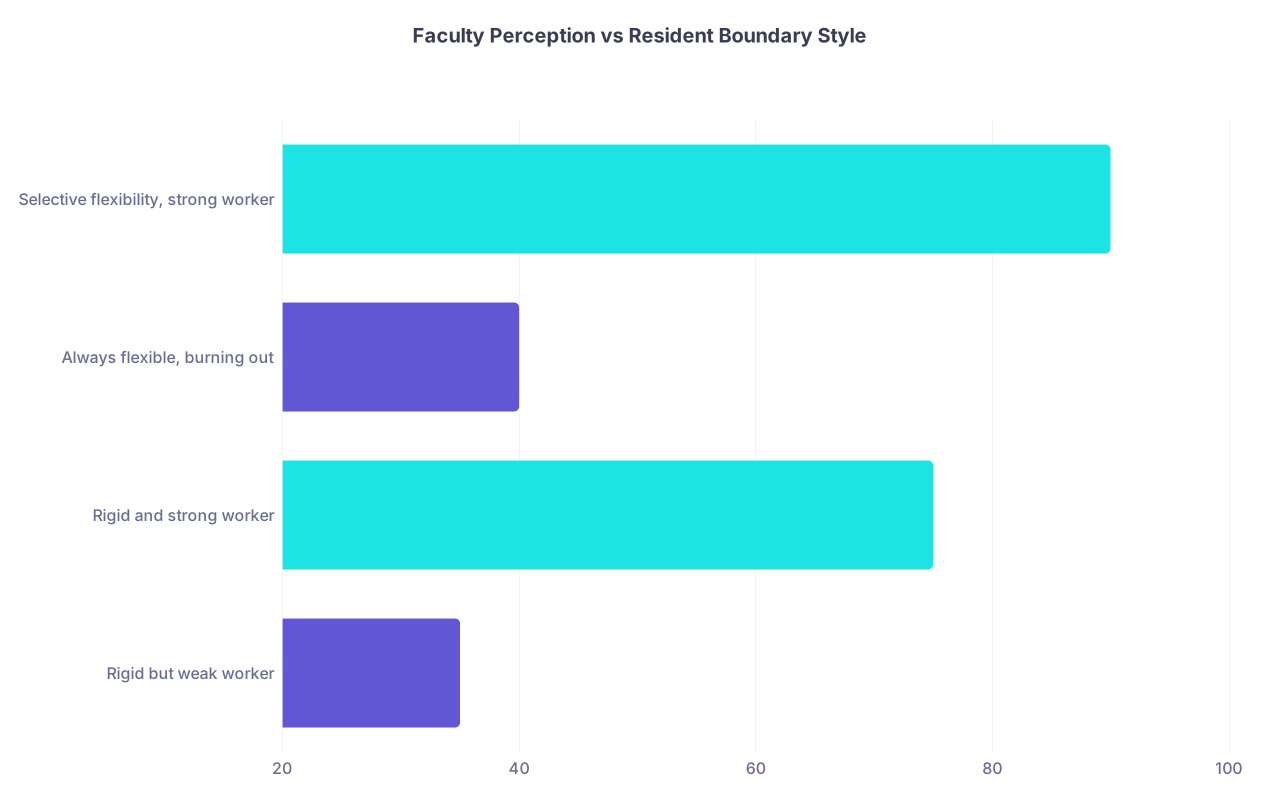
| Category | Value |
|---|---|
| Rigid but weak worker | 35 |
| Rigid and strong worker | 75 |
| Always flexible, burning out | 40 |
| Selective flexibility, strong worker | 90 |