
The way attendings react when you stay late every night is not what you think it is.
You think it screams dedication. What they actually see is a mix of risk, insecurity, and sometimes a problem they’ll have to fix before it blows up at a committee meeting.
Let me walk you through what’s really being said about you on that silent walk from the workroom to the parking garage. Because those conversations? They matter more than the “Nice work today” you get at sign‑out.
The First Week They’re Impressed. After That, They’re Worried.
The honeymoon period is real.
The first few times you stay late, most attendings think something like:
- “Okay, this one cares.”
- “Good hustle.”
- “They’re trying to learn. Fine.”
They notice. They always notice. We know roughly when the residents should be out. When someone is still at the workstation 45 minutes after sign-out, attendings clock it. Even if we don’t say anything.
But here’s the part learners don’t see: there’s an internal clock attendings run in their head. And it changes quickly.
Roughly it goes like this:
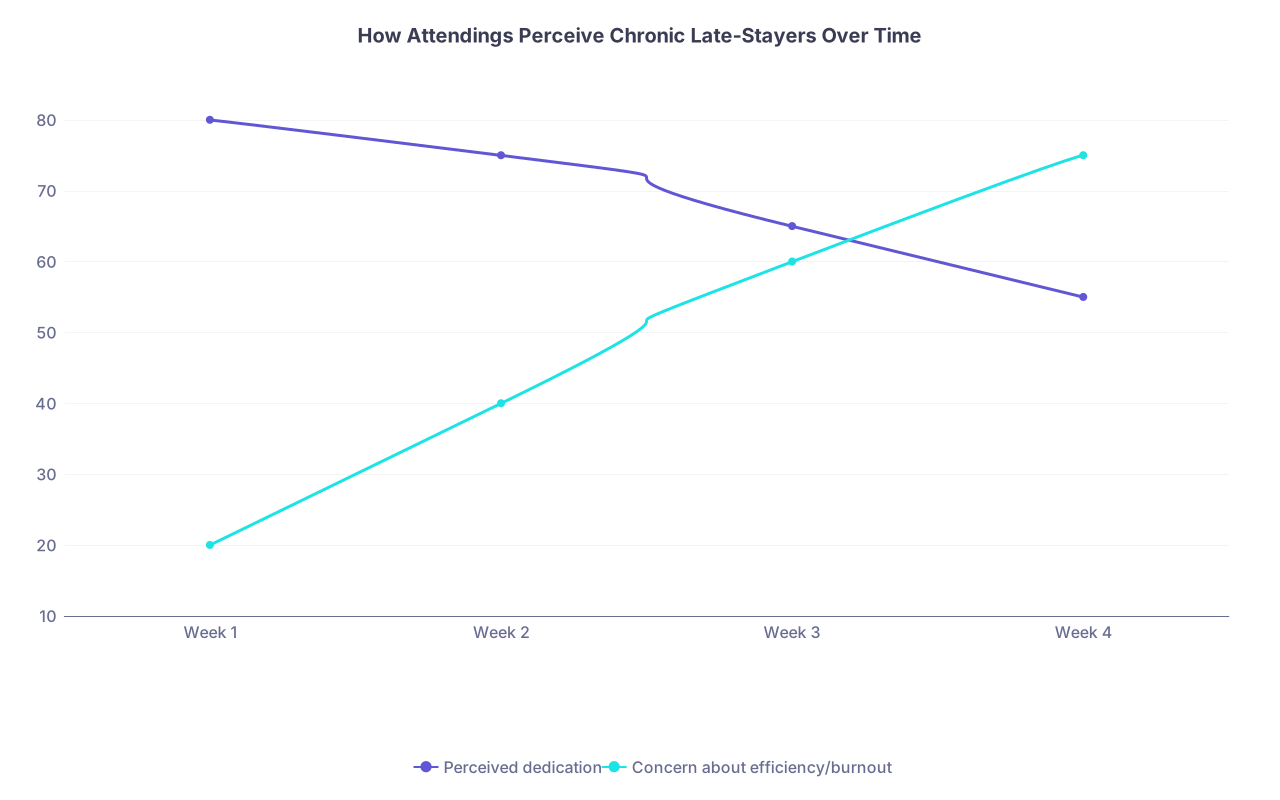
| Category | Perceived dedication | Concern about efficiency/burnout |
|---|---|---|
| Week 1 | 80 | 20 |
| Week 2 | 75 | 40 |
| Week 3 | 65 | 60 |
| Week 4 | 55 | 75 |
Week 1: “Motivated.”
Week 2: “Still staying late a lot…”
Week 3: “They’re struggling with efficiency or boundaries.”
Week 4: “We might need to intervene before this becomes a professionalism or wellness issue.”
And no, I’m not exaggerating. I’ve sat in those meetings where we talk about “trajectories” and “patterns.” Chronic late‑staying shows up as both.
You think it’s invisible. It isn’t.
What Attendings Actually Say About Chronic Late‑Stayers
You want the real language? Here’s what I’ve heard in faculty rooms and eval meetings about residents and students who stay late “all the time.”
“Great kid. But he’s here constantly. I’m starting to worry he can’t keep this pace up without making mistakes.”
“She’s still working at 8:30 every night. Either she can’t prioritize, or she’s terrified to leave. We need to figure out which.”
“He’s always the last to leave, but his notes are still mediocre. That’s not a good sign.”
“She’s too available. Families are calling her for everything. She has no boundaries. That will crush her in fellowship.”
The harshest one, from a program director in a big IM program:
“If I see a PGY‑2 staying late every night, I don’t think ‘future chief.’ I think ‘future burnout, maybe future complaint.’ That’s a liability, not a flex.”
This is what’s really going on: attendings are trying to interpret the why behind your behavior. And your why determines whether they see you as promising or problematic.
The 5 Main Stories Attendings Tell Themselves About You
Attendings build a story around your pattern. They have to. We’re constantly trying to sort who’s thriving, who needs support, and who might implode.
Here are the usual interpretations when you’re always there after hours.
1. “They’re inefficient and can’t keep up.”
This is the most common interpretation. Especially on busy services.
If you’re a PGY‑1 on wards and you’re still pre‑charting at 7 pm, most attendings don’t think, “What a hard worker.” They think:
“They still haven’t figured out how to round efficiently, structure their day, or delegate.”
That gets written as:
- “Needs to improve time management.”
- “Difficulty prioritizing tasks.”
- “Tends to stay late to complete routine work.”
Those phrases are poison in a residency or fellowship application. They sound mild but they brand you as a high‑maintenance trainee.
I’ve seen residents denied chief positions not because of knowledge, but because the narrative on them was “always behind, always staying late, never in control of the list.”
2. “They’re anxious and afraid to go home.”
Different flavor, same concern.
There are residents who re‑check every lab, re‑read every order, re‑document interactions, and call three consults for something one would have handled. They’re paralyzed by the fear of missing something.
We can see that from a mile away.
For those residents, the late‑staying becomes evidence of:
- Perfectionism that will eventually crack
- Poor confidence in clinical judgment
- Difficulty tolerating uncertainty
Attendings start saying things like, “We need to work on their threshold for ‘good enough’” or “We need to help them be comfortable signing out loose ends appropriately.”
And when wellness committees and GME start pushing “duty hour compliance,” that anxious over‑worker starts to look like a system problem, not just a personal quirk.
3. “They’re avoiding their life outside the hospital.”
Nobody says this out loud on eval forms. They do say it in hallways.
“He’s always here. Does he even have a life?”
“I think she lives in this hospital.”
Sometimes it’s half‑joke, half‑concern. But sometimes it’s dead serious. A resident who lingers two hours after everyone else day after day starts to look like someone using work to hide from their personal life or mental health issues.
There’s a PD I know who explicitly tells interns: “If I see you in this building more than 80 hours a week, I’m not impressed. I’m suspicious.”
Chronic late‑staying triggers that suspicion.
4. “They’re trying to impress me—and it’s backfiring.”
Attendings are not dumb. We know when we’re being performed for.
The med student who just happens to be the last one out every single night on an away rotation at a top‑tier program? We know exactly what they’re doing.
Some attendings find it endearing. Many find it awkward.
They’ll say:
“Good student, but they’re laying it on thick.”
“Feels like they’re trying too hard to be seen as ‘the hardest worker.’”
Here’s the part no one tells you: being remembered as “the hardest worker” is less valuable than being remembered as “the one I completely trusted.”
Those two are not the same.
5. “They care about patients—but they don’t know boundaries yet.”
This is the most generous and the most fixable story.
You stay late because you’re on the phone with a scared family. Or sitting with a dying patient. Or walking a new cancer diagnosis through their options.
That gets noticed too.
But even then, attendings will eventually go: “I love the heart, but this is not sustainable. And it’s not always appropriate to be everything to everyone.”
The ethical dimension starts to creep in. Are you actually helping? Or are you making yourself feel like “the good doctor” while disrupting sign‑out, delaying decisions, or confusing families about who’s really in charge?
We think about that more than you realize.
The Hidden Systems Pressure: Duty Hours, Safety, and Liability
You might think staying late is purely between you and your attending. It isn’t. There are bigger forces watching.
Hospitals track:
- Duty hours
- Fatigue‑related errors
- Resident wellness metrics
- Burnout survey scores
Chronic over‑work shows up as risk. Not virtue.
| Stakeholder | Primary Reaction |
|---|---|
| Attending | Efficiency / judgment risk |
| Program Director | Burnout / remediation risk |
| GME / Compliance | Duty hour / legal risk |
| Nursing / Staff | Boundary / reliability mix |
| Patients/Families | “So dedicated!” (surface) |
So if you’re the intern always staying until 9 pm, your attending may have to address it. Not because they dislike your work ethic, but because:
- Duty hour violations trigger reviews of the program
- Fatigued residents make mistakes that become morbidity & mortality fodder
- A bad outcome with a clearly over‑worked resident looks terrible on paper
I’ve seen programs called out at the GME level because multiple residents logged >80 hours week after week on certain rotations. Suddenly, every attending on that service is “strongly encouraged” to send people home. Early.
Your “dedication” can become your attending’s compliance problem.
How It Shows Up on Your Evaluations (The Part You Never See)
Residents and students underestimate how coded language in evaluations works.
Nobody writes: “This resident stays late way too much and looks like a burnout risk.”
Instead, you get subtle phrases. Attendings are experts at them.
Common phrases that sometimes mean “stays late every night”:
- “Needs improvement in efficiency.”
- “Would benefit from continued development of task prioritization.”
- “Sometimes has difficulty completing work during assigned hours.”
- “Very dedicated, but must be mindful of work‑life balance.”
- “Tends to take on more than is sustainable.”
You see those on your eval, shrug, and think, “Yeah, I work hard.” A selection committee reads those across multiple rotations and thinks, “Pattern.”
I’ve sat in fellowship rank meetings where someone reads those lines aloud and the room immediately says, “So they’re the over‑worker type. Any concerns about burnout?” That’s the hidden translation.
The Ethical Layer: When Staying Late Becomes Unethical
Work ethic isn’t the only lens here. There’s a genuine medical ethics angle you need to understand.
At some point, chronic late‑staying crosses into ethically questionable territory.
Here are the lines attendings see you approaching:
Patient safety.
Past a certain hour, your error rate goes up. You know it. We definitely know it. If you’re the resident writing chemo orders at 10 pm on your 14th consecutive day of work, that’s not “heroic.” It’s dangerous.Team reliability.
If you’re always staying late, you’re often also the one who “just finishes up” instead of signing out appropriately. That creates Swiss cheese in coverage. The night team may not know what you’ve half‑done.Boundary ethics.
When patients or families start calling you instead of the covering team because “You always stay late and you know everything,” that undermines the system’s safety net. It feels compassionate, but it erodes clarity about who’s responsible.Role modeling.
Seniors who routinely stay late send a message to interns and students: “This is what good looks like.” They then copy you. You’ve now helped normalize unsafe work patterns. Ethically, that’s on you too.
An attending who understands this will not quietly praise you for grinding yourself into the floor. The good ones will pull you aside. The blunt ones will shut it down.
What Makes Attendings Actually Respect You
Let me flip the script. Here’s what gets real respect in an attending’s mind.
It’s not who’s physically present at 8:30 pm. It’s who:
- Anticipates problems at 10 am so they don’t blow up at 8 pm.
- Signs out cleanly, with clear plans and contingencies.
- Knows when to say, “I’ve done what’s safe and appropriate. The rest hands off to nights.”
- Protects their own sleep and sanity so they’re sharp for the next day.
- Has the judgment to stay late when it truly matters—and the discipline to go home when it doesn’t.
There’s a resident archetype attendings love: the one who’s rarely late, but when they are still here at 7 pm, you know something serious is going on—a crashing patient, a complex goal‑of‑care discussion, a disaster transfer.
That resident? You don’t worry. You trust their judgment.
They’re not here every night. They’re here when it counts.
How to Stay Late Without Killing Your Reputation (Or Yourself)
You’re not a robot. Sometimes you just have to stay. New admit pile‑up, complicated discharge, family meeting that ran long—real life happens. Staying late occasionally is normal. Expected.
The trick is not to become “the one who always stays late.” You want to be “the one who stays when it matters.”
Here’s how you thread that needle.
1. Make your attending your ally, not your judge.
If you know you’re behind at 4 pm, say something like:
“I’m noticing I’m running behind today. I want to make sure I’m being efficient. Can we quickly look at my to‑do list and see what should be prioritized or signed out?”
That phrase does three things:
- Signals insight into your own performance
- Invites coaching rather than silent judgment
- Shows you’re not trying to martyr yourself
Most attendings will respect that and help triage your evening.
2. Use staying late as data, not identity.
Instead of thinking, “I’m the hardest worker, I stay late,” try: “I stayed late three times this week. Why?”
Track it for two weeks. Was it:
- Notes?
- Calling families?
- Waiting until 5 pm to start admits?
- Perfectionism with orders and labs?
Then ask seniors or attendings: “Here’s where I lose time. How did you fix this when you were an intern?” People love that question. And you’ll get real strategies.
3. Leave conspicuously and professionally.
If you had a normal day, leave. Don’t loiter.
Say to the resident or attending: “I’ve finished my tasks, checked on all my patients, and signed out appropriately. Anything else before I head out?”
That shows:
- You’re not sneaking out
- You’re not abandoning work
- You have a mental checklist and you’ve run it
The ones who quietly slink away or the ones who always hover uncertainly are the ones we worry about.
4. Choose your “late nights” carefully on key rotations.
You’re not dumb. You know there are rotations where impressions matter more: Sub‑I, away rotations, niche electives.
On those, it’s fine to have a couple of visible late nights, if they’re clearly tied to meaningful work: holding a dying patient’s hand, staying for a decompensation, finishing a complex admission so nights doesn’t drown.
But even on those rotations, your attending will be more impressed if you say at 5:30 pm:
“I’ve done X, Y, Z. If nothing urgent comes up in the next few minutes, I’ll sign out to nights so I’m rested for tomorrow. Sound good?”
That’s maturity. Not laziness.
The Real Behind‑the‑Scenes Judgment
Here’s the unvarnished truth you asked for.
Attendings don’t badge‑scan who leaves at 4:59 vs 5:07. We’re not time cops. We’re pattern readers.
We’re watching for:
- Patterns of chronic over‑work that smell like inefficiency or anxiety
- Patterns of martyrdom that suggest poor boundaries
- Patterns of rare but meaningful late‑stays tied to genuine patient care needs
The resident who is still working at 8:30 pm every night doesn’t look like a hero to us. They look like a pending problem. For themselves, for their patients, for the program.
The resident who occasionally has a late night for the right reasons, but generally runs a clean, efficient, focused day? That’s the one we trust. That’s the one we’d hire. That’s the one who becomes faculty.
You’re not graded on how late you stay. You’re graded on why you stay and whether you could have prevented needing to stay in the first place.

| Step | Description |
|---|---|
| Step 1 | Resident often here late |
| Step 2 | Probably normal variation |
| Step 3 | Needs time management coaching |
| Step 4 | Risk for burnout and errors |
| Step 5 | Good judgment if not chronic |
| Step 6 | Overcompensating, image focused |
| Step 7 | Eval language about efficiency |
| Step 8 | Wellness concern, close follow up |
| Step 9 | Positive narrative, trusted |
| Step 10 | Mixed narrative in evals |
| Step 11 | How often? |
| Step 12 | Why? |
FAQ: What Attendings Really Think When You Stay Late
Is it ever good to stay late on purpose to make a good impression?
Occasionally, yes—if it’s tied to real clinical work that clearly needed doing and you weren’t just dragging your feet. Staying to help with a crashing patient, a complicated admission surge, or a critical family meeting can help your reputation. But if you’re routinely staying late just to “look dedicated,” most attendings will see through it and some will quietly downgrade you for poor judgment or efficiency.How late is “too late” in most attendings’ minds?
There’s no magic time, but patterns matter. Once you start staying more than 60–90 minutes past sign‑out multiple times per week, attendings start to see it as a problem. An isolated 7 pm or 8 pm when something big is happening? Fine. “Always still here at 7”? That ends up in the narrative about you, and not in the way you want.What should I say if an attending tells me to go home but I still have work left?
Be transparent and specific. Something like: “I still have two notes and one discharge summary to finish. Do you want me to stay and complete them, or would you prefer I leave a clear sign‑out and finish tomorrow?” Let the attending own that decision with you. They’ll either help you prioritize or explicitly tell you what can safely wait.How do I know if my staying late is seen as dedication or dysfunction?
Look at the feedback patterns. If your evals contain phrases like “needs to improve efficiency” or “struggles to complete tasks in allotted time,” your late nights are being interpreted as dysfunction. If, instead, you hear, “She runs a tight list,” “He anticipates issues,” and no one comments on time management, then your occasional late stays are probably being seen as appropriate and context‑driven.Is leaving on time ever seen as laziness or lack of commitment?
Not if your work is done, your patients are safe, and your sign‑out is solid. In fact, attendings respect residents who can consistently finish the day’s work within normal hours without chaos. What gets labeled as laziness is leaving early with loose ends, poor sign‑out, or visible disengagement. Leaving on time after a well‑managed day? That’s called being good at your job.
Key points: Attendings aren’t counting minutes; they’re reading patterns. Chronic late‑staying is usually interpreted as inefficiency, anxiety, or poor boundaries—not pure dedication. The residents who truly earn trust are the ones who are efficient, set limits, and choose their late nights carefully, for the right reasons.