
Perfectionism in Physicians: Subtypes and Their Impact on Burnout Risk
You are standing in the hallway outside a patient room at 6:45 p.m. You should have left 45 minutes ago. Instead, you are rewriting a discharge summary because the first one “wasn’t good enough.” Your resident already said it was fine. The patient is already gone. But you are still there, “fixing” commas and rearranging sentences.
If that feels uncomfortably familiar, this is for you.
Perfectionism in medicine is not one thing. It is a cluster of traits and habits that look similar on the surface—high standards, meticulousness, intense responsibility—but they behave very differently under stress. Some subtypes are protective. Others are rocket fuel for burnout.
Let me break this down specifically.
1. What “Perfectionism” Actually Means in Physicians
Most physicians will tell you, half‑jokingly, “I’m a perfectionist.” Usually what they really mean is “I have high standards and I care about details.” That is not inherently a problem. That is how you avoid amputating the wrong leg.
The trouble starts when three ingredients show up together:
- Unrealistic standards (far beyond what is clinically necessary or humanly sustainable)
- Self‑worth tied directly to performance (“I am only as good as my last note / case / exam”)
- A harsh internal critic that turns every imperfection into evidence of personal failure
Clinically and in research, perfectionism is usually broken into:
- Perfectionistic strivings – setting very high standards, being driven to do things well.
- Perfectionistic concerns – fear of mistakes, worry about others’ evaluations, chronic sense of “never good enough.”
Perfectionistic strivings can be adaptive if they are flexible. Perfectionistic concerns are strongly linked to anxiety, depression, and burnout.
In physicians, the line between adaptive and destructive is thin, and the system rewards both for a while. Then you hit residency, a high‑volume outpatient panel, or leadership roles—and the cost shows up.
2. The Core Perfectionism Subtypes in Medicine
There are formal psychological models (Hewitt & Flett’s self‑oriented, socially prescribed, and other‑oriented perfectionism). I will translate those into what they actually look like on the wards and in clinics.
2.1 Self‑Oriented Perfectionism: “I Must Be Flawless”
This is the classic internal pressure subtype.
Typical thought process:
“If I were competent enough, I would not miss anything, I would not need to ask for help, and nothing I do would ever be questioned.”
How it shows up in physicians:
- Spending excessive time on individual tasks:
- 40 minutes writing one note that could be safely done in 10.
- Re‑reading labs and imaging multiple times “just to be sure” with no change in management.
- Avoiding delegation:
- Rewriting nurse or NP notes instead of giving feedback and moving on.
- Redoing interns’ orders yourself “because I trust my work more.”
- Reluctance to expose uncertainty:
- Delaying consults because “I should know this.”
- Avoiding teaching moments where your own gaps might be visible.
Short‑term: you look meticulous and “strong.”
Long‑term: you erode your time, increase your cognitive load, and eliminate recovery time between shifts.
Burnout link: high. Not because high standards are bad, but because they become rigid. There is no “good enough for today.” Only “still not enough.”
2.2 Socially Prescribed Perfectionism: “They Expect Me To Be Perfect”
This one is poison in medicine because the culture often confirms the distortion.
Typical thought process:
“My attendings, colleagues, patients, and even my family expect near‑infallibility. If I slip, I will be judged and discarded.”
How it shows up:
- Extreme fear of evaluations:
- Over‑preparing for routine presentations to the point that it eats into sleep.
- Ruminating for days over a single neutral or mildly negative comment (“You could be more concise.”).
- Image management over learning:
- Asking fewer questions on rounds to avoid “looking dumb.”
- Hiding near‑misses instead of bringing them up for debrief and systems learning.
- Chronic comparison:
- Constantly checking how many publications / RVUs / leadership titles others have.
- Feeling behind even when objectively performing well.
This is heavily driven by environment: malignant programs, shaming attendings, zero‑error narratives in morbidity and mortality conferences.
Burnout link: very high. You live like you are under surveillance. Your nervous system never gets to stand down.
2.3 Other‑Oriented Perfectionism: “Why Is Everyone Else So Incompetent?”
Less talked about, but very common in senior residents, attendings, and administrators.
Typical thought process:
“I hold myself to a high standard. Why doesn’t everyone else? Their mistakes are unacceptable.”
How it shows up:
- Chronic frustration with team performance:
- Anger when interns do not anticipate every lab or order.
- Dismissiveness toward nurses or consultants who have different workflows or priorities.
- Micromanagement:
- Hovering over others’ tasks, correcting minor stylistic issues that do not affect safety.
- Insisting tasks be done “my way” even when multiple approaches are valid.
- Harsh communication:
- Public criticism, sarcasm on rounds, shaming language (“You should know this by now.”).
Burnout link: two‑way. These physicians are often burned out themselves, and they also contribute to burnout in everyone around them. They live in constant irritation because the world never measures up to their internal template.
2.4 Adaptive Perfectionistic Striving: “Excellence With Flexibility”
This is the version you actually want.
Typical thought process:
“I aim for a very high standard because the work matters. But I accept that I am human, the system is imperfect, and some days B+ care is the best that is realistically possible.”
How it shows up:
- Prioritizing accuracy where it matters:
- Double‑checking chemo doses, surgical laterality, anticoagulation plans.
- Being strict with procedures and critical value follow‑up.
- Letting go where it does not:
- Templates and macros for routine documentation.
- Accepting that you will not remember every rare condition on the spot, using resources openly.
- Learning orientation:
- Viewing errors and near‑misses as data to improve systems, not as identity threats.
- Seeking feedback without spiraling.
Burnout link: lower. These physicians still experience stress (they are not carefree), but they recover better and last longer.
3. How Each Subtype Drives Burnout Mechanistically
Burnout is not just “too much work.” It is a mix of emotional exhaustion, depersonalization, and reduced sense of accomplishment. Perfectionism hits all three.
Let’s be precise about how.
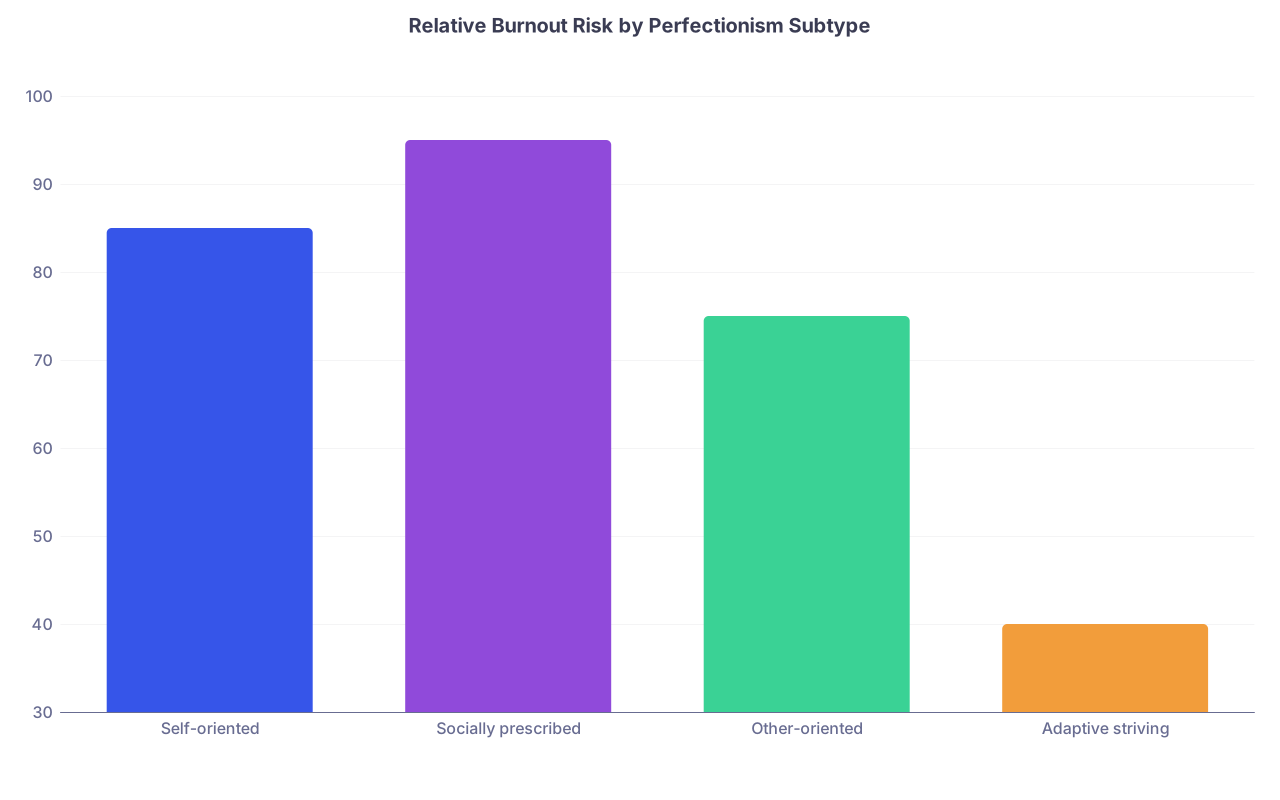
| Category | Value |
|---|---|
| Self-oriented | 85 |
| Socially prescribed | 95 |
| Other-oriented | 75 |
| Adaptive striving | 40 |
(Values are conceptual “risk scores,” not formal percentages—but they match the pattern seen in the literature: highest risk with socially prescribed, lowest with adaptive.)
3.1 Emotional Exhaustion
Self‑oriented perfectionism:
- Time cost: Tasks take 2–3 times longer than necessary. Call days bleed into post‑call.
- Cognitive cost: Constant second‑guessing, mental replays of encounters, “Did I miss something?” loops.
Socially prescribed:
- Hypervigilance: Every interaction is scanned for judgment.
- No safe off‑switch: Even at home, your mind is rehearsing tomorrow’s potential failures.
Other‑oriented:
- Frustration: You are perpetually annoyed at the “mediocrity” around you.
- Isolation: You stop trusting your team; everything feels like it rests on your shoulders.
Result: your sympathetic system runs hot, baseline cortisol never settles, and sleep becomes less restorative even when you get decent hours.
3.2 Depersonalization (Cynicism, Detachment)
This is where burnout becomes dangerous. When you start seeing patients as tasks, annoyances, or obstacles instead of humans, something has broken.
Self‑oriented:
- Patients become tests of your competence. Challenging cases feel like threats.
- When you feel constantly evaluated (by yourself), you start emotionally detaching to reduce the pressure.
Socially prescribed:
- The institution becomes an adversary. Every email, policy, or metric is interpreted as criticism.
- You detach as a defense: “If I stop caring, they can’t hurt me.”
Other‑oriented:
- You begin to categorize people as “good” or “incompetent.” Less patience, more contempt.
- Patients who are noncompliant or complex are labeled as “difficult,” not understood.
Depersonalization is not a moral failure. It is the way a depleted brain protects itself. Perfectionism accelerates that depletion.
3.3 Reduced Sense of Personal Accomplishment
Here is the paradox. Many perfectionistic physicians are objectively high performers. But they feel like chronic underachievers.
Why?
Self‑oriented:
- Standards keep moving. Finish a paper? Should have been in a better journal.
- Save a crashing patient? Remember the one you lost last month instead.
Socially prescribed:
- Any positive feedback is dismissed (“They are just being nice”).
- Neutral or absent feedback is coded as negative.
Other‑oriented:
- You disqualify your own accomplishments because the system still feels “broken” and others are not matching you.
- There is always another problem, another person to “fix.”
Over time, this mismatch between actual impact and felt impact is demoralizing. You work harder and harder for less and less internal reward. Classic burnout recipe.
4. How Training and Culture Feed Different Subtypes
Perfectionism does not appear in a vacuum. Medicine selects for it, trains it, and then claims surprise when people break.
4.1 Selection: Who Gets In
Medical school admissions favor:
- High GPA, high test scores
- Long lists of achievements and leadership positions
- Evidence of “going above and beyond”
Translation: people who already have strong self‑oriented perfectionism, and often socially prescribed (to keep parents / mentors proud).
Once they are inside, the system doubles down.
4.2 Training: How It Is Reinforced
You have probably heard:
- “There is no room for mistakes in medicine.”
- “You are only as good as your last shift.”
- “I stayed until every task was done; that is what commitment looks like.”
That is perfectionistic culture, not reality. There is a difference between minimizing preventable harm and pretending zero error is possible.
Specific reinforcements:
- Evaluations that prioritize “polish” over learning:
- Students graded harshly for saying “I do not know” even when appropriate.
- Residents rewarded for heroic overwork rather than sustainable practice.
- Shame‑based teaching:
- Pimping that equates knowledge gaps with laziness or stupidity.
- Public humiliation in conferences.
Who does this hit hardest? Those high in socially prescribed perfectionism. They already believe others hold impossible standards. The environment confirms it.
4.3 Specialty Culture: Different Flavors of Perfectionism
Different specialties tend to amplify different subtypes. Stereotypical but not entirely untrue:
| Specialty | Dominant Subtype |
|---|---|
| Surgery | Self- and other-oriented |
| Anesthesia | Self-oriented, adaptive striving |
| Internal Med | Self- and socially prescribed |
| Pediatrics | Socially prescribed |
| Radiology | Self-oriented |
| Pathology | Self-oriented, adaptive striving |
You already know the vibe. In some ORs, minor deviations from the attending’s style become character flaws. In others, there is strictness around safety but room for human variance.
If you are choosing a specialty and you know you are highly sensitive to criticism or evaluation, these cultural differences matter. They can either inflame or soften your perfectionistic tendencies.
5. Identifying Your Own Perfectionism Profile
You cannot change what you refuse to see. So you need a fairly unsentimental look at your own patterns.
Ask yourself, concretely:
When I make a non‑catastrophic mistake (e.g., forgot to order a non‑urgent lab):
- Do I:
a) Berate myself internally for hours? (self‑oriented, concerns)
b) Obsess over what my attending / peers now think of me? (socially prescribed)
c) Get more angry at the person who pointed it out than at the error itself? (other‑oriented)
- Do I:
When I hand over tasks or notes:
- Do I silently redo them because “no one does it as well as I do”? (other‑oriented + self‑oriented)
- Can I tolerate a different (but safe) style? (adaptive striving)
How do I respond to “good job” feedback?
- Genuine satisfaction that something went well? (more adaptive)
- Immediate thought of “Yes, but I messed up X”? (self‑oriented concerns)
- Suspicion that the feedback is fake or incomplete? (socially prescribed)
You do not need a formal psychometric scale to see the trend. Physicians are generally self‑aware enough when they stop posturing for a minute.
6. Subtype‑Specific Strategies to Lower Burnout Risk
You cannot and should not eliminate your drive for excellence. You need to redirect it and pull out the toxic components.
6.1 If You Lean Self‑Oriented: “Perfect Or Failure”
Your strengths: conscientious, reliable, detail‑oriented.
Your risks: overwork, paralysis, inability to prioritize.
Targeted strategies:
Explicitly define “good enough” for common tasks.
Do this with someone you respect.- For notes: “A complete, accurate HPI/assessment that another provider can safely act on. Not literary prose.”
- For sign‑out: “Key active problems, code status, clear contingency plans. Not full chart recitation.”
Write these down. Use them as stopping rules.
Use time boxes.
Set a fixed limit for routine documentation or follow‑up (e.g., 10–15 minutes per progress note). When the time is up, you must either:- Declare it done, or
- Consciously violate your own rule and justify it (e.g., “complex case, first note of admission”).
The act of justifying forces you to separate legitimate complexity from pure anxiety.
Train uncertainty tolerance.
On rounds or in clinic, deliberately say “I am not sure, I will look that up” once a day. Survive it. Notice that the world does not implode.Keep a “did not matter” list.
Track the extra time you spent perfecting something where, in retrospect, no outcome changed: rewriting patient instructions three times, adjusting phrasing in an email, endlessly reformatting slide decks. Review it weekly. That is harvestable time.
6.2 If You Lean Socially Prescribed: “Everyone Is Judging Me”
Your strengths: responsive to feedback, often very empathic, good with patients.
Your risks: anxiety, overorientation to external validation, chronic people‑pleasing.
Targeted strategies:
Audit your “they expect X of me” beliefs.
Write down three expectations you feel from:- Attendings / supervisors
- Colleagues
- Patients
For each, ask senior people you trust: “Is it actually true that [residents must never say 'I don’t know' on rounds]?” You will be surprised how many of your “rules” exist only in your head or in a few toxic voices, not the majority.
Shrink the evaluator panel.
Right now, you may be allowing dozens of people to define your worth: every attending, every nurse, every patient satisfaction survey. Pick 3–5 people whose judgment you truly respect. Give their feedback weight. Everyone else gets downgraded from “verdict” to “data point.”Separate behavior feedback from identity.
When you hear “You were disorganized today,” translate it deliberately into: “My task management on this shift was suboptimal” instead of “I am disorganized as a person.” This sounds semantic but it is not. It preserves the possibility of change.Limit post‑mortem rumination.
Give yourself one short, structured debrief window after a shift (e.g., 10 minutes): what went well, what to change. Write it down. After that, any repetitive thinking about the same incidents gets labeled as “unproductive rumination” and you redirect. You need that cut‑off.

6.3 If You Lean Other‑Oriented: “Why Can’t People Just Do Their Jobs?”
Your strengths: high standards for safety, often excellent clinical judgment.
Your risks: toxic leadership style, eroded relationships, constant frustration.
Targeted strategies:
Sort errors: safety vs style.
Before reacting, ask:- “Is this a safety issue (dose, diagnosis, delay) or just a style issue (documentation order, wording)?”
- Safety issues deserve firm, clear feedback. Style issues often do not.
If you are burning energy on style 80% of the time, you are burning yourself and everyone else out.
Use “coaching, not contempt.”
When someone makes a mistake, speak as though you expect improvement, not as though you are delivering a final judgment on their worth.
Example difference:- Contempt: “You should know this already.”
- Coaching: “This needs to be tighter. Here is how I think about it. Next time, I expect you to apply this structure.”
Build a realistic mental model of other people’s load.
That nurse who “forgot” vitals? Covering two extra patients. The intern who missed the subtle rash? On hour 26. That does not make everything excusable, but it changes your interpretation from “lazy” to “overloaded.”Ask for upward feedback.
Pick a resident / fellow you trust and ask directly, “When I push for high standards, when does it cross into feeling unreasonable or personal?” Listen without arguing. If three people tell you the same thing, believe them.
7. System‑Level Moves That Blunt Perfectionistic Harm
You alone cannot fix a broken department or hospital, but if you have any influence at all—as chief resident, committee member, attending—you can reduce the environmental gasoline poured on perfectionism.
7.1 Normalize “Human, Not Perfect” in Formal Settings
Grand rounds and M&M conferences are the obvious places.
Structure them to answer:
- “What went wrong in the system?”
- “What was reasonable for a competent clinician to miss?”
- “How do we reduce future risk without pretending we can hit zero?”
If every M&M ends with some version of “The resident should have…”, you are training socially prescribed perfectionism and shame. Shift to checklists, workflow redesign, and explicit acknowledgment of cognitive limits.
7.2 Stop Rewarding Heroic Self‑Destruction
Programs say they care about wellness but then praise residents for:
- Staying hours late routinely
- Working through illness
- Taking on extra shifts without boundaries
You want to shift reinforcement to:
- Effective delegation
- Safe handoffs
- Asking for backup early
The perfectionistic physician learns quickly what gets them positive attention. Change the currency.

| Step | Description |
|---|---|
| Step 1 | High personal standards |
| Step 2 | Overwork and overcontrol |
| Step 3 | Positive feedback for dedication |
| Step 4 | Internal belief - I must keep this up |
| Step 5 | Emotional exhaustion |
| Step 6 | Burnout symptoms |
| Step 7 | Decreased performance |
| Step 8 | More self-criticism and higher standards |
7.3 Train Supervisors in Precision Feedback
Vague criticism is fertilizer for socially prescribed perfectionism:
- “You need to be better prepared.”
- “You are not cutting it.”
Contrast that with:
- “On rounds, your presentations run long. Tomorrow, aim for a one‑minute summary of overnight events, then your top three assessment points.”
- “Your documentation is thorough but too time‑consuming. Let’s build a template together.”
Same issue, different impact. One creates shame and excess anxiety; the other creates a to‑do list.
8. Where Ethics Enters the Picture
This is labeled under “Personal Development and Medical Ethics” for a reason. Perfectionism is not just a personal suffering problem. It has ethical edges.
8.1 Patient Safety vs Self‑Destruction
There is an ethical obligation to aim for competence and to reduce preventable harm. There is no ethical mandate for self‑erasure.
If your perfectionism drives you to:
- Work beyond safe fatigue levels
- Hide errors for fear of judgment
- Avoid asking for help when over capacity
…you are drifting from ethical excellence into unethical risk.
An exhausted, isolated, burned‑out physician is more likely to:
- Miss subtle findings
- Snap at patients or staff
- Cut corners on shared decision‑making
Your well‑being is not a luxury add‑on. It is part of your duty of care.
8.2 Honesty About Limits
Ethically, physicians are obligated to be honest, including about their own limits. Perfectionistic culture pressures you to pretend:
- You are always available
- You can always take one more patient
- You never need mental health care
That dishonesty harms patients and colleagues. Saying “No, I am at capacity” or “I need help” is not a personal failing; it is a corrective against a dysfunctional ideal.
8.3 Role Modeling for Trainees
If you are an attending or senior resident, trainees are watching how you handle imperfection.
Two different scripts:
- “I cannot believe I missed that. I am an idiot. Do not be like me.”
- “I missed that, and here is why. I was tired, the cue was subtle, and my mental shortcut failed me. Here is how I am adjusting my process.”
The second is ethically superior. It teaches accountability without self‑hatred. It creates a culture where people can learn from errors instead of hiding them.

9. Practical Integration: A Weekly Reset Framework
If you want a single concrete practice that hits all the subtypes and reduces burnout risk, use a brief weekly reset. 20–30 minutes. Non‑negotiable.
Structure:
Three wins
Write down three specific things that went well this week, however small. Force your brain to register success.One learning point from an imperfection
Pick one mistake, near‑miss, or “not my best” moment.- Describe what happened in neutral language.
- Identify at least one systems factor and one personal factor.
- Define a specific change (checklist, script, boundary) for next week.
Boundary check
List where your perfectionism overrode your limits:- Stayed late for noncritical polishing
- Took on work that was not yours because “I do it better”
- Avoided asking a question for fear of looking less than perfect
For each, decide what you will do differently once next week. Just once. Do not promise total transformation.
One act of self‑permission
Write a single statement like:- “It is acceptable to ask for clarification on rounds.”
- “It is acceptable to leave with two nonurgent notes to finish tomorrow.”
- “It is acceptable to delegate patient education to the nurse when I am at capacity.”
Post it somewhere you will see mid‑week.
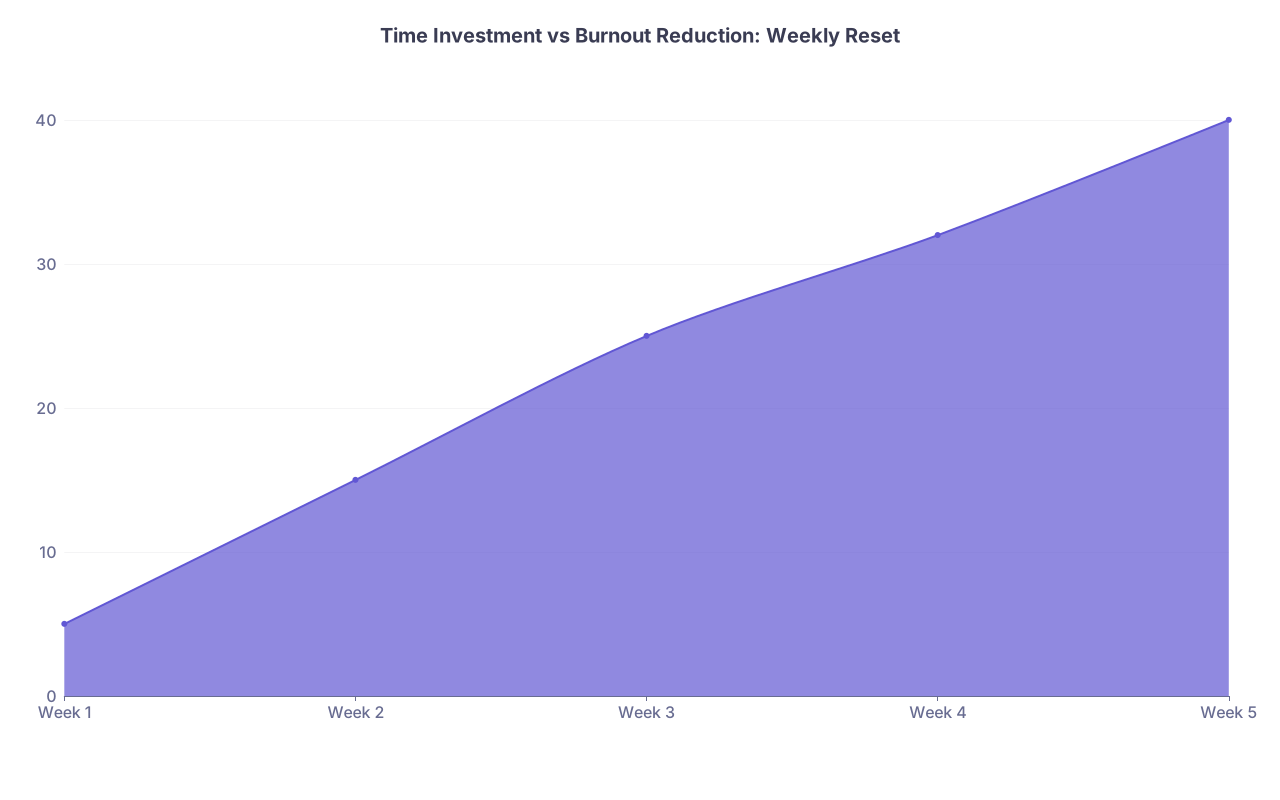
| Category | Value |
|---|---|
| Week 1 | 5 |
| Week 2 | 15 |
| Week 3 | 25 |
| Week 4 | 32 |
| Week 5 | 40 |
(Conceptual: modest time investment, compounding benefit on perceived burnout.)
10. Two Things To Stop Doing, Starting Now
If you skimmed everything above, take this part seriously.
Stop using “I am just a perfectionist” as a brag.
It is not a personality quirk that makes you special. It is a double‑edged trait that can ruin your career if you refuse to shape it. Talk instead about striving for excellence with limits.Stop equating self‑neglect with professionalism.
Doing unsafe amounts of work so that every tiny detail feels tied up is not professionalism. It is fear in a white coat. True professionalism is sustainable, teachable, and honest about being human.
You can keep your high standards. You should. But you need to know which subtype you are feeding—and what it is costing you.
Key Points
- Perfectionism in physicians is not monolithic. Self‑oriented, socially prescribed, and other‑oriented subtypes affect burnout risk very differently; socially prescribed perfectionism is especially corrosive.
- Adaptive perfectionistic striving—high standards with flexibility, boundaries, and acceptance of inevitable imperfection—is compatible with both excellent patient care and a sustainable career. The rest needs active pruning.
- Ethically, managing your perfectionism is part of your duty: to your patients, your colleagues, and the trainees watching you learn how to be “excellent” without destroying yourself in the process.