
The way most residents “push through” decision fatigue on ward months is unsafe, cognitively wasteful, and brutal on their lives outside the hospital.
Let me break this down specifically.
You are not just tired. You are running an overloaded decision engine all day, then trying to have a life with the same burnt-out circuitry at night. If you do not manage cognitive load intentionally, “work–life balance” remains a slogan, not something you actually feel.
This is not about spa days or mindfulness apps. It is about how many decisions you force your brain to make per day, under what conditions, and what you automate, outsource, or simply stop doing.
What Decision Fatigue Actually Is (On The Wards, Not In a Textbook)
Decision fatigue is not just “I cannot think anymore.” It is the measurable decline in decision quality after repeated demands on your executive function.
On wards, that plays out in very recognizable patterns:
- 06:15 – You thoughtfully reconsider diuretics, adjust bowel regimens, rewrite pain regimens from scratch.
- 15:45 – You are reordering the exact same bowel regimen and analgesia you used yesterday because you cannot bear to think through alternatives.
- 19:30 – On call, you are saying “continue current management” as a default unless someone physically drags you into a patient’s room.
The problem is not that you are lazy. The problem is that ward months create a firehose of micro-decisions, many of which are clinically trivial but cognitively expensive.
Let me list some you probably do not count as “decisions” but your brain absolutely does:
- Does this lab need to be checked today or tomorrow?
- Do I pre-round on 4 West or 6 East first?
- Do I update this family now or after rounds?
- Do I text my attending or wait until sign-out?
- Do I answer this non-urgent patient message now or batch it?
- Do I eat now or finish this H&P?
Each one costs you a little bit of glucose and willpower. Hundreds per day. Day after day.
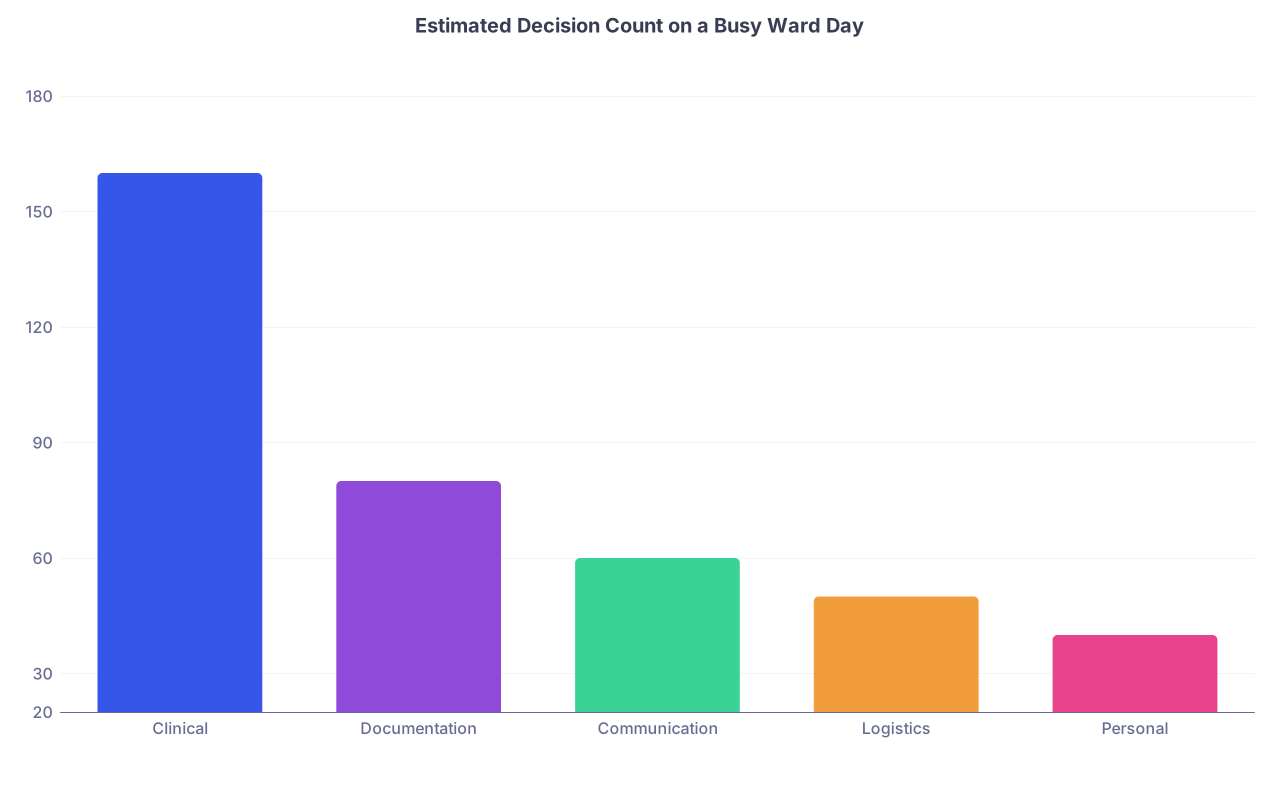
| Category | Value |
|---|---|
| Clinical | 160 |
| Documentation | 80 |
| Communication | 60 |
| Logistics | 50 |
| Personal | 40 |
Once those circuits are worn down, you start:
- Defaulting to “no” on anything extra (teaching, research, even simple favors).
- Defaulting to “yes” on convenience (unnecessary tests, over-consulting, more imaging “just in case”).
- Defaulting to autopilot in your personal life (junk food, doomscrolling, ignoring relationships).
That is decision fatigue. And it directly affects patient care, professionalism, and your ethical obligations to yourself.
Cognitive Load on Wards: Why Your Brain Feels Full by 10 a.m.
There are three main components of cognitive load. On wards, you are usually maxing all three.
- Intrinsic load – the actual complexity of the task: managing septic shock, balancing anticoagulation, interpreting subtle exam changes.
- Extraneous load – all the useless or avoidable mental effort: awful EHR workflows, bad handoffs, unclear attending preferences, hunting for a working computer.
- Germane load – the constructive effort of learning and building schemas: understanding why you chose that diuretic strategy, integrating guidelines.
You are stuck. Because ward months crank up intrinsic load by design and then bury you in extraneous load. Germane load (the part that actually makes you a better physician) gets squeezed out.
Here is how a typical busy day might distribute actual cognitive effort:
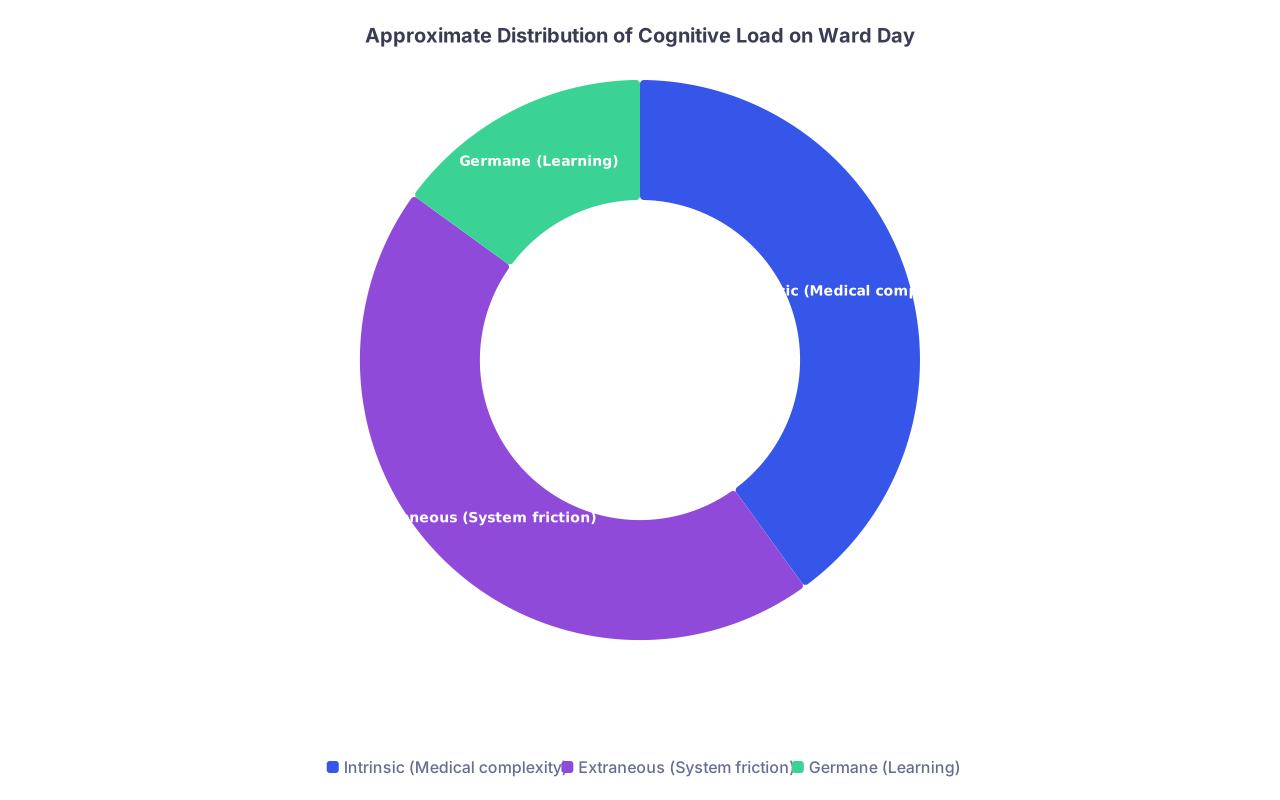
| Category | Value |
|---|---|
| Intrinsic (Medical complexity) | 40 |
| Extraneous (System friction) | 45 |
| Germane (Learning) | 15 |
That 45% extraneous? That is where your decision fatigue is bleeding you dry. And that is also your biggest lever.
Concrete examples from real ward life
- You spend 4 minutes deciding how to structure every progress note, because there is no shared template. That is extraneous.
- You mentally juggle which attending hates discharge summaries after 3 p.m., which one wants you to call for every K < 3.5, and which one freaks out if you do not order PT/OT on day 1. Extraneous.
- You re-review the same echocardiogram 4 times for sign-outs and consults, because you do not trust your own prior synthesis. That is partly intrinsic, partly failure to convert to germane load with a solid one-time summary.
On a cognitively sane service, you would reduce extraneous load aggressively, protect some bandwidth for germane load, and let intrinsic load be what it is.
But most residents never explicitly think in those terms. They just drown.
The Ethical Angle: You Owe Yourself (and Patients) Better Than “Just Survive”
This lands squarely in medical ethics, whether your program names it or not.
You have ethical duties in multiple directions:
- To patients: competent, attentive, reflective care.
- To colleagues: reliable contributions, safe handoffs, not making others carry your cognitive slack.
- To yourself: preservation of your long-term capacity to practice without burning out or descending into chronic cynicism.
Chronic decision fatigue undermines all three:
- You lean harder on heuristics (“this is probably just volume overload again”) and miss subtle but important changes.
- You cut corners on communication (“family updated” in the note when in fact you did a rushed two-sentence hallway conversation).
- You neglect your own basic maintenance – sleep, food, real rest – then justify it as “part of training”, which is an ethical cop-out.
No one will protect your cognitive bandwidth for you. Not your PD. Not your chief. Not your attending. They are protecting their own.
So yes, this is personal development. But it is also ethics: how you choose to steward a very finite resource – your attention – inside an environment that will happily consume all of it.
Where Decision Fatigue Hits Hardest Across the Day
Let me map your day to predictable cognitive failure points. You will recognize these.
Early morning: pre-rounding and orders
You wake up already in decision mode: snooze or not, what to eat, what to wear, bike or drive. Then:
- Decide who to pre-round on first.
- Decide whether to wake the patient or read the chart quietly.
- Decide if you trust the 03:00 vitals or want to recheck.
- Decide whether to wake up night float with a question pre-7 a.m.
Most people burn 15–20 minutes of good cognitive capacity on stupid pre-work choices (which socks, which podcast, which breakfast) before they even touch the EHR.
The better residents I have worked with standardize nearly everything about the first 90 minutes of their day. No novelty, no friction, no choices that do not matter.
Mid-morning: rounds – the “executive function marathon”
Rounds are peak intrinsic plus extraneous load:
- Integrating overnight data, exam, and imaging.
- Anticipating attending questions and preferences.
- Making dozens of interdependent management decisions plus discharge planning.
This is the point of maximum professional visibility and evaluation. Unfortunately, you often hit it after a dull pre-rounding slog that has already eroded your mental sharpness.
The result? You fall back to scripts. You stop actively reasoning on patient 11. You order that CT “just in case” because you cannot tolerate another complex risk–benefit discussion.
Afternoon: orders, pages, and a thousand paper cuts
Post-round:
- Calling consults.
- Writing notes.
- Returning pages.
- Calling families.
- Entering orders, chasing tests, fixing discharge logistics.
This part of the day is prime territory for sloppy decisions made just to remove something from your task list. “Just restart home meds.” “Just discharge tomorrow, I cannot do it today.”
This is also where interpersonal mistakes creep in – curt replies, passive-aggressive notes, friction with nurses – because your emotional regulation is degraded by decision fatigue.
Evening: cross-coverage and call
By the time you are cross-covering:
- You are more risk-averse or more reckless than you think, depending on your personal default.
- You take shortcuts: fewer bedside evaluations, more “we will see how they do.”
- You often ignore your own body (no food, no water, no bathroom) in order to knock down pages, further worsening cognitive function.
At home post-call, you are using the exact same stripped-down decision system to “decide” about your life:
- Whether to talk to your partner or scroll in silence.
- Whether to eat real food or cereal straight from the box.
- Whether to exercise or tell yourself you will “start next month.”
And then you call this “lack of willpower” instead of what it is: a predictable result of uncontrolled cognitive load.
Strategic Moves: Reducing Load Without Reducing Care
The point is not to make fewer medical decisions. It is to:
- Automate or outsource as many trivial or repetitive decisions as possible.
- Front-load high-quality decisions to when you are cognitively freshest.
- Build default pathways and templates for common scenarios.
- Protect a realistic amount of bandwidth for your non-work life.
I am going to be specific.
1. Standardize ruthlessly outside the hospital
Your home life is not exempt from decision fatigue. It is a huge contributor.
You should have:
- A default weekly meal pattern. Not “meal prep like Instagram.” Just 3–4 rotating dinners that require zero thought and can be cooked half-asleep.
- A pre-packed work bag that you never fully unpack. Refill when you get home, not in the morning.
- Two or three “work uniforms” you rotate. If you are thinking about outfits on a ward month, you are wasting juice.
Do this so your mornings become nearly decision-free:

| Step | Description |
|---|---|
| Step 1 | Wake at set time |
| Step 2 | Shower or wash |
| Step 3 | Standard scrubs or outfit |
| Step 4 | Preset breakfast option |
| Step 5 | Grab pre-packed bag |
| Step 6 | Leave home |
You are not boring. You are protecting your frontal lobe for where it matters.
2. Use templates like a professional, not like a lazy person
Everyone talks about smart phrases; few use them intelligently.
You want three levels:
- Micro-templates: common phrases for assessment and plan blocks (e.g., “HF exacerbation,” “DKA,” “CAP,” “GI bleed”).
- Mesos-templates: structure for entire notes (H&P skeleton, progress note skeleton, discharge summary skeleton).
- Macro-scripts: checklists for situations that repeat (admission flow, discharge flow, cross-cover evaluation).

The ethic here: you use templates so you have more bandwidth for non-template-worthy thought. If your heart failure plan is templated, you can actually think about the nuance of this particular patient (blood pressure margin, social supports, palliative triggers).
Residents who insist on reinventing every note from scratch in the name of “individualization” are usually the same ones who make lazy 6 p.m. decisions.
3. Batch decisions on purpose
Switching tasks every minute is cognitive poison. Your pager will force some of that, but you have more control than you think.
Try:
- Lab review windows: 2–3 dedicated times to pull and act on labs (e.g., pre-round, post-round, mid-afternoon) instead of reflexively checking every new result.
- Message windows: one or two short blocks where you return all non-urgent messages at once.
- Consult calling blocks: group consult calls after rounds with a shortlist and clear questions.
That batching does two things:
- Reduces constant context-switching.
- Lets you approach groups of similar decisions with a consistent mental model.
You will make better, more coherent decisions when you are dealing with 4 similar issues at once than 4 unrelated issues scattered through the day.
4. Build “if–then” defaults for common scenarios
You should have internal protocols. Not to replace thinking, but to anchor it.
For example:
- “If Hgb ↓ but vitals stable and no overt bleeding, then: repeat CBC, bedside exam, med review, call senior before transfusing.”
- “If patient is clinically improving, eating, mobilizing, and on oral meds by day X, then explore discharge that day barring clear barriers.”
This kind of mental automation minimizes dithering. You are not inventing entire decision trees each time. You are checking whether the current case fits the tree, and if not, why.
On paper, that might look like this:

| Step | Description |
|---|---|
| Step 1 | Alert - low Hgb |
| Step 2 | Check vitals and symptoms |
| Step 3 | Bedside eval and call senior |
| Step 4 | Review trend and meds |
| Step 5 | Repeat CBC if needed |
| Step 6 | Discuss with senior before transfuse |
Again, the goal is not to be robotic. It is to reserve deep thought for when reality does not match your default.
5. Protect two non-negotiable things on ward months
You will not have a balanced life on heavy wards. Pretending otherwise is delusional. But you can define a minimum ethical standard for how you treat your future self.
I push residents to choose two non-negotiables:
- One for physical maintenance (e.g., 20-minute walk on post-call days, fixed bedtime window, stretch routine, 10 pushups before shower – I do not care what, only that it is realistic).
- One for connection or meaning (e.g., 10-minute call with partner 3x/week, reading a non-medical book 10 minutes before bed, religious or reflective practice once per week).
Those two get scheduled like consults. They are not “if I have energy.” Because you will never “have energy” left. You decide in advance.
| Resident Type | Physical Non-Negotiable | Connection/Meaning Non-Negotiable |
|---|---|---|
| Intern on Q4 call | 15 min walk post-call days | 2x/week call to partner |
| Senior with kids | Fixed 20:30–21:00 bedtime routine with child | Sunday breakfast with family |
| Night float | Stretch + brief workout before shift | Listen to one favorite podcast per night |
These are not “nice extras.” They are part of your ethical responsibility to maintain yourself as a functioning professional.
How This Relates to Work–Life “Balance” Without Being Sentimental
Balance in a 28-day ward month does not mean equal. It means predictable and intentional.
Without cognitive discipline, your month will look like this:
- First week: high effort at work and at home, overcommitting socially, trying to “still be myself.”
- Second week: depletion, short-tempered at work, withdrawing at home.
- Third week: pure survival, poor decisions, fast food, no exercise, strained relationships.
- Fourth week: mild recovery and guilt-driven overcompensation.
With some of the strategies above, it looks more like:
- Steady but sustainable work output.
- Lower but consistent investment in personal life.
- Less variability in mood and decision quality over the month.
Here is what that difference might look like subjectively over time:
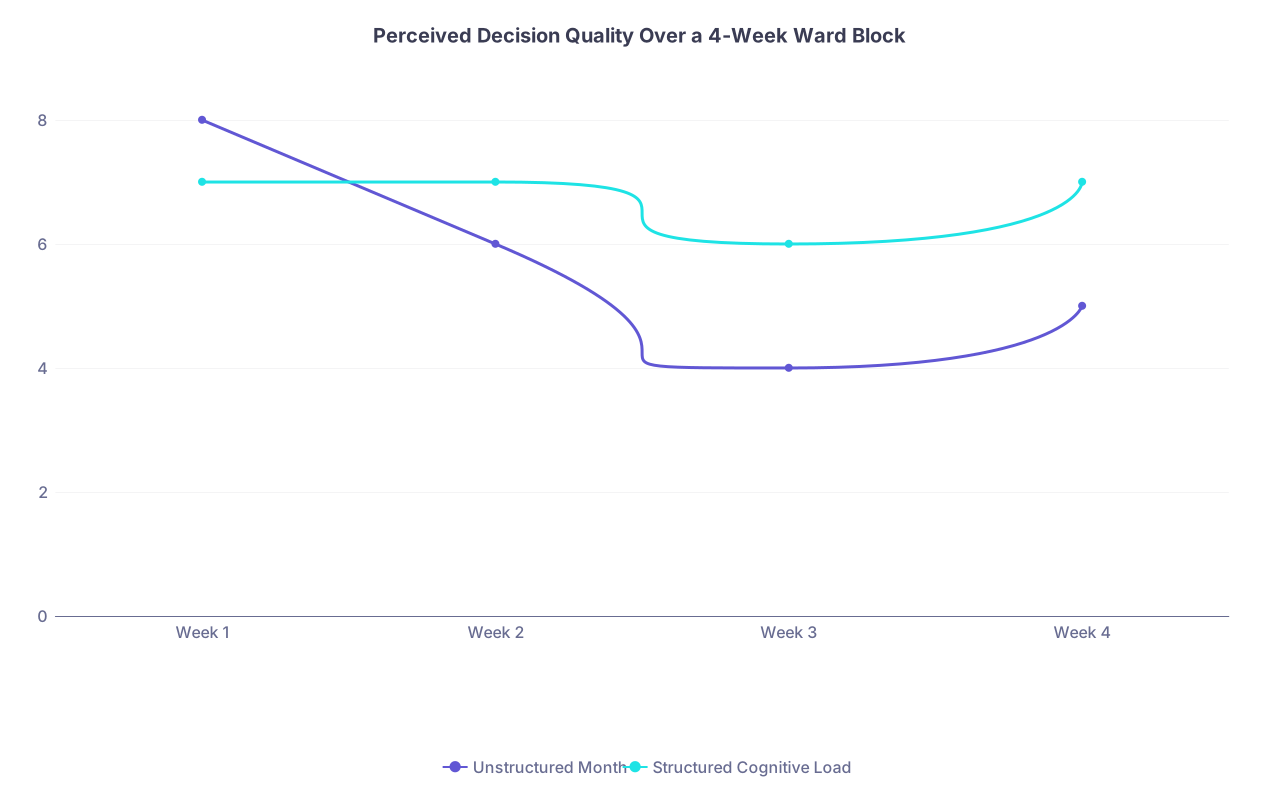
| Category | Unstructured Month | Structured Cognitive Load |
|---|---|---|
| Week 1 | 8 | 7 |
| Week 2 | 6 | 7 |
| Week 3 | 4 | 6 |
| Week 4 | 5 | 7 |
(Scale 1–10, where 10 is “sharp, thoughtful decisions.”)
Notice: structure keeps you away from the catastrophic dip. That is the win.
Common Self-Sabotage Patterns I See on Ward Months
Let me call out a few specific traps, because recognizing them is half the battle.
The “Hero Intern” routine
Signs:
- Keeps every decision on their own plate (“I do not want to bother my senior or attending”).
- Refuses to use templates (“I learn more by writing from scratch”).
- Opts in to every extra task (family meeting, QI project, student teaching) early in the month.
Result: By week 3, this intern is making sloppy decisions, avoiding pages, and quietly dropping balls. They burn trust.
Ethical fix: Learn to escalate appropriately and automate the unimportant. Being a hero for 3 days and unsafe for 25 is not admirable.
The “Off-service, I Do Not Care” attitude
Signs:
- Minimal intellectual engagement (“I am just here to survive my surg month”).
- Overuses default options (imaging for everything, consult for everything, no effort to understand the plan).
- Uses all non-work time for pure numbing (screens, junk food) with no real rest.
Result: Work feels pointless, so they do not build any lasting schemas. Decision fatigue still hits because the environment is the same, but there is zero germane load payoff.
Ethical fix: Set a modest learning target: one concept per day, one case per week that you actually understand in depth. You are borrowing from your future self otherwise.
The “Life Denial” strategy
Signs:
- “I will just disappear this month and make it up to people later.”
- Cancels all social and family contact “to focus.”
- Treats basic self-care as optional until the month ends.
Result: You become a better cog and a worse human. Also, decision quality still drops, because you are not a machine and your brain degrades without some connection and pleasure.
Ethical fix: Keep small but stable threads to your life outside. You are training for a career, not a siege.

The Program and System Are Not Off the Hook
I have focused on what you can control, because that is what you came here for. But it would be dishonest not to say this clearly: many ward structures are cognitively abusive by design.
Red flags at the system level:
- No cap or an absurd cap on patient numbers for interns.
- Chronic under-staffing of ancillary services, pushing non-clinical tasks onto you.
- Culture of glorifying “toughness” over thoughtful care (“We survived, so you will too”).
- EHR setups with no standardized templates, no efficient routing, and endless redundant documentation.
Those increase extraneous load to the point of predictable harm. Harm to patients, to staff, and to you.
You still have ethical duties in the middle of that. But you also have the right to:
- Push for service caps and realistic duty hours.
- Build and share cognitive tools (order sets, templates, sign-out structures).
- Say no to non-essential “opportunities” on top of a crushing ward month.
Work–life balance is not only individual resilience. It is also structural sanity.

Putting This Into Practice: A Concrete 7-Day Experiment
If you want something actionable, not theoretical, run this as an experiment on your next week of wards.
Day 0 (night before):
- Choose your two non-negotiables (one physical, one connection/meaning).
- Set up 1–2 simple note templates you will actually use.
- Pack your bag fully and choose your outfit / scrubs for the entire week.
Days 1–5:
- For the first hour at work, do not check your phone for non-work stuff. Save that bandwidth.
- Batch lab review twice (e.g., 06:45 and 14:00) unless something is genuinely urgent.
- Notice one situation per day where you are dithering. Ask: “Can I make a default rule here for future me?”
- Execute your two non-negotiables no matter how you feel.
Post-call or post-weekend (Day 6–7):
- Take 15 minutes to write down:
- 3 decisions you regret and when they happened.
- 3 situations where automation / templates helped.
- One extraneous load source you can eliminate or reduce (e.g., specific documentation inefficiency, repeated confusion about workflows).
You are not fixing the system in a week. You are proving to yourself that cognitive load is modifiable, not just something that happens to you.
Three core points to carry forward:
- Decision fatigue on ward months is not a character flaw. It is the predictable result of massive, unmanaged cognitive load – and it directly affects patient care, ethics, and your life outside the hospital.
- Your main leverage is reducing extraneous decisions through standardization, templates, batching, and realistic non-negotiables, so you preserve bandwidth for high-stakes clinical and personal choices.
- Work–life balance during wards does not mean symmetry. It means building a sustainable, intentional pattern that protects your decision quality and your humanity over the long haul, even in an imperfect system.