
Most residents are using handoffs to protect patients, but ignoring the fact that a good handoff also protects their own mind. That is a mistake.
You are not just transferring clinical responsibility at sign-out. You are deciding how much of your mental bandwidth stays trapped in the hospital after you walk out the door. That is where structured handoffs come in—not as another checkbox, but as a deliberate tool for mental off-loading and long-term psychological survival.
Let me break this down specifically.
Why Your Brain Refuses To Leave The Hospital
The persistent post‑shift rumination—“Did I order that CT?”, “Did I sign that warfarin order?”, “What if that febrile neutropenic patient decompensates?”—is not just anxiety. It is a predictable cognitive outcome of how we manage (or mismanage) task closure.
Your brain keeps “open loops” active. If a task is:
- unclear,
- incomplete, or
- not anchored to a trustworthy system,
your prefrontal cortex will keep pinging you about it. Walking out of the hospital does not close these loops. A reliable, structured handoff does.
Unstructured, ad‑hoc sign-out does the opposite. It leaves dozens of silent “to‑do” flags running in your head, because the brain does not trust that things are handled.
Structured handoffs have three ethical and psychological jobs:
- Transfer clinical responsibility safely.
- Make the plan explicit enough that another clinician can execute it without you.
- Signal to your own brain: “This is documented, handed off, and no longer mine.”
When you skip structure, you sabotage all three.
What “Structured Handoff” Actually Means (And What It Does Not)
A structured handoff is not just “I told the night float the big stuff.” It is an intentional, repeatable framework that:
- standardizes what information is conveyed,
- sequences how it is conveyed,
- embeds triggers for anticipatory guidance and contingency planning,
- lives in both verbal and written form.
Most places will have some version of:
- SBAR (Situation, Background, Assessment, Recommendation)
- I-PASS (Illness severity, Patient summary, Action list, Situation awareness & contingency planning, Synthesis by receiver)
I do not care which acronym you use. I care whether you use any of them completely and consistently.
Because from a mental off‑loading perspective, what really matters is that:
- You have a finite, predictable checklist you run through.
- That checklist includes explicit assignment of who is responsible next.
- The plan is stored in a trusted external system (written/electronic) that both teams actually use.

Why Structured Handoffs Reduce Mental Load: The Cognitive Mechanics
Let us get concrete about what is happening in your head.
There are four big cognitive advantages to a structured handoff:
1. Externalization of Working Memory
During a shift, you are juggling:
- Active orders, pending labs, consult calls, imaging follow-ups
- “Soft” tasks: call family, update PCP, check on borderline patient after MRI
- Big picture: disposition, code status, risk points
If you rely on memory and scattered sticky notes, your brain never believes that the list is complete. That incompleteness is fuel for rumination after shift.
A structured handoff template forces you to dump:
- a clear patient summary,
- current status and primary diagnosis,
- action list with explicit owners,
- “if X then Y” contingency plans.
Once those are written into an external system used by your team, your working memory can stand down.
2. Closure of Responsibility Loops
Ethically, you are not abandoning patients at 7:01 pm. You are transferring responsibility.
Ethically clean transfer requires:
- Identification of next responsible clinician (by role, not just a name you vaguely mutter).
- Documented awareness of that transfer (they heard it, repeated it back, or it is clearly embedded in a shift-based system).
- Clear instructions for foreseeable scenarios.
Without that, your conscience has a point when it wakes you up at 1 am asking, “But who is actually watching them?”
Structured handoffs explicitly close the loop: “I, Dr X, am signing out Mrs Y to the night float resident covering Blue team. They understand the action list and contingencies.” Your mind recognizes that as a legitimate hand-off of duty.
3. Reduction of Ambiguity
Ambiguity is gasoline for anxiety.
- “The patient might decompensate, but I did not say what to do…”
- “CT is pending, but no one knows what we are doing with the result…”
- “If they spike a fever, are we calling ICU or just giving fluids?”
Structured handoffs, especially I-PASS style, force you to articulate:
- What you are worried about.
- What should happen if that worry materializes.
- How urgent those events are.
That ambiguity reduction is not just safer for the patient. It is a psychological sedative for you.
4. Predictable Ritual = Psychological Off Switch
Humans respond well to rituals. A repeatable end‑of‑shift routine (review list → update sign-out → verbal handoff → quick mental scan → log off) trains your brain:
“This sequence = we are done.”
Over time, this becomes a conditioned cue for letting go. If your “handoff” varies wildly every day, your brain never gets that consistent end‑of‑shift signal.
Anatomy of a Handoff Designed for Mental Off‑Loading
Let me give you a concrete structure that hits both safety and mental health.
You can map this onto I‑PASS or your institution’s tool.
1. Pre‑Handoff Internal Pass
Before you talk to anyone, sit down with your list and do a quiet “internal handoff” to the system.
For each patient, document (succinctly):
- A one‑line summary: “64F, CHF exacerbation, improving on diuresis, floor level.”
- Illness severity: stable / watcher / unstable.
- Critical overnight risks: e.g., “Risk of hypotension with diuresis”, “Post‑op day 0, risk for bleeding.”
- Action list:
- Pending labs/imaging and what to do with them.
- Tasks the night resident actually needs to do, not just be vaguely aware of.
- Contingencies:
- “If MAP <60 despite 250 cc bolus, call ICU.”
- “If troponin increases and chest pain recurs, get ECG, start heparin per ACS protocol, call cards.”
- Family/ethical issues:
- “DNR discussion partially done, do not push tonight unless clinically forced; re‑visit with son in AM.”
This is not “busy work.” This is you exporting the overnight version of your brain into a reusable format.
2. Verbal Handoff: Focused, Not Casual
During the live sign-out, do not wing it.
Run each patient through the same quiet mental framework:
- Illness severity: start with “This one is a watcher” or “This one is fine, low risk.”
- Key recent events: no full H&P—just what changed or could change.
- Action list: “Here is what you actually have to do tonight.”
- Contingencies: “If X happens, here is what I would do.”
- Landmines: “The family is angry; if there is any issue, loop attending early.”
Then require a brief synthesis back from the receiver. That final step is not just for them. It reassures you that your plan now lives in someone else’s head, not just yours.

| Step | Description |
|---|---|
| Step 1 | Finish Last Patient Task |
| Step 2 | Update Written Handoff Tool |
| Step 3 | Mark Illness Severity and Action List |
| Step 4 | Add Contingencies and Landmines |
| Step 5 | Verbal Handoff to Oncoming Clinician |
| Step 6 | Quick Mental Scan for Loose Ends |
| Step 7 | Log Off Systems and Leave |
3. Post‑Handoff “Loose Ends” Scan
Before you walk out:
- Scroll your list top to bottom.
- For each name, ask: “Is there any unassigned task or silent worry still in my head?”
- If yes, either:
- Add it clearly to the written sign-out and mention it verbally, or
- Decide it is non‑actionable tonight and let it go on purpose.
This micro‑ritual matters. It converts vague unease into either a documented plan or a conscious decision not to act. Your brain is far less likely to ambush you later with “But what about…”
Data: Structured Handoffs Help More Than Just Safety
We usually sell structured handoffs as a patient safety intervention. They are. But they do more.
Here is the kind of data that rarely gets highlighted: improvements in provider workload perception and cognitive strain.
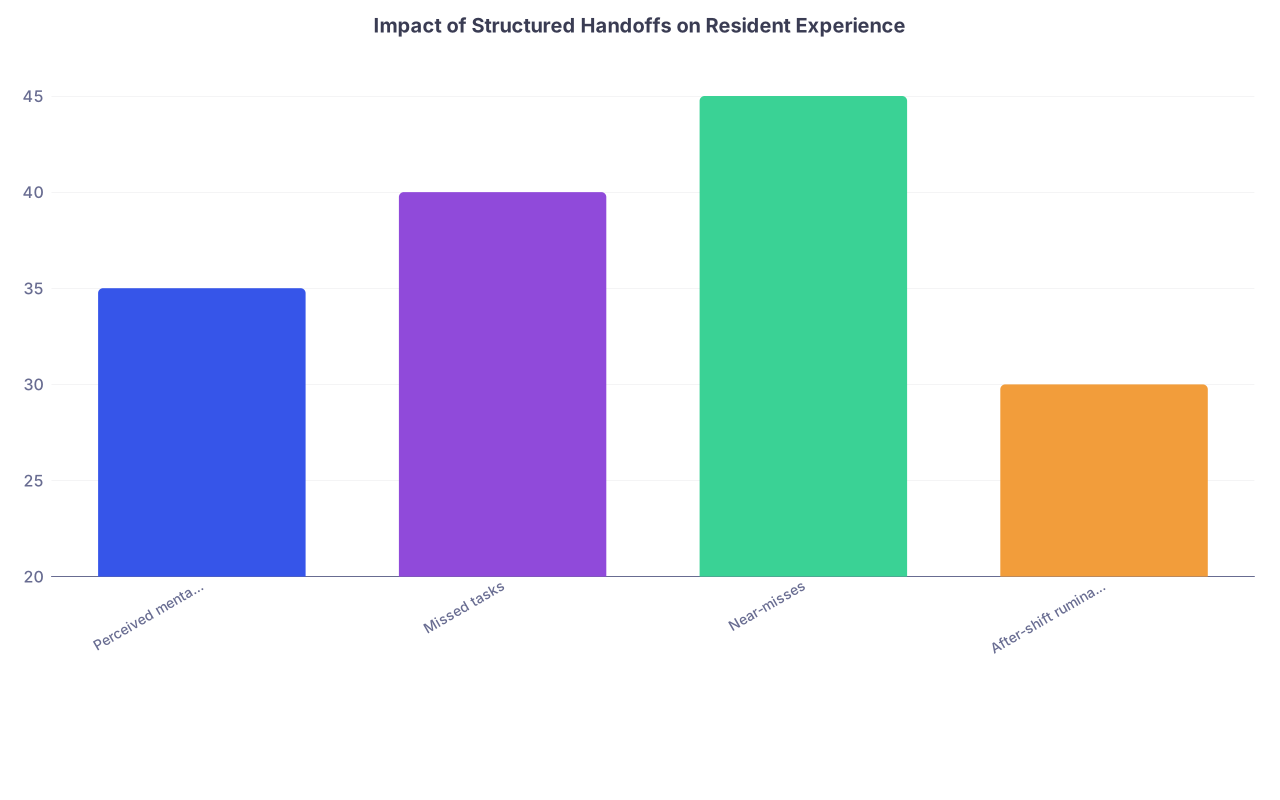
| Category | Value |
|---|---|
| Perceived mental load | 35 |
| Missed tasks | 40 |
| Near-misses | 45 |
| After-shift rumination | 30 |
Interpretation (approximate, generalized from multiple studies and my own experience):
- Perceived mental load during sign-out drops when you have a structured framework, because you are no longer re‑inventing the wheel each time.
- Missed tasks and near‑misses fall with standardized action lists and contingencies.
- Residents often report fewer intrusive thoughts about work in off hours when sign-out is thorough and ritualized.
You feel “lighter” leaving the hospital not because the patients are less sick, but because your cognitive system trusts that the right information is where it needs to be.
The Ethical Dimension: Duty, Delegation, And Self‑Respect
Let’s talk ethics, because this is where some trainees get stuck.
They equate being a “good doctor” with:
- Hyper‑vigilance beyond their shift.
- Keeping mental tabs on “their” patients all night, even when off duty.
- Responding instantly to every text or call from the hospital when not on.
That is not professionalism. That is boundary failure dressed up as virtue.
Ethically:
- You owe patients competent, continuous care from the team, not 24/7 personal martyrdom.
- You owe yourself sustainable practice, which includes rest, family life, and psychological recovery.
- You owe colleagues trust—trusting them enough to let them actually carry the baton after sign-out.
Structured handoffs are how you make that trust ethically legitimate. You are not “dumping” your patients. You are discharging your duty to prepare the next clinician to care for them.
That is radically different from disappearing at 7 pm with half‑baked notes and an undocumented plan.

Work–Life Boundary Training: Using Handoff As Your “Off Switch”
Residents are usually told to “set boundaries” with vague advice that ignores the actual clinical workflow. You cannot just decide to unplug emotionally at 5 pm if you handed off chaos at 4:55.
So you build the boundary into the handoff itself. Think of it as “boundary‑based sign-out”:
Time box your handoff prep.
Start 30–45 minutes before your official end time. Not 5 minutes before. Rushed handoffs are anxiety factories.Treat your sign-out checklist as sacred.
Do not skip steps because “it is busy.” Busier days require more structure, not less.Tie your emotional off‑switch to the completed ritual.
Internal rule: “If I completed my structured handoff fully, I am not allowed to ruminate about specific patient tasks at home. If there is a true catastrophe, they will call me.”Use a brief exit phrase to yourself.
Sounds silly. Works. Something like: “Responsibility transferred. I am off duty.” You are cueing your own brain.Have a containment plan for intrusive thoughts.
When your brain brings up, “Did you check that K+?”, your default response is:- “If it mattered urgently, night float has it on the action list.”
- “If they need me, they will call.”
Then redirect to something sensory: the feel of your steering wheel, the sound of your feet walking home. Basic CBT applied to post‑shift.
Over time, your nervous system learns that post‑handoff worry is not rewarded with useful action. It quiets down.
Common Failure Modes That Destroy Off‑Loading (And Fixes)
I have seen the same patterns over and over. Let me call them out bluntly.
Failure Mode 1: “Drive‑By” Sign‑Out
You rush in at the end of a brutal shift and say:
“Room 12 CHF, room 14 pneumonia, room 16 abd pain awaiting CT. Call me if something crazy happens.”
Off‑loading score: zero.
Fix:
- Force yourself to at least state illness severity and one concrete action or contingency per patient. Even for the “easy” ones.
- Use the written tool to pre‑structure your thoughts. You do not have to speak in paragraphs, but you do have to say enough for someone else to act intelligently.
Failure Mode 2: “I’ll Just Check Results From Home”
You leave several labs and imaging studies pending with no contingencies. You tell yourself you will “just peek” from home.
You have now guaranteed several hours of fragmentary attention and zero genuine rest.
Fix:
- Before you consider remote checking, ask: “Is there a clinically necessary, time‑sensitive decision that only I can make tonight?”
- If no: build a clear plan for the on‑call person instead.
- If yes (rare): time‑limit your remote involvement and document your handoff back to the responsible team as soon as that decision is made. Do not stay half‑attached all night.
Failure Mode 3: Emotional Handoff Avoidance
You avoid telling night float that a family is angry, a patient is on the edge, or the attending is upset with the plan. You keep that stress in your own head instead.
Fix:
- Treat psychosocial and ethical landmines as part of “critical information.” They belong in handoff as much as vitals and labs.
- Phrase it neutrally but clearly: “The daughter is very distressed and may call tonight. Aware of prognosis discussion but not fully accepting; if she calls, it may consume time.”
Once you say it out loud and document it, the responsibility is shared. Your mind will not keep rehearing the conflict alone at 2 am.
How To Adapt Structured Handoffs Across Settings
The principle is the same whether you are on inpatient medicine, emergency, ICU, or outpatient call. The implementation details shift.
| Setting | Critical Focus For Off-Loading |
|---|---|
| Inpatient Ward | Action list, contingencies, disposition plans |
| ICU | Instability triggers, escalation thresholds |
| Emergency Dept | Disposition status, “must not miss” diagnoses |
| Night Float | Watcher list, what not to wake attending for |
| Outpatient Call | Triage thresholds, follow-up arrangements |
A few specific notes:
ED: The biggest mental load comes from boarded patients and “could be bad” presentations. Good ED sign-out makes explicit:
- What workup has ruled out.
- What specific change would trigger admission, higher level of care, or specialist call. That clarity lets you walk out post‑shift without mentally re‑diagnosing every borderline abdominal pain.
ICU: Your off‑loading hinges on clear instability thresholds:
- “If norepi >0.2 and MAP still <65, call attending and consider second agent.”
- “If PaO2/FiO2 drops below 100, prep for proning or additional support.”
Your brain can let go because the algorithm is spelled out.
Outpatient call: Here the structured handoff is often about who owns follow‑up:
- Document: “Spoke with patient about chest pain; low risk, ED precautions given, urgent clinic slot held for tomorrow with Dr X.”
Your worry at home plummets when you know the next step is scheduled, not hypothetical.
- Document: “Spoke with patient about chest pain; low risk, ED precautions given, urgent clinic slot held for tomorrow with Dr X.”
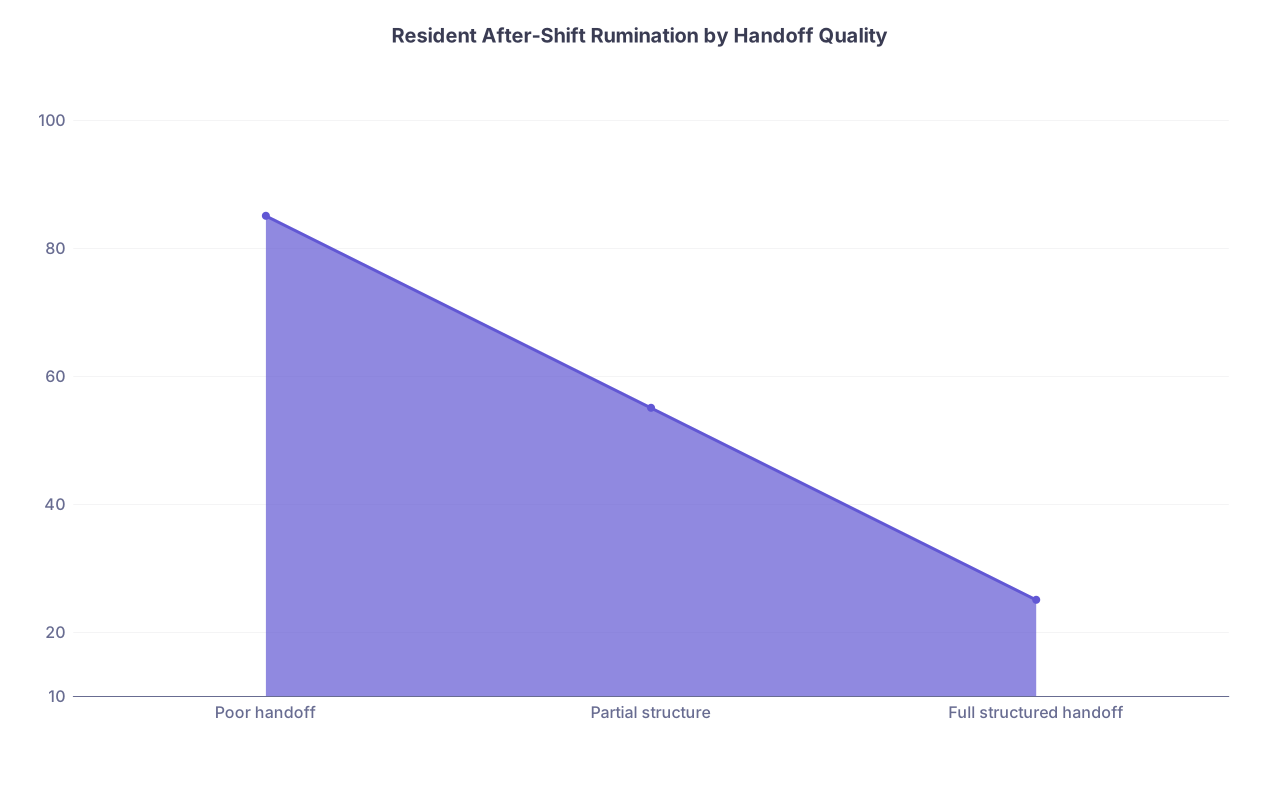
| Category | Value |
|---|---|
| Poor handoff | 85 |
| Partial structure | 55 |
| Full structured handoff | 25 |
You can feel this clinically: sloppy handoff days are the ones where you re-run the list in your head on the bus. Meticulous handoff days are the ones where you might actually notice the sunset.
Integrating Handoffs Into Personal Development
This is labeled under “work life balance” and “personal development” for a reason. You are not just learning to do safe sign-outs. You are building:
- Cognitive discipline: forcing clarity about what matters now vs later.
- Ethical clarity: understanding where your duty begins and ends each shift.
- Professional sustainability: protecting yourself from chronic hyper‑arousal and guilt.
Treat structured handoffs as a core professional skill, not a clerical task you outgrow once you are an attending. The best attendings I know still do mini‑I‑PASS style communication with each other, with ICU, with surgery—very explicitly. They off‑load to each other constantly.
If you train your mind early to trust the combination of:
- external systems (checklists, templates, EMR tools),
- explicit transfer of responsibility,
- predictable end‑of‑shift ritual,
you will be far less likely to slide into the pattern of the burned‑out mid‑career physician who mentally lives at the hospital 24/7 even when physically at home.

Where This Leaves You
You do not need another generic lecture on “self‑care.” You need a practical, ethically solid mechanism to close the mental door on your shift so you can be a human being again.
Structured handoffs, done well, are that mechanism:
- They give your patients continuity.
- They give your colleagues clarity.
- They give your brain permission to rest.
So next shift, do not treat sign-out as an afterthought you speed through while half‑standing with your backpack on. Treat it as your most important tool for both patient safety and personal sanity.
With that habit built, you are in a much better position to tackle the deeper work of boundary setting, career design, and long‑term resilience. But that is a conversation for another day.