
You are here
It is the middle of PGY‑2. 11:37 p.m. You are on yet another inpatient month, half‑listening to sign‑out while silently calculating how many calls you have left this block.
You are decent at your job now. Not flailing. Nurses call you “doc” without that raised eyebrow. You can staff a new admit in 5 minutes and not sound like a disaster.
But a quiet thought has been looping for months:
“Is this actually the career I want?”
And its twin:
“I am not okay, but I do not have time to not be okay.”
This is the point in training where those questions stop being hypothetical. PGY‑2 and PGY‑3 are when competence rises, the novelty fades, and the cost becomes painfully clear. So the timeline here is not about how to survive. It is about when and how to reassess:
- Your specialty choice
- Your long‑term career goals
- Your mental health and ethical boundaries
Chronologically. With concrete checkpoints.
Big picture timeline: PGY‑2 through early attending
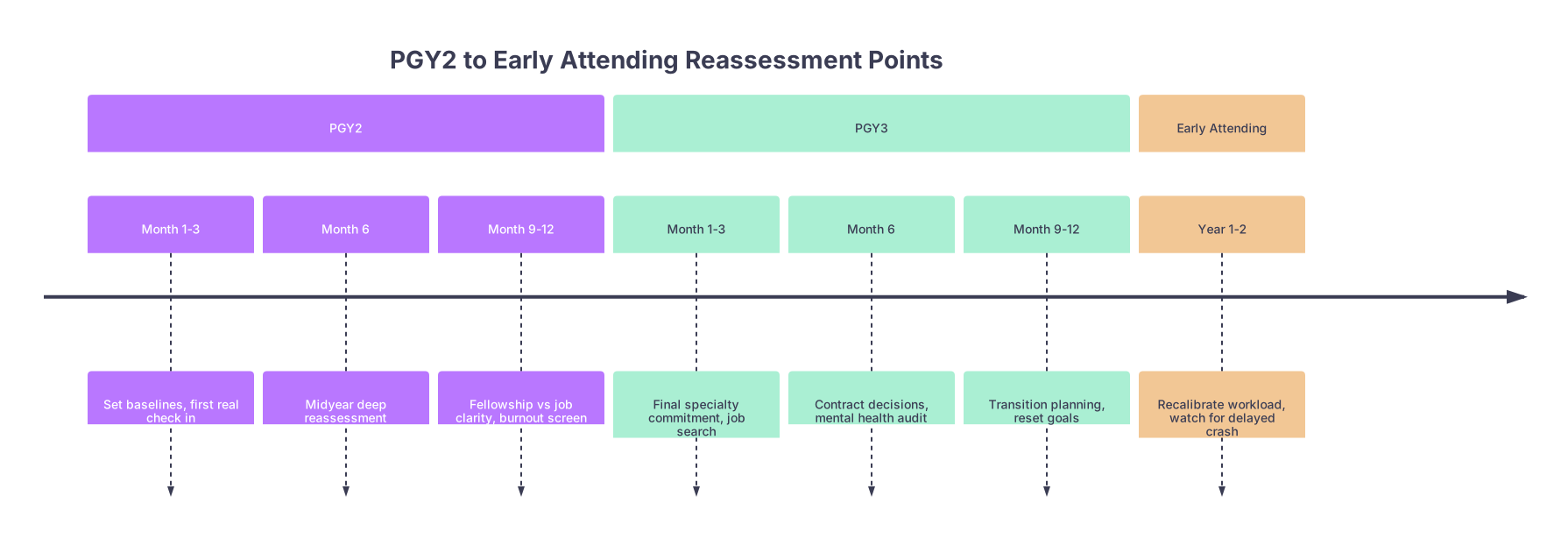
| Period | Event |
|---|---|
| PGY2 - Month 1-3 | Set baselines, first real check in |
| PGY2 - Month 6 | Midyear deep reassessment |
| PGY2 - Month 9-12 | Fellowship vs job clarity, burnout screen |
| PGY3 - Month 1-3 | Final specialty commitment, job search |
| PGY3 - Month 6 | Contract decisions, mental health audit |
| PGY3 - Month 9-12 | Transition planning, reset goals |
| Early Attending - Year 1-2 | Recalibrate workload, watch for delayed crash |
Keep that arc in mind. Now let us go point‑by‑point.
PGY‑2: Competent, tired, and finally able to see clearly
PGY‑2, Months 1–3: Set your baseline
At this point you should stop pretending you are still “just adjusting to intern year.” You are not. You have enough data about your day‑to‑day reality to start measuring it.
Use the first quarter of PGY‑2 to do three things:
- Document your reality for 2 weeks
Do not overengineer this. Grab a small notebook or a simple phone note. For 14 days:
- Write your start and end time each day
- Jot 1–2 sentences:
- “Clinic was actually energizing”
- “Third death this week; feel numb”
- “Caught myself snapping at nurse; not like me”
You are building a baseline of:
- Hours
- Emotional tone
- What gives vs drains energy
Pick something standardized:
- PHQ‑9 for depression
- GAD‑7 for anxiety
- A simple 0–10 burnout self‑rating: “How emotionally exhausted am I?”
You are not diagnosing yourself. You are giving future‑you reference points.
- List what you thought this specialty would be
Three columns. Fast.
- Column A: What I thought this specialty would be
- Column B: What it actually is, based on intern + early PGY‑2
- Column C: What still excites me, if anything
If Column C is empty, that is a red flag. Not “quit immediately” territory. But it means PGY‑2 is not just a rough patch.
PGY‑2, Months 4–6: First real career reassessment
By the middle of PGY‑2, you should be asking blunt questions about fit, not just survival.
At this point you should answer:
- Do I actually like the core work of this specialty when I am not drowning?
- Which rotations made me forget to check the clock? Which made me fantasize about leaving medicine entirely?
- Is my distress about:
- The system (hours, documentation, toxic culture), or
- The actual patients and problems I deal with daily?
A quick comparative table helps make this concrete:
| Domain | Green Flag (Stay) | Yellow Flag (Question) |
|---|---|---|
| Daily clinical work | Often engaging, time passes quickly | Chronically draining, dread most days |
| Identity alignment | Proud to say "I am a ___ doctor" | Feel miscast or vaguely embarrassed |
| Learning curve | Still curious, want to get better | Indifferent, just wanting it to end |
| Future versions | Can picture a version of attending you | All future versions feel miserable |
| Moral comfort | Few ethical compromises, manageable | Regularly feel you are crossing lines |
If you are majority yellow by 6 months into PGY‑2, this is not “just residency being hard.” It is misalignment.
Mental health checkpoint at 6 months
At this point you should:
- Repeat PHQ‑9 / GAD‑7 / burnout score
- Literally compare to your early‑PGY‑2 baseline
- Ask:
- Am I getting more cynical by default?
- Am I drinking / using substances more often “to take the edge off”?
- Have friends/family said, “You sound different,” and not in a good way?
If scores are rising and you are starting to detach from patients as a defense, that is not sustainable. Or ethical. Detached, numb physicians cut corners and miss things. I have seen that slide happen slowly, then all at once.
PGY‑2, Months 7–9: Fellowship vs job vs pivot
For most three‑year programs, this window is when fellowship applications crystallize. It is also when some residents quietly realize:
“I might be in the wrong field entirely.”
At this point you should be clear on three questions:
- Do I actually want more subspecialty training, or do I just want out of my current misery?
Common mistake: applying to any fellowship that gets you “out of the hospital” or promises better hours, without caring about the work itself.
Filter it like this:
- Would I still choose this fellowship if:
- Salary were equal to generalist
- Hours were similar
- Prestige were removed
If the answer is no, you are chasing escape, not a calling.
- Am I willing to double down on this specialty for another 10–20 years?
Not “can I finish residency.” You probably can. Real question:
Can you picture 45‑year‑old you doing a version of this that does not make you bitter?
- Is a bigger pivot on the table?
That might mean:
- Switching specialties (yes, people do it in PGY‑2 and PGY‑3)
- Planning an early shift to:
- Hospital administration
- Quality / safety
- Palliative care, addiction medicine, informatics
- Or realistically, leaving clinical medicine over 3–5 years
You do not have to act yet. But you must let yourself ask.
PGY‑2, Months 10–12: Hard mental health audit
Burnout and depression are not the same thing, but by late PGY‑2 they frequently coexist. This is when people crack: divorces, substance issues, suicidal ideation. I have seen all of those peak near the end of PGY‑2.
At this point you should run a full audit:
- Symptoms you should not normalize
- You fantasize about an accident as a “way out”
- You cry in the call room weekly and then wipe your face and go back out like nothing happened
- You feel nothing when people die that would have broken you during MS3
- You start cutting ethical corners:
- “I will just copy‑paste that note again”
- “I know I should discuss X with the patient, but I do not have the energy”
- Minimum professional response
If any of the above are true, you are beyond self‑care hacks. At this point you should:
- Schedule with:
- A therapist who has worked with physicians or trainees
- Or your institution’s employee assistance program if that is all you can access quickly
- Talk to at least one of:
- Program director
- Chief resident
- Trusted faculty mentor
Not to dramatize. To prevent quiet self‑destruction that eventually turns into patient harm.
- Ethical line in the sand
Your duty to patients does not require sacrificing your basic mental integrity. Practicing while severely impaired is not noble. It is unsafe.
If you are at the point of:
- Recurrent suicidal thoughts
- Using substances on or before shifts
- Regularly missing or ignoring critical tasks
Then the ethical move is to step back, not “push through.”
PGY‑3: From “Can I finish?” to “What life am I building?”
PGY‑3 is where your decisions start locking in. That can be terrifying. Good. It should make you pay attention.
PGY‑3, Months 1–3: Final specialty commitment and early job search
At this point you should do a structured reset:
- Update your “real life” preference list
Outside of the hospital, what do you actually want?
- Geographic priorities (family, partner career, cost of living)
- Type of work:
- Inpatient / outpatient / mixed
- Procedural vs cognitive
- Academic vs community vs locums
- Workload:
- Maximum number of nights per month you are willing to tolerate long‑term
- Call expectations you will refuse
Write this down. You will get offered jobs that violate it. That is where people sell out their own mental health.
- Reassess earlier career doubts with slightly more distance
Look back at your PGY‑2 notes. Ask:
- Did things get better with senior autonomy?
- Or did more control just make you more aware of how misaligned the work is?
- Are you still fantasizing about different specialties (rad onc, derm, psych, palliative) with a sense of “that is who I was supposed to be”?
If doubts have persisted unchanged for 12+ months, they are no longer “a mood.” They are data.
- Start job conversations with mental health front and center
When you talk with potential employers, you should be asking about:
- Protected time: Is “0.8 FTE” actually honored, or does everyone work like they are 1.2 FTE?
- Support:
- Access to mental health services
- Culture when someone needs time off for psychiatric care
- Staffing:
- Real MA/APP support or just marketing language
- Coverage during vacations / leaves
You are not just buying a salary. You are buying an environment that can preserve or destroy you.
PGY‑3, Months 4–6: Locking in offers, confronting tradeoffs
This is where people get trapped by sunk cost and prestige.
At this point you should:
- Compare offers and paths using a brutally practical grid
| Factor | Option A (Fellowship) | Option B (Hospitalist Job) | Option C (Outpatient Job) |
|---|---|---|---|
| Weekly hours | 60+ | 45 | 40 |
| Night shifts/yr | 60 | 12 | 0 |
| Base salary | 65k | 240k | 220k |
| Commute (min) | 45 | 20 | 10 |
| Burnout risk (1-5) | 4 | 3 | 2 |
You do not need a perfect system. But you do need to see in black and white what you are trading.
- Name your non‑negotiables
By mid‑PGY‑3, you should have 3–5 hard lines, for example:
- No more than 2 overnight shifts per month
- No primary job where documentation regularly spills 2+ hours into home time
- Must have colleagues I respect ethically — not just clinically
If an offer or path violates those, say no. Even if it is branded, prestigious, or “what people from this program usually do.”
- Recheck your mental health
Burnout often dips a bit in PGY‑3 as you taste the finish line. Do not let that fool you.
Repeat your PHQ‑9, GAD‑7, burnout rating. Look at the trend from early PGY‑2 → late PGY‑2 → mid PGY‑3.
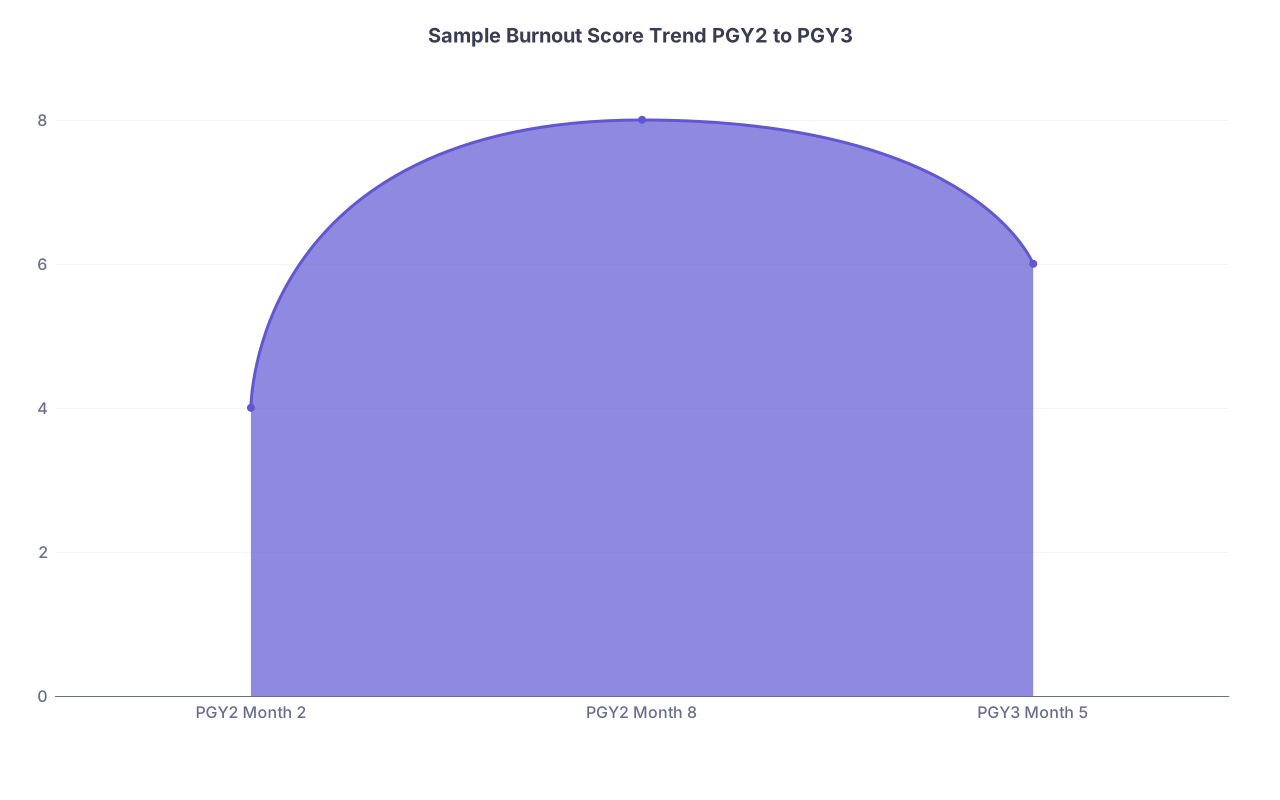
| Category | Value |
|---|---|
| PGY2 Month 2 | 4 |
| PGY2 Month 8 | 8 |
| PGY3 Month 5 | 6 |
If your “improvement” is just going from catastrophic to barely functional, that is not a green light to sign up for the most intense job.
PGY‑3, Months 7–12: Transition planning and ethical reset
This phase is where you convert vague intentions into structures that will either protect or erode you as an attending.
At this point you should:
- Design your first attending year like a rehab plan, not a victory lap
I am not joking. Your risk in year 1–2 attending is:
- Overcommitting (“Sure, I can be on three hospital committees”)
- Overearning then feeling trapped by lifestyle
- Losing all guardrails because “I finally have freedom”
You should plan for:
- A realistic FTE. Many residents do well starting at 0.8–0.9 FTE clinically, if finances allow.
- A protected nonclinical block:
- Teaching
- QI
- Research
- Or just less time in the EHR
- Set explicit mental health follow‑ups
Before you finish residency, book:
- A therapy appointment within 1–2 months of starting your attending job
- Annual or semiannual self‑check blocks:
- Half‑day off where you review:
- Hours
- Sleep
- Relationships
- Ethical compromises you have felt pressured into
- Half‑day off where you review:
Write those into your calendar now, before your attending schedule calcifies.
- Reaffirm your ethical boundaries in writing
You went into medicine with some version of: “First, do no harm.” Residency can sand that down into “First, get through the day.”
Before you graduate, write two lists:
Things I will not do as an attending, even if pressured:
- Falsify documentation
- Ignore serious safety issues to keep metrics pretty
- Stay silent when colleagues are abusive to staff or patients
Things I will actively do:
- Call for backup when mentally overwhelmed instead of guessing
- Advocate for lighter loads when patient safety is at risk
- Say “no” to roles that clearly compromise my health for optics
Then tell at least one colleague or mentor. Accountability matters.
Early attending years: The delayed crash zone
Many people hold themselves together through PGY‑3 on adrenaline and the promise of “once I am attending, it will be better.” Then they hit year 1–2 and fall apart.
Here is how to not be that story.
Year 1 attending: Months 1–6
At this point you should:
- Track your actual weekly work hours for at least 8 weeks
- Notice:
- How often you are charting after hours
- How often you are waking up thinking about a missed lab or order
If you are already back near PGY‑2 burnout levels by month 6, you mis‑estimated your job or yourself. Bring that data to your leadership and renegotiate before it becomes “just how it is.”
Year 1–2 attending: Ongoing reassessment
Set a repeating 6‑month reminder to ask:
- If I were PGY‑2 again, watching my life now, would I choose this path?
- What part of my job is aging me the fastest?
- Nights?
- RVU pressure?
- Moral distress from system failures?
Then adjust one concrete thing every 6 months:
- Drop a committee
- Shift FTE
- Move toward a niche that fits you better (palliative consults, teaching heavy roles, QI)
Your career is not a 3‑year project. You are designing something that has to be livable for decades.
When to make big moves vs small adjustments
You are probably in “adjust, not escape” territory if:
- There are still parts of your day that feel meaningful
- Your worst symptoms improve with protected time off and support
- A different practice setting (academic vs community, outpatient vs inpatient) would plausibly fix 70–80% of what is wrong
You should seriously consider major change (different job, different specialty, or step away from clinical work) if:
- You have had persistent dread and misalignment for >12 months despite:
- Therapy
- Reasonable schedule adjustments
- Supportive leadership
- You cannot picture any version of your current specialty that feels acceptable long‑term
- Your mental health has significantly worsened every year of residency
I have seen residents switch from surgery to anesthesia, from IM to psych, from EM to outpatient primary care in mid‑PGY‑2 or PGY‑3 and end up dramatically better off. The sunk cost fallacy is strong. It is also garbage. Three hard years are not a reason to sacrifice the next 30.
Final 3 takeaways
PGY‑2 and PGY‑3 are not just about “getting through.” They are the primary window to decide whether your current specialty and path are actually compatible with a sustainable life.
You need structured checkpoints—every 6–12 months—to reassess both career goals and mental health with data, not just vibes. Use simple tools, repeat them, and pay attention to the trend.
Protecting your mental health is not optional or selfish. It is an ethical requirement for safe, compassionate care over a full career. Adjust early, say no often, and do not be afraid to make big changes when the numbers—and your gut—have been pointing in the same direction for a long time.