
The average medical student’s Sunday night is chaos masquerading as “catching up.” You need a ritual, not random panic.
What follows is a structured, repeatable Sunday Night Reset built specifically for medical students. By the end of this, your week will not be “busy and blurry.” It will be deliberate. And you will know exactly what happens every Sunday, almost down to the minute.
The Logic of a Weekly Reset (Why Sunday Night Matters)
Before the timeline, you need the principle.
Medical school weeks do not self-organize. Left alone, they expand to fill every waking hour. That is how you wake up Friday wondering what happened to your “day off” and why you still feel behind on Anki, ethics reading, and laundry.
Your Sunday Night Reset has three goals:
- Protect your time – You actively decide where your hours go instead of letting school eat all of them.
- Protect your judgment – You pre‑commit to ethical and personal boundaries before you are exhausted and on autopilot.
- Protect your brain – You reduce cognitive load by externalizing decisions into lists, schedules, and routines.
Think of it as a weekly “systems check” for:
- Your schedule
- Your tasks and studying
- Your body and sleep
- Your ethics and boundaries
- Your relationships
And yes, we will do this in order, with time blocks.
Weekly Flow Overview: What Sunday Night Should Look Like
Here is the high‑level structure. Then we will drill down into 10–15 minute blocks.
| Time Block | Focus Area |
|---|---|
| 0–10 min | Physical reset & environment |
| 10–25 min | Calendar & time blocking |
| 25–40 min | Academic and clinical planning |
| 40–55 min | Personal life & self‑care planning |
| 55–70 min | Ethics, values, and boundary check |
| 70–90 min | Wind‑down & sleep prep |
You can compress this into 45–60 minutes on brutal weeks. But the categories do not change. Skipping an entire category is how things spiral.
Step 1: 0–10 Minutes – Physical Reset and Environment
At this point you should not touch your calendar yet. You start with your space.
0–2 minutes: Quick room sweep
- Clear visible trash (coffee cups, wrappers, old notes).
- Dump everything that is out of place into a single “catch-all bin” if you must. Perfection is not the goal. Visual calm is.
2–5 minutes: Desk reset
- Remove everything not needed for studying.
- Wipe the surface. Yes, actually wipe it. A clean physical space reliably drops anxiety a notch.
- Put out only:
- Laptop / tablet
- One notebook
- Pen
- Water bottle
5–10 minutes: Digital reset (micro-version)
- Close all tabs except:
- Calendar
- Task manager or note app
- Put your phone on Do Not Disturb and upside down.
- Optional but recommended: 30-second inbox sweep to delete junk and mark non-urgent emails to handle later in the week.
If your environment is a mess, your planning will be vague. You want clear surfaces and a single point of focus.
Step 2: 10–25 Minutes – Calendar & Time Blocking
Now your space is clean. At this point you should lay out the skeleton of your week.
Open your calendar (Google Calendar, Outlook, Notion, paper planner—pick one and commit).
10–15 minutes: Lock in non‑negotiables Block off:
- Scheduled classes / small groups / labs
- Exams, quizzes, OSCEs
- Clinical shifts or preceptorships
- Required meetings (advising, research meetings, committee work)
They happen when they happen. Treat them as immovable.
15–20 minutes: Block core study time Now you add your anchor study blocks around the non‑negotiables:
- 2–3 hour blocks on your highest-energy times (for most people: mornings or early afternoon).
- Separate:
- Content review blocks (lectures, reading, ethics cases)
- Question practice blocks (Anki, UWorld, case questions)
- Do not fill every open hour. That is rookie behavior. Leave at least 1–2 hours daily unblocked for overflow.
20–25 minutes: Protecting non‑study time Here is where most medical students fail.
You must explicitly block:
- Sleep window (e.g., 11 pm–6:30 am, every day)
- Exercise (at least 2–3 sessions, even if 20 minutes each)
- One real break block:
- A dinner with friends
- A walk with a podcast
- A movie night If you do not protect these in writing, school will erase them.
At this point, your week should look full but not suffocating. You should see:
- Required commitments
- Study anchors
- Sleep
- Minimum self‑care
Add color coding if you want to see balance at a glance.
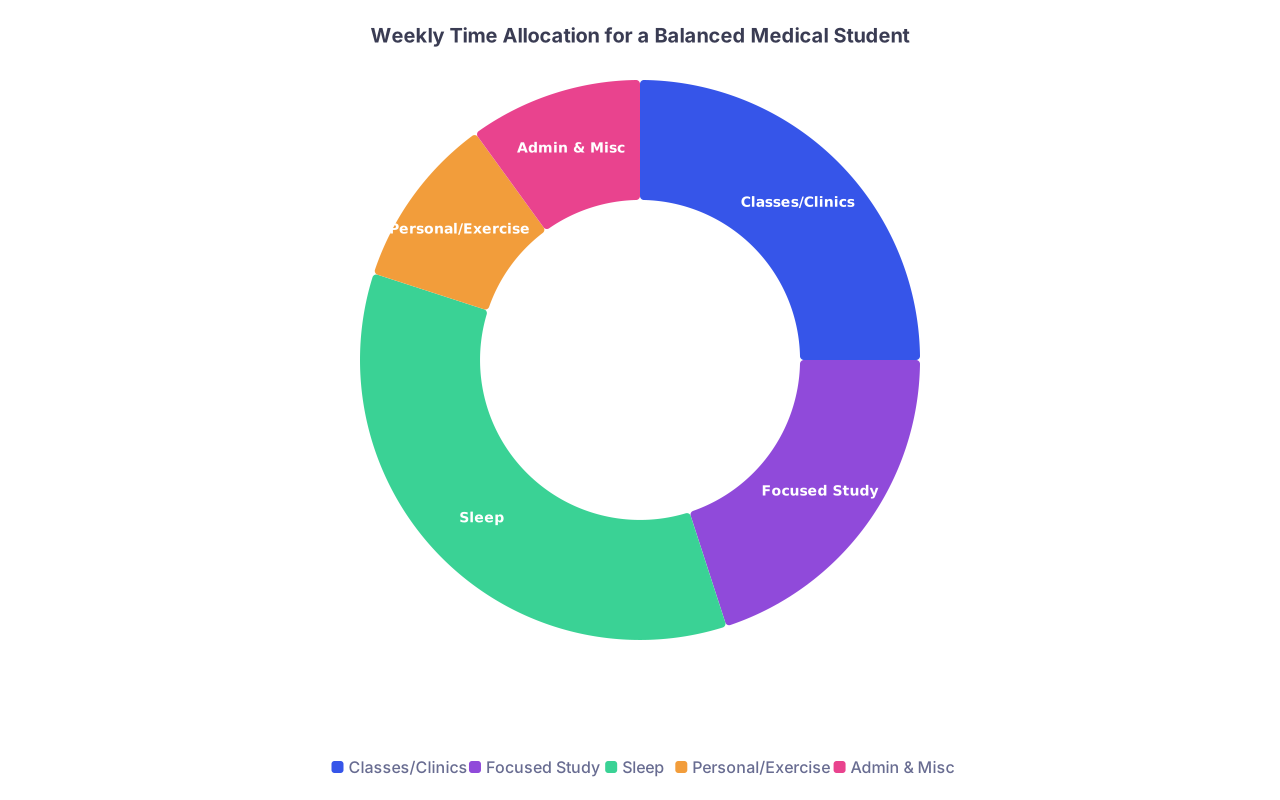
| Category | Value |
|---|---|
| Classes/Clinics | 25 |
| Focused Study | 20 |
| Sleep | 35 |
| Personal/Exercise | 10 |
| Admin & Misc | 10 |
Step 3: 25–40 Minutes – Academic and Clinical Planning
Now you have the skeleton. At this point you should define exactly what “study” means this week. Vague plans = vague results.
25–30 minutes: Weekly academic overview List out, on paper or in a task app:
- Exams or quizzes (with topics)
- Required readings / ethics modules
- Lab reports, write-ups, or presentations
- Required clinical prep (e.g., pre‑reading for surgery service, reviewing patient lists)
Then, for each item, assign:
- A due date
- A work session in your calendar (using the study blocks you already created)
Avoid magical thinking (“I will just fit it in somewhere”). Put it on a specific day and block.
30–35 minutes: Micro‑plan the next 48 hours Medical school is unpredictable. Planning the entire week in detail is fantasy. You plan the week at a high level, but you micro‑plan only the first 1–2 days.
For Monday and Tuesday, write a simple checklist:
- Morning:
- Finish cardio phys lecture 7–9
- Anki reviews (250 cards)
- Afternoon:
- 40 UWorld questions – heme
- Ethics: read “Informed Consent and Capacity” chapter
- Evening:
- 20 minutes of Step review
- Pack bag and pre‑read for Tuesday clinic
Be specific. “Study cardio” is useless. “Finish cardio lecture 6 + 80 related Anki cards” is functional.
35–40 minutes: Clinical rotation overlay (if you are on wards)
If you are on clinical rotations, you add one more layer:
- List the days you are:
- On call
- Post‑call
- Pre‑rounding at 5 am like a zombie
- Adjust expectations:
- Heavy call day → lighter study goal (Anki only, no big new content)
- Post‑call day → prioritize sleep, not hero studying
- Identify 1–2 patients or topics you intend to follow in depth this week (example: “all DKA patients on the team” or “all pre‑op counseling conversations”).
This is where work‑life balance intersects with reality. You cannot “optimize” a 28‑hour call. You can only be honest about what is possible and plan around it.
Step 4: 40–55 Minutes – Personal Life and Self‑Care Planning
Most students stop after Step 3. That is why they burn out by mid‑block.
At this point you should intentionally design non‑school life into your week.
40–45 minutes: Health basics audit Quick checklist:
- Sleep:
- Target bedtime and wake time for each day this week.
- One contingency plan if you know a night will run late (e.g., “If I am up past midnight Wednesday, I will nap 30 minutes Thursday afternoon and shorten that evening study block.”)
- Food:
- Choose 2–3 default meals you can repeat without thinking.
- Decide when you will cook or batch prep (even if it is just a giant pot of rice and beans).
- Movement:
- Choose specific days and times:
- 20‑minute walk after Monday class
- 30‑minute gym Wednesday night
- Bodyweight exercises Saturday morning
- Choose specific days and times:
Do not write “eat healthier” or “work out more.” That is noise.
45–50 minutes: Relationships and connection You are not a machine. And when you ignore your people for weeks, you feel it.
Decide:
- Who needs at least a check‑in this week?
- Partner
- Close friend
- Parent / sibling / mentor
- When will it happen?
- Call mom during walk to campus Tuesday
- Coffee with a classmate Thursday after lab
- 15‑minute FaceTime with partner Sunday afternoon (yes, you can schedule things like that)
You are planning for sanity here. Not just productivity.
50–55 minutes: “Joy anchors” You are allowed to enjoy your life in medical school. Radical idea, I know.
Pick 1–2 small, guaranteed pleasures and assign them to the calendar:
- Weekly bakery coffee after Friday exam
- Watching one episode of a show on Wednesday night
- A long bath on Saturday evening
They go on the calendar like any other appointment. Because if you do not schedule joy, it will be sacrificed first.

Step 5: 55–70 Minutes – Ethics, Values, and Boundary Check
This is the part almost every “productivity” guide ignores. Huge mistake.
You are not just managing time. You are shaping the kind of physician you become. Every week. Especially when you are tired.
At this point you should align your upcoming week with your values.
55–60 minutes: Weekly ethics reflection (5 minutes, not optional)
Open a journal or notes app. Answer three prompts, briefly:
“When did I feel misaligned last week?”
Concrete examples:- You charted something you did not fully explain to a patient because everyone else was rushing.
- You brushed off a classmate who was clearly stressed because you “did not have time.”
- You cut corners on studying material related to patient safety or consent, telling yourself you would “catch it later.”
“What kind of physician do I refuse to become?”
One or two phrases. Example:- The physician who is too exhausted to listen.
- The physician who treats patients like checkboxes.
- The physician who normalizes subtle disrespect on rounds.
“One small ethical practice I will commit to this week is…”
Make it specific:- “I will introduce myself clearly and sit down with at least one patient each day, even if only for 2 minutes.”
- “I will ask one clarifying question when I do not understand the plan, instead of nodding.”
- “I will say something when I see a classmate being dismissed or interrupted.”
Write them down. That tiny written commitment matters later when you are tired and tempted to cut corners.
60–65 minutes: Boundary review
Medical training loves to invade every boundary unless you define them first.
Ask:
- Workload boundary:
- “What is my maximum daily study time on a normal day this week?” (e.g., 9 hours total including class)
- “What is my absolute cutoff time in the evening?” (e.g., no new content after 9:30 pm)
- Respect boundary:
- One behavior you will not tolerate toward yourself (e.g., repeated belittling on rounds without pushing back in some fashion—could be debriefing with a chief or clerkship director, not necessarily direct confrontation).
- Self‑respect boundary:
- One thing you will not sacrifice this week, even if you feel behind (e.g., sleep below 6 hours, skipping all movement, ignoring your partner for 7 straight days).
You are not promising perfection. You are setting red lines.
65–70 minutes: Integrity check against your calendar
Look back at the calendar you built and ask:
- Does this schedule make it more likely or less likely I will behave like the physician I want to be?
- Have I allowed any block that practically guarantees unethical shortcuts?
Example:- 6 hours sleep, 14 hours work, no meal breaks → you will be impatient and sloppy.
- Constant back‑to‑back commitments, no reflection time → you will not learn from your mistakes, you will repeat them.
Adjust one or two things:
- Add 10 minutes to eat before clinic.
- Add a “debrief/reflect” 10‑minute block after a heavy clinic day.
- Shorten one study block to preserve sleep.
This is how work‑life balance and medical ethics intersect: through extremely practical weekly choices, not lofty mission statements on white coats.

| Step | Description |
|---|---|
| Step 1 | Start Sunday Reset |
| Step 2 | Clean space |
| Step 3 | Review calendar |
| Step 4 | Plan study blocks |
| Step 5 | Plan self care |
| Step 6 | Ethics reflection |
| Step 7 | Set boundaries |
| Step 8 | Wind down and sleep |
Step 6: 70–90 Minutes – Wind‑Down and Sleep Prep
You have planned the week. At this point you should switch from planning mode to recovery mode. If you stop here and then scroll your phone for an hour, you just sabotaged yourself.
70–75 minutes: Physical prep for Monday
- Pack your bag:
- ID badge, stethoscope, pens
- Lecture notes / iPad
- Small snack
- Lay out clothes for the morning:
- Scrubs or business casual
- Shoes, socks, coat
Remove as many Monday‑morning decisions as possible.
75–85 minutes: Mental decompression Pick one:
- Short walk without your phone
- 10–15 minutes of stretching or yoga
- 5–10 minutes of guided breathing or meditation
- Reading a non‑medical book
The goal: signal to your brain that the week is planned and you are safe to power down.
85–90 minutes: Tech cutoff
- Put your phone on charge, away from the bed.
- Set alarm for the same wake time you committed to earlier.
- No email, no schedule changes, no “one last check.”
You are done. The week is set.

A Sample “Sunday Night Checklist” You Can Actually Use
Here is a condensed version you can print or keep in a note. Follow it in order.
| Order | Task |
|---|---|
| 1 | 5–10 min clean and desk reset |
| 2 | Add all classes/clinics/exams to calendar |
| 3 | Block study, sleep, exercise, one social event |
| 4 | List all academic tasks and assign to days |
| 5 | Micro‑plan Monday and Tuesday |
| 6 | Plan meals and 2–3 movement sessions |
| 7 | Schedule 1–2 key check‑ins with people |
| 8 | 5‑minute ethics reflection and commitment |
| 9 | Define weekly boundaries and adjust calendar |
| 10 | Pack bag, lay out clothes, tech cutoff, wind‑down |
Print this. Tape it above your desk. Walk down the list every Sunday.

Making It Stick: Week‑by‑Week Progression
You will not run a perfect reset the first week. Or the third. That is fine.
Here is how this ritual usually stabilizes over a month:
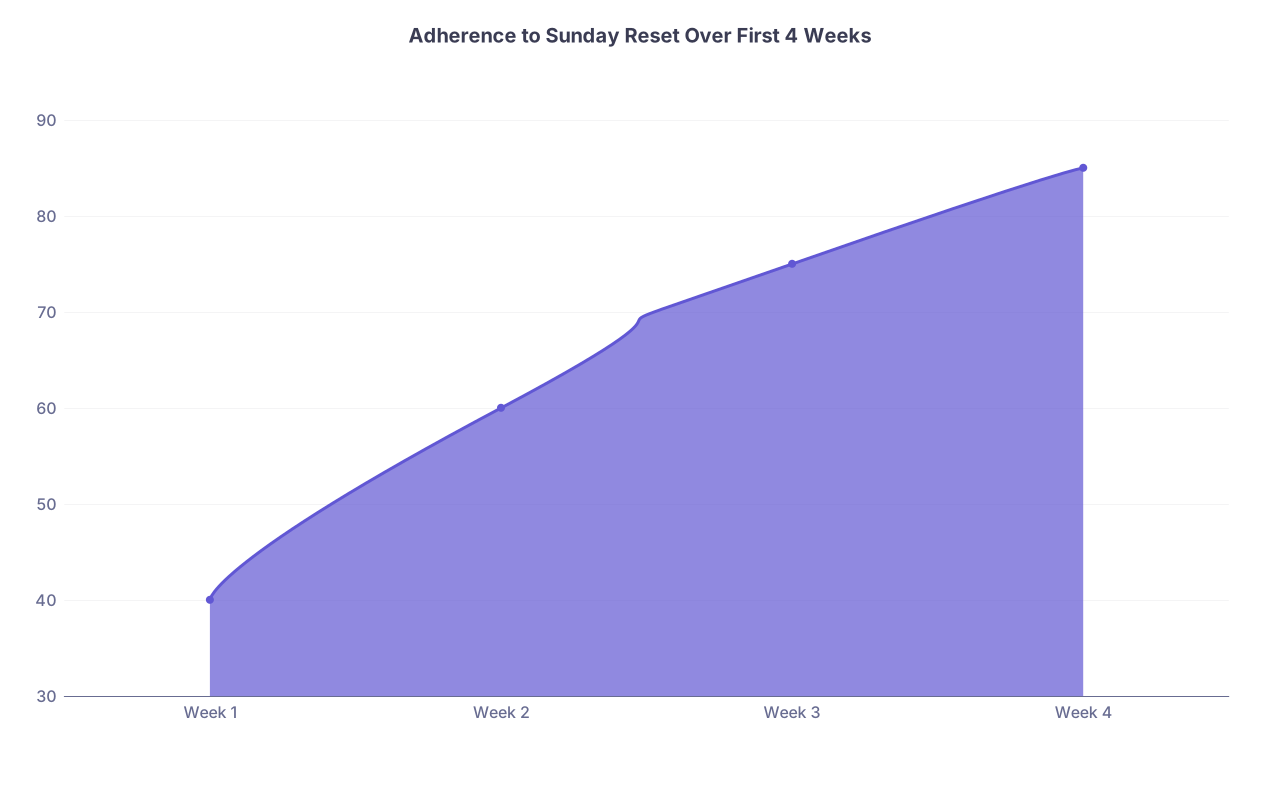
| Category | Value |
|---|---|
| Week 1 | 40 |
| Week 2 | 60 |
| Week 3 | 75 |
| Week 4 | 85 |
Week 1:
You follow maybe 40–50% of the checklist. You underestimate how long planning takes. You forget the ethics part.
Week 2:
Your calendar looks less chaotic. You actually sleep a bit more. You realize that blocking joy was not “soft”; it made Monday less miserable.
Week 3:
The ritual feels familiar. You start seeing patterns: same mistakes, same over‑commitment tendencies. The ethics reflection starts to sting in useful ways.
Week 4 and beyond:
You do not “feel ready” every week. But you are not guessing anymore. You have a process. That alone puts you ahead of most of your cohort.
The Core Takeaways
- Your Sunday night is not for random catching up. It is for a structured reset: space → schedule → tasks → life → ethics → wind‑down.
- Ethics and work‑life balance are not separate chapters. Weekly decisions about sleep, time blocks, and boundaries directly shape the kind of physician you become.
- Ritual beats willpower. Run this same checklist every Sunday. Imperfectly. Over time, the habit will carry you even when your motivation does not.