
The first 90 days of residency will either protect you for years—or break you fast.
Most interns stumble into July, react to everything, and hope it gets better. It does not. The habits you build in these first weeks will set your baseline for sleep, boundaries, ethics, and burnout risk. You’re not “just surviving” this period; you’re wiring your default settings as a physician.
Let’s build those defaults on purpose.
Big Picture: Your 90-Day Habit Map
Here’s the real game: you are building protective habits across four domains at the same time:
- Sleep and physical routines (your basic hardware)
- Mental hygiene and emotional processing
- Work–life boundaries and sustainable workload
- Ethical backbone and professional integrity
These do not magically appear later “when things calm down.” They start now or they rarely start at all.
We’ll walk this chronologically:
- Month 1: Survival with structure
- Month 2: Refinement and boundaries
- Month 3: Leadership of your own life
Then I’ll drill into weekly and daily moves.
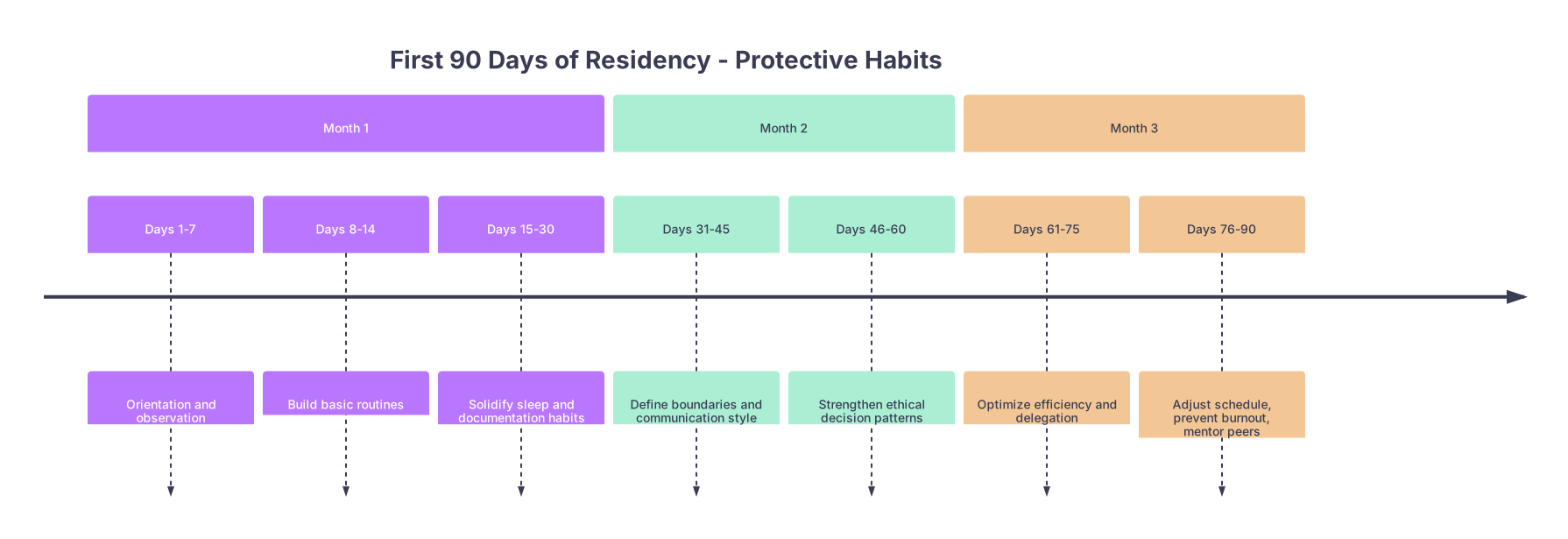
| Period | Event |
|---|---|
| Month 1 - Days 1-7 | Orientation and observation |
| Month 1 - Days 8-14 | Build basic routines |
| Month 1 - Days 15-30 | Solidify sleep and documentation habits |
| Month 2 - Days 31-45 | Define boundaries and communication style |
| Month 2 - Days 46-60 | Strengthen ethical decision patterns |
| Month 3 - Days 61-75 | Optimize efficiency and delegation |
| Month 3 - Days 76-90 | Adjust schedule, prevent burnout, mentor peers |
Month 1 (Days 1–30): Survival, But Structured
Days 1–7: Orientation and “Default Settings”
At this point, you should watch more than you talk and decide your non‑negotiables.
Daily non‑negotiables (even on call):
- A real meal (not just coffee and crackers)
- 5–10 minutes of movement
- 5–10 minutes of mental decompression
- 1 tiny act of non-medical life (text a friend, read one page of a book)
These sound small. They’re not. I’ve watched interns who skip these for a week turn into interns who can’t remember the last time they did anything for themselves.
Concrete actions this first week:
Set your sleep anchor
- Pick a consistent sleep window on non-call days (example: 10:30 pm–5:30 am).
- On nights call, protect the wake-up time more than the bedtime. Your body loves a consistent anchor.
Build your “go” bag
- One small bag that lives ready by the door:
- 1–2 protein snacks
- Electrolyte packets
- Phone charger
- Compression socks
- Travel-size toothbrush + toothpaste
- You don’t decide to eat or hydrate when you’re already crashing. The bag makes the decision for you.
- One small bag that lives ready by the door:
Decide your ethics red lines right now Write these down (on paper, not in your head):
- “I will not falsify any documentation, ever.”
- “I will not ignore a safety concern I believe is real; I will escalate.”
- “I will not yell at, demean, or gossip about patients or staff.” You’d be shocked how many people slide on these because they never made them explicit.
Start a 2-minute reflection habit
- On your commute home or just before bed, answer:
- What did I see today that I never want to become?
- What did I see today that I want to emulate? That’s how you start building your ethical identity as a physician.
- On your commute home or just before bed, answer:
Days 8–14: Protect Sleep, Learn the System
At this point, you should stop trying to be impressive and start trying to be consistent.
You’re still in survival mode, but now you add structure.
Sleep and fatigue rules (write these down somewhere):
- No screen scrolling in bed. 15 minutes = 1 hour of lost restorative sleep because your brain doesn’t shut off.
- If you’re post-call and unsafe to drive, you do not drive. Period. Call a co-resident, Uber, whatever. This is an ethical issue, not convenience.
Work habits to build this week:
- Same note template every day. Build a personal template for H&Ps and progress notes. Save keystrokes, save your brain.
- Create a handoff checklist. Do NOT rely on memory at 2 am.
| Item | Example Prompt |
|---|---|
| Code Status | Full/DNR/DNI |
| Active Issues | GI bleed, sepsis, etc. |
| Overnight Tasks | 2 am BMP, redraw CBC |
| Watch Closely For | Hypotension, bleeding |
| Family Contact | Who to call, when |
This isn’t busywork. Good handoffs prevent 3 am disasters that keep you in the hospital longer and wreck your mental state.
Ethical micro‑habits this week:
- Always look at the patient before the chart. Human first, data second.
- When talking about patients, use their name once before the room number. “Ms. Jones in 402” not “the 402 pancreatitis.”
- That’s not fluff. It keeps them human in your mind, which changes your decisions under fatigue.
Days 15–30: Lock In Foundations
By now, the chaos feels slightly less chaotic. This is the danger zone: people think, “I’ve got it,” and let bad habits cement.
At this point, you should refine and protect what works, and ruthlessly cut what doesn’t.
Weekly reset (pick one day, 20 minutes):
- Look at your last 7 days of:
- Sleep hours (rough estimate is fine)
- Days you actually exercised
- Times you ate a real meal vs. vending machine
- Ask: What is obviously unsustainable?
Then make one small change for the coming week:
- Pack food the night before for 2 days.
- Block one 30-minute window post-call for actual sleep before anything else.
- Schedule a 15-minute walk with a co-intern after rounds 2x/week.
Ethical and professional habits to reinforce:
- Say “I don’t know, I’ll find out” once per day.
It fights the ego that leads to unsafe shortcuts. - Re-read your own notes for accuracy.
Don’t let copy-paste turn into lies. If you wrote “no edema” because the last note said that, but you never looked—fix it.
Mental health safeguard:
- Identify one person you can text with the phrase: “Today was bad, I can’t talk long, just need to say that to someone.”
Not to unload everything. Just to not be alone in it.
Month 2 (Days 31–60): Boundaries and Ethical Backbone
By the second month, you know the workflow. Now the question becomes: will you bend yourself to the system or shape how you move through it?
Days 31–45: Define Your Boundaries
At this point, you should decide what you will and will not sacrifice.
No, you cannot control your hours. But you can control the margins.
Pick your “always” and “never” rules:
Examples:
- “I will always call my partner/parent/friend at least once per week, no matter what rotation.”
- “I will never skip eating for more than 6 consecutive hours at work.”
- “I will always speak up if a discharge feels unsafe, even if it annoys people.”
Put 2–3 rules in writing. If everything is flexible, your life gets pulled to the lowest common denominator.
Communication upgrades this fortnight:
- Start using closed-loop communication consistently:
“So I’ll order the CT now and call you with results in an hour. If I don’t call, please page me.” - When you’re overwhelmed:
- Say: “I can do X or Y safely in the next hour, not both. Which is higher priority?”
That’s a boundary and a patient safety move, not weakness.
- Say: “I can do X or Y safely in the next hour, not both. Which is higher priority?”
Work–life balance reality check:
Use this quick visual to roughly assess where your time is actually going:
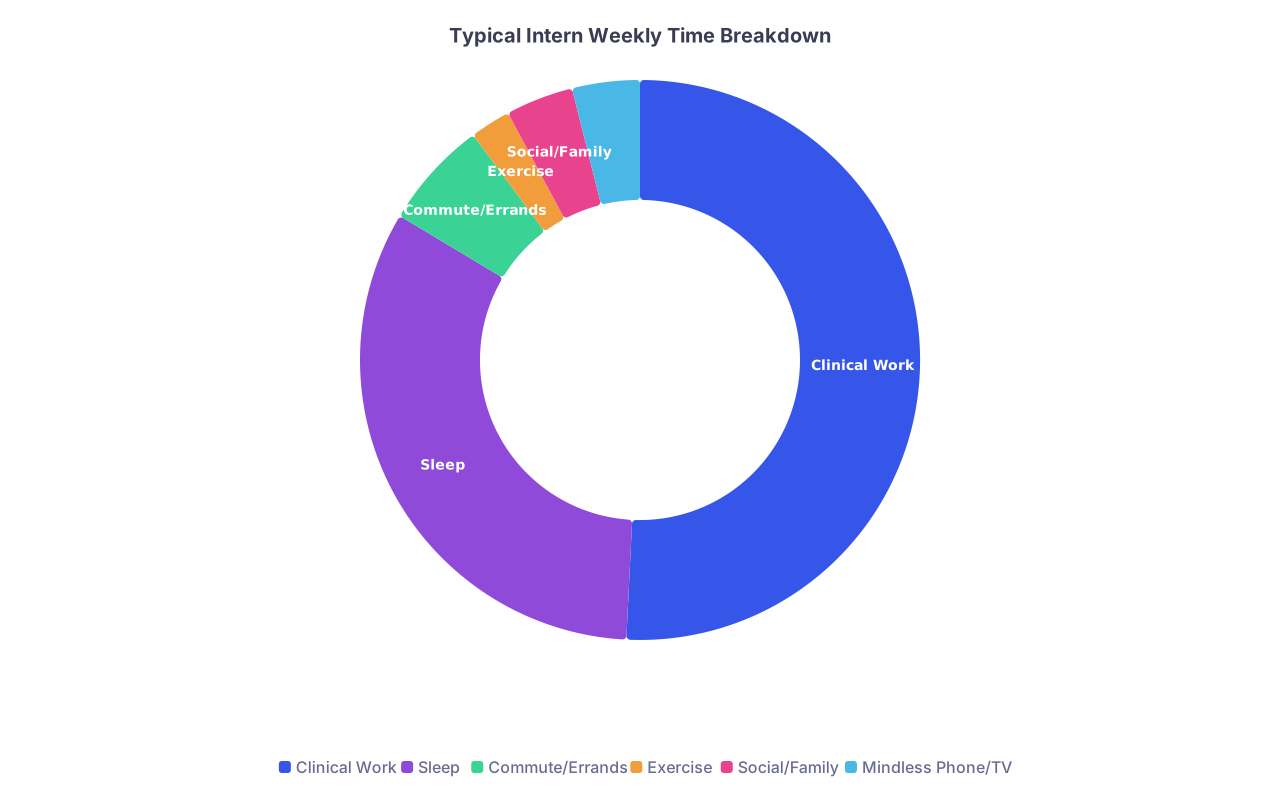
| Category | Value |
|---|---|
| Clinical Work | 65 |
| Sleep | 42 |
| Commute/Errands | 8 |
| Exercise | 3 |
| Social/Family | 5 |
| Mindless Phone/TV | 5 |
Now ask yourself:
- Where are you okay with those numbers?
- Where do you want to steal 2–3 hours back?
Notice I didn’t say “add more.” You only steal back time in residency. From somewhere. Usually from mindless phone scroll or pseudo-work.
Days 46–60: Strengthen Your Ethical Reflexes
By this point, you’ll see the gray zones: pressured discharges, borderline informed consent, “just sign this, everyone does it” moments.
At this point, you should practice small acts of courage repeatedly.
Weekly ethics drill (10 minutes):
Once a week, pick a case that made you uneasy and ask yourself:
- What exactly felt wrong?
- Who had the power in that room? Who didn’t?
- If I had infinite time and no hierarchy, what would I have done differently?
- What is one step closer to that ideal that is realistic next time?
Do this alone, or with a co-intern you trust. This is how you build your own moral compass, not just absorb the team’s mood.
Phrases that protect both you and patients:
Use these verbatim if you need to:
- “I’m concerned we might be discharging faster than is safe. Can we clarify the follow-up plan?”
- “I’m not comfortable documenting that without confirming it in the chart/exam.”
- “From an ethics standpoint, I think we should involve the patient more in this discussion.”
No, these won’t make you the most popular intern on day one. But they’ll make you the physician you actually wanted to become.
Month 3 (Days 61–90): Lead Your Life, Not Just Your List
By month three, you’re no longer brand new. Now it’s about optimization and prevention of the slow collapse.
Days 61–75: Efficiency and Delegation
At this point, you should stop proving you can suffer and start proving you can work smart.
Daily efficiency moves:
Morning:
- Before prerounds, triage your list:
- Sickest 2–3 patients get full attention first.
- Flag discharge candidates early.
- Batch tasks:
- Call all consults in one block.
- Place orders in clustered groups, not one at a time.
Midday:
- Do NOT leave all notes until 5 pm. Get 1–2 done between rounds and noon conference.
- Offload what can be offloaded:
- “Could nursing please draw morning labs when they place that IV?”
- “Can the med student pre-chart Ms. X while I call the family?”
Evening:
- 5-minute “tomorrow setup” before you leave: pre-write a skeleton list, star the complex patients, jot one line about what you need to do first thing.
Why this matters for work–life balance:
Every note finished early, every call batched, every consult done before 4 pm is 10–30 minutes you’re not staying late. Those 10–30 minutes, repeated, are the difference between chronic sleep debt and barely staying whole.
Days 76–90: Adjust, Protect, and Start Mentoring
By now you’re someone the brand‑new interns will quietly watch. Whether you like it or not.
At this point, you should course-correct and intentionally model healthier behavior.
90-day self-audit (do this once, in writing):
Split a page into four quadrants:
- Sleep & Physical Health
- Mental Health & Relationships
- Professional Growth & Learning
- Ethics & Integrity
For each quadrant, write:
- What’s working?
- What’s clearly not?
- One change for the next 30 days.
Example:
- Sleep: Working – consistent wake time on clinic weeks. Not working – scrolling till midnight on wards. Change – phone in another room by 10:30 pm on ward nights.
Micro-mentoring new folks:
You don’t need formal power to change culture. One-liners matter:
- To a new intern staying late to perfect every note:
- “Write a safe note, not a novel. Go home.”
- To a colleague skipping lunch again:
- “You’re less useful to patients hypoglycemic. I’ll cover two pages while you eat.”
You normalize that caring for yourself is part of being a good doctor, not a side hobby.
Weekly Rhythm: What a Protective Week Actually Looks Like
Let’s zoom out. A reasonably protective week in residency (yes, including nights) has a pattern, not perfection.
At this point in your training (anywhere in the first 90 days), a week should include:
- 5–6 nights with at least a 5–6 hour sleep block
- 2 short bouts of intentional movement (10–20 minutes)
- 1 longer connection (phone call or in-person) with someone outside medicine
- 1 deliberate practice block (reading, reviewing a topic, or reflecting on a difficult case)
- 1 explicit ethics/values check‑in (that 10-minute drill)
If you hit those, you’re ahead of most of your peers. Really.

Daily Playbook: Morning, Mid‑Shift, and Night
Let’s get even more concrete. Because vague “self-care” talk won’t help you at 4:45 am.
Morning (or pre‑shift)
At this point each day, you should prep your body and your brain, not just your notes.
10–15 minutes total:
Check-in (1 minute)
- “What’s my actual level today: green, yellow, or red?”
- Green: baseline tired but functional
- Yellow: dragging, irritable, low patience
- Red: unsafe, microscopic fuse
- Yellow or red days = reduce optional tasks and be extra cautious with big decisions.
- “What’s my actual level today: green, yellow, or red?”
Micro-movement (3–5 minutes)
- 20 squats + 20 wall push-ups + stretch. That’s it.
- You’re waking up your nervous system.
Fuel (5 minutes)
- Protein + carbs. Egg, yogurt, peanut butter toast, whatever.
- Coffee is not breakfast. You know this.
Intent (1 minute)
- Pick one focus:
- “Today I will pause before I respond when frustrated.”
- “Today I will make sure every patient understands one thing about their care.”
- Pick one focus:
That’s how “ethics and professionalism” become real, not a paragraph in a handbook.
Mid‑Shift
At this point, you should take tiny resets before you hit the wall.
Twice per shift (set a silent alarm if needed):
- 1-minute breath reset:
- In for 4 seconds, out for 6, repeat 5 times.
- Ask: “What’s the single most important thing to do in the next 30 minutes?”
Then do that and ignore the noise briefly.
If you’re about to snap at someone:
- Drop your shoulders. Unclench your jaw.
- Say: “Give me a second to think, I’ll get right back to you.”
That 10-second buffer has saved more residents from complaints than any communication seminar.
Night / Post‑Shift
At this point, you should let the day end.
Non-negotiables:
No rehashing every mistake in bed.
- Give yourself a 5-minute “processing window” before you get home or while showering.
- If something truly serious happened, write a brief note to yourself: what happened, what you learned, what you’ll do next time. Then close it.
2-minute gratitude or sanity check:
- One thing you handled well.
- One thing you’ll do 5% better tomorrow.
Then stop. Rumination is not learning; it’s mental self-harm in a white coat.

Your First 90 Days, In One Sentence
You’re not just becoming a doctor; you’re becoming a particular kind of doctor—one whose brain, body, and ethics either hold up or slowly corrode.
You build that version of yourself day by day, habit by habit, in this exact window.
Today, do this:
Write down three protective rules for your residency (one for your body, one for your relationships, one for your ethics) on a piece of paper and put it in your bag. If you cannot name your rules, the job will write them for you.