
The usual “check in on your colleagues” advice is useless without structure. If you want real support in medicine, you need a small, deliberate, well-run micro‑group—not random venting in the workroom between pages.
Here is how you actually build one that helps.
Step 1: Get the Size and Purpose Right (or the Group Will Die)
Most peer support groups fail before they start because they are too big and too vague.
Target: 3–5 people. Clear purpose. Clear boundaries.
Anything bigger turns into a seminar or a performance. Anything without a defined purpose turns into gossip or disappears after two meetings.
Think of three “flavors” of peer micro‑groups in medicine:
- Performance + sanity group (e.g., “We are interns trying to survive wards and study”)
- Processing + ethics group (e.g., “We need a place to unpack moral distress and tough cases”)
- Career + boundaries group (e.g., “We want better work–life integration and to hold each other accountable”)
You can blend them, but you must name the primary job of the group in one sentence.
Example:
- “We are a 4-person micro‑group that meets weekly for 45 minutes to debrief hard cases, check in on burnout risk, and hold each other accountable to one small habit that protects our non‑work lives.”
If you cannot say that sentence out loud, you do not have a group. You have an idea.
Who to Invite (And Who to Avoid)
You need:
- 1–2 peers who will actually show up
- 1 person who is a natural “structure keeper”
- 1 person who is more emotionally open (often the first to share)
You are looking for:
- Similar level of training (MS3s together, residents together, early attendings together)
- Enough psychological safety that people will be honest within 2–3 meetings
- Mixed personalities (not four anxious overachievers feeding each other’s panic)
Who will sink the group:
- Chronic complainers who never take responsibility
- People who treat everything as a joke, especially when others are serious
- Colleagues who overshare patient details or ignore confidentiality
- Your direct supervisor. Power dynamics kill honesty.
Good test: if you cannot imagine admitting a serious error or saying “I am not okay” in front of them, do not invite them.
Step 2: Set Ground Rules Like You Mean It
Most groups mumble something about confidentiality and “no judgment.” That is not enough. You need hard rules and explicit scripts, or medicine’s culture of stoicism and subtle shaming will seep right in.
Here is a practical baseline.
Core Rules (Non-Negotiable)
Write these down. Literally. Shared note, Google Doc, email—does not matter. Everyone agrees verbally.
Confidentiality is default.
- What is said in group stays in group.
- You may share your own story outside; you may not share anyone else’s.
- Patient details are de‑identified to the level of being unrecognizable (no unusual diagnoses + unit + timeframe combos).
No fixing unless asked.
- The group defaults to listening and reflecting.
- Before giving advice: “Do you want ideas or just space to vent for a bit?”
- “Actually, that’s just how residency is” is banned.
No one is the therapist.
- You are peers, not mental health professionals (unless you are, and even then, not in this space).
- You can encourage someone to get professional help; you do not provide it here.
Respect time and turn‑taking.
- Start and end on time.
- Use a timer for check‑ins and hot seats.
- No one gets to dominate every session.
Red flags must be named.
- If someone sounds unsafe (self‑harm, serious impairment, harm to others), the group has a duty to:
- Name it
- Encourage urgent professional help
- In extreme cases, act according to institutional duty to report
- This is not breaking confidentiality; this is preserving life and ethics.
- If someone sounds unsafe (self‑harm, serious impairment, harm to others), the group has a duty to:
Ethical red lines.
- This is not a place to brag about cutting corners or hiding dangerous errors.
- Talking about moral distress, errors, and close calls is encouraged.
- Ongoing, serious unsafe behavior must be addressed and escalated through appropriate channels.
You enforce this by actually saying the rules at the first meeting. Out loud. It feels formal. Good. That is the point.
Step 3: Choose a Simple, Repeatable Meeting Format
Unstructured “how’s everyone doing?” turns into scattered chatter. When you are exhausted and post‑call, structure saves the group.
Aim for 30–60 minutes, weekly or biweekly, with a consistent pattern.
Here is a 45‑minute format that works in the real world:
- 2 minutes – Opening check‑in (one word)
- 10–15 minutes – Round‑robin emotional + ethical check‑in
- 20 minutes – One or two “hot seats” (deep dives)
- 5–8 minutes – Work–life micro‑commitments
- 2–3 minutes – Meta check: “How did this feel? What tweak for next time?”
Let me break each part down into what you actually say and do.
1. One-Word Check‑In (2 minutes)
It sounds silly. It works.
- Go around quickly: “One word or short phrase for how you are arriving.”
- Examples: “fried, hopeful, numb, pissed, oddly okay”
Purpose: It surfaces the emotional temperature fast. If 3 out of 4 people say “numb,” you know this is not the day to talk productivity hacks.
2. Round‑Robin Emotional + Ethical Check‑In (10–15 minutes)
Each person gets 3 minutes. Use a timer. People always underestimate how long they talk.
Prompt them with a simple structure:
- “One moment from this week that stuck with you emotionally or ethically.”
- A patient death
- A family yelling at you
- An attending pushing you to do something that felt wrong
- A boundary you actually held—or failed to hold
Encourage specific phrases:
- “The part that bothered me was…”
- “I felt… and then I shut it down because I had to keep working.”
- “Ethically, this rubbed me wrong because…”
No one comments yet except brief acknowledgments:
- “I hear you.”
- “That sounds heavy.”
- “I’ve had something similar; can we come back to that in the hot seat?”
This keeps it from turning into cross‑talk and flattening the emotional impact.
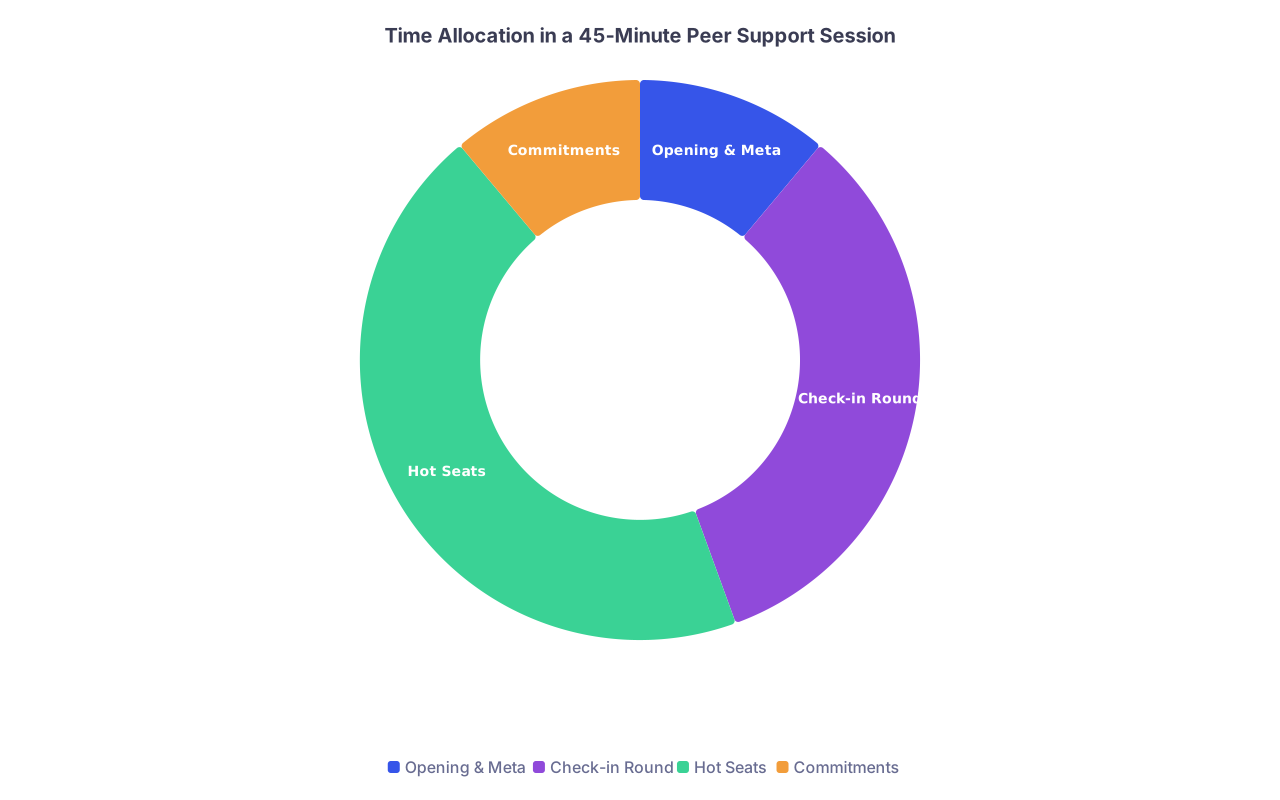
| Category | Value |
|---|---|
| Opening & Meta | 5 |
| Check-in Round | 15 |
| Hot Seats | 20 |
| Commitments | 5 |
3. Hot Seats: Where the Real Work Happens (20 minutes)
Pick 1–2 people for a “hot seat” each session. They get a focused block (10–15 minutes per person) to unpack something with the group’s full attention.
How to choose:
- At the start: “Who’s got something they really need space for today?”
- Or rotate: Everyone gets a hot seat at least once a month.
Basic hot‑seat protocol:
Story (3–5 minutes)
- The person shares the situation: what happened, why it matters, their emotional and ethical reaction.
- They keep it concrete: what was said, what they felt, where they got stuck.
Clarifying questions (3–5 minutes)
- Group asks questions only to understand, not to challenge.
- Examples:
- “What was going through your head when your attending said that?”
- “What did you want to say but did not?”
- “What would have felt like the ethically right action for you?”
Reflections + options (5 minutes)
- Group reflects back what they heard. Example:
- “I hear you felt pressured to discharge someone you did not think was safe.”
- “You sound more angry than sad to me. Does that land?”
- Then, and only if the person wants it: brainstorm options.
- “If this happens again, what is one sentence you would like to be able to say?”
- “Who is one person you could debrief with on your team?”
- “What boundary would feel non‑negotiable next time?”
- Group reflects back what they heard. Example:
Close the loop (1–2 minutes)
- Hot seat person summarises:
- “My takeaway is…”
- “This week I will try…”
- Hot seat person summarises:
This is where burnout prevention and ethical integrity live: identifying where your internal values clashed with external demands, and rehearsing better responses.
Step 4: Hard-Wire Work–Life Balance into the Agenda
If you do not explicitly talk about your non‑work life, medicine will swallow it whole. The system is built to do that.
You want your micro‑group to function as a counter‑system.
Use “Micro‑Commitments,” Not Grand Plans
At the end of each session, each person makes one tiny, specific, measurable commitment that protects their life outside medicine, or their ethical center inside medicine.
Examples:
- “I will leave the hospital by 7:30 p.m. at least twice this week, no charting from home those nights.”
- “I will schedule therapy. I have been ‘meaning to’ for six months.”
- “I will say ‘I need 60 seconds to think’ at least once, instead of instantly agreeing to everything.”
- “I will do one 20‑minute walk without my phone before my next call shift.”
Next session, you report back:
- “Kept it.”
- “Half‑kept it.”
- “Failed it. Here’s why.”
The group’s job is not to shame. It is to:
- Notice patterns. (“You have set ‘schedule therapy’ three weeks in a row.”)
- Ask sharper questions. (“What is the actual barrier?”)
- Help right‑size the commitment. (“Can you send one message to one therapist this week? That is enough.”)
If you want to keep this tight, track commitments in a shared note or simple table.
| Member | Commitment | Status Next Week |
|---|---|---|
| Aisha | Therapy email to 1 provider | Sent, awaiting reply |
| Marco | 2 tech-free dinners | 1/2 done |
| Lina | Leave by 7:30 twice | 0/2, pager issues |
| Tom | Debrief code with senior | Done, felt better |
Step 5: Build Psychological Safety Fast
If people do not feel safe, they will either:
- Perform wellness (“Yeah I’m tired but it’s fine”), or
- Drop out.
You do not have years. You have 2–3 meetings to set the tone.
Use Vulnerability Scaffolding
You do not start with “What is your deepest shame?” You escalate gradually.
Meeting 1 – Starter prompts:
- “Describe a moment this month when you thought: ‘I cannot do this for 30 years.’”
- “What is one behavior you have picked up in training that you are not proud of?”
Meeting 2–3 – Deeper prompts:
- “Tell us about a patient you think about when you cannot sleep.”
- “Share a time you felt you violated your own ethical standards at work—by action or silence.”
The key is that everyone participates, including the most senior person in the group. I have watched groups transform the moment an attending says, “I almost quit in my PGY‑2 year” with specifics. That breaks the myth of invulnerability more than any wellness lecture.
Ban Subtle Shaming
You must catch and kill these behaviors early:
- “Well, that is just residency.”
- “I went through worse and I turned out fine.”
- “You are overreacting; that is normal here.”
These are poison. Script your response:
- “Our rule is no minimizing. Their experience stands.”
- “Normalize the system, not the harm. Just because it is common does not mean it is okay.”
This is where your “structure keeper” earns their spot.
Step 6: Protect Ethics Without Turning the Group into Risk Management
You are operating in a profession with legal and regulatory realities. You can talk openly about moral distress and hard cases without turning the group into an incident report committee.
What You Can Safely Do
- Discuss how things felt: shame, anger, regret, fear.
- Explore ethical tension:
- Patient autonomy vs. family wishes
- Pressure to discharge vs. perceived safety
- Duty hours vs. continuity of care
- Role‑play conversations:
- “How to push back politely but firmly”
- “How to ask for supervision when you are uncomfortable”
- Debrief mistakes at the level of:
- “I missed this lab result and the patient got worse overnight.”
- “I did not speak up when I thought the plan was wrong.”
What You Should Not Do in Detail
- Share uniquely identifying patient details (very rare condition + location + time window).
- Strategize how to hide errors.
- Replace institutional reporting channels if someone was seriously harmed by negligence.
If a situation crosses into true safety territory, your group response should be:
- “This sounds like something that needs to go through the official channels. How can we support you in doing that?”
- “Do you want one of us to sit with you when you talk to risk management or your PD?”
Your group is a support layer, not a shadow governance structure.

| Step | Description |
|---|---|
| Step 1 | Distressing Case Shared |
| Step 2 | Process Emotions Only |
| Step 3 | Support Reflection and Learning |
| Step 4 | Encourage Formal Reporting |
| Step 5 | Offer Peer Support During Process |
| Step 6 | Safety Concern? |
| Step 7 | Ongoing Risk? |
Step 7: Logistics That Make or Break It
Most groups do not die because the idea was bad. They die because people get busy and it becomes optional.
You prevent that with clear logistics.
Meeting Cadence and Duration
- Weekly 30–45 minutes works best in high‑stress phases (ICU months, early internship).
- Biweekly 45–60 minutes can work for attendings or more stable rotations.
Pick:
- Day of week
- Start and end times
- Format (in‑person vs. virtual)
Then treat it like a scheduled clinic, not a “maybe.”
In-Person vs. Virtual
In‑person:
- Better connection, easier to read shifts in mood
- Harder to coordinate schedules and space
Virtual (Zoom, Teams, etc.):
- Easier to protect time across rotations and sites
- Must enforce cameras on, phones away rule to keep engagement
My blunt recommendation:
- If you are all in the same hospital: start in‑person if at all possible.
- If you are across sites or on crazy shifts: hybrid is fine, but protect the video quality and privacy (no charting during group).

Roles: Rotate Them
Two roles keep the group alive:
Facilitator of the day
- Opens, keeps time, moves you along the agenda.
- Does not need to be the most senior.
Scribe of commitments
- Jots down each person’s micro‑commitment.
- Briefly checks in at the start of the next meeting: “Quick: how did last week’s commitments go?”
Rotate monthly or every 4–6 meetings. This prevents one person from becoming the “permanent wellness captain” and burning out on the group itself.
Step 8: Handle Common Failure Modes Before They Happen
I have watched dozens of these groups crash. The patterns are predictable. You can pre‑empt most of them.
Problem 1: It Becomes a Venting Pit
Symptoms:
- Same complaints every week.
- No movement, no commitments.
- People leave feeling heavier, not lighter.
Fix:
- Add a “what do you need from us?” question after each share.
- Enforce the “takeaway + micro‑commitment” at the end of hot seats.
- Once a month, do a solutions‑only session:
- Each person brings one stuck point
- Group offers only concrete ideas and scripts, limited time per person
Problem 2: One Person Dominates
Symptoms:
- They take every hot seat.
- They jump in after every share with a story about themselves.
- Others start going silent.
Fix:
- Name it kindly but directly:
- “I am glad you feel safe here. I also want to protect space for everyone. Let’s keep comments brief and make sure each person gets equal time.”
- Use a visible timer.
- Consider a structured turn:
- No one speaks twice until everyone has spoken once.
Problem 3: Attendance Slips
Symptoms:
- “Sorry, got stuck charting” texts 10 minutes in.
- People say they value the group but keep skipping.
Fix:
- Shorten the meeting to 30 minutes for a trial.
- Experiment with time of day (e.g., early morning vs. evening).
- Ask directly:
- “On a scale of 1–10, how valuable is this group? What would make it a 9 or 10 for you?”
- Cut the group down if needed. Four partially engaged members are worse than three committed ones.
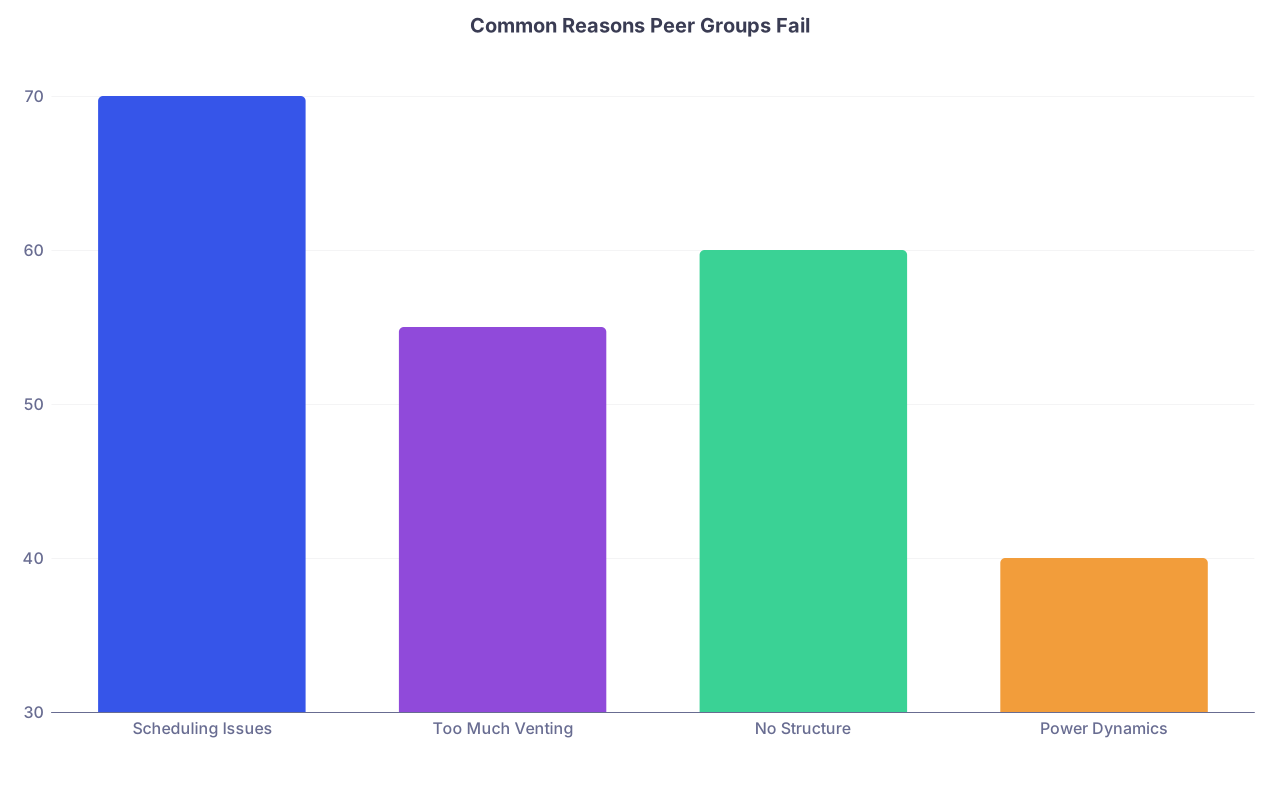
| Category | Value |
|---|---|
| Scheduling Issues | 70 |
| Too Much Venting | 55 |
| No Structure | 60 |
| Power Dynamics | 40 |
Problem 4: It Starts to Feel Like Just Another Meeting
Symptoms:
- The vibe turns formal.
- People censor themselves.
- It feels like a committee.
Fix:
- Bring back a human element:
- Once a month: share “one non‑medical thing you are excited about.”
- Occasionally meet outside the hospital: coffee, walk, simple dinner.
- Drop one agenda item if it feels over‑engineered. Simpler is better than bureaucratic.
Step 9: Know When to Suggest Professional Help
Your micro‑group is a buffer, not a treatment plan.
Red flags that should trigger a higher level of support:
- Persistent insomnia, hopelessness, or anhedonia
- Talk of self‑harm, even half‑joking
- Using substances to get through shifts or sleep
- Serious functional decline (missing shifts, constant late documentation, repeated errors)
The script you use matters. Avoid: “You need therapy.” It sounds like a judgment.
Try:
- “From the outside, it looks like you are carrying more than our group can hold. I care about you. Would you be open to getting some extra support?”
- “We can help you find someone if logistics are the barrier.”
And mean it:
- Help them navigate the employee assistance program.
- Share lists of clinician‑friendly therapists (Physician Support Line in the US, for example).
- Offer to sit with them as they send the first email.
If there is imminent risk to self or others, you already know the drill: emergency services, institutional policies, call the on‑call psychiatrist, whatever your hospital protocol requires. Ethical duty overrides peer confidentiality at that point.

Step 10: Start Now, Even If It Is Imperfect
You will not design the perfect micro‑group on paper. You refine it in action.
A minimal viable launch plan:
Week 0 – Recruit
Identify 2–4 people who:
- Complain about burnout
- Show glimpses of honesty
- Are not your direct supervisors
Send a direct, concrete message:
“I want to start a small, confidential peer group—3–5 of us—where we meet for 45 minutes every week or two to debrief hard cases, talk about work–life boundaries, and support each other. No fixing, no judgment, just real talk and small commitments. Want to try it for 4 sessions and then reassess?”
Week 1 – First Meeting
- Share purpose and rules.
- Do short check‑ins.
- One hot seat.
- Very small commitments.
- End by scheduling the next three sessions.
Week 2–4 – Stabilize
- Keep the same format.
- Rotate facilitator.
- At week 4, ask:
- “Do we want to continue?”
- “What one thing should we change?”
If the answer is yes from at least 3 people, you have a working peer support micro‑group. Guard it.
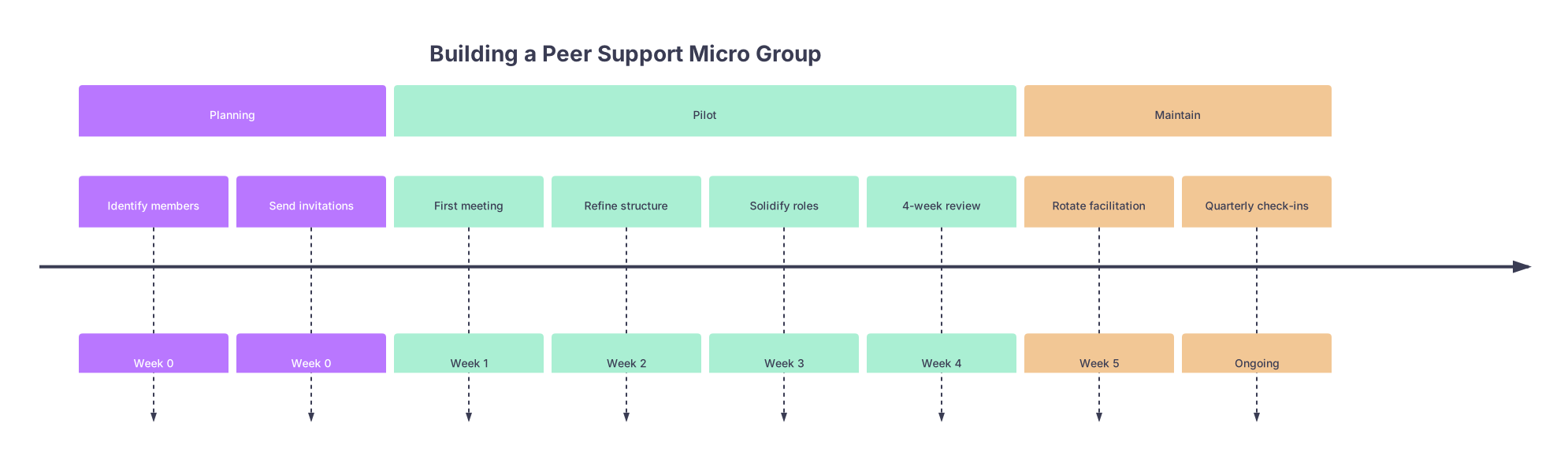
| Period | Event |
|---|---|
| Planning - Identify members | Week 0 |
| Planning - Send invitations | Week 0 |
| Pilot - First meeting | Week 1 |
| Pilot - Refine structure | Week 2 |
| Pilot - Solidify roles | Week 3 |
| Pilot - 4-week review | Week 4 |
| Maintain - Rotate facilitation | Week 5 |
| Maintain - Quarterly check-ins | Ongoing |
The Bottom Line
You do not need a wellness committee to protect your sanity and ethics. You need 3–5 colleagues, a repeatable structure, and the courage to be honest.
Keep three things front and center:
- Tiny, structured, and regular beats big, inspiring, and rare. A 30‑minute weekly micro‑group will do more for your integrity and work–life balance than any annual retreat.
- Rules and scripts prevent drift. Confidentiality, no unsolicited fixing, time limits, and explicit commitments are not “extra.” They are the skeleton that keeps this from becoming useless venting.
- Your values need a home. The system will not protect them for you. A well‑run peer support micro‑group can.
Build it. Protect it. Let it protect you back.