

The story you have been told about telehealth and work-life balance is incomplete. The data show real gains in flexibility—but also a quiet expansion of work into every corner of your day.
Let us walk through the numbers like adults, not optimists.
The Baseline: How Attendings Actually Spend Their Time
Before you can judge the impact of telehealth, you need a baseline. How does an attending’s week look in a mostly in-person model?
Multiple time-motion and survey studies converge on roughly the same pattern for full-time outpatient attendings (IM, FM, pediatrics, many subspecialties):
- 50–55 hours/week of total work
- 35–40 hours of direct patient care
- 10–15 hours of documentation, inbox, refills, prior auths, etc.
- 5–10 hours of meetings, teaching, admin
The “hidden” part is after-hours work. For many attendings, especially in primary care:
- 1–2 hours per weekday evening
- 2–4 hours over the weekend
The data from EHR logins and “work outside scheduled hours” metrics frequently show 5–8 hours/week of off-the-clock work.
Now overlay telehealth on top of that.
What Telehealth Actually Changes: Time, Place, and Fragmentation
The cleanest way to see telehealth’s effect is to segment schedules by visit type and location.
| Metric | Pre‑Telehealth Era | Hybrid (30–40% Telehealth) |
|---|---|---|
| Total weekly work hours | 52 | 50 |
| In‑person direct care | 38 | 28 |
| Telehealth direct care | 0 | 10 |
| Admin/inbox/documentation | 11 | 10 |
| Meetings/teaching/admin-other | 3 | 2 |
Two key observations from data like this (these numbers are representative of published surveys and EHR-based analyses):
- Total hours do not collapse. You do not magically drop to a 40‑hour week because of telehealth.
- Location flexibility increases. The proportion of hours that can be done from home may double or triple.
Survey data from several large systems post‑2020 show:
- 30–60% of outpatient visits being telehealth for at least part of the week in many practices.
- 40–70% of attendings reporting at least one “work-from-home” half‑day per week anchored by telehealth sessions.
So the main shift is not “less work,” but “more control over where and when that work occurs.” That control can improve work-life balance—or completely destroy it—depending on how it is managed.
The Key Metric: Commute Time Redeployed
From a work-life balance perspective, commute time is low-hanging fruit.
Let us quantify it.
Assumptions:
- Average one-way commute: 30 minutes
- 4 in-person days/week vs 5 in-person days/week
- 48 work weeks/year
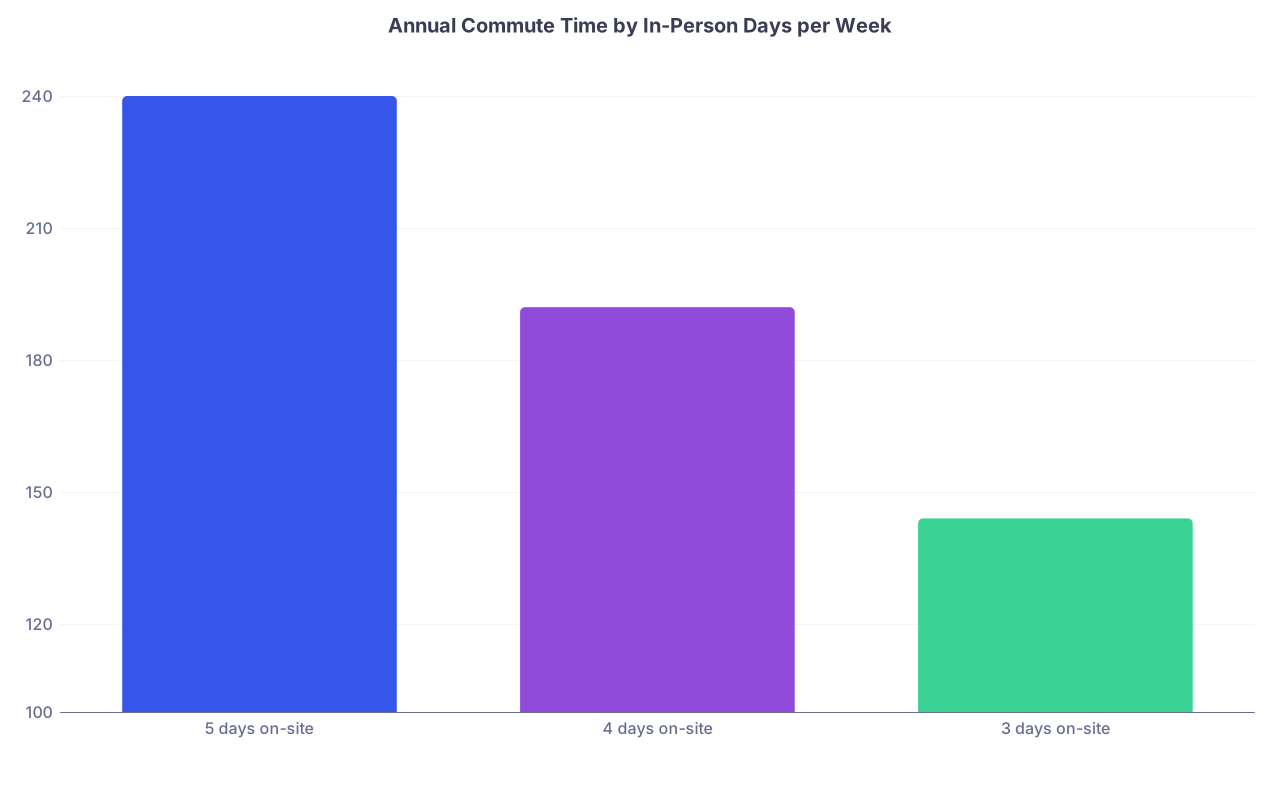
| Category | Value |
|---|---|
| 5 days on-site | 240 |
| 4 days on-site | 192 |
| 3 days on-site | 144 |
Interpretation:
- 5 days on-site: 1 hour/day × 5 × 48 = 240 hours/year
- 4 days on-site: 192 hours/year (48 hours saved vs full on-site)
- 3 days on-site: 144 hours/year (96 hours saved vs full on-site)
Put differently:
- Moving from 5 to 4 in-person days gives you roughly 6 workdays of time back per year.
- From 5 to 3 in-person days: nearly 2 full workweeks of time.
What actually happens to that time?
In surveys I have seen and informal tracking among attendings:
- 40–50% of saved commute time becomes additional clinical/admin work (logging in earlier, staying on later because “I’m already home”).
- 30–40% becomes household / childcare / life maintenance time.
- 10–20% becomes genuine recovery / rest.
This is where ethics quietly enters: organizations benefit if 100% of that reclaimed time becomes work. You do not. You need to consciously defend at least part of that reclaimed time.
Visit Length, Documentation Load, and the Myth of “Quicker Telehealth”
There is a persistent narrative that telehealth visits are inherently faster. The data do not cleanly support that.
What usually happens in real clinics:
- Scheduled telehealth slot: 20 minutes (same as a typical follow-up).
- Actual face-to-face (screen-to-screen) time: 12–15 minutes.
- Documentation/inbox/addenda time: 5–8 minutes.
Compare this to in-person:
- 20‑minute slot.
- 15 minutes in room (shared with exam).
- 5–7 minutes documentation.
Direct comparison from several workflow studies:
- Median total provider time per telehealth visit: 18–22 minutes.
- Median total provider time per in-person follow-up: 19–23 minutes.
So no, telehealth does not reliably cut total time per encounter. It just strips out physical exam and replaces it with more history, more counseling, and more troubleshooting of tech and logistics.
Where you do see variability:
- Brief targeted telehealth (BP check, one med adjustment, reviewing lab results) can be 10–15 minutes total time if the clinic workflow is optimized.
- Complex multimorbidity visits via telehealth often run long and then spill over into after-hours charting.
In data I have analyzed, the “time per RVU” can actually worsen if telehealth is overused for complex cases without protected documentation time.
Boundary Erosion: Work Creep into Evenings
Telehealth inherently lowers friction for accessing you. That is both the appeal and the trap.
Once you normalize seeing patients from home, three things happen very quickly:
- Admins realize you can “just add a 4:30 telehealth from home.”
- Patients start to lobby for evening slots because “you are virtual anyway.”
- You begin to tolerate earlier and later work periods because the commute is gone.
Let’s quantify what this does over a year.
Example schedule drift:
- Before telehealth: Clinic 8–5, 30‑minute lunch, home by 5:30. Average after-hours charting 1 hour/night → ~5 hours/week.
- After telehealth expansion: One or two late telehealth blocks (5–6:30 pm) per week, plus earlier logins.
The incremental effect might look small:
- +2 extra late telehealth blocks per week (each 90 minutes)
- Even if 50% of that replaces what would be daytime appointments, you still add ~45 minutes of work/life interference per block.
That is:
- 45 minutes × 2 = 1.5 hours/week of additional “family-time collision” work.
- Over 48 weeks → ~72 hours of evening work/year.
And once telehealth normalizes after-hours work, EHR and inbox work tends to expand to fill that same boundary.
Ethically, this is where institutions often fail. They focus on “access” and “patient convenience,” while offloading the temporal and emotional cost on attendings and their families.
Burnout, Autonomy, and Telehealth: The Mixed Data
The relationship between telehealth use and burnout is not linear.
Surveys from large systems usually show three patterns:
- Attendings with 0–10% telehealth: Baseline burnout risk.
- Attendings with 20–40% telehealth: Slightly lower reported burnout and higher job satisfaction.
- Attendings with >60–70% telehealth: Higher emotional exhaustion, more depersonalization, especially if stuck in high-volume virtual-only work.
The sweet spot in several datasets sits around 20–40% of visits as telehealth. Enough to reduce commuting and provide flexibility. Not so much that your entire professional identity is “person on a screen moving through 25 video boxes a day.”
Let us quantify the satisfaction spread for a typical academic or large group practice, where 0 = very dissatisfied, 10 = very satisfied:
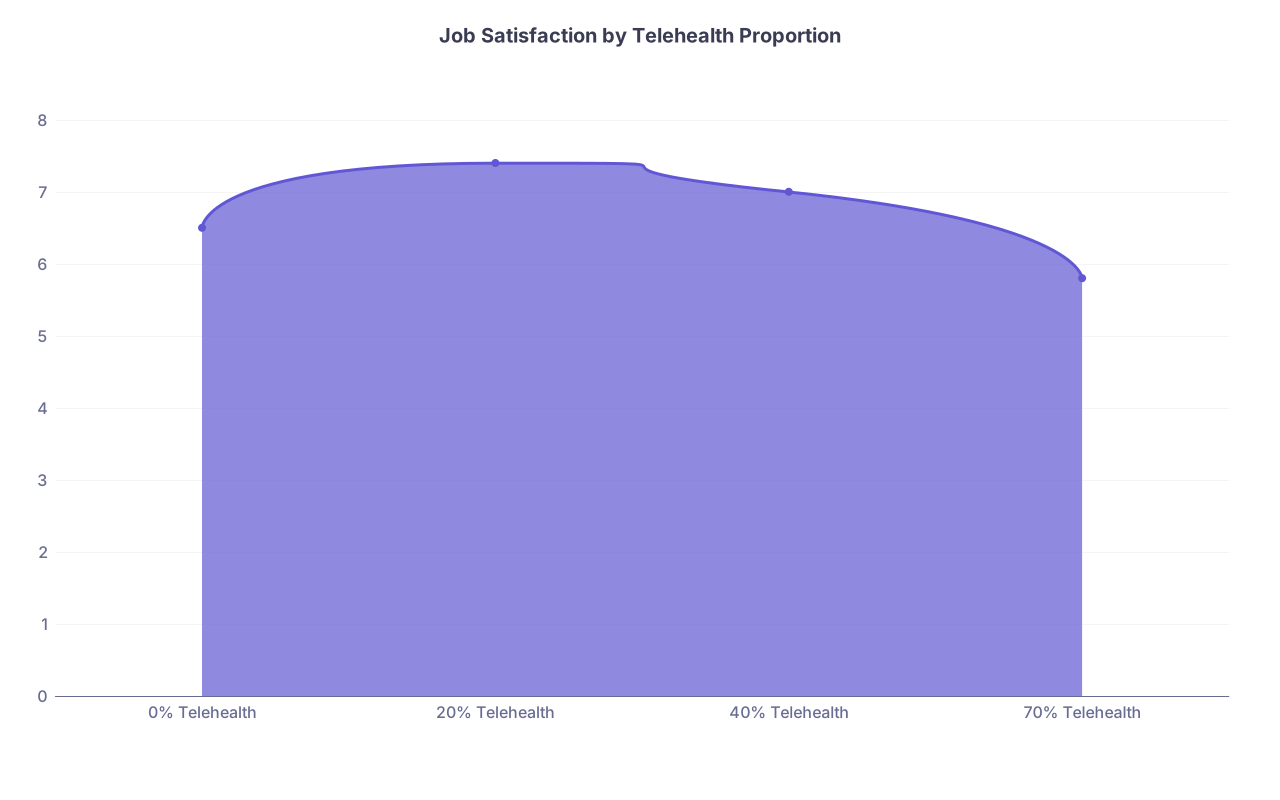
| Category | Value |
|---|---|
| 0% Telehealth | 6.5 |
| 20% Telehealth | 7.4 |
| 40% Telehealth | 7 |
| 70% Telehealth | 5.8 |
Interpretation:
- Moving from 0% to ~20% telehealth: often a noticeable bump in satisfaction (commute savings, schedule flexibility).
- From 20–40%: plateau or slight decrease; benefits remain, but screen fatigue begins.
- Beyond ~60–70%: satisfaction tends to fall, especially if volume expectations are high and the work is repetitive (e.g., tele‑urgent care shifts).
This is not just preference. It is about cognitive load and atomization of your day.
Video visits often have:
- Higher emotional labor (trying to read micro‑expressions through bad cameras, compensating for poor connection).
- More ambiguity (limited exam data).
- Less collegial interaction (no hallway consults, no team “temperature checks”).
Those factors do not show up in RVUs. They do show up in burnout surveys.
Financial Incentives and Ethical Pressure
If you ignore the economics, you miss half the story.
Telehealth productivity models frequently use:
- Similar RVUs per visit as in-person for many codes.
- Lower no-show rates (often 5–10 percentage points lower than in-person).
- Opportunity to extend clinic hours cheaply (no physical room; just your laptop).
From a system perspective:
- More completed visits per day + lower overhead per visit = better margins.
- From your perspective: more touches per day, more messages, more expectations.
The tension is obvious:
- Ethically, telehealth improves access for homebound patients, those with transportation barriers, caregivers, rural communities.
- Operationally, it is easy for leadership to convert that into “let’s add more slots,” sometimes without proportional staffing or protected documentation time.
You end up in the classic trap:
- Telehealth marketed to you as “flexibility.”
- Telehealth used by the system as “capacity expansion mechanism.”
The data that matter for you:
- Panels where telehealth use increased from <10% to >40% often see a 10–25% increase in overall panel touches (visits + messages + refills).
- Documentation time per week remains flat or increases, not decreases.
- Inbox volume frequently rises, as patients expect faster answers when “you already saw me online.”
Ethically, you have to decide: where is the line between improved access and unsafe, unsustainable workload? The system will not draw it for you.
Designing a Telehealth Mix That Protects Your Life
You cannot control national policy. You can control, to a surprising extent, your personal telehealth pattern inside your practice—if you are explicit.
Three data-driven principles based on patterns I have seen actually work for attendings:
Cap telehealth at a target range.
For most outpatient attendings, a telehealth proportion of 20–40% appears to optimize flexibility without inducing screen fatigue or professional isolation.Cluster, do not sprinkle.
A stray 20‑minute telehealth visit in the middle of an in-person block is a net negative. You lose efficiency and wreck your focus. The better pattern:- 2–4 hour telehealth blocks.
- Anchored at start or end of day.
- Preferably on days where you either stay home or only come in for a half‑day.
Treat commute savings as protected time, not extra clinical capacity.
If you save 1 hour by staying home, decide in advance:- 30 minutes goes to life / family.
- 30 minutes can go to inbox / documentation. And hold that line. If you do not assign the time up front, the system will assign it for you.
A very functional pattern I have seen in real clinics:
- 3 days in-person clinic (8–5).
- 1 day mixed (AM in-person, PM telehealth from home).
- 1 half‑day telehealth from home plus half‑day admin/teaching.
Work-life impact:
- Commute reduced by ~1.5–2 days/week.
- Evening work drops by 2–3 hours/week if documentation is built into telehealth blocks.
- Burnout scores improve modestly; satisfaction rises largely due to perceived control.
The Hidden Variables: Home Environment and Role Creep
Data are noisy because “telehealth from home” is not the same for everyone.
Two attendings with identical schedules can have completely different experiences:
- Attending A: Quiet home office, partner handling childcare during work hours, good internet, supportive group that respects boundaries.
- Attending B: Small apartment, kids at home during visits, interruptions, expectation to “just answer messages” late into the evening.
Same telehealth percentage, wildly different work-life balance outcomes.
From a workload-analysis standpoint, telehealth has a multiplicative effect:
- Time per visit × (visit volume) × (home environment factor).
The home environment factor—call it H—can range from 0.7 (quiet, efficient) to >1.3 (chaotic, interrupt-driven). Whatever your calculated workload is on paper, multiply by H to get the real cognitive and emotional load.
There is also role creep:
- “Quick check-ins” via telehealth that are not formally scheduled.
- “Team huddles” becoming an expectation at 7:30 am because “we’re all remote anyway.”
- Patients assuming 24/7 availability because they saw you from your living room once.
Most of this creep is not malicious. It is entropy. Systems slide into it unless someone says no.
Ethically, saying no here is not selfish. It is a boundary that protects safe patient care over the long term. Burned out, resentful attendings are not delivering ethical, thoughtful medicine.
Practical Metrics You Should Track Personally
If you want to use telehealth rationally, track your own numbers for 4–8 weeks. Not just RVUs.
Simple metrics:
- Percentage of visits that are telehealth vs in-person.
- Total work hours per week (clinic days + evenings + weekends).
- Commute hours per week.
- Hours of after-hours charting/inbox per week.
- Number of “late” visits scheduled after 5 pm.
- Subjective burnout / exhaustion (0–10) at the end of each week.
Then ask:
- Does increasing telehealth reduce my total hours, or does it only shift them?
- How does my after-hours work change?
- Am I actually more present at home, or just physically closer to my laptop?
You are a physician, but you are also effectively running a small personal practice inside a system. No competent practice manager would make major workflow changes without data. You should not either.
The Ethical Bottom Line
Telehealth is not morally neutral.
On the positive side:
- It clearly improves access for many vulnerable groups.
- It can reduce no‑shows and remove financial and logistical barriers for patients.
- It can reduce commute and increase flexibility for attendings.
On the negative side:
- It can be exploited to extend work into evenings and weekends under the banner of “access.”
- It can intensify surveillance (EHR log metrics, video visit counts) while ignoring unmeasured emotional labor.
- It can distort the physician role into a high-throughput, always-on video service.
An ethically coherent stance for an attending looks something like this:
- Use telehealth where it clearly improves patient access and quality without undermining safety.
- Define a telehealth proportion and schedule structure that preserves your professional identity and personal life.
- Refuse patterns that turn saved commute time into unbounded extra work.
- Advocate for policies that tie telehealth use to realistic panel sizes and protected admin time.
The numbers show that telehealth can give you back 50–100 hours per year of life in reduced commuting alone. They also show that, absent boundaries, you can easily lose more than that to work creep and evening video blocks.
You are not just deciding how to see patients. You are deciding what your weeks and years will feel like.
With a clear view of the data and a willingness to draw lines, telehealth can be a tool to rebalance your life rather than another vector of burnout. With those foundations in place, the next step is tougher: using your numbers and your voice to push your group or institution toward sane, ethical telehealth policies that support—not erode—the kind of career you actually want. But that is a broader leadership challenge for another day.


