
The myth that ACGME duty-hour limits “fixed” burnout in training is statistically false. The data are blunt about it.
You asked what has actually changed since ACGME imposed work-hour limits. The honest answer: schedules changed on paper, some safety metrics improved at the margins, but burnout stayed high and simply shifted shape. Let’s walk through what the numbers show, not what programs like to say on recruitment day.
1. The Baseline: What ACGME Actually Changed
Let us anchor on policy, then move to outcomes.
In 2003, the ACGME instituted national duty-hour standards for residents in the United States, driven by patient safety concerns (famous cases like Libby Zion) and data linking fatigue to errors. Core rule: 80 hours per week, averaged over four weeks. Plus caps on continuous duty, mandatory time off between shifts, and one day off in seven.
2011 brought another major revision, especially for interns (PGY‑1s), with a 16-hour cap and more detailed supervision rules. Then in 2017, ACGME rolled back the 16‑hour limit, allowing PGY‑1s up to 24+4 hours again, under the argument that continuity and education were being harmed.
So three eras:
| Era | PGY-1 Max Continuous Duty | Weekly Limit | Key Feature |
|---|---|---|---|
| Pre-2003 | Often 30–36+ hours | Uncapped | No national limit |
| 2003–2011 | 24+6 hours | 80-hour average | First formal duty-hour rules |
| 2011–2017 | 16 hours | 80-hour average | Heavier focus on fatigue and supervision |
| 2017–Now | 24+4 hours | 80-hour average | Return of longer shifts, more “flexibility” |
The structure changed. But did burnout?
2. Burnout Rates: Before and After ACGME
The narrative that “things used to be terrible, now they’re reasonable” is only half‑true. Yes, raw hours went down from the worst pre‑2003 extremes. But burnout did not collapse. It plateaued at a distressingly high level.
The difficulty: we do not have a perfect longitudinal burnout panel from 1990 to today. But we do have enough snapshots and meta-analyses to see the pattern.
What the numbers say
Across specialties, resident burnout typically runs between 40–70%, depending on the instrument (Maslach Burnout Inventory versus single-item measures) and the specific program environment.
Representative findings:
- A 2014 meta‑analysis of resident burnout (pre‑ and post‑2003) showed burnout rates mostly in the 35–60% range, with no clear step-change after duty-hour limits. Slight variations, but not a dramatic fall.
- Large surveys by professional societies (internal medicine, surgery, emergency medicine) after 2011 consistently report burnout prevalence around 50–60% in residents.
- Medscape and national specialty society surveys of early-career physicians (just out of residency) show burnout rates around 40–50%, suggesting the problem continues beyond training.
If duty-hour reform had truly “fixed” burnout, those numbers should have dropped into the 10–20% range. They did not. The data show a system that reduced extreme fatigue but failed to address the core determinants of burnout: autonomy, workload intensity, organizational culture, and misalignment of values.
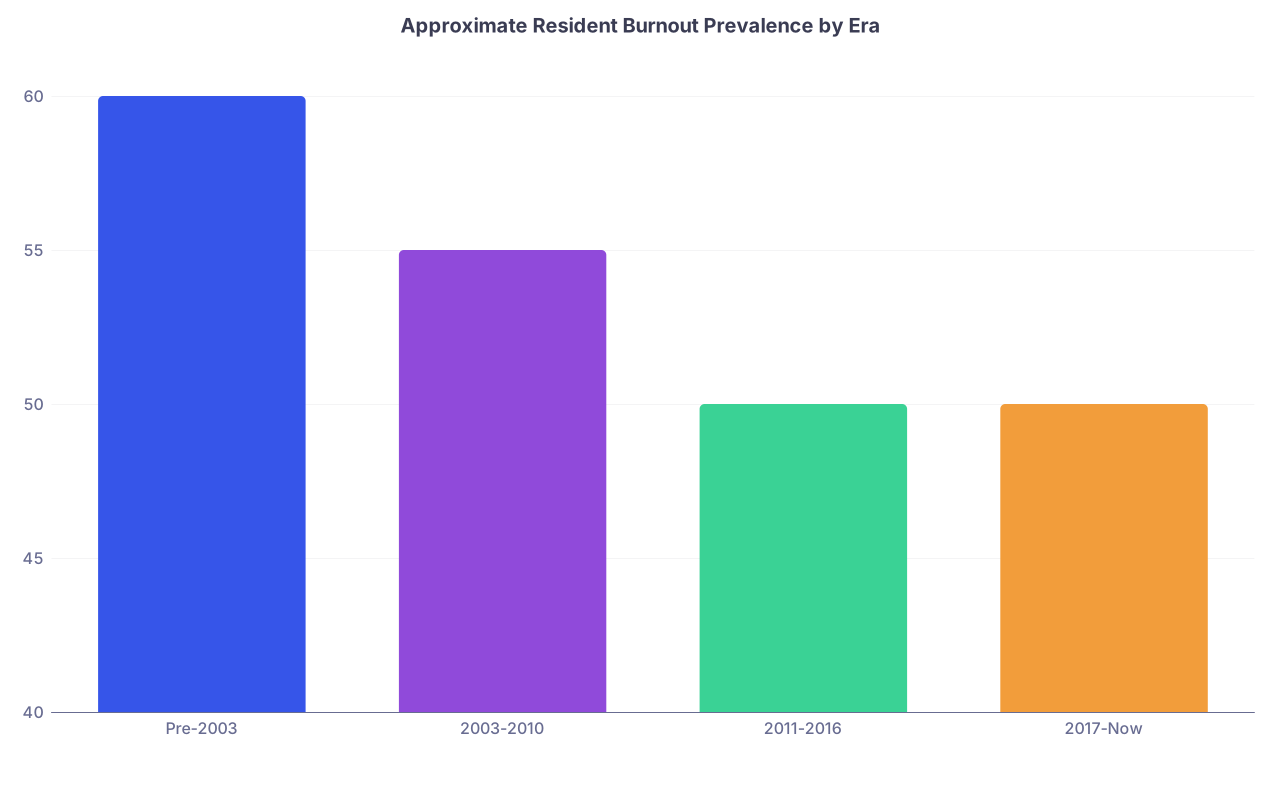
To visualize the broad pattern (approximate, aggregated from multiple studies):
| Category | Value |
|---|---|
| Pre-2003 | 60 |
| 2003-2010 | 55 |
| 2011-2016 | 50 |
| 2017-Now | 50 |
You can argue over a few percentage points. You cannot argue that burnout was “solved.” It was not.
3. Hours vs Intensity: The Compression Problem
Here is where the story gets uncomfortable. Programs obeyed the letter of the ACGME law. Many did not absorb the lost hours into staffing. They compressed the same or greater workload into fewer hours.
I have seen this play out on the ground, and the pattern is consistent:
- Pre‑ACGME: 100–120 hours per week, steady but brutal grind, more “down time” on call (sleeping in the call room, slower nights).
- Post‑ACGME: 70–80 hours per week, but with relentless pace — no real lulls, constant pages, more handoffs, and fewer residents per patient.
The result: fewer hours, same or greater cognitive and emotional load.
A simple way to view this mathematically:
Suppose a pre‑2003 resident covered 20 ICU patients over 100 hours/week. That is 0.2 patients per resident-hour.
Now in a leaner post‑ACGME system, the same service covers 24 patients with a resident capped at 80 hours/week. That is 0.3 patients per resident-hour. A 50% increase in patient‑hour load.
You can feel that at 2 a.m. when you are on your 14th admission and nursing is calling about three cross-cover issues.
4. Patient Safety and Education: What Improved, What Did Not
Duty-hour rules were sold as a patient safety intervention. So, did safety improve?
The data are mixed and frankly underwhelming.
Patient outcomes
Several high-profile studies looked at mortality and complications before and after ACGME rules.
- Large Medicare database analyses around 2003 implementation found minimal or no change in mortality for common conditions.
- Some subspecialty areas (e.g., complex surgery) showed small improvements, others no change.
- Meta-analyses generally conclude: no consistent, clinically large safety benefit attributable solely to duty-hour reforms.
The 2011 intern 16‑hour cap was tested in randomized fashion via the FIRST trial (surgery) and iCOMPARE (internal medicine), which compared standard ACGME rules to more flexible scheduling with longer shifts but same weekly caps.
Result: No significant difference in 30‑day mortality or serious complications. Safety did not meaningfully worsen with more flexible hours, which is inconvenient for simplistic “shorter = safer” arguments.
Education
Education is trickier to quantify, but we have proxy data:
- Board pass rates in many specialties have stayed relatively stable across eras. No catastrophic decline that would have clearly implicated duty hours.
- Self‑reported educational satisfaction is often lower in residents under tight shift caps, largely due to missed operative cases or loss of continuity in inpatient care.
- Trials like FIRST and iCOMPARE also measured education metrics; again, differences were small.
So on safety and education, the data show: no clear disaster either way, modest effects at best. The system adapted.
Burnout, however, remained stubborn.
5. The Burnout Equation: More Than Just Hours
If you want to understand why burnout did not disappear, look at Maslach’s classic burnout domains and map them to residency:
- Workload
- Control (autonomy)
- Reward (not just money; recognition, growth)
- Community
- Fairness
- Values alignment
Duty-hour rules touched exactly one component: workload in a narrow, time‑based sense. They did not solve:
- Documentation burden exploding with EHR adoption.
- Rising patient complexity and throughput demands.
- Constant scrutiny and metrics (length of stay, readmissions, RVUs).
- Toxic microcultures where humiliation is called “teaching.”
- Administrative bloat pushing scut down the chain to the cheapest labor — residents.
If anything, EHRs and throughput expectations got worse after 2003. So you traded 20–40 fewer hours a week for much higher density of clicks, consults, and metrics.
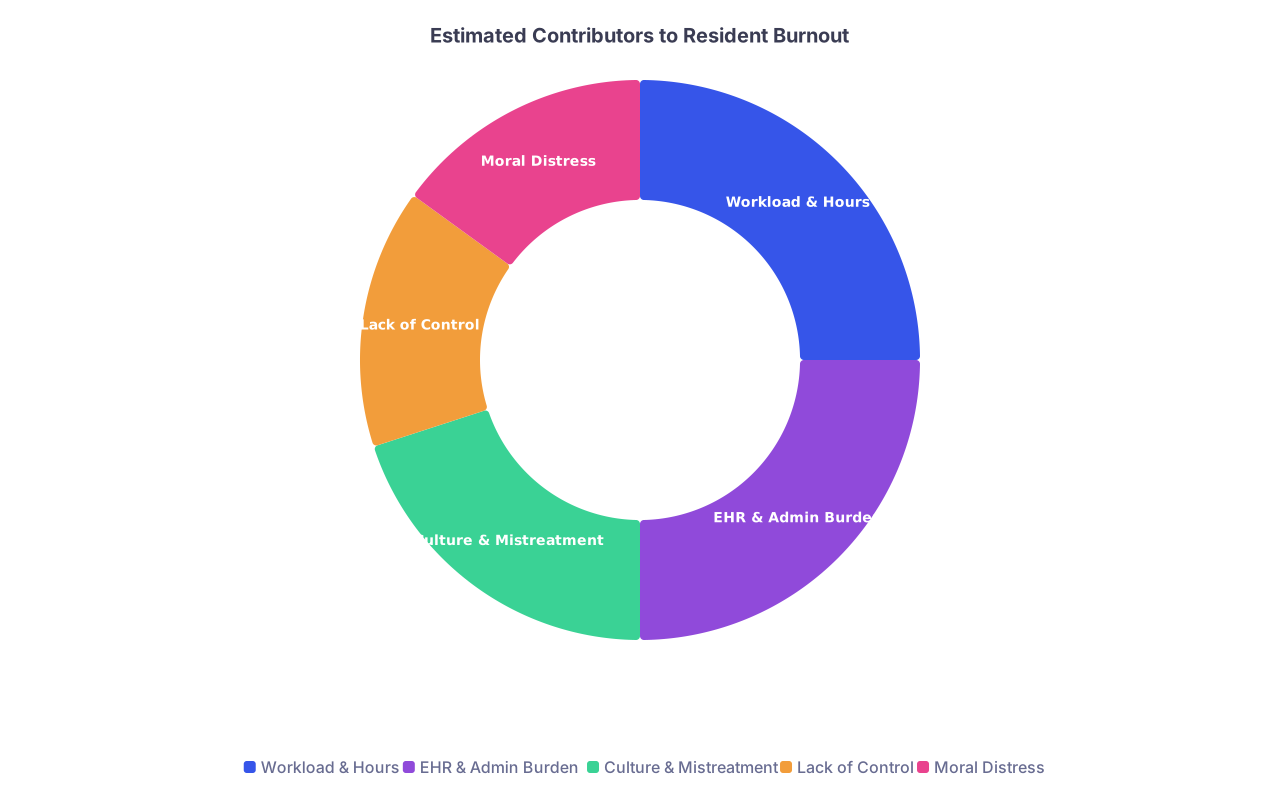
Here is a simple conceptual breakdown based on survey and workflow studies:
| Category | Value |
|---|---|
| Workload & Hours | 25 |
| EHR & Admin Burden | 25 |
| Culture & Mistreatment | 20 |
| Lack of Control | 15 |
| Moral Distress | 15 |
Duty-hour reform attacked maybe 25% of the problem, while other components either stayed flat or got worse.
6. What Has Actually Changed in Day-to-Day Life
Let us get concrete. If you walk through a teaching hospital today compared to pre‑2003, what is actually different for trainees?
1. Shift Structure and Handoffs
You now see:
- More night float systems.
- More frequent handoffs (sign-out might happen 2–3 times a day on a given patient).
- Less classic 24–30 hour “call” for interns in many programs, though it persists for seniors.
This reduces extreme sleep deprivation but increases fragmentation. Many residents will tell you: they feel more like shift workers and less like the doctor “owning” a panel of patients.

| Step | Description |
|---|---|
| Step 1 | Pre-2003 Resident |
| Step 2 | Long calls 24-36h |
| Step 3 | Fewer handoffs |
| Step 4 | High continuity |
| Step 5 | Post-ACGME Resident |
| Step 6 | Shorter shifts 8-16h |
| Step 7 | Frequent handoffs |
| Step 8 | Lower continuity |
2. Off-Duty Time (On Paper vs Reality)
On paper, ACGME gives you one day off in seven, 10 hours between shifts, and an 80‑hour average cap.
Reality, from resident surveys:
- “Home” work (notes, calls, prep) is rarely counted.
- Pre‑rounding at 4:30 a.m. for a 6:00 a.m. “start” is often not documented as work.
- The 80‑hour rule is reported on block averages, which can hide brutal weeks within a “compliant” month.
Residents game the reporting to avoid punitive consequences for programs. Actual hours can exceed reported hours by 5–15% easily.
3. Culture of Surveillance
Duty hours created a new layer of surveillance and bureaucracy:
- Residents log hours into tracking systems.
- Programs perform “spot checks” and audits.
- ACGME site visits stress documentation compliance.
This has two side effects:
- Some residents feel infantilized — “I am trusted with life-or-death decisions but not with managing my own sleep.”
- Others feel pressured to lie to protect the program from citations.
Neither of those dynamics helps burnout.
7. Burnout Trends Since ACGME: What the Recent Data Say
We are now more than 20 years into the duty‑hour experiment. If anything, burnout talk has become louder, not quieter.
Recent survey snapshots (illustrative ranges):
- Internal Medicine residents: burnout ~50–60%
- General Surgery residents: burnout ~40–60%, depending on postgraduate year.
- Emergency Medicine residents: burnout ~45–55%.
- OB/GYN, Anesthesia, Pediatrics: similar patterns, generally >40%.
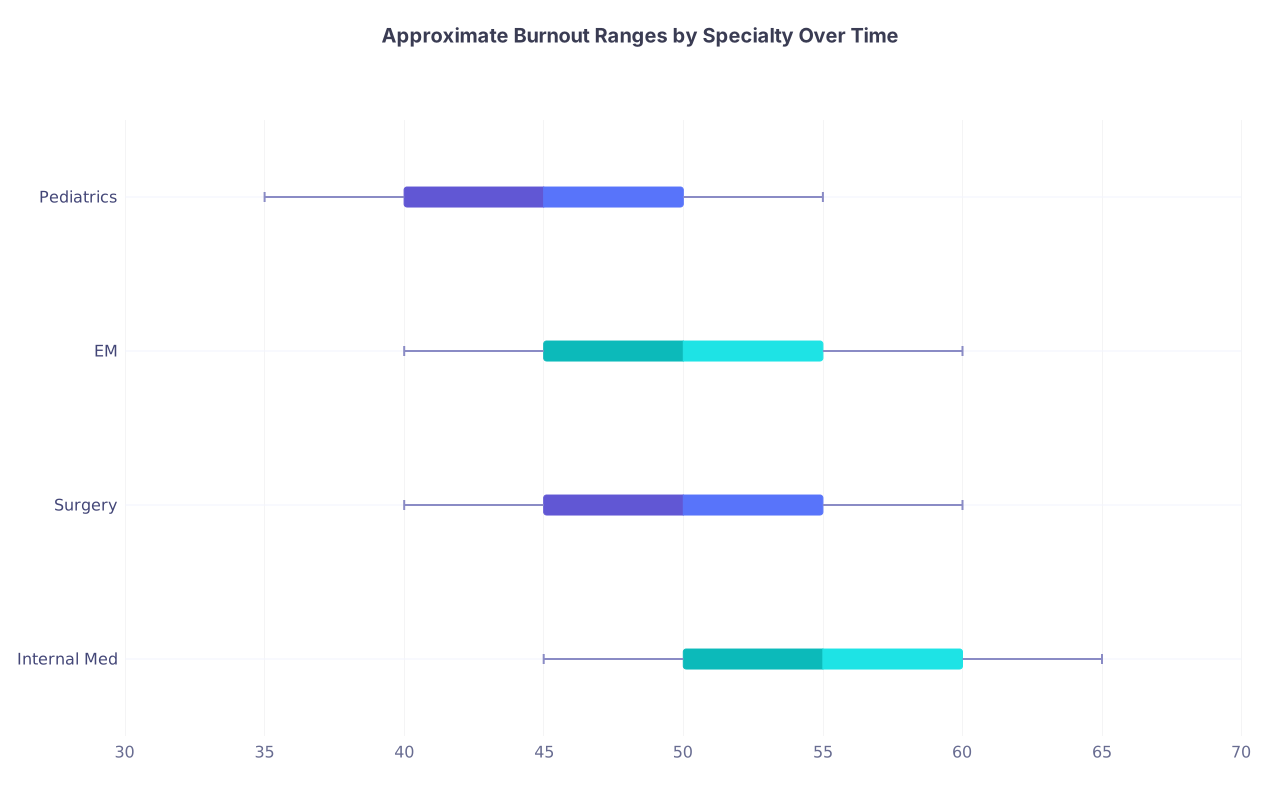
Let us compare a composite of pre‑2010 versus post‑2015 survey ranges by specialty (approximate):
| Category | Min | Q1 | Median | Q3 | Max |
|---|---|---|---|---|---|
| Internal Med | 45 | 50 | 55 | 60 | 65 |
| Surgery | 40 | 45 | 50 | 55 | 60 |
| EM | 40 | 45 | 50 | 55 | 60 |
| Pediatrics | 35 | 40 | 45 | 50 | 55 |
Translation: the median did not crash. If anything, some specialties have seen persistence or mild creep upward, especially as EHR and productivity pressures have intensified.
So what changed since ACGME?
- More structure, caps, and formal wellness language.
- Burnout prevalence still in the red zone.
8. Ethics and Work-Life Balance: Where the Data Point
You tagged this under work-life balance and medical ethics, which is exactly where the conversation belongs now.
Ethically, the old 120‑hour weeks were indefensible; fatigue‑induced impairment is no different from practicing drunk. ACGME did the minimum required to align training with basic safety standards.
But if we look only at hours, we miss the real ethical problem the numbers are screaming about: residents are still functioning in an environment where:
- 1 in 2 is burnt out.
- Depressive symptoms and suicidal ideation rates are significantly higher than age‑matched peers in other professions.
- Mistreatment and harassment still exist at non‑trivial rates in many programs.
From a data standpoint, this is not “a few fragile people.” This is a structurally toxic environment.
Work‑life balance in training now looks less like pure hours and more like:
- How much control residents have over their schedules and rotations.
- Whether vacation is protected in reality, not just policy.
- Whether home time is genuinely off or consumed by charting, studying, and mandatory “wellness” tasks.
Programs that actually move the needle on burnout almost always change more than hours. Common features (from case studies and surveys):
- Reasonable patient caps per resident.
- Non-physician staff handling truly clerical work.
- Attendings who protect educational time and explicitly discourage martyrdom.
- Systems to identify and intervene on distress early, not in PGY‑3 exit surveys.
The numbers on burnout are not destiny. They are design flaws made visible.
9. So, What Has Actually Changed Since ACGME?
Let me strip it down into three blunt points.
Extreme fatigue is less common.
You still see 24+ hour shifts, but 36‑hour marathons multiple times a week are less frequent, especially for interns. That is a genuine improvement in safety and basic human rights. The data on psychomotor performance and error rates support at least this level of reform.Burnout did not resolve; it morphed.
Residents went from chronically exhausted to chronically compressed and surveilled. The driver shifted from raw sleep deprivation to workload intensity, administrative burden, and culture. The prevalence numbers are clear: 40–70% burnout is not an improvement story.Patient outcomes did not dramatically change.
Mortality and complication rates largely held steady. You traded continuity and long-shift ownership of patients for less fatigue and more handoffs. The FIRST and iCOMPARE trials show that flexibility around shift length does not automatically break the system.
The headline: ACGME solved the worst abuses of hours while leaving the core burnout engine operational.
FAQ (Exactly 3 Questions)
1. Are residents actually working fewer hours now than before ACGME?
Yes, on average. Self‑reported weekly hours have dropped from typical ranges of 90–120 to 60–80 for most programs. However, this underestimates the true workload because off‑site work (charting at home, study, administrative tasks) is often not logged. Also, intensity per hour has increased, so the experience of “being crushed” can persist even at technically lower hours.
2. Did the 2011 16‑hour intern rule reduce burnout?
Not consistently. Some interns reported less acute fatigue, but program‑level burnout data do not show a strong or sustained decline. Many residents reported worse continuity, more handoffs, and feeling like disposable shift workers. This contributed to ACGME reversing the 16‑hour cap in 2017, moving back to 24+4‑hour limits while keeping the 80‑hour weekly cap.
3. What changes actually reduce burnout in residency according to data?
Interventions that adjust only duty hours tend to have modest effects. More effective levers include: capping patient load, reducing documentation and non-educational tasks, improving staffing (scribes, APPs, decent ancillary support), addressing mistreatment, and increasing resident input into scheduling and policy. Programs that combine these elements show lower burnout rates in local data, even within the same ACGME framework.
Key takeaway: the problem is not just how long residents are at the hospital; it is what they are doing and how much control and respect they have while they are there.