
Asking for help is not a sign that you’re weak. In medicine, pretending you don’t need help is what actually makes you dangerous.
The story you’ve been fed is simple and toxic: competent clinicians don’t ask; they just know. The resident who calls the attending “too much” gets labeled needy. The student who asks clarifying questions gets tagged as slow. The fellow who double-checks a plan is “not confident enough for attending life.”
That story is wrong. And the data does not back it up.
Let’s dismantle this myth properly—on clinical, ethical, and career grounds.
Where This Myth Actually Comes From
This fear did not appear out of nowhere. It’s built into how medical culture trains you.
You hear things like:
- “Don’t call me unless the patient is dying.”
- “Figure it out before you ask me.”
- “What did you find in UpToDate before you came to me?”
Underneath that is a clear message: self-sufficiency = competence. Visible uncertainty = weakness. So you learn to:
- Sit on questions during rounds.
- Delay calling a consult.
- Recheck labs three times hoping the answer will magically appear.
- Rewrite a note five times instead of asking the senior how they would frame it.
I’ve watched interns at 2 a.m. hovering over the phone, literally rehearsing how to call an attending so they “don’t sound dumb.” That’s not an individual confidence problem; that’s a culture problem.
But here’s the uncomfortable truth: high performers in high-risk fields are more likely to ask for help, not less.
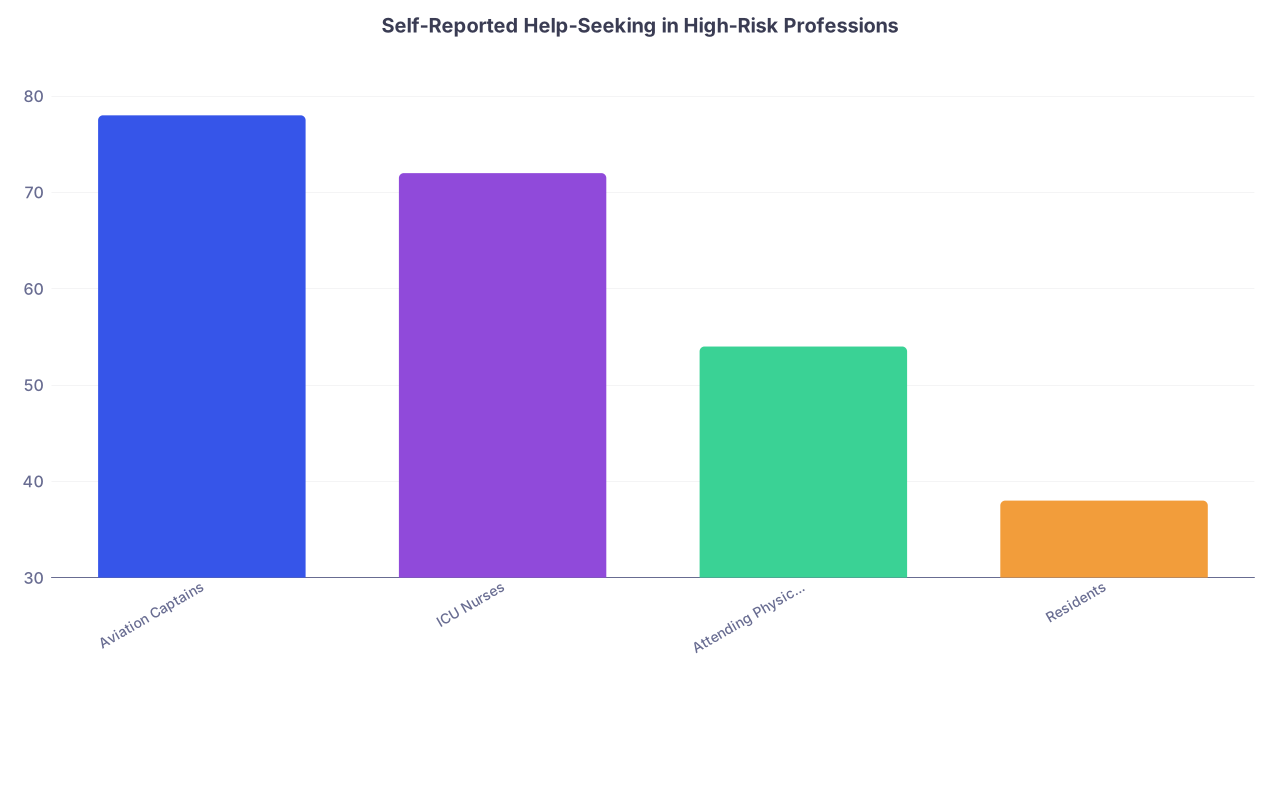
| Category | Value |
|---|---|
| Aviation Captains | 78 |
| ICU Nurses | 72 |
| Attending Physicians | 54 |
| Residents | 38 |
Notice the pattern from studies on crew resource management and clinical teamwork: the more formal training in safety and human factors a group has, the more normalized help-seeking becomes.
Medicine talks a big game about patient safety but often still rewards cowboy behavior on the ground.
What the Evidence Actually Shows About Asking for Help
Let’s go past vibes and into data.
Patient safety and help-seeking
Decades of safety science—from aviation to anesthesiology—say the same thing: silent struggle kills people.
In ICU and OR research, units with better “psychological safety” (where team members feel they can speak up and ask for help) have:
- Lower mortality
- Fewer complications
- Fewer near-misses that escalate
Amy Edmondson’s work on hospital teams is the classic example. Teams that reported more errors initially looked worse, until you realized they had better outcomes. Why? People in those units felt safe enough to admit errors and ask for guidance. Their “high error” reporting was actually high transparency.
And this is not abstract. Think about a new intern:
- Unsure about starting a heparin drip in a borderline case.
- Feels dumb paging the night float again.
- Decides to just copy yesterday’s dose and hope for the best.
That is how you get preventable bleeds, clots, and M&Ms built entirely on ego and fear.
Performance and learning
The fear is: if I ask for help, I’ll look incompetent. The reality from cognitive science and education research: asking for help at the right time is a marker of strategic learners and higher performers.
A few consistent findings:
- Students and trainees who use “adaptive help-seeking” (trying, then asking when stuck) actually learn faster and retain more.
- People who never ask for help are often either overconfident or underperforming and trying to hide it.
- Supervisor ratings of “teachability” and “insight into limitations” correlate strongly with later trust and responsibility.
I’ve heard attendings say outright in selection meetings:
“I trust the resident who pages me with a real question. I don’t trust the one who never calls and then I find out about problems on chart review.”
Silence reads as either arrogance or obliviousness. Neither screams “future partner.”
The Career Myth: “If I Ask for Help, My Evaluations Will Tank”
Let me be blunt: the thing that torpedoes careers in medicine is not asking for help. It’s needing help and pretending you don’t.
Yes, feedback language can punish help-seeking when done badly: “needs more independent thinking,” “lacks confidence,” “requires frequent supervision.” You’ve seen those phrases. Maybe you’ve had them.
But when you look closely, those comments are usually describing something else:
- Asking the same question three times without integrating feedback.
- Asking about things that are clearly your responsibility to look up first.
- Offloading work upward instead of collaborating.
That’s not “asking for help.” That’s poor preparation disguised as helplessness.
Programs that take evaluation seriously increasingly differentiate between:
- Appropriate escalation: “Recognizes limits, seeks timely input on complex decisions.”
- Avoidable dependency: “Does not attempt to solve routine issues before escalating.”
The first is career-safe, often career-enhancing. The second is a problem, yes. But they’re not the same behavior.
| Trainee Behavior | Typical Supervisor Interpretation |
|---|---|
| Asks after clear attempt and reasoning | Thoughtful, teachable, safe |
| Never asks, then has preventable miss | Poor judgment, unsafe |
| Pages attending for every minor detail | Unprepared, dependent |
| Asks early on high-risk, time-sensitive | Mature, reliable |
The sweet spot is obvious once you see it: try first, know when the risk is too high to guess, then escalate with a coherent summary and a tentative plan.
That pattern doesn’t hurt careers. It’s exactly what seniors and attendings want to see.
The Ethical Angle: Help-Seeking Isn’t Optional
This gets framed as a personal development issue. It’s not. It’s a medical ethics issue.
Four basic principles of medical ethics show up here whether people name them or not: beneficence, nonmaleficence, autonomy, justice. Failure to ask for help when you should is a direct hit to at least two of them on almost every shift.
Let’s be concrete.
You’re on night float. A patient is hypotensive and febrile. You’re thinking sepsis, but the source is unclear, the lactate isn’t back, and you’re not sure whether to call the ICU team now or “watch closely.”
Scenario A: You try to “be independent,” manage on the floor, wait for more data. They decompensate, you call late, transfer is chaotic, they end up intubated.
Scenario B: You call the ICU senior early, explain your concern, ask: “Here’s what I’m thinking, do you think we should move now or trial fluids and antibiotics first?”
Only one of those scenarios respects nonmaleficence (do no harm) and beneficence (act in the patient’s best interest). Only one reflects appropriate humility about your limits.
The AMA Code of Medical Ethics is blunt about this: physicians must “consult colleagues” when appropriate and must “not exceed the limits of their competence.” Hiding doubt to appear more competent is a direct ethical violation, not a style choice.
Patients don’t consent to be practice material for your ego. They assume you’ll get help when you need it. That’s the social contract.
What “Good” Asking for Help Looks Like
Here’s where people get tripped up. They think the choice is between stoic independence and panicked dependence. That’s a false binary.
High-quality help-seeking has a structure. It signals competence, not weakness.
The pattern I see in strong residents and attendings is usually:
Attempt first
You review the chart, examine the patient, think through the differential, glance at the latest guideline or resource. Ten to fifteen focused minutes, not two seconds.Define the specific question
“I’m unsure whether we should anticoagulate this subsegmental PE with high bleeding risk” is very different from “I don’t know what to do.”Propose a plan
Even if you’re unsure. “Given X, Y, Z, I’m leaning toward A rather than B. Is that reasonable?”Choose timing based on risk, not your anxiety
- Clinical instability, unclear diagnosis, or major irreversible decisions: call early.
- Documentation style, minor med rec cleanup, minor workflow preferences: batch for later or ask peers first.
Integrate feedback and reduce redundancy
If your senior walked you through DKA management once, your next question should build on that, not reset from zero.
When trainees do this, I’ve seen notoriously harsh attendings turn into eager teachers. Why? Because this kind of question respects their time and shows your brain is on.

| Step | Description |
|---|---|
| Step 1 | Identify Problem |
| Step 2 | Assess Patient Risk |
| Step 3 | Call Senior or Attending Now |
| Step 4 | Attempt to Solve |
| Step 5 | Consult Guidelines or Resources |
| Step 6 | Formulate Working Plan |
| Step 7 | Decide |
| Step 8 | Implement Plan and Monitor |
Notice the question isn’t “Will I look dumb?” It’s “What is the patient’s risk if I’m wrong?”
That’s the ethical filter that matters.
The Hidden Career Upside of Asking for Help
Now flip the script. Not only does good help-seeking not hurt you—it quietly builds the exact things careers run on in medicine:
1. Trust
People trust colleagues whose behavior is predictable under stress. If your pattern is:
- Tries appropriately.
- Escalates early for serious issues.
- Owns uncertainty.
…you become the person other clinicians feel safe handing patients to. That matters far more than whether you knew the mechanism of a rare drug interaction on the spot.
2. Visibility to mentors
Senior people invest in those who show both initiative and openness. Asking for help in a thoughtful way gives attendings and faculty a clear window into how you think. That’s how you end up on:
- Research projects.
- Letters of recommendation that actually say something specific.
- “Short lists” for chief resident, fellowship spots, or early leadership roles.
I’ve sat in meetings where someone said, “They came to me early about a tough situation, and handled the follow-up exactly as we discussed. I’d take them in my fellowship.”
They weren’t praising omniscience. They were praising the ability to recognize limits and then execute.
3. Long-term sustainability
Let’s be blunt: solo heroics burn people out. Because you’re trying to carry what was never meant to be a one-person load.
People who never ask for help:
- Stay later to fix avoidable messes.
- Ruminate endlessly about whether they made the right call.
- Accumulate quiet errors and near-misses that erode self-confidence over time.
People who normalize asking for input:
- Share cognitive load.
- Sleep better because they know decisions were vetted.
- Build actual teamwork rather than parallel lone-wolf tracks.
You don’t build a balanced work life by becoming superhuman. You build it by not pretending you are.
How to Ask for Help Without Getting Labeled “Needy”
Let’s be tactical. You’re not imagining that some environments punish any sign of uncertainty. You still live there tomorrow. So how do you work this reality without selling out patient safety or your own development?
A few practical moves that I’ve seen work even in toxic cultures:
Front-load your reasoning
Start with: “Here’s the situation, here’s what I’m thinking, and here’s where I’m stuck.” It differentiates you instantly from the “I don’t know, what should I do?” crowd.Use risk language, not emotion language
“I’m concerned about missing X and the patient deteriorating before morning” lands better than “I’m really anxious about this case.”Ask meta-questions
“In future, for similar cases, at what point would you want to be called?” This turns your immediate need into a learning moment and shows you’re trying to internalize their threshold, not just offload decisions.Signal learning over dependence
“Last time you recommended A in a similar situation; this time I’m wondering if B might be better because of Y—am I thinking about that right?”
Behavior like this gets labeled “engaged” and “insightful,” not “needy.”
When Not Asking for Help Really Does Hurt Careers
Let’s end the myth the other way around: there are very specific patterns that absolutely do damage careers. They almost all share one thing—failure to seek help when appropriate.
Patterns I’ve seen sink evaluations, referrals, and reputations:
- “Independent” decisions that were clearly above the trainee’s competence and went badly.
- Repeatedly managing deteriorating patients without escalation.
- Hiding errors until they’re discovered by someone else rather than disclosing and asking for guidance.
- Ignoring nursing concerns because “they’re overreacting” instead of teaming up to reassess.
Those stories circulate. They show up in off-the-record backchannel conversations: “Technically fine, but I would not trust them on nights alone.” You do not want to be the person attached to that sentence.
Ironically, that’s the exact future many people are trying to avoid by not asking for help.
The Real Myth
The real myth isn’t just “asking for help will hurt your career.”
The deeper myth is that competence in medicine equals certainty and self-sufficiency. It doesn’t. It never has.
Competence is knowing what you know, knowing what you don’t, and having the judgment and humility to close that gap before a patient pays the price.
If you internalize that, your career becomes more stable, not less.
The Takeaways
- Asking for help, done thoughtfully, is a marker of safety and judgment, not incompetence. The data on high-performing teams backs this up.
- Ethically, you’re obligated to seek help when the risk to patients exceeds your competence. Not asking is the liability.
- Careers in medicine are built on trust, teachability, and judgment—all of which are strengthened, not weakened, by strategic, well-framed help-seeking.
Stop performing invincibility. Start practicing accountable uncertainty. That’s where both good medicine and sustainable careers actually live.