
The Hustle Culture Lie: Why Constant Productivity Backfires in Medicine
The cult of endless hustle is quietly wrecking physicians and medical trainees. And the data could not be clearer: the more medicine worships productivity, the worse we get at the actual job—thinking clearly, caring ethically, and not harming patients.
The idea that you should “always be grinding” to succeed in medicine is not just wrong. It’s dangerous.
Let me walk through what the numbers, not the Instagram quotes, actually show.
Medicine’s Favorite Myth: More Hours = Better Doctor
You know the script. I’ve heard attendings say it aloud on rounds:
“Real surgeons live in the hospital.” “If you are not reading every night, someone else is and they will take your spot.” “Sleep is for primary care.” (Yes, I’ve actually heard this, and yes, it’s idiotic.)
The hidden premise is simple: the harder you push—more shifts, more charts, more committees, more moonlighting—the better you will become. Hustle culture dresses this up as “grit” and “dedication.” Residency culture calls it “paying your dues.”
The evidence says something very different.
What the data actually shows on long hours
Start with work hours and performance.
Studies on resident duty hours over the past two decades are remarkably consistent on one thing: at a certain point, more hours don’t make you better; they make you dangerous.
The classic cognitive fatigue data is old but still true: after about 16 hours awake, your psychomotor performance resembles someone with a blood alcohol level around 0.05–0.1. That’s not a metaphor. That’s measured.
Large randomized trials of duty-hour reforms (like the FIRST trial in surgery and iCOMPARE in internal medicine) get spun into “flexible hours are safe,” but if you actually read the details, you see a different story:
- Long shifts don’t magically create more learning. Residents in longer-shift arms didn’t have some huge educational advantage.
- Burnout remained high in both groups, and chronic sleep deprivation persisted.
- Where patient outcomes were “similar,” that bar is already uncomfortably low.
Meanwhile, outside those specific trials, observational work is blunt: fatigued residents make more serious medical errors, have more needle sticks, more car crashes post-call, and worse mental health. And attending physicians aren’t magically immune; the burnout prevalence hovers at 40–60% in many specialties.
Hustle culture treats those numbers like background noise. They’re not background. They’re the consequence.
Constant Productivity Makes You a Worse Clinician
The uncomfortable truth: “always-on” productivity doesn’t just make you tired. It directly erodes the exact cognitive functions medicine relies on most.
Decision quality tanks before you feel “tired”
Sleep research and decision science show a few patterns that apply directly to daily clinical work:
- Diagnostic accuracy drops as cognitive load and fatigue rise.
- You revert to heuristics and mental shortcuts—anchoring on initial impressions, premature closure, ignoring disconfirming data.
- Your ability to update probabilities (Bayesian reasoning, if you want to be fancy) gets worse.
This is not theoretical.
A study in primary care documented “decision fatigue” within the same day: rates of ordering cancer screenings and prescribing appropriate meds dropped steadily as clinic sessions went on, then reset after breaks. Early-morning visits got more guideline-concordant care than late-afternoon ones.
Extrapolate that to a resident on hour 24 of a call shift.
I’ve seen this in sign-out rooms: the PGY-2 staring blankly at an anion gap, saying “it’s probably just starvation ketosis,” not because that’s a reasoned judgment, but because their brain is done. Another few minutes, fresh, and they’d have considered toxic alcohols. In the moment, they literally can’t.
Hustle culture worships the resident who “powered through” 28 hours on MICU. Ethically, we should be asking: what was the quality of each note, order, and decision after hour 18? Hour 22?
“More reps” is not the same as deliberate practice
Here’s another lie baked into hustle culture: if you just see more patients, do more notes, cram more reading in, you’ll necessarily improve.
That’s not how expertise works.
Real skill development requires:
- Feedback
- Reflection
- Mental bandwidth to analyze mistakes
Endless throughput without reflection becomes repetition, not mastery. Think about the attending who’s been practicing 20 years but still makes the same sloppy diagnostic shortcuts. They’re not under-experienced. They’re under-reflective.
Hustle culture rewards volume. Ethics demands competence.
When you’re grinding 80-hour weeks, then “using your off time” to moonlight, publish, pre-round on research, and answer 2 a.m. emails from that fellowship director—you’re not creating space for insight. You’re just stuffing more low-yield tasks into an already maxed-out system.
Burnout Isn’t a Vibe; It’s a Safety Issue
People talk about burnout like it’s a feelings problem. You’re “tired,” “not as passionate,” “need a vacation.”
In medicine, burnout is a structural defect with measurable consequences.
The triad is familiar: emotional exhaustion, depersonalization, and reduced sense of personal accomplishment. Look at what each does to your ethical functioning:
- Emotional exhaustion → you have less capacity for empathy and moral sensitivity.
- Depersonalization → patients become “the CHF in bed 4,” not human beings; it’s a defense mechanism, but it breeds ethical numbness.
- Low accomplishment → you’re more likely to cut corners, because nothing you do feels like it matters.
Meta-analyses have shown strong associations between clinician burnout and:
- Increased medical errors
- Lower patient satisfaction
- Higher rates of unprofessional behavior and reduced adherence to best practices
This is the ethical elephant in the room: promoting a culture where you’re expected to selalu be productive—charting at home, answering portal messages at midnight, saying yes to every “opportunity”—is not morally neutral. It directly supports conditions under which harm is more likely.
You cannot claim to prioritize patient safety while glorifying a lifestyle that predictably induces cognitive failure and emotional blunting.
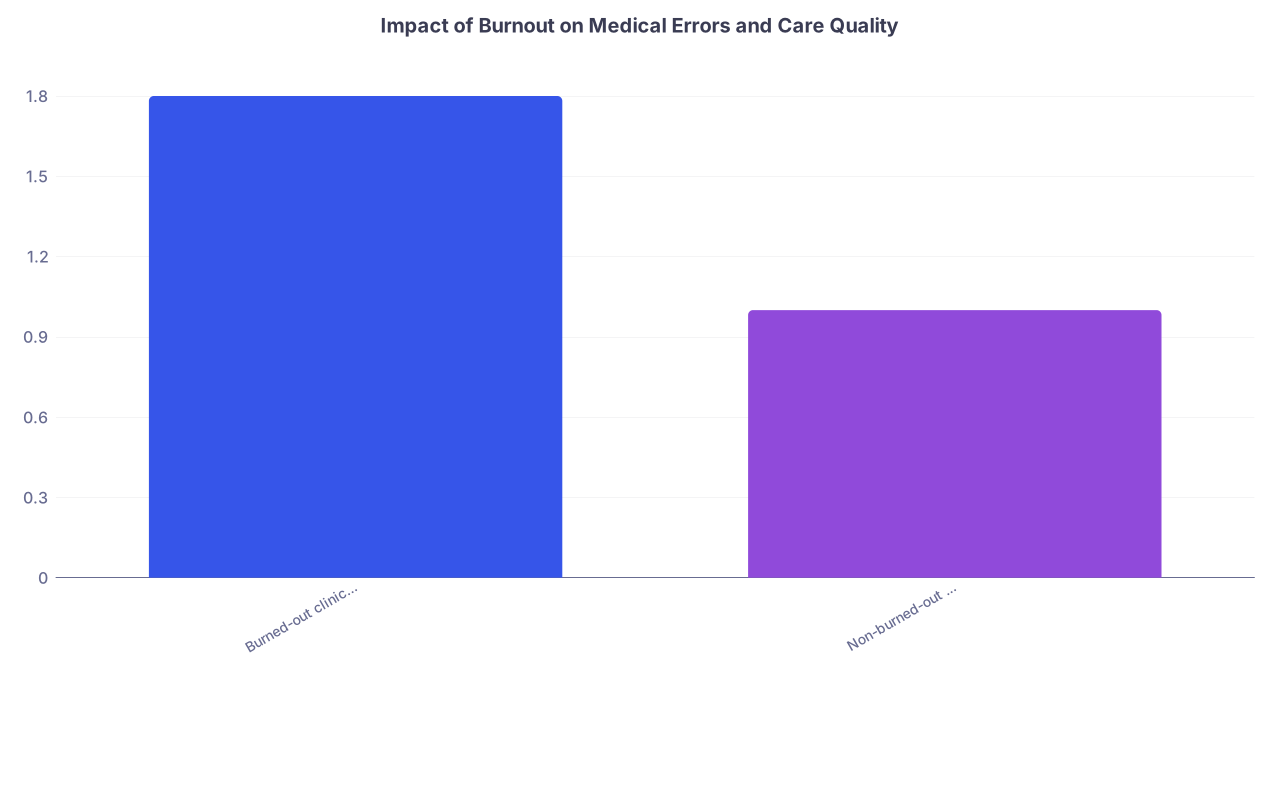
| Category | Value |
|---|---|
| Burned-out clinicians | 1.8 |
| Non-burned-out clinicians | 1 |
That bar chart might look simplistic, but that ~1.8x relative risk of self-reported major medical errors among burned‑out clinicians? That’s patient-level harm, not an abstract wellness talking point.
The Ethical Problem: Hustle Culture vs Professional Responsibility
This is where personal development and medical ethics collide head-on.
Autonomy vs exploitation
We love to dress hustle up as “choice.” You chose to pick up extra shifts. You chose to answer emails at 11 p.m. You chose to do research on your golden weekend.
But in a hierarchy where:
- Evaluations are subjective
- Letters of recommendation can make or break careers
- “Fit” is code for “do they work like us”
…those choices are not exactly free.
If your program director casually praises the resident who “never says no” and rolls their eyes at the one who sets boundaries, you’ve created a coercive environment. The resident who opts out of the 10th research project isn’t less dedicated; they’re just less willing to self‑sabotage.
From an ethical standpoint, “voluntary” overwork in a structurally coercive system stops being purely voluntary.
Nonmaleficence and beneficence aren’t part-time duties
“Do no harm” is not suspended because you’re tired and your program normalized it.
If we know—because we do know—that chronic sleep loss, moral overload, and emotional exhaustion increase error rates and reduce empathy, then participating in a culture that generates those conditions is not ethically neutral.
It’s complicity.
Beneficence (acting in the patient’s best interest) requires sustained attention, curiosity, and the psychological capacity to care. Those are not infinitely renewable on demand. They are consumed by endless hustle.
Justice and the distribution of harm
Here’s the other ugly layer: hustle culture in medicine doesn’t burn everyone equally.
Residents with caretaking responsibilities, chronic illness, or belonging to marginalized groups often pay a heavier price. They may have less ability to “volunteer” for extra grind without substantial personal or financial damage.
Programs that silently equate “best” with “most available to work all the time” are building a workforce optimized for single, ultra-privileged physicians and then acting surprised when diversity and retention suffer.
That’s not just bad HR. That’s a justice problem.
The Neuroscience: Your Brain Is Not a Machine
Strip away the ethics and philosophy for a second. Look at the hardware.
Human brains are not designed for continuous throughput. They run on oscillation—effort and recovery. Focus and diffusion. Sympathetic and parasympathetic.
Basic neurocognitive research shows:
- Working memory and executive function degrade under chronic sleep curtailment, even if subjective sleepiness plateaus. Translation: you think you’re “fine.” You’re not.
- Creativity and problem-solving improve after rest, not after squeezing a 17th task into a 14-hour day.
- Emotional regulation depends heavily on sleep; amygdala reactivity spikes with even one bad night.
In medicine, we’ve managed to build workflows that stomp on every one of these principles.
Residents “catch up” on notes late at night, sacrificing sleep. Attendings answer MyChart messages on their supposed days off. Students feel guilty if they aren’t reading UpToDate in every spare minute, while ignoring the fact that half of what they crammed last night won’t consolidate because they slept 4 hours.
Hustle culture in this context is basically saying: ignore the last 50 years of neuroscience; grind harder.
That’s not resilience. That’s willful self-harm with a white coat on.
What Actually Works: Sustainable Excellence, Not Perpetual Hustle
Let me be direct: the opposite of hustle culture is not laziness. It’s intelligent, sustainable excellence.
The people I’ve seen become genuinely outstanding clinicians and ethical leaders do a few things differently. None of them are romantic or Instagrammable.
They respect bandwidth. They prioritize depth over constant activity. They protect recovery like it’s part of their job—because it is.
| Dimension | Hustle Culture Model | Sustainable Excellence Model |
|---|---|---|
| Hours mindset | Maximize hours worked | Optimize cognitive peak time |
| Identity | Always on, “grinder” | Professional with protected off-time |
| Learning approach | Volume of reps | Deliberate practice with reflection |
| Ethics lens | Sacrifice is noble | Safe, rested care is mandatory |
| Career trajectory | Fast, brittle, burnout-prone | Slower, robust, more durable |
The key difference is that the sustainable model treats your cognitive and emotional capacity as a finite, valuable resource—not a disposable fuel source to impress attendings or program directors.
That shift matters for two reasons:
- It preserves you as a person.
- It concretely improves your ability to uphold your ethical obligations over decades, not just during training.
How the Lie Persists—and Why You Don’t Have to Buy It
If this is all so obvious in the data, why does hustle culture still dominate?
Three reasons, and you’ve seen all of them.
First, inertia and identity. Older generations were brutalized by epic hours and survived. Some cope by mythologizing it: “It made me the physician I am today.” Maybe. Or maybe they succeeded in spite of the system, not because of it. Survivorship bias is powerful.
Second, misaligned incentives. Hospitals and systems profit from doctors who answer messages at home, skip vacations, and keep productivity RVUs high. Nobody gets a bonus for well-rested, wise decision-making. They get a bonus for throughput.
Third, fear. Students and residents are scared—of not matching, not getting the fellowship, not being “that resident” who “doesn’t go above and beyond.” Hustle culture feeds on that fear and disguises itself as the only way out.
Here’s the punchline: you cannot change the entire system alone. But you absolutely can refuse to internalize its most self-destructive myth.
You can say: I am not a better doctor because I answer emails at 11 p.m.
I am not a better resident because I have no hobbies.
I am not more ethical because I destroy my own health to prove loyalty to a broken workflow.

| Step | Description |
|---|---|
| Step 1 | Current State - Always hustling |
| Step 2 | Set non negotiable rest |
| Step 3 | Prioritize high value work |
| Step 4 | Protect reflection time |
| Step 5 | Long term sustainable practice |
| Step 6 | Recognize limits |
This Is Personal Development and Ethics
People like to separate “wellness” from “professionalism,” as if self-care is a side hobby and ethics is what you do at the bedside.
That’s a false split.
Your ability to:
- Notice subtle changes in a patient
- Catch the lab that doesn’t fit
- Sit with a family in crisis without rushing
- Choose not to order the fifth unnecessary test just to feel you “did something”
…these are not purely knowledge-based functions. They’re state-dependent. They rely on an intact, functioning human mind and body.
The hustle culture lie says: productivity is the highest good.
Medicine—real medicine—says: safe, thoughtful, humane care is the highest good.
Those two value systems collide the minute your “grind” makes you worse at the job.
So if you care about being an ethical physician, not just a busy one, you have to start treating rest, boundaries, and selective focus as ethical obligations, not guilty pleasures.
Bottom line
Three things to walk away with:
- The data is clear: beyond a point, more hours and constant productivity degrade clinical performance, increase errors, and fuel burnout. That’s not “soft” wellness; it’s hard outcomes.
- Hustle culture in medicine isn’t ethically neutral. It conflicts directly with nonmaleficence, beneficence, and justice by normalizing conditions that make harm more likely and disproportionately burden certain clinicians.
- Sustainable excellence—protecting rest, narrowing focus, valuing depth over constant output—is not a luxury. It’s the only way to stay competent, humane, and ethical across a full medical career, not just a training slot.
If someone sells you the idea that you must always hustle to be worthy of your white coat, they’re not defending professionalism. They’re defending a broken system.