
The “hero resident” is not a compliment. It is a trap that quietly shortens your career, poisons your boundaries, and makes you easier to exploit.
Let me tell you what really happens behind closed doors when people at a program start calling someone a “hero.”
They do not mean “role model.” They mean “we can load them up and they will not complain.”
They mean: more notes, more cross-cover, more extra calls, more last-minute “can you just…” tasks. And the worst part? The system will reward you just enough to keep you chasing it, while quietly burning through your empathy, judgment, and health.
You think you are being noble. Leadership thinks you are free labor.
Let’s dissect this properly.
What Programs Really Mean by “Hero Resident”
The mythology sounds harmless: always says yes, never leaves early, takes on more patients, covers for co-residents, stays late to finish everything “perfectly.” You are “that resident” who “goes above and beyond.”
Inside residency leadership meetings, that language is code.
I have sat in on those meetings. I have heard these exact phrases:
- “He’s a machine, just give it to him, it’ll get done.”
- “She’ll stay as long as it takes; she doesn’t push back.”
- “He’s solid. Never complains. You can always lean on him.”
Sounds flattering until you listen for the subtext: reliability plus silence equals capacity for more work.
There are a few archetypes that get labeled as “heroes”:
- The Step-Scored-to-the-Moon overachiever who thinks productivity equals worth.
- The immigrant or visa-dependent resident terrified of rocking the boat.
- The “team mom/dad” who over-functions to protect weaker co-residents.
- The guilt-driven one: constantly afraid of harming a patient by leaving “one more thing” undone.
Here’s what attendings and program directors quietly notice, but don’t always say aloud: hero residents make the system look functional when it is not.
Your extra unpaid hours plug holes that should be fixed at the structural level—with staffing, process changes, or realistic expectations. Instead, your self-sacrifice becomes the excuse not to change anything.
How the Hero Identity Quietly Wrecks Your Career
This image does not just make you tired. It alters how people see you in very specific, damaging ways.
1. You Get Pigeonholed as a Workhorse, Not a Leader
Attendings differentiate residents quickly. You probably think they are ranking you by intelligence and clinical reasoning. They are also ranking you by role.
Here’s the rough taxonomy I’ve heard in more than one program:
| Archetype | How Faculty Use Them |
|---|---|
| Hero Resident | Extra labor, high call |
| Star Leader | Committees, chief track |
| Quiet Grinder | Reliable but invisible |
| Problem Child | Documentation, remediation |
| Flight Risk | Retention-friendly tasks |
The “Star Leader” is not usually the one staying until midnight finishing every box in Epic. It is the one who shows they can delegate, triage, and say no when needed.
I have watched this play out over and over:
Two PGY-3s on the same service. One is the hero: 8:30 pm sign-outs, perfect notes, takes admissions “so others can get out.” The other leaves on time most days, hands off cleanly, pushes back when census is unsafe, and actually goes home.
Guess which one was made chief?
Not the hero.
Why? Leadership said it out loud: “He’s great but not scalable; he just does more himself. She actually thinks like an attending.”
The heroic resident is seen as a high-output machine, not as someone who can build and manage a system. You train people how to see you. If you teach them “give it to me, I’ll do it,” they will not picture you at the table where decisions get made.
2. You Lose Leverage for Change
You cannot be both:
- The person who silently absorbs abuse
- And the person who demands systemic reform
Your behavior tells a story. If you consistently over-function, leadership hears: “It’s rough, but they can handle it.”
When the ACGME surveys come back with bad work-hour scores, program directors get nervous. They need to show improvement. Do you know what happens in rooms you are not in?
That one resident who actually logs accurate hours and flags unsafe workload? Leadership remembers them. They grudgingly respect them. They may fear them a bit. That person has leverage.
The hero who always “rounds down” their hours in New Innovations? The one who claims, “It’s fine, we were just hanging out and talking”? That person erases the paper trail that would have forced change.
You think you are being a team player. What you are actually doing is protecting the institution from accountability.
The Ethical Problem Nobody Likes to Name
Let’s talk medical ethics, since that is supposedly the category you are reading this under.
Everyone loves to quote “patient-centered care” and “nonmaleficence” while silently encouraging behavior that leads to exactly the opposite.
A sleep-deprived, decision-fatigued resident who has not eaten in 14 hours is not ethical. They are dangerous. I do not care how noble their intentions are.
We all know the data. Beyond a certain point, your cognitive performance equals someone legally drunk. The difference is, the drunk person is not the one managing vasopressors or deciding whether that borderline belly needs the OR.
But what does the hero narrative say? Stay. Push through. Finish everything yourself. Don’t hand off because “sign-out is risky.” Do not burden the night float. Be a martyr.
Here is the ethical tension you will feel and you need to recognize it for what it is:
- Your guilt says: “If I leave now, a patient could suffer.”
- Reality says: “If you stay like this, your judgment is deteriorating, and that is more dangerous long-term, not just today.”
I have seen morbidity and mortality cases where the real root cause was not written: “Resident was in their 16th hour, had skipped two meals, and missed the deteriorating trend.” Nobody wants to document that. So it becomes a “learning point” about vigilance.
That is the ethical cost of the hero script. It normalizes unsafe behavior as virtue.
How the Hero Role Damages Your Relationships
The saddest part? Hero residents often think they’re protecting their team. Often they’re poisoning it.
Here is how it plays out over a year or two:
You stay late, pick up everyone’s slack, “just do it myself” because it is faster. At first your co-residents are grateful. Then they start subtly adjusting to it.
They start assuming you will handle the hard sign-outs. They let you take the admissions when they are tired because “you’re better at moving quickly anyway.” Interns learn that if they are overwhelmed, you will swoop in.
Then quietly, resentment creeps in both directions.
You resent that others are getting out on time. They resent the unspoken judgment that they “aren’t as committed.” The attending starts to prefer you for tough rotations because things just magically get done. Now everyone knows you are the one who dumps work from the system onto your own shoulders.
And in the background, your personal life thins out. The partner who was patient for 6 months becomes irritated at year 2. The friendships outside medicine shrink. You become the person who “can never commit” to a dinner, a trip, a wedding.
Not from a single big decision. From a thousand tiny “I’ll just stay a bit later” moments.
The Long Shadow: How This Follows You After Residency
You think you can survive residency as the hero and then magically turn into a boundary-respecting attending?
No.
What you rehearse for 3–7 years becomes your default.
I’ve watched “hero residents” as attendings. The patterns are almost identical:
- They cannot say no. Extra clinics, extra OR days, extra admin tasks, they accept them all.
- They micromanage. Still doing intern-level tasks because “it’s faster if I do it.”
- They become bottlenecks. Trainees and colleagues wait for them because everything must go through them.
- They are first to burn out. Not always the ones who leave medicine, but often the ones who become bitter, cynical, and quietly miserable.
There’s also an invisible financial cost. The hero mentality makes you an easy target for lowball contracts and uncompensated “leadership” roles. Night call “volunteering.” Committees “for exposure.” Panels beyond safe limits.
You are trained to equate self-sacrifice with goodness. Employers are trained to recognize that as exploitable.
The Psychology Driving the Hero Script
This is where I am going to be blunt: this is not just about systems. It is about your own psychology.
The residents most vulnerable to this trap usually share some mix of:
- Perfectionism: If it is not done exactly right, it feels like a failure.
- External validation hunger: You’re chasing praise, high evals, that “best resident” award.
- Fear: Of being seen as weak, lazy, replaceable, or uncommitted.
- Identity fusion with medicine: If you are not the “good doctor,” who are you?
Training programs do not cause those traits. They weaponize them.
Someone in leadership notices: “She always steps up.” “He never pushes back.” Once that reputation is established, you will be tested. Slowly. A little more work here. Another call there. A new initiative. “Can you just…” until your baseline is absurd and no one notices anymore.
The real danger is when you start believing your only value is in being that person.
You are not just overworked. You are addicted to being needed.
How to Break the Hero Pattern Without Tanking Your Reputation
Here is the part nobody tells you: you can step away from the hero persona and actually improve how you are perceived by the people who matter.
1. Start Thinking Like an Attending, Not a Martyr
Attendings with staying power do not run themselves into the ground daily. They triage, delegate, and set limits. They accept that some problems are system problems, not “I will just stay until midnight” problems.
On your next heavy call, force yourself to ask:
- What truly requires me right now?
- What can safely be signed out with a clear plan?
- What can be done by ancillary staff if I communicate it well?
- What can genuinely wait until tomorrow without harming the patient?
Then act accordingly, even if your reflex screams at you.
You will feel guilty the first few times you leave “unfinished” tasks that are actually appropriate to hand off. That guilt is not morality. It is conditioning.
2. Use Strategic “No,” Not Defiant “No”
Saying no does not mean slamming doors. It means being explicit about trade-offs.
Instead of “I can’t take that admission,” try: “If I take another patient now, I will not be able to get through the cross-cover issues safely. Which is the priority?”
You hand the decision back to the senior, chief, or attending. Most halfway decent leaders, when forced to say out loud, “Yes, I want you to take another unstable patient on top of 16 cross-cover patients,” will pause. Some will not. You document mentally who is who.
Same in academics or extra duties: “I’d like to help with that QI project, but I’m already on two others. If you want me on this, I’ll need to step off one of the current ones. What would you prefer?”
This is how you shift from hero grunt to colleague.
A Simple Framework for Sustainable Responsibility
Let’s get concrete. You want to be committed, competent, and reliable. You just do not want to be consumed.
Use this mental model on every rotation:
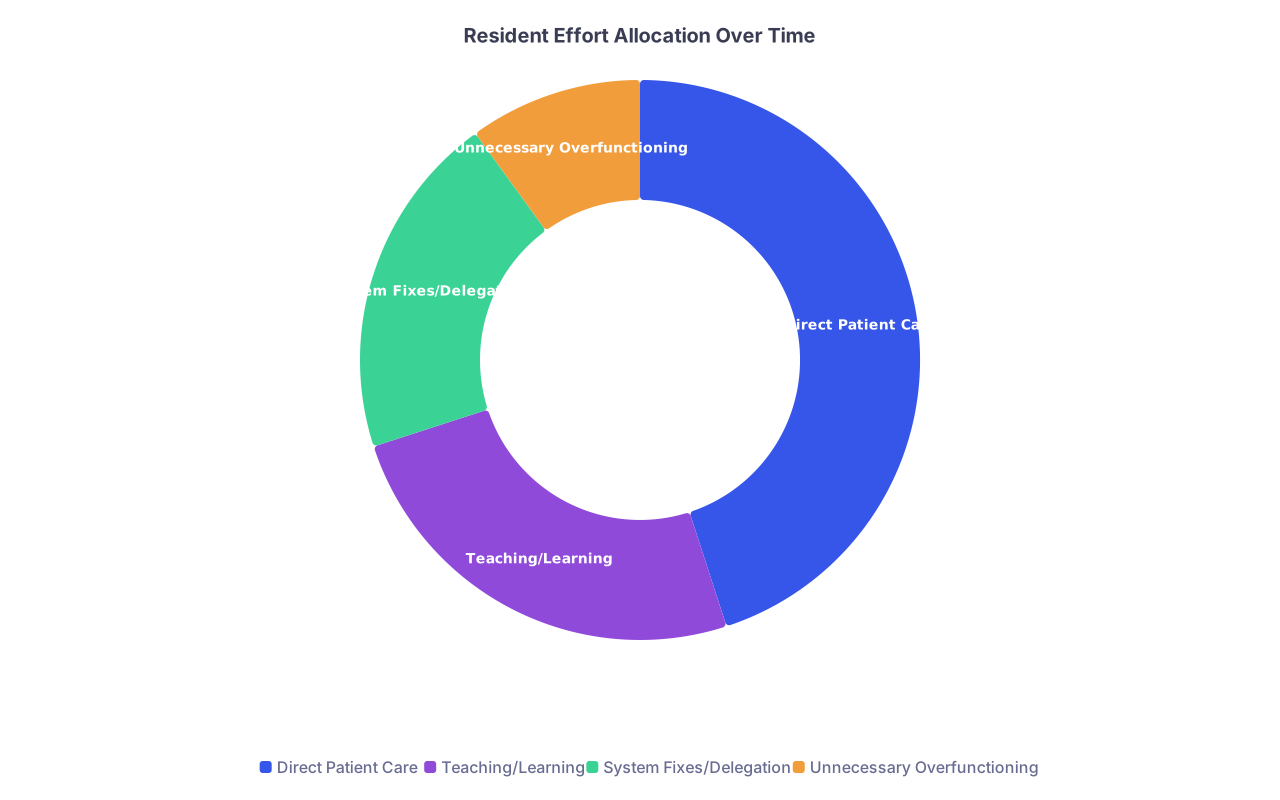
| Category | Value |
|---|---|
| Direct Patient Care | 45 |
| Teaching/Learning | 25 |
| System Fixes/Delegation | 20 |
| Unnecessary Overfunctioning | 10 |
Your goal is to shrink that “Unnecessary Overfunctioning” wedge to near zero, and grow the “System Fixes/Delegation” part. That is what actually builds your career.
Ask yourself weekly:
- What am I consistently doing that someone else could safely do with proper instructions?
- What bottlenecks always seem to land on me—and why?
- Where am I the only person who knows how to do something, and how can I fix that?
Heroes hoard tasks. Leaders build systems so the tasks do not always fall on them.
Recognizing When You’re Already in Too Deep
If you are reading this and thinking, “That kind of sounds like me,” you are probably further in the trap than you realize.
Red flags I’ve seen in residents who are burning out under the hero identity:
- You are constantly praised, but you feel oddly unseen.
- You dread days off because you feel guilty not being there.
- You get irrationally angry when co-residents set boundaries you will not allow yourself.
- You cannot remember the last time you went a week without someone saying, “I don’t know how you do it.”
- You fantasize about walking away from medicine entirely, but you push it down and keep grinding.
If three or more of those hit, you are not just “working hard.” You are eroding.
This is the point where some residents either:
- Break: clinical error, meltdown, health crisis, or formal leave.
- Numb out: still show up, but emotionally unplug, go through motions.
- Or—rarely, but it happens—pivot: consciously change how they practice.
The pivot is possible, but it requires you to disappoint the system a little.
You have to allow other people’s perception of you to shift from “always available” to “appropriately boundaried.” They will not applaud you for that. At least not at first.
But your future self will.
What a Healthy “Non-Hero” Reputation Looks Like
Let me give you a model that actually gets you where you think the hero path will lead.
Residents who end up with strong letters, chief positions, and sustainable careers usually look like this:
They work hard in bursts, but not mindlessly. They speak up when things are unsafe. They know their limits and are honest about them. They treat nurses and staff like true teammates, not just support. They admit when they do not know something and then learn it. They care about patients, but they also go home.
Attendings talk about them like this:
- “Solid judgment.”
- “Understands systems.”
- “Good to work with, doesn’t dump, doesn’t disappear.”
- “Will be a colleague I trust.”
Notice what is missing: “Never leaves,” “takes everything,” “superhuman.”
You are not trying to be a Marvel character. You are trying to be a competent physician who can do this job for decades without imploding.
The Quiet Shift: How to Start Tomorrow
You do not fix this in one dramatic announcement. You fix it in small, boring decisions.
Tomorrow, on your next shift:
- Eat. Even if it’s 7 minutes with a protein bar and water.
- Hand off at a reasonable time with a clean, concise plan—even if you “could just finish it.”
- Say no once, strategically, with a clear explanation of trade-offs.
- Leave one or two tasks for day team that genuinely do not need to be done overnight.
- Log your real hours. Not the fantasy ones.
You will feel like you are failing. You are not. You are rewiring.
The hero identity is seductive because it feels good short-term. You will get praise, awards, that “best resident” nod. But the price tag shows up later—in your health, your relationships, and your stalled leadership trajectory.
You can still be excellent. You can still go the extra mile when it actually matters. You just stop living at the extra mile marker.
That is how you build a career, not just survive a residency.