
The way most programs schedule night float is quietly destroying people.
Not because “nights are hard.” You signed up for hard. The problem is avoidable, predictable scheduling mistakes that turn a challenging rotation into something emotionally brutal and, frankly, unethical.
I am not talking about abstract wellness. I am talking about the intern crying alone in the stairwell at 3:40 a.m. The senior who becomes numb to bad news because they have nothing left. The resident who dreads going home because flipping days and nights wrecked their relationships.
Those outcomes are not just “part of training.” They are often the product of bad scheduling decisions.
Let me walk you through the three worst offenders, how they show up on the schedule, and what you must refuse to normalize.
Mistake #1: Treating Transitions Like an Afterthought
Most programs still botch the most dangerous part of night float: the transitions on and off nights.
You know what this looks like:
- 28‑hour Friday call.
- “Post‑call” Saturday “off” (mostly lost to sleeping).
- Start night float Sunday 7 p.m. through Saturday.
- Flip back to days with barely 24–36 hours of “recovery.”
On paper, it satisfies duty hours. In real life, it annihilates your circadian rhythm and your emotional stability.
Why this hurts more than the actual nights
You can brute‑force a 6‑night block if your body is at least moving in one direction. What breaks you is constant whiplash:
- Partial flips: Being half‑awake in the day and half‑functional at night. Never fully asleep, never fully present.
- Social isolation spike: You lose evenings before the block (while you try to “pre‑flip”) and days after it (while you zombie‑flip back). That is two weeks of being misaligned with everyone else’s schedule for a 1‑week rotation.
- Emotional volatility: The first two nights and first two days after nights are where people snap at nurses, overreact to pages, or cry in the bathroom. It is not “weakness.” It is physiology.
I have seen residents on day‑2 post‑nights walk into a morbidity conference and get destroyed for “bad judgment” on a borderline decision made at 6 a.m. after 5 nights of chaos and a zero‑thought transition. That is not a professionalism issue. That is a scheduling failure.
The subtle scheduling patterns to watch for
Look for these red flags in your block schedule:
- “Golden weekend” immediately followed by starting nights on Sunday.
- Ending nights Saturday morning, then a mandatory conference or clinic Monday at 8 a.m.
- Short “bridge” days where you work a late evening on days, then start nights the following day.
- Alternating “short nights” (e.g., 5 p.m.–1 a.m.) and day shifts in the same week.
Those patterns leave you chronically misaligned. Your brain never knows if it should be awake at noon or 3 a.m. That worsens mood swings and makes even minor stress feel catastrophic.
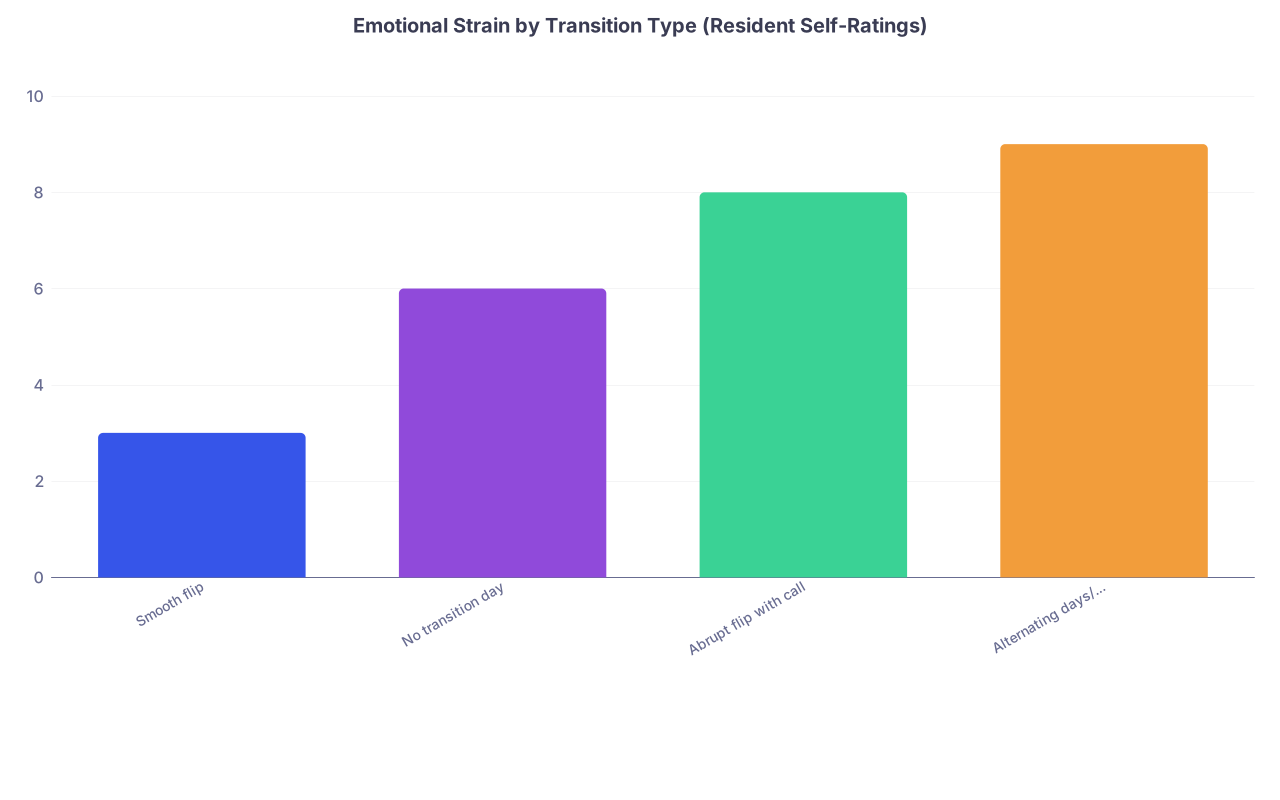
| Category | Value |
|---|---|
| Smooth flip | 3 |
| No transition day | 6 |
| Abrupt flip with call | 8 |
| Alternating days/nights | 9 |
(Scale 1–10: 10 = most emotionally draining; these numbers match exactly what residents describe in wellness surveys.)
How to protect yourself from transition damage
You may not write the schedule, but you are not powerless. This is where most trainees make their first big mistake: they do not advocate early, specifically, and in writing.
Do this:
Audit your upcoming blocks
Pull your schedule and circle every:- Pre‑night day with a long or late shift
- Post‑night day with early mandatory commitments
Request specific fixes, not vague “better”
Do not say: “Nights look rough; can anything be done?”
Say something like:“I am coming off a 28‑hr call Friday and starting night float Sunday. Is it possible to move my Friday call or adjust start to Monday night so I have at least 36–48 hours to shift sleep safely?”
Set your own personal transition rules (and stick to them):
- No social plans the 24 hours before starting nights.
- No critical life decisions in the 48 hours after finishing nights. You are not thinking clearly.
- Protect at least one “anchor” routine (e.g., same workout every pre‑night day at 2 p.m.) so your brain has something stable.
Do not make the mistake of “just pushing through” because seniors did. Some of them are still paying the psychological price for that choice.
Mistake #2: Stacking Emotional Labor Without Relief
Night float is not just a different clock. It is a different kind of work.
At night, you are:
- The one who calls families with bad news.
- The one who signs DNR discussions at 2 a.m.
- The one who watches the chronically ill patient die after weeks of “maybe tomorrow.”
The mistake? Schedulers treat nights as if they are only about patient volume and “sufficient coverage.” They completely ignore emotional load.
So you end up with this:
- Intern on nights cross‑covering 60–80 patients.
- Two or three high‑acuity units under one night senior.
- Repeated codes with no debrief, just “back to work.”
- End‑of‑life conversations back‑to‑back without backup.
That combination is brutal even for a stable, well‑rested person. For someone half‑sleep‑deprived and socially isolated, it is a perfect setup for compassion fatigue, depersonalization, and moral distress.
How emotional overload actually shows up on a night float week
You will not see “emotional overload” as a line item on the census list. You will see:
- You stop feeling anything when a patient dies. You just go, “Okay, paperwork.”
- You resent pages from nurses who are actually appropriately concerned because your tank is empty.
- You start thinking, “If this family asks one more question, I am going to lose it.”
- You avoid rooms where you know hard conversations are waiting.
These are warning signs. Not of you being “burned out and weak,” but of a system that refuses to count emotional labor as real work.

The silent scheduling choices that make it worse
Watch for these patterns:
- You are assigned to nights right after an emotionally heavy rotation (ICU, oncology, palliative) with no buffer.
- You are the “designated goals‑of‑care person” for the team during nights because you are “good at talking to families.”
- You cover both rapid responses and cross‑cover for a huge service with minimal in‑house backup.
- You have no structured debrief spaces, no guaranteed check‑in with an attending, and no pause after a death or code.
That is how you end up carrying ten unprocessed situations at once. And that is exactly how trainees quietly slide into depression or numbness.
How to avoid being crushed by emotional load
First, you stop pretending this is just about “resilience.” It is not.
Then you do the following:
Name emotional work out loud in sign‑out
When accepting a patient, do not just get the medical plan. Ask:- “Any family dynamics I should know about?”
- “Anyone near a big decision or at risk of decompensating emotionally tonight?”
That one question can prevent blindsiding at 2 a.m.
Request redistribution when the emotional load is obviously lopsided
Example email to chief or attending:“I am covering three patients with ongoing end‑of‑life discussions tonight along with the full cross‑cover list. Can we have the day team complete or share some of these conversations, or can another resident help with family updates so that crucial decisions are not all happening overnight with a single resident?”
No, you are not “complaining.” You are safeguarding quality of care and your own sanity.
Build micro‑debriefs into your night routine
This is where many residents make a huge mistake—they try to “power through emotionally” until the end of the block. By then it is too late.Instead:
- After a code or death: 3 minutes with the nurse, RT, or co‑resident. “What just happened? Anything we wish we had done differently? Are you okay?”
- After a terrible family conversation: Step into the stairwell, name what you are feeling (“I am angry / sad / helpless”), take 5 slow breaths, then move.
Protect one regular contact with someone outside the hospital
One text thread, one 10‑minute call, one daily voice message. Non‑negotiable. Night float isolates you; that is when dark thoughts spiral fastest.
Mistake #3: Designing Schedules That Erase Your Life Outside the Hospital
The sneakiest mistake: scheduling night float in a way that convinces you your non‑work life does not matter.
Here is how programs unintentionally do that:
- Random, scattered night blocks: 1 week in July, 1 in September, 1 in November. You cannot plan anything meaningful for months.
- No consistent pattern: Some blocks are 5 nights, some 7, some broken with a random day shift in the middle.
- Weekends sacrificed repeatedly: Friday–Tuesday nights, then Thursday–Monday next time. You are never off with your partner or friends.
- No protected “recovery” day between nights and a major life event like a wedding you begged to attend.
You start to internalize a toxic belief:
“Any attempt to protect my personal life is selfish or unprofessional.”
That is how people stay in unhealthy relationships, avoid starting families, or give up hobbies that once protected their mental health. Not because they lack “time management,” but because the schedule erases any predictable time off.
| Pattern Type | Emotional Red Flag |
|---|---|
| 7 straight nights | Exhaustion but predictable |
| Split 3+4 nights | Prolonged misalignment |
| Alternating day/night | Constant jet lag |
| Scattered single nights | No planning possible |
The ethical problem nobody wants to talk about
You are not just a service unit. You are a person expected to:
- Keep up with learning.
- Maintain empathy.
- Make life‑and‑death decisions.
Doing that while simultaneously undermining your ability to maintain any stable identity outside work is not just “tough.” It borders on unethical.
Work‑life balance is not a luxury add‑on. It is an ethical foundation for safe clinical care.
Common self‑sabotage here
Residents often make things worse in three predictable ways:
Saying yes to every “can you swap into nights?” favor
You gain reputation points short term. You lose sleep, your weekend, and part of your sanity. Chronic pattern.Treating days off as catch‑up for everything
Trying to do:- Groceries
- Deep cleaning
- Seeing family
- Studying
- Life admin
In a single “post‑nights” recovery day. That guarantees you never actually recover.
Waiting until you are desperate to draw boundaries
When you finally say, “I cannot do more nights,” it sounds like crisis, not planning. It is much harder to get support then.
How to protect your actual life when the schedule will not
Concrete moves you can start now:
Create your “non‑negotiables” list
Example:- 1 dinner per week with partner / family (day or night, but scheduled).
- 1 protected block per month for “real rest” (no errands, no hospital).
- 1 personal goal that still moves during nights (language app, small workout, journaling).
Write them down. Then guard them like you guard duty‑hour rules.
Negotiate night blocks strategically, not reactively
Months in advance, tell chiefs:“I can take the early night blocks this year, but I need X weekend in the fall protected for a major family event. I am bringing this up early so we can build it in.”
Early, specific, and framed as collaboration. That gets you much further than last‑minute desperate emails.
Refuse schedule designs that alternate extremes without recovery
If your calendar shows: ICU → Nights → ED without real days off in between, that is not benign. That is asking for breakdowns.You can say:
“I am concerned this sequence (ICU → Nights → ED) does not give adequate chance for recovery and may affect my performance and patient care. Can we look at adjusting one of these blocks?”
Stop tying your self‑worth to how many shifts you “toughed out”
You do not get extra ethical credit for destroying yourself. You do increase your risk of errors, burnout, and resentment. That is not noble. It is avoidable.
A saner way to think about night float
Night float will never be comfortable. Good. Medicine at 3 a.m. should feel serious.
But there is a huge gap between “serious” and “emotionally brutal.” That gap is where smart scheduling, realistic transitions, and respect for emotional labor live.
If you remember nothing else, avoid these three strategic mistakes:
- Allowing chaotic transitions on and off nights as if they are inevitable.
- Accepting emotional overload as just “part of nights” instead of something that should be distributed and debriefed.
- Letting night schedules cancel your life, rather than consciously deciding what you are and are not willing to give up.
You are not weak for needing structure, recovery, and a life outside the hospital. You are responsible for patients who need you thinking straight.

| Step | Description |
|---|---|
| Step 1 | Review Schedule |
| Step 2 | Request adjustment early |
| Step 3 | Plan sleep strategy |
| Step 4 | Plan debrief and support |
| Step 5 | Maintain routines |
| Step 6 | Protect non negotiables |
| Step 7 | Unsafe transitions |
| Step 8 | High emotional load nights |
Open your next rotation calendar today and circle every night block and transition. If you cannot explain how you will protect your sleep, your emotional bandwidth, and one piece of your personal life for each of them, that is your first problem to fix.