
The belief that taking a leave for burnout will end your medical career is wrong—and dangerously so.
You can step away, protect your health, and still have a successful career in medicine. But only if you stop hiding, stop waiting until you completely fall apart, and start making deliberate, documented choices.
Let me walk you through how this actually plays out in real life—not the fear-driven version you hear whispered in call rooms.
1. The Real Question: “Can I Leave… and Come Back?”
You are not really asking, “Can I take a leave of absence?”
You are asking:
- Will my program fire me?
- Will I ever match / get a job / get privileges?
- Will I be labeled “weak,” “a problem resident,” “not resilient”?
Here’s the blunt answer:
A well-planned, medically supported leave of absence for burnout, depression, anxiety, or related issues almost never “ends” a medical career by itself.
What actually ruins careers are:
- Secret spirals: showing up impaired, unsafe, or erratic
- Sudden no-shows, disappearing without process
- Unprofessional behavior tied to untreated burnout
- Dishonesty on applications or to licensing boards
A leave taken early, transparently, and with documentation is not career-ending. It is risk management—for your health and for patient safety.
2. How Leaves of Absence Are Actually Viewed
Forget the myths you hear from the most burned-out attending on the service. Here is how different groups actually think about leaves.
| Stakeholder | Typical Reaction |
|---|---|
| Current program | Concerned about coverage, but legally constrained and often supportive if you are honest and organized |
| Future programs | Curious what happened and whether it is resolved, not automatically rejecting you |
| Licensing boards | Focused on impairment and safety, not punishing people who sought treatment |
| Credentialing bodies | Want to see stability, treatment, and no current impairment |
Program leadership
Program directors think in these terms:
- Is this person safe to work?
- Are they honest with me?
- Is there a plan, or am I going to be surprised repeatedly?
They do not want:
- Residents collapsing mid-ICU month
- Angry families and incident reports
- A remediation mess with no documentation
When you come to them early, with a doctor involved and a clear request, responsible PDs often feel relief: “Good, we can address this before it becomes a disaster.”
Future programs and employers
They will ask a simple question internally:
“Did this person have a problem? Yes. Did they handle it like a professional? Also yes?”
A leave with a clear story—“I was struggling, I stepped back, I got treatment, I returned and performed well”—often lands better than the resident who never took leave but has a trail of professionalism warnings and marginal evaluations.
3. When a Leave for Burnout Makes Sense (and When It’s Avoidable)
You do not need a leave every time you are tired after nights. Residency and practice are hard. But there are red lines.
You should seriously consider a leave or reduced schedule if:
- You’re having persistent thoughts like “I don’t care if I get hurt driving home” or “If I got admitted as a patient, it might be a relief.”
- You dread every single shift and cry between cases or in the bathroom more days than not.
- Your cognitive function is shot: you keep making near-miss errors you never would have made two years ago.
- You’re using substances—benzos, alcohol, stimulants—to “get through the day” or sleep.
- People around you (partner, co-residents, nurses) are saying, “You’re not okay.”
A short vacation will not fix this. A random “mental health day” here and there usually just delays the crash.
On the other hand, you probably do not need a formal leave if:
- You’re exhausted at the end of a brutal month, but you bounce back with a few days off.
- You’re frustrated with specific rotations or attendings, but you’re still functioning, learning, and safe.
- You still have joy and energy in parts of your life outside work.
You’re allowed to be tired. The leave is for when tired turns into impaired or at-risk.
4. How to Ask for a Leave Without Blowing Up Your Life
Here’s the part everyone is scared of. So let’s make it concrete.
Step 1: Get an actual clinician involved
Not a friend. Not Reddit. An actual health professional.
- For students: student health, campus counseling, or an outside therapist/psychiatrist
- For residents/attendings: your own PCP, therapist, or psychiatrist—not someone who supervises you directly
Be honest. Say the word “burnout.” Say “I’m not safe” if that’s true. This is not the time to underplay.
You want:
- A diagnosis if appropriate (depression, anxiety, adjustment disorder, etc.)
- A treatment plan
- Documentation that can support a medical leave
Step 2: Know your policies before you disclose
Look up:
- Your school/residency leave policy (GME office, handbook, or student affairs website)
- Whether mental health/medical leaves are covered under FMLA (often yes for residents in the US)
- Any deadlines related to graduation, promotion, or board eligibility
Then you are not walking in blind.
Step 3: Decide who to tell first
Usually, this order works best:
- Your treating clinician (to confirm that leave is appropriate)
- Student affairs / GME office / HR or equivalent
- Program director or dean’s office leadership
The key: you do not need to overshare details. You need to say:
- You have a health condition affecting your ability to safely perform.
- Your treating clinician recommends leave or accommodations.
- You’re requesting a formal medical leave of absence.
Language you can literally use:
“I’ve been experiencing significant burnout and associated mental health symptoms. I’m under the care of a clinician, and based on their recommendation, I’d like to request a medical leave of absence so I can recover and return safely.”
That’s enough. Details go to your doctor, not your PD.
Step 4: Get it documented, not informal
Do not rely on “take a couple weeks off, we’ll see how you feel.” That’s how people get lost in the system.
Push for a formal status:
- “Medical leave,” “LOA,” or similar in the official record
- Clear start date, planned duration, and conditions for return
- Clarification about pay, benefits, and health insurance
Unclear status creates risk later for licensing forms that ask: “Were you ever removed from duties, restricted, or suspended?”
A clean documented leave is easier to explain than a series of unexplained schedule gaps.
5. The Part Everyone Forgets: Planning Your Return
A leave does not fix burnout by itself. What you do during and after it matters.
During the leave, the goals are:
- Treatment: therapy, medication if needed, sleep restoration, addressing substance use if present
- Stabilization: get back to baseline functioning in your regular life
- Insight: understand what specifically pushed you over the edge (volume, trauma exposure, perfectionism, bullying, lack of boundaries, untreated ADHD, etc.)
Before you return, you need a conversation about:
- Any needed accommodations (phased return, no nights initially, specific types of rotations, protected therapy time)
- A clear plan if symptoms flare again
- Timeline for catching up missed time/requirements
You want to avoid:
- Coming back at 60% capacity into a 150% workload
- Agreeing to “return to full duty” when you and your clinician know that is unrealistic
Some programs will resist accommodations. That’s where having GME/HR and your clinician on your side matters.
6. Will a Leave for Burnout Hurt My Future Applications?
Yes, it will raise questions. No, it is not an automatic rejection.
Here’s what selection committees and licensing boards look for:
- Honesty – Did you lie or omit when directly asked?
- Pattern – Is there a trail of multiple leaves, repeated failures, disruptive behavior?
- Resolution – Did you get treatment? Are you now stable and functioning?
- Recency and severity – Last year with multiple psych hospitalizations vs three years ago with one leave and smooth performance since.
What you say later, in ERAS or job interviews, sounds like this:
“During residency, I experienced significant burnout and depression. I recognized I was not at my best, sought care, and took a medical leave to address it. I engaged in treatment, returned to training, and have since completed my rotations successfully. The experience forced me to build better boundaries and habits, and my evaluations since returning have been strong.”
Clean. Direct. No self-pity. No hiding.
7. Big Ethical Question: Are You Obligated to Take a Leave?
If your burnout has progressed to the point where your judgment, cognition, or reliability is impaired, then yes—you have an ethical obligation to step back.
Not because you’re weak. Because you hold a license (or are in a role) that puts you in front of vulnerable patients who assume you’re safe to treat them.
Ethical principles in medicine are not abstract here:
- Nonmaleficence – Don’t harm patients by working when you’re unsafe.
- Beneficence – Acting in patients’ best interest may mean removing yourself temporarily.
- Professionalism – Owning your limitations before others have to intervene.
There is a big difference between:
- “I’m tired but I can function.”
- “I am so burned out that I forgot to check potassium before giving Lasix. Twice.”
The second situation crosses from personal wellness into patient safety. That is where a leave is not just allowed; it’s the right thing to do.
8. Red Flags That Your Career Is at Risk (and What to Do)
A leave itself does not end your career. But these patterns can:
- Multiple leaves with no clear treatment or ongoing care
- Documented incidents: unprofessional conduct, patient complaints, near-misses related to your condition
- Dishonesty: hiding a dismissal, falsifying dates, omitting required disclosures on licensing forms
- Refusal of recommended treatment combined with ongoing impairment
If any of this is already happening, you need:
- A lawyer familiar with medical education/licensing, if you’re facing discipline
- An independent psychiatrist or psychologist with experience in physician evaluation
- Early contact with your specialty’s wellness or impaired-physician program (yes, they can be scary, but they’re designed to get you safely back to work, not just end you)
Do not wait until the letter says “Non-renewal” or “Termination.”
9. Quick Reality Check: You’re Not the Only One
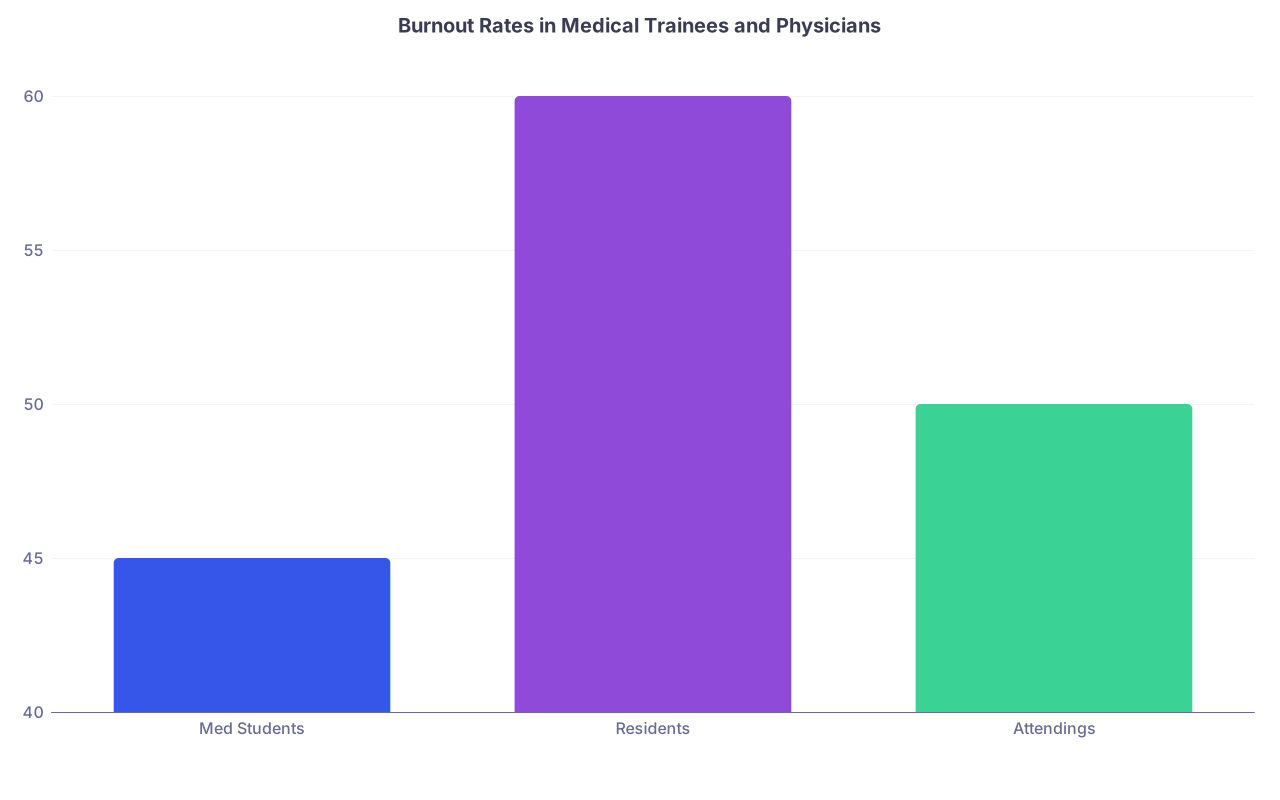
To ground this, here’s the scale of the problem.
| Category | Value |
|---|---|
| Med Students | 45 |
| Residents | 60 |
| Attendings | 50 |
Rough ballpark numbers from multiple studies: nearly half of medical students, most residents, and about half of attendings report significant burnout. Many of them never take leave—but a non-trivial number do.
The people who quietly stepped out for six months, got treatment, then came back? You usually never hear their stories. Because they’re now just your colleagues, functioning normally.
You only hear the extremes: the one who quit completely, or the one who had a spectacular disciplinary crash. That skews your sense of risk.

| Step | Description |
|---|---|
| Step 1 | Feeling burned out |
| Step 2 | Optimize schedule, seek support |
| Step 3 | See clinician urgently |
| Step 4 | Treatment while working with limits |
| Step 5 | Request formal medical leave |
| Step 6 | Document plan and duration |
| Step 7 | Treatment and recovery |
| Step 8 | Plan structured return |
| Step 9 | Resume training or work |
| Step 10 | Impaired or unsafe? |
| Step 11 | Clinician recommends leave? |
FAQ: Leaves of Absence for Burnout (7 Key Questions)
1. Will a leave of absence for burnout automatically show up on my record forever?
It will appear in your training timeline and often on institutional verification forms as a gap or extended training dates. That’s normal. What matters is that it’s clearly labeled as approved medical leave, not as suspension or termination. Most credentialing bodies are used to some gaps.
2. Do I have to tell my program it’s “mental health” or can I just say “medical”?
You’re generally allowed to keep it at “medical” or “health-related” with your program leadership. The detailed diagnosis belongs with your treating clinician and, sometimes, the occupational health or HR office. On licensing forms, answer exactly what’s asked. Do not fabricate, but you rarely need to volunteer more than required.
3. Can my program refuse my request for a medical leave?
They can push back on timing and logistics, but if your clinician supports that you’re not currently fit for full duties, most institutions will grant a medical leave rather than risk patient safety and liability. The details (paid vs unpaid, duration, rotation credit) may vary. If they flatly refuse despite clear safety issues, you may need GME, HR, or legal support.
4. How long is “too long” of a leave before it hurts my career?
There’s no single cutoff, but patterns matter. A 2–6 month leave once in a multi-year training period is common and usually manageable. A year or more out, especially with multiple fragmented returns, will raise more questions—still not a death sentence, but you’ll need a very clear, honest, and stable story of recovery and ongoing functioning.
5. Should I mention the leave in my personal statement or only if asked?
If the leave is obvious in your timeline (extra year, gap), it’s better to briefly address it on your terms rather than hope no one notices. Keep it concise: acknowledge the issue, describe what you did to address it, and emphasize your stable performance since. Do not turn it into a three-page confessional.
6. What if my culture or family thinks taking leave is weakness or failure?
They are not the ones who will be sued, sanctioned, or traumatized if something goes wrong while you’re impaired. Medicine has a toxic hero culture in many places; you do not have to adopt it. Protecting your ability to practice safely for decades matters more than preserving other people’s illusions about “toughing it out.”
7. What is one concrete sign that I should stop debating and seriously pursue a leave?
If you are starting to hope something external—an accident, an illness—will “take the decision out of your hands,” you’re past the stage of minor stress. That’s the point to talk with a clinician immediately and discuss a formal leave. Waiting until you’ve made a major error or had a full breakdown on the ward is not noble. It’s preventable damage.
Open your calendar and your email right now. Identify who you’d contact first if you decided to request a leave—student affairs, GME office, your clinician—and write their name down. Having that one concrete next step ready makes it ten times easier to act before things truly break.