
It’s 9:30 p.m. You just finished another brutal call. Your next therapy appointment is in the morning, and you’re staring at your schedule thinking, “Do I tell my program? Will this hurt me? Or do I just keep it quiet and hope no one notices I keep blocking out this time?”
Here’s the answer you’re looking for:
Most of the time, you should keep your therapy private and treat it like any other personal medical care. You only bring your program into it when there’s a concrete training or patient-safety reason to do so.
Let’s walk through what’s actually smart, what’s risky, and how to decide.
1. The Core Principle: Therapy Is Medical Care, Not a Confession
If you remember nothing else, remember this:
Seeing a therapist is healthcare. Healthcare is private.
You aren’t ethically obligated to tell your program that you:
- See a therapist
- Take an SSRI
- Go to couples counseling
- Have weekly EMDR
You have the same privacy rights as any other patient.
You don’t have to “disclose mental health treatment” the same way you don’t have to tell them about your IUD, your blood pressure meds, or your dermatology biopsies.
The legal and ethical framework backs you up:
- HIPAA protects your treatment details
- Most programs cannot demand full mental health records
- Licensing boards are increasingly restricted from asking sweeping “have you ever had mental health treatment” questions (and many are revising this because they’ve realized it was harmful and likely illegal)
So the default answer:
No, you don’t owe your program info about your therapist.
The real question isn’t “Am I allowed to keep it private?”
It’s: “Are there specific situations where telling them is strategically smart or ethically necessary?”
Let’s answer that.
2. When You Do Not Need to Tell Your Program
I’m going to be blunt: residents and med students massively overshare with programs out of fear and misplaced guilt.
You do not need to disclose your therapist or mental health treatment to your program when:
- You’re stable and functioning in your role
- You’re able to meet patient care and education responsibilities
- You just need time off like anyone else for medical appointments
- Your treatment doesn’t require schedule restructuring beyond normal accommodations
In those cases, you can treat therapy like:
- A dentist appointment
- A primary care visit
- A physical therapy session
You simply say:
“I have a medical appointment every Tuesday at 3 p.m. I need to be blocked during that time.”
You don’t owe them the type of doctor, the diagnosis, or the details. If they push for details beyond what’s necessary to arrange coverage, that’s a red flag.
, Performance Issues, Seeking Support](https://cdn.residencyadvisor.com/images/articles_svg/chart-common-reasons-trainees-consider-disclosing-therap-9492.svg "Common Reasons Trainees Consider Disclosing Therapy")
| Category | Value |
|---|---|
| Scheduling | 60 |
| Fear of Licensing | 45 |
| [Program Culture](https://residencyadvisor.com/resources/work-life-balance/how-do-i-choose-a-program-that-truly-respects-work-life-balance) | 40 |
| Performance Issues | 30 |
| Seeking Support | 25 |
3. When You Should Strongly Consider Disclosing Something
Now, there are situations where keeping absolutely everything private becomes unsafe or unrealistic. Not because you “owe them your story,” but because there are real training and safety implications.
You should consider talking to your program (or at least GME/Student Affairs/Ombuds) if:
Your condition or treatment meaningfully affects your ability to work
- You’re frequently missing work due to panic attacks, severe depression, or med side effects
- You can’t safely take call or handle acute situations right now
- You’re making repeated errors related to fatigue, cognition, or emotional dysregulation
Your therapist/psychiatrist is recommending official accommodations
- Reduced hours or no overnight call temporarily
- A partial leave or full leave of absence
- Protected time for intensive treatment (IOP, DBT program, etc.)
You’re unsafe – to yourself or potentially to patients
- Active suicidal thoughts with plan/intent
- Substance use that could impair your practice
- Episodes of dissociation, mania, or psychosis affecting clinical work
In these cases, the ethical obligation isn’t “tell them you have a therapist.”
It’s: make sure your practice is safe and sustainable, which often means looping in someone in authority to help modify your workload.
And even then, notice the nuance:
You typically share functional limitations, not your full psychiatric history.
Example language:
- “My physician recommends I be off overnight call for 4 weeks while we adjust medications.”
- “I’m undergoing medical treatment that requires a brief leave of absence.”
- “I’m dealing with a health condition that affects my sleep and concentration; my doctor recommends a temporary schedule adjustment.”
That’s often enough.
4. The Licensing And Future-Career Question (What Programs Actually Care About)
The fear in the back of your mind is usually this:
“If I tell my program I’m in therapy, will this wreck my future licensing, credentialing, or fellowship chances?”
Short version:
Licensing boards and hospital credentialing bodies care about current impairment and safety, not whether you’ve ever had therapy.
Trick is, a lot of people don’t believe that because older attendings still repeat outdated horror stories.
Here’s the more accurate, modern picture:
| Entity | Focuses On Ever Had Treatment? | Focuses On Current Impairment? |
|---|---|---|
| State medical boards | Less and less | Yes, primarily |
| Hospitals/credentialing | Rarely | Yes |
| Programs (informally) | Sometimes, in a vague way | Yes, if affecting performance |
What usually triggers problems isn’t:
- “I see a therapist weekly.”
It’s:
- You repeatedly show up impaired, unsafe, or unreliable
- There’s a pattern of unaddressed serious issues that spill into patient care
- There’s a documented event (e.g., intoxication at work, suicidal behavior at work) that forces institutional action
Ironically, getting treatment early and consistently makes you less likely to have one of those career-threatening events.
So hiding therapy because of licensing fears is backward.
The bigger threat to your career is untreated illness, not treatment.
5. How To Decide: A Simple Framework
Here’s the decision tree I’d use if I were in your shoes.
Let me translate that into real language:
- If work is fine → keep it private, schedule like any health visit.
- If you need recurring time blocked but you’re stable → request “medical appointment” time, no diagnosis.
- If your symptoms or treatment meaningfully change how you can work → talk with your therapist/psychiatrist first, then consider limited, focused disclosure.
- If safety or major impairment is on the table → you involve your program or GME, and you do it with your clinician’s help if possible.
6. HOW to Talk About It If You Decide To Share
If you decide to tell someone at your program, don’t overshare. You’re not in a confessional; you’re managing a workplace issue.
Pick the right person:
- Program Director if it directly affects rotations or evaluations
- Associate PD or Chief if you want a softer entry point
- GME office or Student Affairs if you want a slightly more neutral, policy-focused ally
- An Ombuds (if your institution has one) for confidential advice first
Then use this structure:
State the functional issue, not your entire life story.
“I’m dealing with a health condition that’s affecting my sleep and focus. I’m working with a physician and therapist, and we have a treatment plan.”Connect it to your goals as a trainee and physician.
“I want to make sure I’m safe and effective with patients and able to complete training successfully.”State what you’re asking for.
“My doctor recommends a temporary decrease in overnight call for 6 weeks.”
or
“I need to schedule a recurring weekly medical appointment during X time.”Reassure about engagement/compliance.
“I’m in ongoing treatment and following recommendations. This is to support my functioning, not a withdrawal from responsibilities.”
You do not need to say:
- “I’m seeing a therapist because I have PTSD from residency.”
- “I was suicidal last month.”
- “I was hospitalized for depression three years ago, and my parents are worried, and…”
Unless you want to. But that’s your choice, not an obligation.

7. Program Culture: When Sharing Helps Vs. Backfires
Let’s be honest. Programs vary wildly.
Some are genuinely supportive:
- PDs say explicitly: “Get therapy, please. Tell us what you need.”
- Colleagues openly talk about their own treatment
- People who take medical LOAs aren’t quietly blacklisted
Others… talk the wellness talk but don’t walk it. You see:
- Residents labeled “not resilient” if they ask for help
- People who took LOA mysteriously not renewed or quietly discouraged from certain fellowships
- PDs saying things like, “We all have anxiety, you just have to push through.”
You already know which one you’re in.
In a supportive culture, limited, thoughtful disclosure can actually help you:
- You can negotiate realistic accommodations
- You get cover for stepping back before a big crash
- You build a paper trail that you sought help early and acted responsibly
In a toxic or skeptical culture, keep your circle smaller:
- Prioritize outside therapy (not directly tied to the institution if possible)
- Use generic “medical appointment” language
- If you need major changes, talk to GME, ombuds, or legal/union support first before baring your soul to a PD who treats mental health as weakness
8. Privacy Tactics: How To Guard Your Space Without Being Sketchy
If you decide to keep this fully private, do it smartly, not sneakily.
Practical moves:
- Schedule therapy consistently early morning, lunch, or post-call when possible.
- Put “Appt” or “Medical appointment” on shared calendars. Nothing more.
- If ever questioned: “I have an ongoing medical appointment during that time. My condition is stable and I’m under care.” Full stop.
- Don’t give colleagues blow-by-blow narratives of your mental health. Your friends may be peers now, but one may be chief or faculty in two years.
- Use institutional mental health services carefully. Some are truly separate and confidential; others are… less walled off than advertised. Ask specifically: “Who has access to these records?”
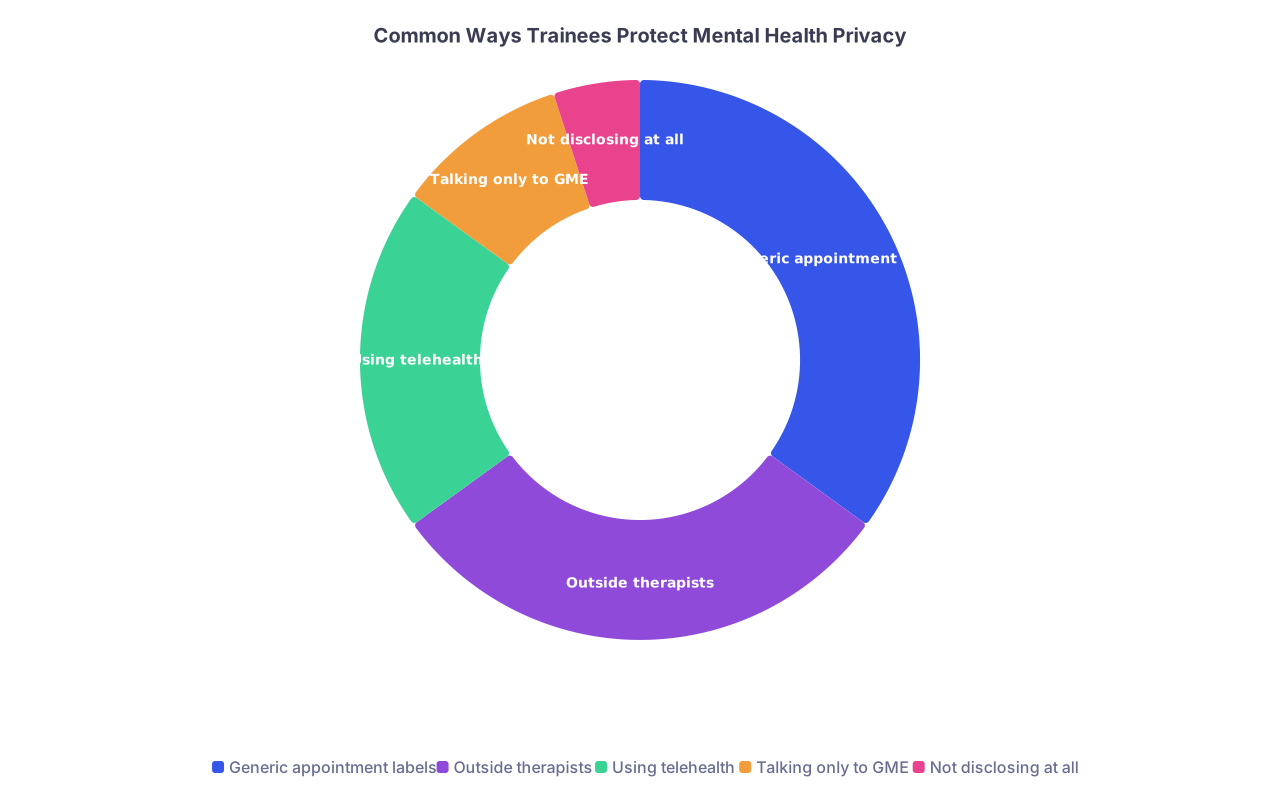
| Category | Value |
|---|---|
| Generic appointment labels | 35 |
| Outside therapists | 30 |
| Using telehealth | 20 |
| Talking only to GME | 10 |
| Not disclosing at all | 5 |
If that feels paranoid, I’ll be blunt: I’ve seen people burned because they overshared in naive trust. Protect yourself first. Compassion is good; blind trust is not.
9. Ethics: Are You Doing Something Wrong by Hiding It?
No. Seeking therapy is an ethical positive, not something to confess.
Your ethical duties are:
- Don’t practice while significantly impaired.
- Get help when you’re struggling.
- Be honest if your condition is actively endangering patients or repeatedly compromising your ability to work.
You can fully meet those duties without ever telling your program the word “therapist.”
If you’re:
- In care
- Honest with your own clinician
- Modifying your workload or taking leave when you truly can’t do the job safely
You’re not “deceiving” anyone. You’re doing exactly what we tell patients to do.

10. Bottom Line: What I’d Actually Do In Your Place
If I were you, here’s my hierarchy:
- Default: Keep therapy private. Schedule it like any other medical appointment.
- If I need ongoing time blocked: Ask for recurring “medical appointment” time. No diagnosis.
- If my functioning is slipping: Talk honestly with my therapist/psychiatrist first. Ask: “Do I need schedule changes or a leave? How do we phrase this?”
- If there’s real impairment/safety concern: Involve GME/PD, with tightly focused disclosure about function and accommodations, not my entire psychiatric chart.
- If my program culture is bad: Use external supports (therapy, legal, union, ombuds) before trusting that disclosure will be used in my best interest.
You don’t need to be a martyr or a hero. You’re allowed to be a physician and a patient.

FAQ: Should I Tell My Program About My Therapist?
1. Can my program force me to disclose whether I’m in therapy?
Generally no. They can address performance and safety issues, but they can’t demand to know your diagnoses or treatment specifics. They can say, “We’re concerned about your reliability/safety,” but they can’t say, “Tell us if you’re in therapy and what meds you’re on.” You always have the right to keep your care private.
2. How do I schedule weekly therapy without telling anyone what it’s for?
Just call it a “medical appointment” or “standing appointment.” Ask for that block the same way you’d ask for a recurring PT or OB visit. If someone tries to pry: “It’s a medical appointment; I’m under active care and stable to work.” You don’t need to explain further.
3. Will therapy show up on background checks or credentialing?
No, not in any normal process. Therapy visits are protected medical information. What can show up are major reportable events (e.g., certain hospitalizations, legal issues, or documented impairment incidents), not the simple fact that you see a therapist.
4. Do I have to tell licensing boards about depression/anxiety or therapy?
Most modern boards are shifting to questions about current impairment, not “have you ever had mental health treatment.” You answer truthfully based on the exact wording. If the question is about current impairment and you’re stable and functioning with treatment, the honest answer is usually “no.” When in doubt, talk to your own doctor, your state physician health program, or legal counsel before you answer.
5. Should I tell my co-residents or classmates I’m in therapy?
Treat it like any other personal medical info. Share with people you trust, recognizing that roles change (today’s co-resident might be tomorrow’s chief). It can be powerful to be open, but you don’t owe anyone that vulnerability. If you’re unsure, start by sharing less, not more.
6. What if my program reacts badly when I ask for mental health–related accommodations?
First, document everything: dates, comments, emails. Second, expand the circle: GME office, Student Affairs, ombuds, union (if you have one), or even an employment lawyer if it’s egregious. There are legal protections for disability and medical conditions, including mental health, and some programs behave better once they realize you actually know your rights.
Key Takeaways:
- Therapy is medical care. Default is: keep it private unless there’s a clear safety or training reason to share.
- When you do disclose, focus on function and accommodations, not your full psychiatric history.
- Untreated illness is far more dangerous to your career (and your life) than getting help.