
The “catch‑up weekend” habit is not a productivity hack. It is a slow, silent way of wrecking your brain and your judgment.
If you are in medicine or training for it, you are especially vulnerable to this trap. You can justify almost any self-abuse in the name of patients, exams, or “being a team player.” I have watched smart, capable people burn out not from 36‑hour calls, but from what they did to themselves on the weekends.
Let me spell out the mistake so there is no confusion.
What the “Catch‑Up Weekend” Pattern Really Looks Like
You already know the story, even if you are still pretending it does not describe you.
- Monday–Friday:
- Clinical work or school from early to late
- Admin, messages, notes bleeding into the evening
- Too tired for real studying, exercise, or meaningful rest
- Quiet promise to yourself: “I will fix it this weekend.”
Then the weekend hits:
- Saturday:
- Sleep in late because you are wrecked
- Try to do all the things: full cleaning, all the email, all the studying, family calls, overdue admin, “self-care”
- End up in a fog of half-finished tasks and guilt
- Sunday:
- Panic about the week ahead
- Smash more tasks into the remaining hours
- Stay up too late “getting on top of it”
Then you start Monday depleted again. Brain fried. Executive function trashed. And you tell yourself the same lie:
“I will use next weekend to really catch up.”
This is not a scheduling problem. It is a pattern problem. And it has predictable consequences.
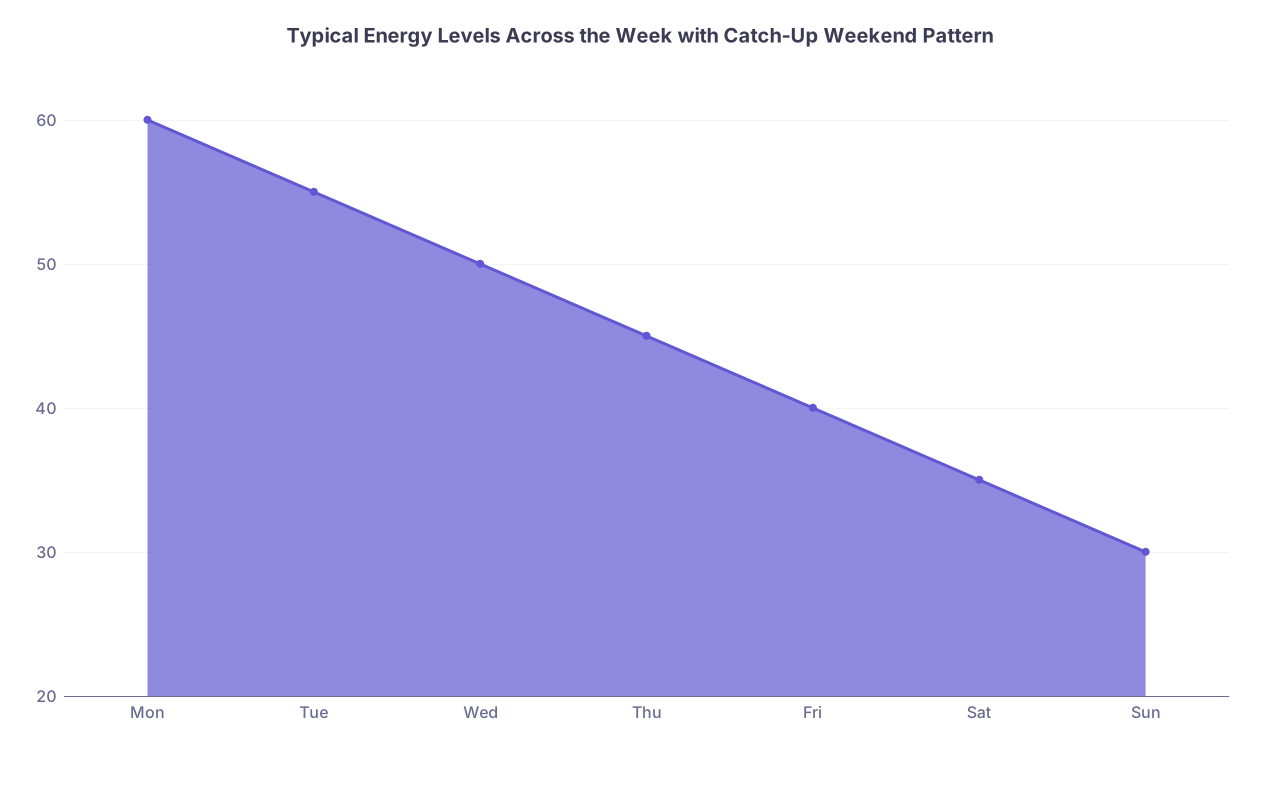
| Category | Value |
|---|---|
| Mon | 60 |
| Tue | 55 |
| Wed | 50 |
| Thu | 45 |
| Fri | 40 |
| Sat | 35 |
| Sun | 30 |
That graph? I have basically watched it play out with residents who insisted they were “fine” right up until they were not.
The Three Hidden Brains You Are Damaging
You do not just have “one brain” here. You have at least three systems that this pattern systematically destroys.
1. The Sleep‑Driven Brain (You Cannot Out‑Weekend Chronic Sleep Debt)
The dumbest part of the catch‑up weekend myth is the sleep fantasy.
“I will run on 4–5 hours nightly during the week and just sleep in on Saturday and Sunday.”
No, you will not. Here is what actually happens:
- You build up sleep debt through the week
- Your cognitive performance and mood slide every day
- By the time the weekend arrives, you:
- Oversleep (which disrupts circadian rhythm)
- Wake up groggy, with “sleep inertia”
- Have less usable productive time than you planned
- Push work later into the night again
And your brain never returns to baseline. Not by Sunday night.
Neurologically:
- Chronic short sleep (even 6 hours) impairs:
- Working memory
- Attention
- Error detection
- Emotional regulation
- These are the exact functions you need:
- To think clearly about patients
- To practice ethically under pressure
- To resist shortcuts when tired
Do not kid yourself. “I catch up on weekends” is the sleep equivalent of saying “I eat well… except for the five days a week when I do not.”
2. The Decision‑Making Brain (Your Ethics Depend on Capacity, Not Intentions)
People love to talk about “being ethical” like it is just about values.
You know what destroys ethical behavior faster than bad values? Exhaustion. Cognitive overload. No decision-making bandwidth left.
On these overloaded weekends, you:
- Push all the “hard” thinking to your lowest-energy time:
- Life planning
- Career decisions
- Difficult emails
- Research planning
- Make rushed, shallow decisions just to clear the list
- Delay anything that feels too complex until “later” (which never comes)
Then on weekdays, when you are already depleted, you are more likely to:
- Cut corners on charting
- Sign notes you barely reviewed
- Accept handoffs you did not truly absorb
- Agree to “small favors” you know you cannot sustain
Not because you are unethical. Because your brain is processing like an overloaded CPU.
Ethical practice depends on:
- Attention
- Foresight
- Self-control
- Emotional regulation
Every hour you steal from your brain’s repair systems on the weekend is another tiny shave off those capacities.
3. The Identity Brain (What You Are Quietly Teaching Yourself)
The catch‑up weekend pattern trains your identity in three toxic ways:
You become someone who is “always behind.”
Rehearsed every single week. The story in your head: “I am never on top of things. I just need one good weekend.” That story kills real improvement because it blames time instead of systems.You erode self-trust.
You promise yourself: “This weekend I will finally…” Then you do not. Over and over. Your brain learns: “My plans are fantasies.” That bleeds into studying, research, and even how you show up for patients.You normalize self-neglect.
You start to believe rest must be fully earned. That you can only relax when the list is at zero. So you… never relax. Because in medicine that list never hits zero.
I have heard versions of the same line from fellows, residents, students:
“I will fix my schedule when rotation X is done.”
But rotation X is always replaced by rotation Y.
You are not waiting for a quiet season. You are living inside a bad pattern.
How This Pattern Wrecks Work‑Life Balance (Hint: You Do Not Actually Have One)
“Work–life balance” sounds like something you do at the level of the month or year.
The reality is simpler and harsher: balance happens at the level of the day. If you destroy your weekends in the name of catching up, you guarantee there is no real balance anywhere.
The Fake Balance Equation
Here is the story people like to tell:
- Weekdays = sacrifice
- Weekends = recovery + catch up
- Net result = “it all evens out”
That looks reasonable. On paper.
But if you actually measure how you spend those weekend hours, it usually looks more like this:
| Activity Type | Planned Hours | Actual Hours |
|---|---|---|
| Sleep / Rest | 10 | 6 |
| Deep Work / Studying | 10 | 4 |
| Admin / Email | 4 | 8 |
| Chores / Errands | 4 | 6 |
| Real Leisure | 6 | 2 |
You walk into Monday not refreshed, not ahead, but more demoralized.
Short version:
If your “rest days” feel like unpaid overtime in your own life, you do not have balance. You have a quiet burnout machine.

The Specific Mistakes That Keep You Stuck Here
Let us name the actual mistakes, because “I am just busy” is too vague to fix.
Mistake 1: Treating Weekends as an Infinite Buffer
You act like the weekend can absorb anything you dump into it:
- Notes you half-finished all week
- Research tasks you procrastinated
- Board review you “could not get to”
- Every personal admin task
So instead of respecting your actual cognitive limits, you create a fantasy weekend with 16 hours of high-quality focus time each day. That time does not exist.
The fix is not “better willpower.” It is acknowledging that:
- Weekend hours are lower quality if you are wrecked
- Recovery is not optional overhead; it is required maintenance
Mistake 2: Loading All the Unpleasant Tasks into Two Days
People shove the hardest, most aversive tasks into the weekend:
- Taxes
- Call scheduling
- Board prep blocks
- Difficult conversations with family
- Financial planning
Result:
- You dread the weekend.
- You associate “off time” with pain.
- So you delay starting. Then stay up late Sunday to “make up for it.” Then blow up your sleep again.
This is how people end up wasting 6 hours doom‑scrolling on Saturday and then trying to brute force 10 hours of work into Sunday.
Mistake 3: Using Guilt as a Primary Motivator
The emotional engine of catch‑up weekends is guilt:
- “I did not do enough this week, so I must suffer now.”
- “I have to earn my rest by being hyper‑productive.”
- “If I am not working, I am falling behind my peers.”
Guilt works like caffeine. Short term boost, long term crash.
In practice:
- You overschedule the weekend to “atone” for the week
- You inevitably fall short
- You feel worse and double down the next weekend
That spiral does not self-correct. You have to break it on purpose.
Mistake 4: Confusing Being “Available” with Being Responsible
This is especially lethal for residents and junior faculty.
You let your weekend be:
- Open to “quick chart messages”
- Open to “just one phone call”
- Open to “small favors” from colleagues
- Open to endless portal messages
You tell yourself this is professional. Responsible. Patient centered.
Then you try to cram your own life into the gaps that remain. There are no gaps left.
Boundary erosion is not just a mental health issue. It is an ethical one. A chronically depleted physician is a clinical risk. Full stop.

| Step | Description |
|---|---|
| Step 1 | Overloaded Week |
| Step 2 | Defer Tasks to Weekend |
| Step 3 | Overscheduled Weekend |
| Step 4 | Poor Sleep and Low Recovery |
| Step 5 | Start Week Depleted |
| Step 6 | Reduced Focus and Capacity |
How to Break the Pattern Without Fantasies or Heroics
You do not need a perfect time‑management system. You need to stop making a few predictable mistakes.
Step 1: Cap the Amount of Work Allowed on Weekends
Yes, cap. Hard limit.
Decide something like:
- Maximum 4–6 hours of focused work per weekend day
- Maximum 2–3 “admin blocks” of 30–60 minutes
- At least one day with zero clinical or academic responsibilities
Then treat that cap as ethically serious:
- Not “I will work until I am done”
- But “I will do the highest‑yield work until this cap, then stop”
This forces you to:
- Prioritize
- Say no
- Stop hiding low‑value tasks in your “free” time
Most people refuse caps because it exposes the real issue: they are over‑committed, not under‑disciplined.
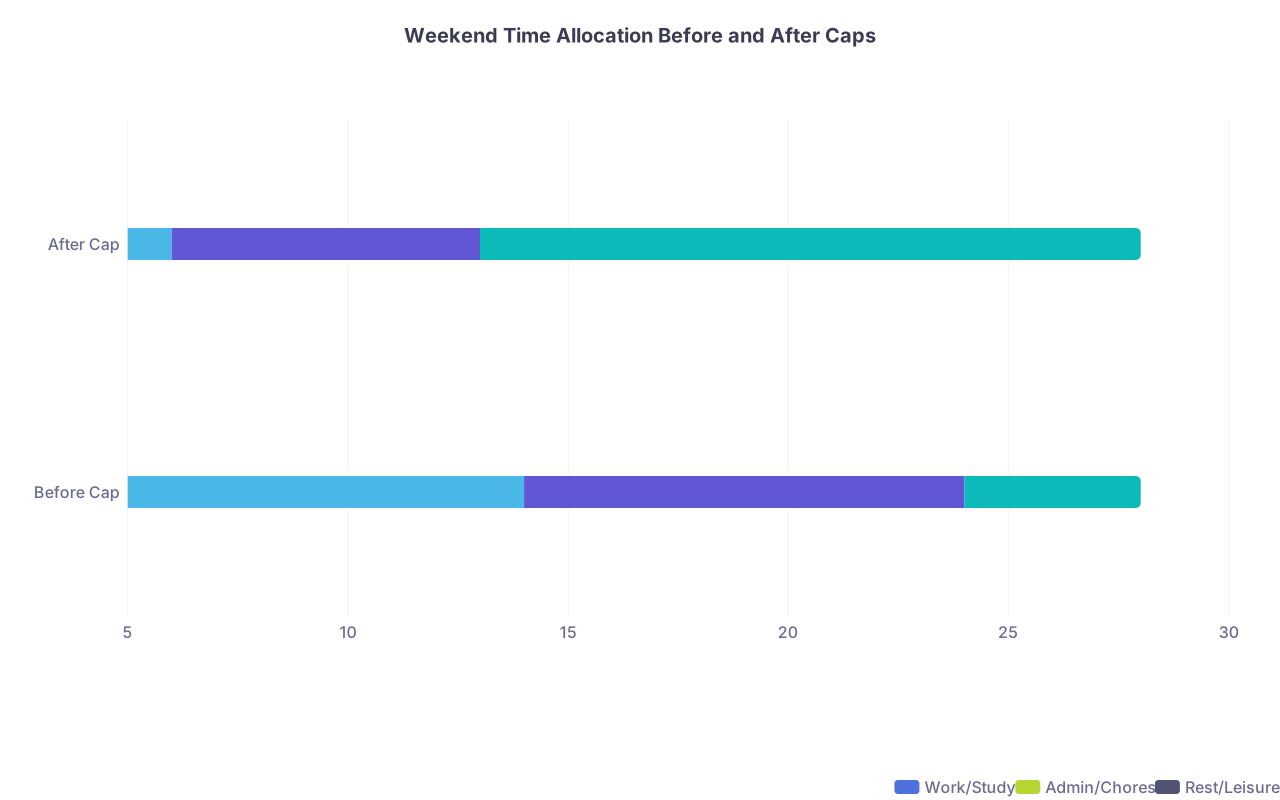
| Category | Work/Study | Admin/Chores | Rest/Leisure |
|---|---|---|---|
| Before Cap | 14 | 10 | 4 |
| After Cap | 6 | 7 | 15 |
Step 2: Move One Chunk of “Weekend Work” Into Each Weekday
You must stop letting your weekdays offload everything.
Pick one category you always shove to weekends:
- Board prep
- Research reading
- Finances
- Life admin
Then:
- Schedule 30–60 minutes for that every weekday
- Protect it like a page in or a case you cannot cancel
- Use a timer; no multitasking, no phone
You are not trying to eliminate weekend work. You are smoothing the brutal peak load that makes weekends unbearable.
Step 3: Design a Non‑Negotiable Recovery Ritual
This is not fluffy “self-care.” This is brain maintenance.
Pick 2–3 things that, when you actually do them, noticeably improve your function:
- 30–45 minutes of movement (walk, gym, yoga)
- 20–30 minutes of truly unstructured time (no phone)
- A social connection that is not about medicine
- Cooking an actual meal instead of default takeout
Put these in the calendar before you add any extra work. If they are not scheduled, they will not happen.
If you feel resistance—“I cannot afford that time”—understand what you are saying: you believe you can safely run a brain that handles human lives with no scheduled maintenance.
That is not work ethic. That is professional negligence toward yourself.

Step 4: Pre‑Decide What “Good Enough” Looks Like
The perfectionist version of you will always insist:
- The weekend list can be longer
- The studying can be more intense
- The apartment can be cleaner
- The inbox can be emptier
You have to define “good enough” in advance, or the weekend will expand to fill your self-loathing.
Examples:
- “If I do 3 focused board review blocks, that is enough studying this weekend.”
- “Notes are caught up if all high‑risk patients are documented, even if low‑complexity ones wait until Monday.”
- “The apartment is acceptable if kitchen and bathroom are done. The rest can slide.”
Ethically, this matters because:
- You are choosing safety‑critical tasks first
- You are not sacrificing your long‑term capacity for short‑term appearance
The Ethical Angle You Probably Do Not Want to Think About
Let us be blunt.
Medicine loves to romanticize self-sacrifice. But there is a difference between working hard and systematically destroying the cognitive and emotional capacity that patients rely on.
When you:
- Show up Monday permanently underslept
- Let your decision‑making degrade
- Numb out on the weekends instead of actually recovering
- Live in a constant state of “I am behind”
You are not just hurting yourself.
You are:
- Increasing your risk of missing subtle clinical changes
- Reducing your capacity for empathy when patients are difficult
- Raising the odds that you cut corners on consent, documentation, or follow‑up
- Making it more likely you will snap at a nurse, a student, or a family member
Ethical behavior is not just about ideals. It is about the physiological conditions under which those ideals can survive.
If you would not let a colleague care for your family member after three straight 20‑hour days, why do you accept a chronically depleted baseline for yourself?