
The most common “coping strategies” in medical school are actually slow-motion self-destruction.
Let me walk you through five of the biggest ones that look normal, even admirable, on the surface—and then quietly wreck your work–life balance, your ethics, and eventually your career.
1. Turning Yourself into a “Machine” (Hyper-Productivity as Identity)
You are not a machine. Stop trying to cope by pretending you are one.
This is the classic M1–M2 mistake: decide you’ll outwork everyone, treat every hour like a productivity contest, and call it “grit.” It works. For a while. Then it chews you up.
Here’s what this looks like in real life:
- Color‑coded Google Calendar, every block from 5:30 a.m. to 11:00 p.m. labeled “productive”
- Gym becomes “flashcard treadmill time”
- Meals are something you “optimize,” not enjoy
- Days off become a source of guilt instead of recovery
You tell yourself it’s temporary. You’ll “rest after boards,” “rest after clerkships,” “rest after interviews.” That promise gets pushed back every few months until you stop believing yourself.
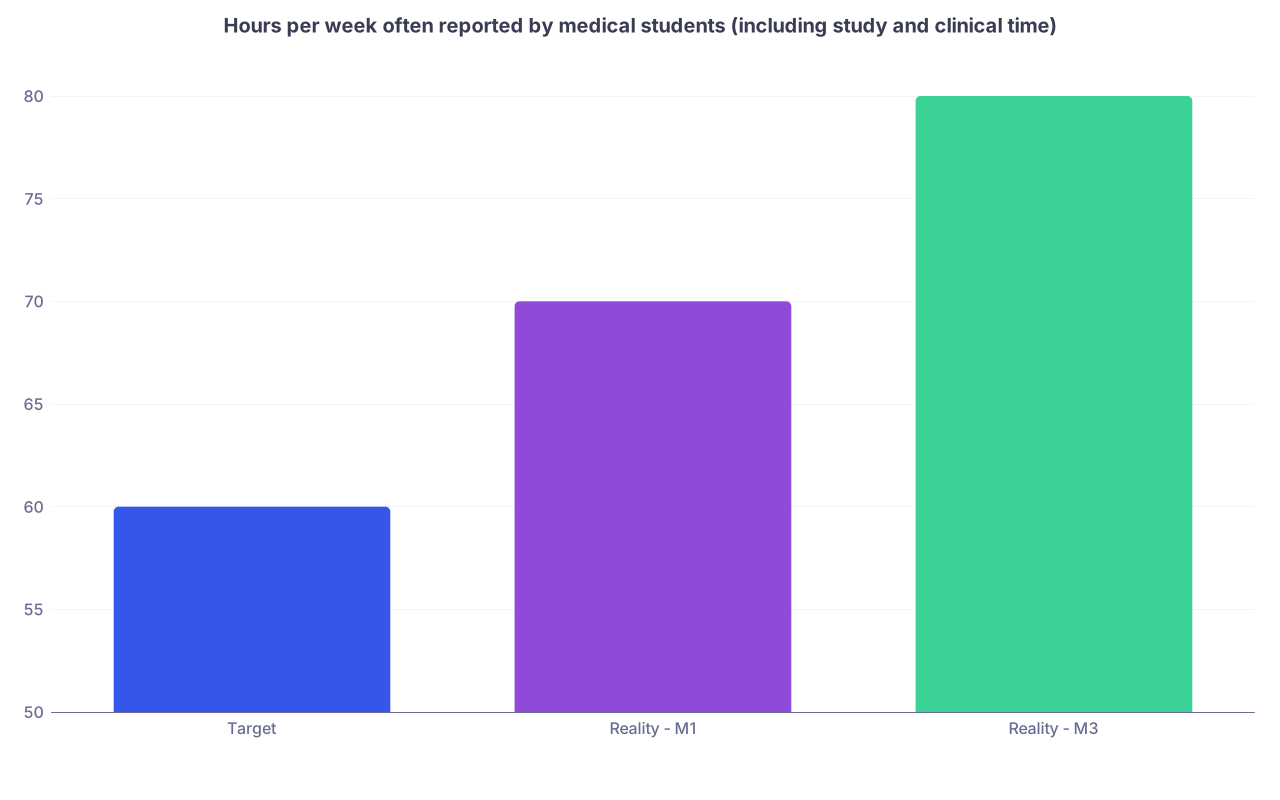
| Category | Value |
|---|---|
| Target | 60 |
| Reality - M1 | 70 |
| Reality - M3 | 80 |
The backfire is brutal:
Your baseline shifts.
What used to be “a big push” becomes your new normal. 10-hour days stop feeling like a lot. Then 12. Then 14. When you hit the clinical years, your body has no higher gear left. You’re already redlining.You flatten your life.
Friends outside medicine drift away. Hobbies die. Anything that doesn’t give you a line on your CV or points on your exam quietly disappears. You become one-dimensional. That feels efficient—until you realize you’ve built a life with no safety net.Your ethics get brittle.
Sleep-deprived, stressed people don’t make great ethical decisions. You start cutting corners:- Signing off notes you did not really review
- Glossing over a patient’s concerns because you “don’t have time”
- Agreeing with something that bothers you because you’re too tired to speak up
I’ve watched good people slide into bad habits simply because they were cooked.
You confuse endurance with virtue.
Working 90 hours one week is sometimes necessary. Needing to do it every week because you cannot say no is not virtuous; it’s a boundary failure.
The worst part? This style of coping shortens your career. The profession is already hard enough. Don’t accelerate your own burnout by worshipping work for its own sake.
Better approach (that doesn’t backfire):
Use intensity in short, deliberate bursts. Build in non-negotiable recovery:
- One real evening fully off per week (no “just a few Anki reviews”)
- Sleep as a hard constraint, not a flexible optional
- One non-medical anchor (instrument, sport, faith community, book club, whatever) that survives exam weeks
If your calendar looks “impressive” but your life feels hollow, that’s not discipline. That’s a warning sign.
2. Numbing Out with “Harmless” Escapes
You already know getting blackout drunk four nights a week is bad. That’s not the sneaky problem.
The sneaky problem is all the numbing that looks socially acceptable or even “needed.”
- Doom-scrolling for 2 hours in bed after “finishing” your day
- Binge-watching a season of something “just this weekend” (every weekend)
- Constant background noise—podcasts, YouTube, whatever—so your brain never has to sit quietly with itself
- Gaming until 2 a.m. because it’s “how you relax”
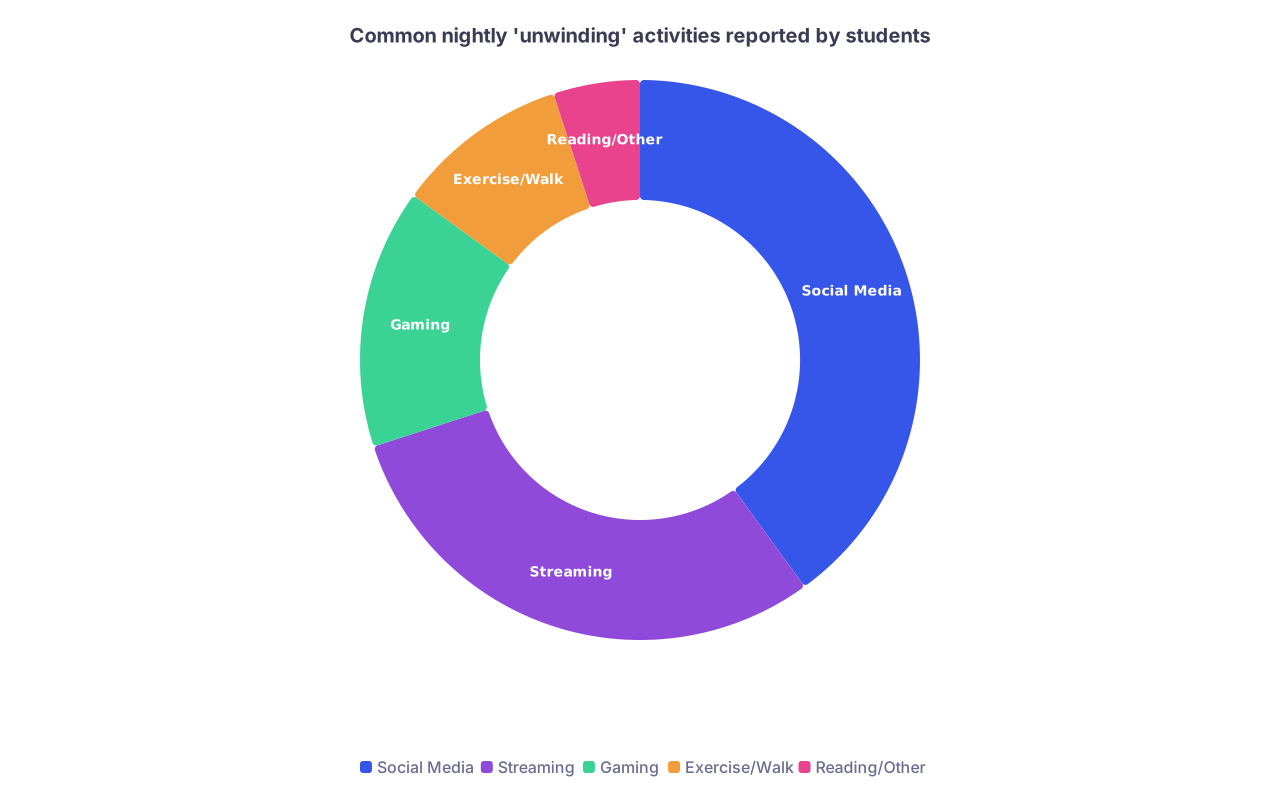
| Category | Value |
|---|---|
| Social Media | 40 |
| Streaming | 30 |
| Gaming | 15 |
| Exercise/Walk | 10 |
| Reading/Other | 5 |
Here’s the backfire that nobody wants to admit:
You’re not resting. You’re avoiding.
Numbing is different from restoring. If you finish a three‑hour Netflix binge and feel both more tired and more anxious, that was not rest. That was sedation.Your sleep quality tanks.
Blue light, constant stimulation, unsettled mind—all terrible for sleep. Then you start dragging through lectures, need more caffeine, feel more stressed, and guess what you “need” to unwind again at night? Same thing that’s making it worse.Your emotional range shrinks.
You get used to avoiding discomfort—loneliness, sadness, fear, uncertainty. That habit leaks into clinical care:- You mentally check out during difficult family meetings
- You avoid asking patients the hard questions because you do not want to hear the answers
- You start seeing patients as “tasks” because feeling the full weight of their stories is intolerable
That’s an ethical problem, not just a wellness issue.
You lose your early warning system.
When you constantly drown out your own thoughts, you stop noticing when you are getting depressed, burned out, or dangerously detached. The first sign becomes something extreme: snapping at a patient, sobbing in a stairwell, or having a near-miss in the OR.
Better approach:
Use comfort activities on purpose, with limits, not as your default state.
Set simple rules like:
- Phone off and away 1 hour before planned bedtime
- Streaming allowed after you’ve planned the next day, not instead of planning
- One “mindless entertainment” block per day, time‑boxed (e.g., 45–60 minutes), not endless scrolling until you pass out
You need real rest: sleep, conversation with someone who knows you, silence, physical movement. Entertainment is fine. Just do not confuse it with healing.
3. Isolating Because “No One Outside Medicine Gets It”
This one feels logical. You’re drowning in content. Your non-med friends complain about their “busy week” of 40 hours and you want to laugh in their faces. So you gradually withdraw:
- Stop going to regular meetups or group activities
- Stop calling old friends because “it takes too much energy to explain”
- Cancel on family repeatedly because “boards” or “call” or “this rotation is insane”
At first, it feels efficient. One fewer thing to manage.
Then it backfires.

Here’s what isolation actually does to you:
It warps your sense of normal.
If everyone you see is also exhausted, also working 70–80 hours, also joking about how they “don’t have feelings anymore,” you start to think that’s just adult life. It’s not. It’s a specific, constrained, and frankly unhealthy phase.Without people outside medicine, you lose perspective on what sustainable looks like.
It makes moral distress worse.
When something ethically troubling happens—a racist comment from an attending, a pressured consent, a rushed discharge—you need people who are not invested in the hierarchy to reality‑check you.Talk only to colleagues and you’ll hear a lot of:
- “Yeah, that’s just how it is.”
- “You can’t rock the boat as a student.”
- “Pick your battles.”
Sometimes that’s wise. Sometimes it’s cowardice disguised as pragmatism. Friends outside the system can help you see the difference.
It increases your vulnerability to burnout and depression.
Loneliness is not just unpleasant; it’s a risk factor. For actual, clinical depression. For suicidal ideation. For substance misuse. I’ve watched people spiral, slowly, and every time they’d already cut themselves off from anyone who truly knew them before med school.It narrows your identity to “future physician.”
That sounds noble. It is not. It’s dangerous. Because if all you are is your role in medicine, any failure, bad eval, low score, or missed honor feels like an attack on you, not your performance.
Better approach:
Protect at least a couple of non-medical relationships like your life depends on them. Because it does.
Some concrete guardrails:
- One standing check‑in (call, video, or in‑person) with a non-med friend or family member every 1–2 weeks
- Don’t cancel on those by default. Treat them like an appointment with a consultant you respect.
- In clinical years, pick one day per month you will not be on service obligations (if possible) and use it to be a human with non-med people
If all your group chats are white coats and scrub caps, you’re playing this on hard mode.
4. Redefining “Professionalism” as Emotional Suppression
This is the quiet killer of empathy.
Somewhere in M3, a lot of students decide that “being professional” means:
- Never crying
- Never showing uncertainty
- Never asking for help
- Always having a dark joke ready when something horrific happens
You see senior residents who seem unshakable. You see attendings throw out gallows humor like confetti. So you copy it.

| Step | Description |
|---|---|
| Step 1 | Exposure to suffering |
| Step 2 | Feel strong emotion |
| Step 3 | Tell self to toughen up |
| Step 4 | Suppress or joke about it |
| Step 5 | Short term relief |
| Step 6 | Emotional numbness |
| Step 7 | Detachment from patients |
| Step 8 | Ethical blind spots |
This works as a short-term shield. It absolutely backfires in the long term:
You lose access to your own moral alarms.
That twisting in your gut when something is wrong? That’s what should make you speak up, take extra time with a patient, or push back on a decision. If you train yourself to mute it, you do not become “resilient.” You become dangerous.You start to dehumanize to cope.
“The appy in 12.”
“The train wreck in 4.”
“The frequent flyer.”These phrases slide out easier when you’re tired. They are early markers of a bigger problem: turning people into puzzles or problems so you don’t have to feel how messed up their situations are. That makes shortcuts easier. It makes dismissing concerns easier. That’s an ethics issue.
Your relationships outside medicine suffer.
You can’t selectively numb. If you deaden your response to suffering all day, don’t be surprised when you get home and feel weirdly blank with your partner or family. You can’t turn your own emotions on and off like a faucet.Eventually, it breaks.
I’ve seen the “I’m fine, this is all fine” wall collapse suddenly. Often around intern year. Cue panic attacks, profound emptiness, or a meltdown that seems to come “out of nowhere.” It wasn’t out of nowhere. It was just deferred.
Better approach:
Redefine professionalism as regulating emotion, not erasing it.
That means:
- You feel the thing. Later, if you can’t right now. After the code. After the round. But you do let it register.
- You talk about cases that bothered you with someone safe: peer, mentor, therapist, chaplain, whoever.
- You allow tears in private. They are not weakness; they’re evidence you’re still human.
Ethically, your emotions are data. They tell you when values are being stepped on. Don’t throw away your best sensor because you want to look untouchable.
5. “I’ll Fix My Life After I Match” (Chronic Deferral of Well‑Being)
This is the most seductive lie in medical training:
“I’ll just push through now, and I’ll sort out my health / relationships / finances / burnout later.”
Later never comes. It just changes names: Step 1, then Step 2, then clerkships, then Sub‑Is, then ERAS, then Match, then intern year, then boards, then early attending.

You think you’re making a smart short-term sacrifice. What you’re really doing is building a habit of self-neglect that becomes your default.
Here’s how this specific strategy blows up:
Your body keeps the score.
That vague plan to “get in shape once things calm down”? Life does not magically get calmer. So:- You gain 15–30 pounds over four years
- Your blood pressure creeps up year after year
- You ignore back pain, headaches, GI issues until they’re chronic
Then you’re counseling patients about lifestyle changes while living on vending machine snacks and four hours of sleep. Try doing that without feeling like a hypocrite.
Your relationships rot in the background.
You tell people, “It’s just this year.” Then it’s two. Then four. Resentment builds. They stop inviting you. Or they stay, but emotionally step back, because they’ve learned you’ll choose work every time.I’ve seen long‑term partners quietly decide to leave years before the breakup actually happens. The decision was made in the 20th cancelled dinner, not the final argument.
Your sense of self erodes.
The longer you postpone what matters to you, the harder it is to remember what that even was. Music? Art? Travel? Activism? Faith? You forget what you used to care about. That’s not “professional growth.” That’s amnesia.It corrupts your ethical compass.
If you can rationalize neglecting yourself for the greater good, it becomes easier to rationalize neglecting patients “for the system”:- “There’s no time to explain, they’ll figure it out.”
- “She probably doesn’t need that follow‑up.”
- “He’s always non-compliant anyway.”
The logic is the same: trade off real, immediate needs in the name of productivity and efficiency.
Better approach:
Assume this is not a sprint. It’s not even a marathon. It’s your entire adulthood.
So:
- Decide on a bare minimum standard for your health: sleep floor, movement floor, nutrition floor. Live above it, always, even in crunch times.
- Decide on a bare minimum standard for relationships: how often you will connect, how you will show up.
- Revisit those standards every 6 months and adjust upward if they’re too low.
You will have seasons of intensity. That’s fine. But if every season is “temporary,” you’re lying to yourself. Build a life that can run indefinitely, not just until the next exam.
Red Flags You’re Already in Trouble
If you see several of these, your coping strategies are backfiring, whether you admit it or not:
| Red Flag Pattern | Healthier Counterpart |
|---|---|
| Studying or working 7 days a week for months | At least 1 real day off every 1–2 weeks |
| Falling asleep with a screen in your hand most nights | Screens off 45–60 minutes before bed |
| No regular contact with friends/family outside medicine | Scheduled non-med check-ins |
| Feeling nothing (or only irritation) with patient stories | Feeling moved and processing later |
| Saying “after this exam/rotation I’ll fix it” for >6 months | Making small changes now, not later |
How to Start Unwinding the Damage (Without Blowing Up Your Grades)
You do not fix this by burning everything down and running off to Bali. You fix it by making small, non-negotiable changes that don’t depend on “when things calm down.”
Three moves that actually work:
Set one protected boundary this month
- Home by a specific time one night per week
- Phone on Do Not Disturb during sleep with only true emergencies allowed through
- No studying during meals once a day
Add one genuine recovery practice
Not numbing. Recovery.- 20-minute walk outside daily, without lectures or podcasts
- 10 minutes of journaling after particularly rough days
- A weekly therapy or counseling session if you’re already showing signs of anxiety/depression
Tell one person the truth
Not the polished version. The real version.- “I’m not okay. I’m exhausted and starting not to care about patients the way I used to.”
- “I feel like my whole personality is disappearing into this.”
- “I’m starting to think about quitting, and that scares me.”
Hiding your struggle is itself a coping strategy—and it backfires hardest of all.
FAQs
1. How do I know if I’m just stressed versus truly burning out?
Stress is situational and fluctuates with workload. You might feel tired and pressured, but you still care, still find moments of meaning, and can recover with rest. Burnout looks like emotional exhaustion, cynicism, and a sense of ineffectiveness that don’t lift even when you have lighter days. If you catch yourself thinking “I don’t care what happens to these patients” or “None of this matters, and I’ll never be good enough anyway,” that’s not normal stress—that’s a red flag you should take seriously and discuss with someone qualified (counseling, mentor, student health).
2. Won’t dialing back these bad coping strategies hurt my performance or chances at a competitive specialty?
It might slightly reduce your raw number of study hours or “always say yes” moments. But those are the same strategies that lead to mistakes, ugly feedback, and actual breakdowns on rotations. Programs do not want a resident who can brute-force Step scores but collapses emotionally or ethically under real responsibility. Sustainable performance beats desperate overextension every time. You’re protecting your long game, not giving up on ambition.
3. What if my environment basically rewards all these bad coping strategies?
Then you’re in the same position as most medical trainees: swimming in a culture that normalizes dysfunction. You won’t fix the system alone, but you are 100% responsible for not letting it erase you. That means quietly resisting where you can: setting your own floors for health and relationships, finding allies who refuse to trade their humanity for prestige, and using institutional resources (student wellness, counseling, ombudspersons) even if others roll their eyes. Culture is powerful, but so is a clear personal line.
Remember:
- Any coping strategy that requires you to become less human—less feeling, less connected, less honest—will backfire.
- Hyper-productivity, numbing, isolation, suppression, and chronic deferral all look like solutions. They’re not.
- Start with one boundary, one recovery habit, and one honest conversation. That’s how you keep both your career and your conscience intact.