
The moment you realize the scroll is killing you
It’s 11:43 p.m. You just finished a brutal call shift, your scrubs smell like chlorhexidine and stress, and you’re finally horizontal. You should sleep. Instead, your thumb opens Instagram before your brain catches up.
First story: co-resident on vacation in Italy—sunset, Aperol, “much needed recharge.”
Second post: classmate from med school just matched derm, “dream specialty, dream city.”
Third: influencer-physician talking about their 6-figure side business and “true work-life balance.”
You glance at your own day: cold cafeteria coffee, three angry families, one patient you’re still worried about, a charting backlog, and a disappointing PD feedback email echoing in your head.
And there it is. That sinking, heavy feeling.
“Everyone else is thriving. I’m behind. I’m failing.”
You are not failing.
But you are falling into a very specific trap that burns doctors out faster than bad call schedules: the social media comparison spiral.
Let me be blunt: if you do not get intentional about how you use social media, it will quietly erode your sense of self, your ethics, and your capacity to care—long before you ever think about quitting medicine.
This isn’t about deleting every app.
It’s about avoiding the comparison habits that almost guarantee burnout.
Mistake #1: Comparing your full life to someone else’s highlight reel
The most common—and most toxic—error: treating curated content like raw data.
You see:
- the fellowship acceptance
- the conference talk
- the vacation
- the “grateful to care for such amazing patients” posts
- the marriage, the baby, the new house
You don’t see:
- the panic attack in the bathroom before rounds
- the program director meeting that went badly
- the missed diagnosis that still wakes them up at 3 a.m.
- the arguments at home about never being present
- the 15 rejected manuscripts before the one they posted
But your brain, especially when exhausted, doesn’t care. It tallies up:
“Derm + vacation + #blessed + happy couple + funded grant = better life than mine.”
Let me be even clearer:
You’re comparing:
- your unfiltered day
- to their edited week
- evaluated by your tired 11:43 p.m. brain.
That’s not self-assessment. That’s self-sabotage.
How this habit fuels burnout
Chronic “not enough” fatigue
You start to believe you’re always behind—academically, financially, socially, even morally (“why am I not more grateful?”). That constant, low-level inadequacy bleeds into clinic, rounds, documentation.Shame instead of growth
Instead of honestly assessing where you want to grow (skills, boundaries, wellness), you just feel vaguely ashamed. Shame rarely leads to healthy change. It usually leads to hiding, overcompensating, or numbing.Warped expectations of what a “good doctor life” looks like
You start thinking being a “successful” physician means: top specialty, photogenic hobbies, nonstop gratitude, no ambivalence about medicine. That’s fantasy. Believing fantasy is real will make your reality feel defective.
What to do instead (today)
Do not trust your 11:43 p.m. brain.
Try this for 48 hours:
Only allow yourself to open any social app after you ask:
“Am I looking to connect—or to compare?”
If the honest answer is “compare,” close it. Not “I’ll just check.” Close.After 5 minutes of scrolling, pause and write (actual words, not mental notes):
- one thing you’re proud of from the last week that is not postable
- one thing you’re still learning that you’re allowed to be bad at right now
If that feels cheesy, good. That means you’re breaking a habit your brain is very attached to.
Mistake #2: Treating others’ timelines as moral benchmarks
Here’s a nasty, quiet shift that happens on social:
A co-resident posts about finishing a big QI project on nights.
A med school friend just submitted a K award.
Another is three years out and already promoted.
You don’t just think, “They’re ahead.”
You start thinking, “I’m lazy. I’m wasting my potential. I’m less committed to medicine.”
This is where comparison stops being annoying and starts corrupting your ethics.
Because instead of asking:
- “What kind of physician do I want to be?”
- “What responsibilities do I actually have to my patients, my family, my health?”
you let Instagram decide that the morally superior doctor is:
- constantly “hustling”
- always productive
- posting about “maximizing impact” even on vacation
So what do you do? You sign up for more. Every. Single. Time.
Extra committees. Extra charts at home. Extra research you don’t care about. Because doing less than the feed feels ethically wrong.
That is how good people burn out. They confuse performative overwork with professional virtue.
The ethical trap behind timelines
This is where your “WORK LIFE BALANCE” actually intersects with medical ethics, whether you realize it or not.
Ethical red flags I see all the time:
- Residents who think saying “no” to an extra project is unprofessional, because everyone online looks endlessly productive.
- Attendings who model self-sacrifice as the only “real” commitment to patients—and post about their all-nighters like battle medals.
- Trainees who interpret needing rest as weakness rather than a condition for safe practice.
Here’s the ugly truth:
A burned-out, resentful, sleep-deprived physician is not more ethical than a rested one with boundaries. They’re just more likely to make mistakes and dehumanize patients.
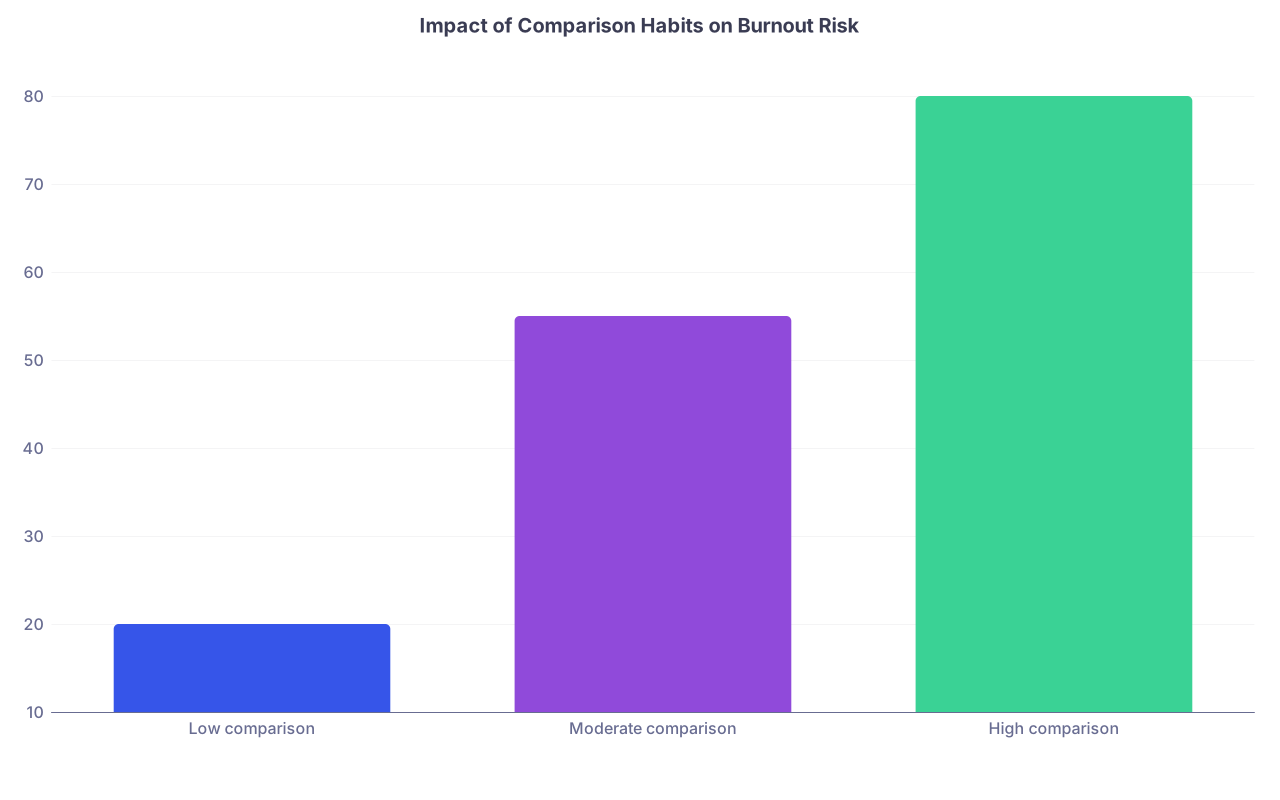
| Category | Value |
|---|---|
| Low comparison | 20 |
| Moderate comparison | 55 |
| High comparison | 80 |
(Think of those numbers as rough relative risk. I’ve watched that pattern repeat every single year in every training program.)
Guardrail to put up now
Write this down somewhere you actually see during the day:
“Their timeline is not my moral benchmark.”
Then, next time you see someone posting a win that triggers you—match, grant, promotion—force yourself to answer these questions before you judge yourself:
- Do I actually want what they have—or do I just not want to feel behind?
- If I had their exact life, would I be willing to carry their tradeoffs? (Call schedule, debt, geography, family strain.)
- Is my current pace sustainable for 3–5 years? If not, why am I trying to speed it up more?
If you cannot answer those without tension, that’s your sign: the problem is not your timeline. It’s your comparison habit.
Mistake #3: Confusing “relatable suffering” content with healthy coping
There’s a particular corner of med Twitter, med TikTok, and Instagram that markets in “relatable” burnout:
- memes about hating every patient
- posts glorifying 28-hour call as a badge of honor
- joke threads about being dead inside
- “haha I haven’t peed in 12 hours” content
- reels about charting until 2 a.m. like it’s just part of the job
Let me be clear: dark humor keeps people alive. I’m not here to police your memes.
The mistake is marinating in that content and calling it coping.
Because while it feels like solidarity, too much of it does three things:
Normalizes dysfunction
You start to believe: “Everyone I respect is this miserable and exhausted. This is medicine.” So you stop questioning systems that are actively harmful to you and your patients.Short-circuits real help-seeking
Why reach out for therapy, mentorship, schedule changes, or accommodations when your entire feed says, “We’re all drowning, haha”? Suffering feels like a membership requirement, not a signal to intervene.Dehumanizes patients and yourself
When the joke is always about how awful your patients are, how stupid consults are, how “annoying” any non-urgent page is—you chip away at your own empathic reflex. That shows up one day when a real human being needs a little more patience than you have left.
The subtle ethical slide
When you spend hours consuming content that makes cynicism look cool, you lower your own bar for:
- how you talk about patients
- how you justify cutting corners
- how you rationalize not addressing your own impairment
That’s an ethics issue, not just a vibes problem.
Ask yourself—if a patient sat next to you and watched your favorite med meme account for 20 minutes straight, would you be completely comfortable? Or a med student looking up to you? If the answer is no, something is off.
Mistake #4: Measuring your worth in likes, followers, or “reach”
The dopamine loop is real and it’s vicious.
You post something:
- a proud moment with your team (de-identified, hopefully)
- a conference talk
- a post about burnout and vulnerability
- or even educational content
Then you check:
- Who liked it?
- Did that attending you admire see it?
- Did this post get fewer likes than my last one?
Pretty soon, the numbers become a crude proxy for professional worth. Or moral worth. Or both.
You start asking:
- “Should I post more of what gets attention?”
- “Should I talk more about burnout if that’s what gets shares?”
- “Should I make my life look a little more… polished?”
This is where people start bending their real life around content instead of around patients, values, and actual needs.
And yes, I’ve watched careers go sideways because someone built a “brand” that was burning them out—and then felt trapped by their own audience.
Why this guarantees burnout
- You’re outsourcing your self-respect to a fluctuating algorithm.
- You’re training your brain to see every experience—good or bad—as potential content.
- You’re reinforcing the belief that if something isn’t seen, it doesn’t matter.
That last one is deadly in medicine. Because most of what actually makes you a good physician is invisible. To everyone but the people in the room.
Hard boundary that will save you
Pick one:
- You can use social media as a tool for education, networking, or limited advocacy.
- Or you can use it as your main source of validation.
You cannot do both and stay sane.
If you already feel the pull, try this 2-week rule:
- No checking likes, shares, or follower counts for at least 24 hours after posting.
- No deleting posts that “underperform” unless there is an actual ethical or privacy issue.
Watch how much psychological space that alone frees up.
Mistake #5: Letting social media quietly rewrite your values
This one is sneaky.
Over time, without ever sitting down and deciding, you start to absorb:
- what counts as “success”
- what careers are “prestigious” or “settling”
- which specialties are desirable
- how many side hustles you “should” have
- what a “balanced” life looks like (spoiler: someone else’s version)
If your entire feed is:
- entrepreneurs
- productivity gurus
- hyper-academic superstars
- “lifestyle medicine” doctors with perfect kitchens and yoga practices
you’ll start to feel like choosing a lower-paying specialty you enjoy, or a 0.8 FTE job for family, or staying in a smaller city is some kind of failure.
Ethically, that’s a problem. Because your values are what should guide:
- which patients you advocate for
- where you choose to practice
- what tradeoffs you accept with your time, money, and health
When Instagram quietly replaces your values with its own currency (status, aesthetics, virality), you will start making decisions that are misaligned with who you actually are.
That misalignment—living a life that looks right but feels wrong—is textbook burnout material.
Quick alignment check
Do this on paper, not in your head.
- Write down your top 5 values as a human (not as a “future cardiologist,” not as “PGY-2”)—things like: family, autonomy, stability, service, learning, faith, creativity, justice, etc.
- Then write down the top 5 things that get you the most praise/likes/attention online or from colleagues.
- Compare the lists.
If there’s heavy overlap, good. Protect that.
If there’s almost no overlap, that’s your warning siren.
You’re building a life and career around something other than your own ethics. You will pay for that later, in ways you can’t fully imagine yet.
Mistake #6: Ignoring the simple math of time and attention
You only have 24 hours. Residency, fellowship, or attending life doesn’t care about your screen time.
If you’re spending:
- 2 hours a day scrolling (which is extremely common)
- that’s 14 hours a week
- ~60 hours a month
- 700+ hours a year
That’s basically a whole additional month of full-time work per year. Given to a tiny screen.
| Daily Scrolling | Weekly Hours | Yearly Hours | Approx. Days Lost |
|---|---|---|---|
| 30 minutes | 3.5 | 182 | ~7.5 days |
| 1 hour | 7 | 364 | ~15 days |
| 2 hours | 14 | 728 | ~30 days |
| 3 hours | 21 | 1092 | ~45 days |
You cannot say you have no time to:
- sleep
- see a therapist
- meal prep
- call your family
- exercise
- reflect on hard cases
- read actually useful material
and then casually donate a month of your year to doomscrolling content that makes you feel worse about yourself.
Does that sound harsh? Good. Because burnout creeps in exactly where you insist you “don’t have a choice.”
You often do have a choice—or at least more of one than you’re admitting.
Mistake #7: Letting “med influencer culture” distort professionalism and ethics
One more trap you should not ignore: watching physicians and trainees build massive platforms and then assuming what they do is the new normal.
You see:
- people sharing highly specific patient stories (sometimes too specific)
- glamour shots in the OR or ICU
- selfies with patients, even “with consent,” that feel suspiciously performative
- aggressive hot takes on colleagues or institutions
- sponsored content that blurs the line between education and advertising
If you consume enough of that, your internal alarm system dulls. You get used to seeing:
- protected health information handled casually
- medical authority used to sell products
- professionalism reputations traded for engagement
And you start to think, “Well, everyone does it.”
No. Everyone does not do it.
But enough people do it loudly that it can warp your instinct for what’s ethically clean.
Here’s the unsexy reality: a lot of that content is walking a tightrope. Some of it falls straight into violation. Boards, hospitals, and patients are catching up, slowly but surely.
If you copy that behavior—even in smaller ways—without hard boundaries, you’re not just risking burnout. You’re risking your license.
A saner way to use social media without letting it own you
Deleting everything forever is not realistic for most people. Nor is it necessary.
What is necessary is refusing to be passive.
Use structure, not vibes. A few options that actually work:
1. Clear “job description” for each app
Write one sentence per platform you use:
- “I use Instagram only to keep in touch with close friends and family.”
- “I use Twitter/X only for following 10–15 people whose content helps my clinical education.”
- “I use LinkedIn only to track my CV and connect with mentors.”
If you can’t write a clean sentence, you’re using the app as a default time-filler—and you’re more vulnerable to all the traps above.
2. Hard limits around vulnerable times
Set app limits or use downtime features. Non-negotiable:
- No scrolling in bed. (That’s where comparison hits hardest.)
- No scrolling between patients or in front of patients’ rooms. Yes, I know everyone does it. It chips away at your presence more than you think.
- No scrolling right after major bad outcomes—codes, complaints, serious errors. That’s when shame+comparison is most likely to spiral.
3. Curate aggressively
Mute or unfollow accounts that reliably trigger:
- inadequacy
- resentment
- ethical discomfort
- “I should be doing more” without any productive call to action
Follow accounts that reliably provoke:
- grounded education
- humane discussions of error and growth
- realistic depictions of mixed feelings about medicine
- humor that doesn’t depend on cruelty toward patients or colleagues
Your next step today
Do this right now. Not “later when I have time.” Now.
- Open the social app you use most.
- Scroll for 60 seconds and notice your body. Tension? Heaviness? Jittery FOMO? Name it.
- In that same 60 seconds, unfollow or mute five accounts:
- anyone whose content reliably makes you feel behind, lesser, or ethically uneasy
- any med meme account that leaves you more numb than relieved
That’s it. Five taps.
Then, close the app.
Open your calendar and block one 30-minute slot this week labeled: “Values check (off social).”
That 30 minutes will do more for your work–life balance, your personal development, and your ethics than another 3 hours of pretending your burnout is just “part of the job.”
Do not let a feed you did not design quietly decide what kind of doctor—and what kind of human—you become.