
More hours do not make you a better doctor. Past a point, they make you a worse and more dangerous one.
That clashes hard with the mythology of medicine. The “I worked 120‑hour weeks and it made me who I am” crowd. The martyrdom Olympics at sign‑out. The pride in never sitting down, never eating, never peeing.
Let’s pull that apart with actual data instead of war stories.
The Origin Myth: Suffering = Competence
The belief is simple: the more hours you grind, the more patients you see, the more you learn. Long shifts “toughen you up,” build “stamina,” and create “real doctors.” If 60 hours a week is good, 80 must be better. Right?
This idea is medicine’s favorite ghost story. It gets passed down by exhausted attendings who were abused by their attendings. You hear variations constantly:
- “You’re not really learning until it hurts.”
- “Shorter shifts create soft residents.”
- “You only become a real doctor at hour 28 of call.”
There’s just one problem: when people actually studied this, the outcomes did not match the mythology.
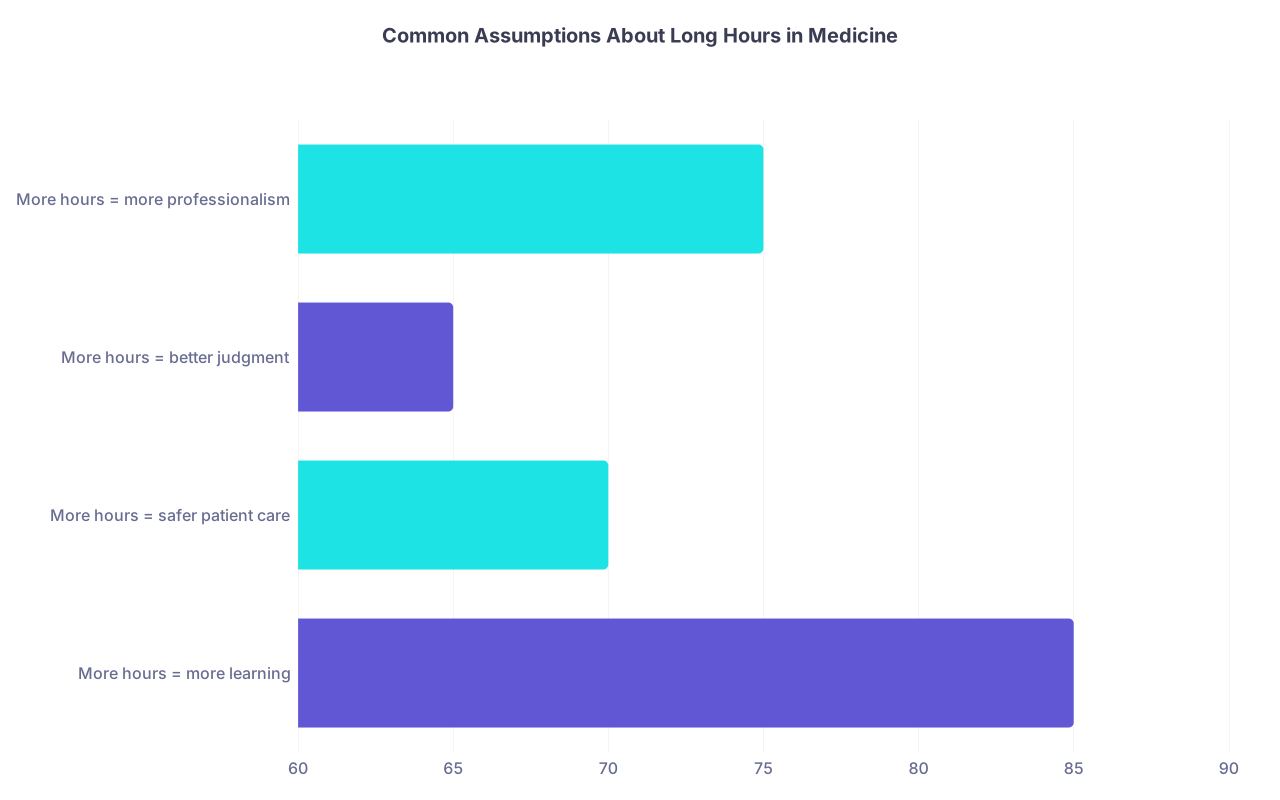
| Category | Value |
|---|---|
| More hours = more learning | 85 |
| More hours = safer patient care | 70 |
| More hours = better judgment | 65 |
| More hours = more professionalism | 75 |
Those numbers could easily be pulled from a hallway survey of attendings and residents who’ve never looked at a single trial on duty hours. Let’s move from vibes to evidence.
What The Big Studies Actually Show
People have not just argued about this. They’ve randomized it.
Duty hour restrictions: ACGME vs “old school”
The ACGME 80‑hour work week and later 16‑hour cap for interns were not invented by “lazy Gen Z.” They came after high‑profile disasters and data showing fatigue‑related errors. Then came the natural question: do shorter shifts hurt training?
Enter the classic resident work hours studies:
Landrigan et al., NEJM 2004: Interns on traditional schedules (up to 30+ hour shifts,
85 hours/week) vs. schedules with shorter shifts (65 hours/week).- Extended shifts were associated with 36% more serious medical errors and 5.6x more serious diagnostic errors.
- There was no miracle “second wind” at 2 a.m. Just more mistakes.
Barger et al., NEJM 2005: Large survey of interns.
- Extended shifts (24+ hours) were linked to 2.3x more motor vehicle crashes after call and more needlestick injuries and near‑misses.
- Translation: you are literally unsafe to yourself and others at the wheel and at the bedside.
Then we get to the more controversial ones:
FIRST trial (surgery, NEJM 2016): Flexible duty hours (allowing longer shifts, fewer restrictions) vs standard ACGME rules.
- No difference in mortality or serious complications.
- Residents in flexible programs didn’t magically become more skilled. They just got more tired and slightly less satisfied with their time off.
iCOMPARE (internal medicine, NEJM 2019): Flexible (longer possible shifts) vs standard duty hours.
- No difference in patient mortality, readmissions, or safety indicators.
- Residents in flexible programs slept less on average and had worse subjective fatigue. Learning outcomes on standardized exams? No meaningful advantage.
So no, longer hours didn’t produce clearly “better” doctors. They produced equally competent doctors with less sleep and similar board scores, while earlier work showed more errors with severe fatigue.
That’s the part attendings often leave out when reminiscing about 36‑hour call.
Learning Isn’t Linear: What Fatigue Does to Your Brain
The core myth is linearity: “If I work 100 hours, I’ll learn twice as much as if I work 50.”
That’s not how human cognition works.
Cognitive performance vs hours worked looks a lot more like a curve that rises, plateaus, then falls off a cliff.
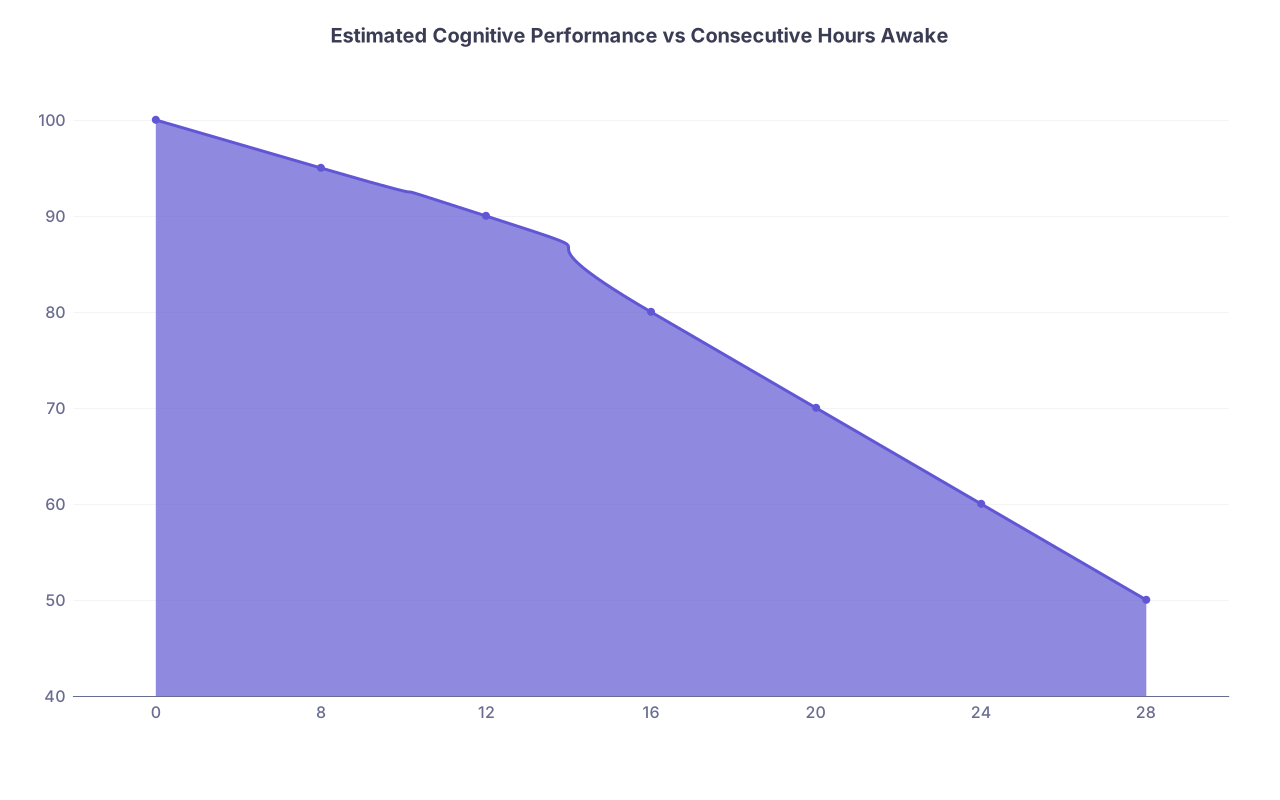
| Category | Value |
|---|---|
| 0 | 100 |
| 8 | 95 |
| 12 | 90 |
| 16 | 80 |
| 20 | 70 |
| 24 | 60 |
| 28 | 50 |
By ~16–18 hours awake, performance on psychomotor and vigilance tasks looks like someone with a blood alcohol level around 0.05–0.1. Try telling a drunk surgeon they’re “building character” by staying in the OR.
Look at what fatigue actually affects:
- Working memory: You forget things more. That’s not “learning by immersion.” That’s “I can’t remember if I held the meds this morning.”
- Attention: You miss small but critical changes. Like a new fever or a subtle rhythm strip change at 3 a.m.
- Risk assessment: Fatigued people become worse at judging risk. Either overly conservative or bizarrely reckless.
- Encoding of long‑term memory: The stuff you “see” when exhausted doesn’t get consolidated well. You remember the suffering, not the pathophysiology.
So yes, maybe you “saw more” at hour 27. But what you actually learned from hour 27 is often negligible and sometimes wrong.
I’ve watched interns proudly talk about “crushing” a brutal call, then two days later misremember major details of the patients from that night. Their brains simply didn’t print the file.
The Productivity Illusion: Busy ≠ Better
Another persistent belief: long hours mean you get more done, see more patients, and therefore must become more efficient.
Reality: there’s a huge productivity illusion with overwork.
You feel like you’re doing more because you’re there more. But per hour, you’re slower, sloppier, and more redundant. You re‑check things, re‑write notes, re‑explain plans. Fatigue taxes everything.
This shows up in multiple ways:
- Handoffs bloat because no one can remember what’s actually important.
- Orders get double‑entered or mis‑clicked, requiring correction.
- Notes balloon with copy‑pasted junk because generating concise impressions takes real cognitive effort.
A rested resident doing a focused 10‑hour day with clear goals often learns more and produces better care than the same resident dragging through hour 28 of a “heroic” call where they’re just trying not to crash.
You’ll see this yourself if you compare how fast you can pre‑round, synthesize, and staff on a good sleep vs post‑call. It’s not subtle.
“But You Need Long Hours to See Enough Pathology”
This is the last semi‑rational defense: you need volume. And volume takes time.
True: you don’t become a competent physician seeing three patients a day and heading home at noon. Medicine is complex; you have to accumulate reps. The question isn’t whether you need reps. It’s where the curve flattens and then reverses.
What the data and common sense both say:
- Going from 20 to 50 hours a week? Massive gain in exposure and learning.
- Going from 50 to 70? Smaller gain, still something.
- Going from 70 to 100? Now you’re trading quality for quantity. You see more patients, but you process them worse.
There’s no convincing evidence that 90‑hour weeks produce more competent doctors than 60‑70 hour weeks in the long run. There is evidence that extreme overwork produces more depression, burnout, and attrition.
Burned‑out residents do not magically transform into better attendings. They either leave, disengage, or carry their trauma into how they teach the next generation. You’ve probably already met some of them.
Ethical Reality: Fatigue is a Patient Safety Issue, Not a Personal Failing
Here’s where medical ethics has been bizarrely slow.
We obsess about tiny relative risks in treatments. We adjust vancomycin by trough levels. We agonize over a 0.5% risk of some rare complication. But we’ll cheerfully endorse a system that makes residents function at the cognitive equivalent of being drunk on a regular basis.
That’s not “professionalism.” That’s ethically lazy.
We already accept some limits:
- Pilots have strict duty and rest rules for a reason.
- Truck drivers have tachographs and regulated maximum hours.
Medicine keeps pretending it’s special. As if human neurobiology takes a holiday when you put on a white coat.
From an ethical standpoint, overworking trainees isn’t just “tough love.” It violates basic principles of non‑maleficence and respect for persons. You are both caregiver and human. You’re not moral furniture to be used until it breaks.
And no, saying “Well, I did it and I’m fine” is not data. It’s survivor bias. You’re only hearing from the ones who stayed.
The Culture Problem: Why This Myth Won’t Die
If the evidence is this lopsided, why does the “more hours = better docs” story hang on?
Because it serves powerful psychological and institutional purposes.
Identity and hazing
People who were abused rarely enjoy admitting it. It’s more tolerable to say, “That suffering made me strong” than to say, “That was unnecessary and dangerous.”
So the abuse becomes a badge of honor. A way to separate “real doctors” from the supposedly softer new generations.Cheap labor
Long hours mean more FTE work squeezed out of the same number of residents. That’s not an accident. It’s a financial structure. Cutting hours means someone else has to pick up the slack—often at real cost.Control
It’s easier to control and social‑engineer a workforce that’s always exhausted and on the back foot. Less time to question, organize, or push back.
None of those have anything to do with evidence‑based education or patient outcomes.
What Actually Makes You a Better Doctor
Here’s the unsexy truth: becoming good is not about how many hours you can be physically present. It’s about how effectively you can think and adapt in the hours you’re awake.
The traits you actually want:
- Enough volume to see patterns and exceptions.
- Enough rest to consolidate what you saw.
- Enough bandwidth to read, reflect, and ask good questions.
- Enough psychological safety to admit what you don’t know and get corrected before it hurts someone.
You know what reliably correlates with better care and better learning?
Not “hardcore” 30‑hour calls. But:
- Strong supervision and accessible attendings.
- Structured feedback and case review.
- Protected time for teaching that isn’t stolen by scut.
- A culture that encourages asking for help early instead of waiting until 3 a.m. when everything is on fire.
Shorter but focused, well‑supervised shifts with explicit learning goals beat endless zombie call nights every time.
So What Do You Do With This as a Trainee?
You’re not going to personally rewrite the ACGME rules. But you’re not powerless either.
A few pragmatic points:
- Stop equating self‑harm with dedication. Leaving on time when your work is done is not laziness. It’s normal.
- Learn to distinguish real learning from performative suffering. Staying two extra hours to go through a complex case with your attending? Worth it. Staying two extra hours to rewrite the same note three times because your brain is fried? Useless.
- Call fatigue what it is: a safety risk. If you’re dangerously out of it, you speak up. Not because you’re “weak,” but because you’re responsible.
- Protect sleep ruthlessly when you can. This is not “wellness talk.” This is protecting your diagnostic accuracy.
And when you get to the teaching side, resist the urge to romanticize your own misery. You’re allowed to say, “We were overworked and it was bad for us and for patients. You deserve better.”
The Bottom Line
The mythology is simple. Reality is not.
But the core facts are pretty clear:
- Beyond a moderate threshold, more hours make you a worse, not better, doctor—with higher error rates, worse cognition, and no proven learning advantage.
- Extremely long shifts are not just a “rite of passage”; they are an ethical and safety problem, closer to letting a drunk pilot fly a plane than to noble professional sacrifice.
- What actually builds great physicians is not maximal suffering, but smart exposure, real rest, and high‑quality teaching—all of which long‑hour culture quietly undermines.
You do not become a better doctor by being awake longer. You become a better doctor by being fully awake for the hours that actually matter.