
“I’m fine” is the biggest lie in residency—and attendings know it.
Let me tell you what actually happens behind closed doors when you keep saying it.
Program directors and chiefs have watched too many residents quietly fall apart after months of “I’m fine.” Suicides. Divorces. Impaired physicians. Disciplinary boards. Burnout so bad someone disappears mid-year and never comes back. Those cases leave scars on leadership. They remember the exact conversations where the resident smiled and said, “No really, I’m okay.”
So now, when you say, “I’m fine,” and your behavior, affect, or performance don’t match that statement, that’s not reassuring. That’s a warning sign.
Not because they think you’re weak. Because they know you’re lying—to them, but more importantly, to yourself.
Let me walk you through what they’re actually thinking.
What PDs and Chiefs See That You Don’t

You experience your life as a day-to-day grind. They see the pattern across dozens of residents over years. That changes how they interpret “I’m fine.”
There are certain combinations that, to you, feel like “I’m just tired” but to them scream “this person is at risk”:
- A normally punctual resident starts coming in right on time or a few minutes late, not catastrophically late—just not early anymore.
- Your notes are still done, but sloppier: a few more typos, a couple of near-misses the attending has to catch.
- You stop showing up to optional education, but you’re technically “meeting requirements.”
- You used to crack dry jokes on rounds; now you’re quiet or overly agreeable.
- Nursing starts sending little FYIs: “Dr. X seems really overwhelmed this week” or “Just wanted you to know he’s been short with staff.”
Then your PD or chief asks, “How are you doing?” and you hit them with: “I’m fine. Just tired. Totally manageable.”
They do not hear reassurance. They hear, “I don’t feel safe telling you the truth,” or “I don’t even recognize I’m not fine,” or “I’m still in denial.”
Because here’s the part nobody tells you as an intern: PDs and chiefs are graded on your outcomes. Your wellness, your professionalism, your safety to practice. They’re on the hook if you crash.
They’ve gone through:
- Root cause analyses after a resident-involved error where fatigue and distress were “known but not addressed.”
- Late-night calls from the ED, “One of your residents is here, intoxicated, saying they can’t do this anymore.”
- Family meetings where a spouse says, “We told him to get help; he said he was fine.”
So when you say “I’m fine” with dark circles, flat affect, and shaky notes, it doesn’t calm anyone down. It tells them they may need to step in before you become the next case review.
The Unspoken Equation: “I’m Fine” + Behavior = Risk
Let me spell out the mental math that’s happening in their heads. They won’t say this to your face, but this is how they think.
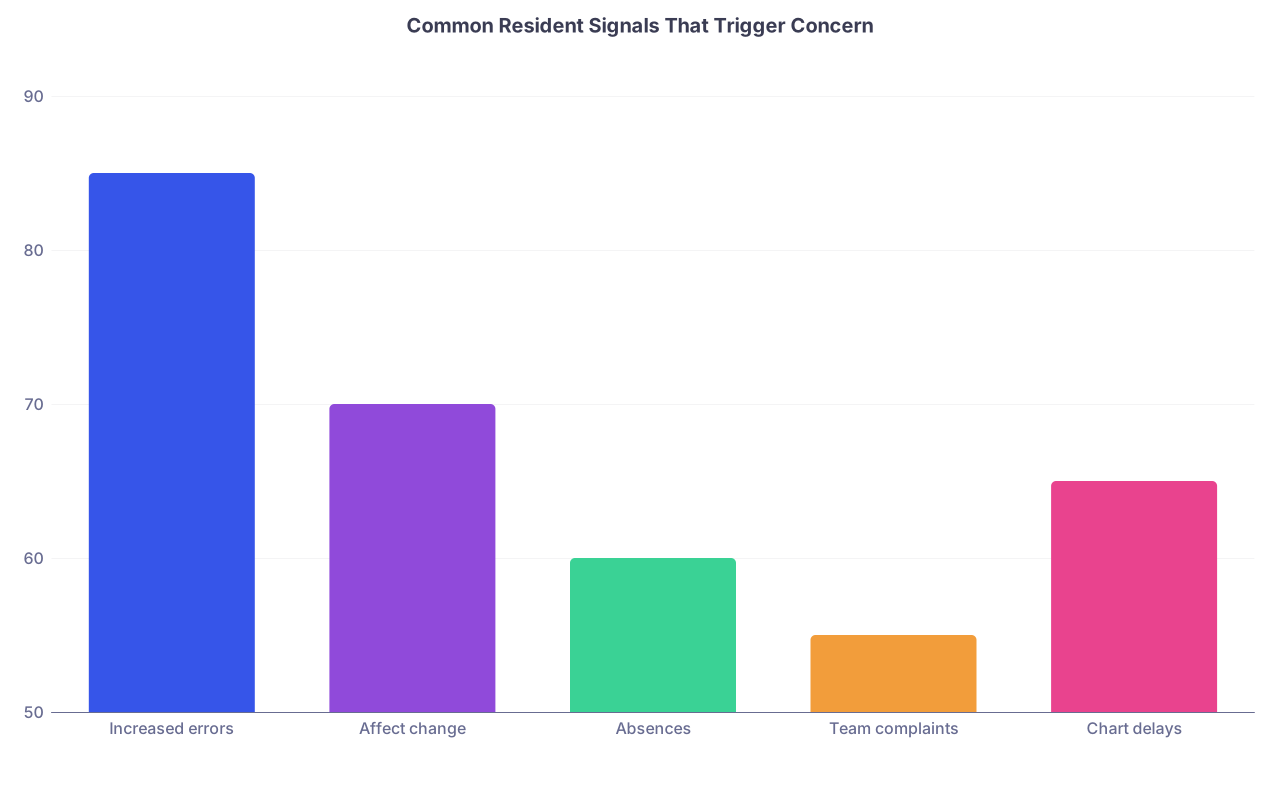
| Category | Value |
|---|---|
| Increased errors | 85 |
| Affect change | 70 |
| Absences | 60 |
| Team complaints | 55 |
| Chart delays | 65 |
They’re constantly weighing three things:
- Performance
- Behavior
- Self-awareness
Performance alone isn’t enough. Behavior alone isn’t enough. What really spooks them is high stress + declining function + denial.
If any two of these are present, “I’m fine” is a lie they’ve heard before:
- Declining performance + irritability + “I’m fine” = They start documenting. Quietly.
- Normal performance + big affect change + “I’m fine” = They start watching you closely.
- Good performance + disclosures like “not sleeping, drinking more” + “but I’m fine” = They wonder how long you can hold that line before it breaks.
I’ve been in those meetings. The language is always vague but the intent is crystal clear:
“She keeps saying she’s fine, but she’s clearly not fine. We need to intervene before this becomes a bigger problem.”
Once those words are said in a conference room with your name attached, you’re in a different category in their minds. Not “bad” or “doomed.” But watched. Tied to a responsibility they now feel explicitly.
Why “I’m Fine” Sounds Ethically Dangerous in Medicine
This is the part residents underestimate. Saying “I’m fine” isn’t just about personal resilience. It intersects directly with medical ethics.
You’ve been taught four core principles: beneficence, nonmaleficence, autonomy, justice. Here’s how PDs link your wellness to those—whether they tell you or not.
- If you’re not sleeping and still operating, they see potential harm (nonmaleficence problem).
- If you’re depressed, checked out, and still signing orders, they see compromised beneficence (are you really acting in the patient’s best interest?).
- If you’re hiding impairment to “protect” yourself, you’re undermining trust and professionalism—which every code of ethics hammers on.
They’re not only asking, “Is this resident okay?” They’re asking, “Is this resident safe to practice?” and “If I ignore this, am I complicit?”
That’s why they’re hypersensitive to your insistence that you’re fine when the evidence says otherwise. It puts them in an ethical bind.
If something goes wrong and there’s documentation that:
- Nurses raised concerns
- A chief checked in
- You repeatedly said “I’m fine” and nobody escalated
Then under the microscope, your PD looks negligent. The institution looks negligent. So your “I’m fine” becomes their risk.
They will not say this to you bluntly, but they act on it.
How Leadership Senses You’re Not Fine (Long Before You Admit It)

| Step | Description |
|---|---|
| Step 1 | Subtle changes in behavior |
| Step 2 | Feedback from nurses or peers |
| Step 3 | Chiefs start observing |
| Step 4 | Informal check in with resident |
| Step 5 | Document and monitor closely |
| Step 6 | Periodic follow up |
| Step 7 | Offer support and resources |
| Step 8 | Resident says I am fine |
You think you’re flying under the radar. You’re not. Programs have a whole informal surveillance system for resident distress.
It starts with people you underestimate:
- The senior night float who tells the chief, “Hey, he seemed off this week.”
- The ward clerk who mentions, “She cried at the desk between admits.”
- The nurse who says, “He’s been snapping at everyone; just wanted you to know something’s up.”
Those comments travel.
Then the chiefs start looking:
- They pull up your duty hours. Are you logging accurately? Are there patterns?
- They check your evaluations. Any recent dips? Any comments like “seems overwhelmed” or “more withdrawn lately”?
- They notice who’s always volunteering to stay late versus who now bolts at 5:01 pm.
Next comes the soft probe: “How are you doing? Really.” Usually in a hallway, call room, or their office with the door half-closed.
If you give them a believable mix of honesty and control—“It’s been rough, I’m more tired than usual, but I’m adjusting; here’s what I’m changing”—they relax.
If you plaster on a fake smile and toss out “Oh, I’m fine, all good!” when everything about you screams the opposite, they don’t buy it.
That’s when the note in the back of the chief’s notebook appears. Literally. I’ve watched chiefs jot down:
“Follow up with J. Seems off, denies problems. Consider meeting with PD if no improvement.”
You’re now an “ongoing concern,” even if no one’s said that phrase out loud to you.
What They Actually Want to Hear Instead of “I’m Fine”
This is where I’m going to be very practical with you. You don’t need to collapse in tears or disclose your darkest trauma to be taken seriously. You just need to show three things:
- Reality-testing
- Insight
- Some kind of plan
Let me give you a few phrases that land much better than “I’m fine” while still protecting your boundaries.
Instead of “I’m fine,” say something like:
“It’s been a tough block. I’m more exhausted than I expected, especially with nights. I’m managing, but I can tell I’m not at my best.”
Or:
“I’m okay enough to do the work safely, but I’m not great. I’ve noticed I’m more irritable and slower on notes. I’m trying to adjust my schedule and sleep, but I could use some guidance.”
Or even:
“I’m not in danger, but I’m also not fine. I think I’m burning out. I haven’t quite figured out what to change yet.”
To a PD or chief, that sounds like:
- You’re connected to reality.
- You’re not hiding your condition.
- You’re still taking responsibility for your impact on patients and colleagues.
That combination calms them far more than a forced “No, really, I’m fine.”
Because remember: they don’t expect you to be fine. They expect you to be honest enough that they can trust you with independent responsibility.
“I’m a little underwater but I see it and I’m working on it” is much safer than “I’m totally fine” while you’re quietly drowning.
Work-Life Balance: The Part They Believe vs The Part They Say Out Loud

Here’s a secret: most PDs and chiefs don’t fully believe in “work-life balance” in the way it gets advertised. They know residency is imbalanced by design. Some even quietly resent the performative wellness language coming from their institution.
But they do believe in two things very strongly:
- Sustainability – Can you keep doing this without breaking?
- Containment – Are your personal struggles contained enough that they don’t spill into patient harm or team dysfunction?
So when you bring up being exhausted, burned out, or overwhelmed, the good ones are not judging you. They’re triaging you.
They’re asking themselves:
- “Is this resident just in the predictable misery zone of training, or are they in a danger zone?”
- “Do they have any life outside work, or are they running on fumes only?”
- “If I ease up here—schedule, rotations, backup—am I protecting them and patients, or just enabling avoidance?”
When you say “I’m fine,” you block them from making those calculations accurately. You force them to guess. And when leaders have to guess with patient safety and accreditation at stake, they get conservative.
This is how you end up with:
- Increased supervision when you insist you’re okay.
- Delayed promotion to more independent roles.
- Hesitation around sending you to off-site electives or away rotations.
- Quiet conversations like, “Let’s keep them on core rotations for now until we’re sure they’re stable.”
You think you’re protecting yourself by looking resilient. You may actually be prolonging the mistrust.
The Ethics of Self-Disclosure: How Much Is Enough?
You do not owe your PD your trauma history. You do not have to cry in your chief’s office to be taken seriously. But you do have an ethical obligation—not just legal—around your own impairment.
The line is roughly here:
- You must disclose functional impairment that affects patient care, reliability, or safety.
- You do not need to disclose every emotional fluctuation, existential dread, or personal relationship issue.
So if what you’re experiencing looks like:
- Occasional sadness, some irritability, still functioning, no safety concerns
→ You can reasonably say, “I’m okay but more stressed than usual; I’m working on it.”
But if you’re at:
- Thoughts like, “If I got in a car accident and didn’t have to come in, that’d be a relief.”
- Drinking to sleep most nights.
- Missing alarms or nearly doing something dangerous on the wards.
- Feeling detached from whether your patients live or die.
Then “I’m fine” is not just inaccurate. It’s ethically wrong.
What PDs and chiefs respect is a calibrated disclosure. Something like:
“I’m not okay right now. I’m having a hard time, and I’m worried it may eventually affect how I work if I don’t get help. I want to address this before it gets there.”
That sentence does three things leaders love:
- Flags a real issue.
- Signals responsibility.
- Invites partnership instead of forcing intervention.
They’d much rather hear that than find out from a nurse that you were sobbing in the stairwell between codes.
The Behind-the-Scenes Playbook Once You Admit You’re Not Fine

| Step | Description |
|---|---|
| Step 1 | Resident says I am struggling |
| Step 2 | Chief listens and assesses urgency |
| Step 3 | Immediate PD and mental health referral |
| Step 4 | Plan adjustments and follow up |
| Step 5 | Schedule tweaks or support |
| Step 6 | Check in after 1-2 weeks |
| Step 7 | Document support and clearance |
| Step 8 | Safety concern? |
You’re terrified that if you admit you’re not fine, they’ll label you permanently. The truth is more nuanced.
When you open up, here’s the usual sequence you don’t see:
Initial check-in:
Chief or PD meets with you. They’re scanning for red flags: suicidal thoughts, substance use, major functional impairment.Risk sorting:
If there’s any hint of imminent risk, they go to emergency mode—occupational health, psych, leave. If not, they move to support mode.Contained documentation:
They write a brief, careful note to themselves or in a secure program file. Not a full psych eval. More like: “Resident reported stress and fatigue; no safety issues; plan for more frequent check-ins.”Targeted changes:
This is where small but real things happen:- Pulling you off back-to-back Q3 call blocks.
- Moving a brutal ICU month a bit later.
- Pairing you with a kinder attending.
- Suggesting actual time off and making sure it’s protected.
Monitoring, not spying:
They don’t shadow your every move. They just mentally put a star by your name for the next few weeks. How are your evals? Any complaints? Any improvements?
You think they’ll see you as weak. What they actually see is someone who understands their limits and cares about practicing ethically.
The resident they distrust more is the one with clear objective issues who keeps smiling and saying, “Honestly, I’m fine. Just need to push through.”
They’ve watched that movie. They know how it ends.
How to Talk About Not Being Fine Without Torching Your Career
| Situation | Better Phrase | Risky Phrase |
|---|---|---|
| General overwhelm | "This block is stretching me, but I'm managing with support." | "I'm fine." |
| Early burnout signs | "I'm noticing signs of burnout and want to address them early." | "It's whatever." |
| Sleep/exhaustion | "My sleep is poor; I'm worried it may start affecting my work if I don't fix it." | "Just tired, I always grind." |
| Emotional distress, no impairment | "I'm not unsafe, but I'm definitely not at my best lately." | "Don't worry about me." |
You don’t need a therapy session; you need a few smart, honest lines you can use when leadership checks in.
Framework that works:
- Acknowledge reality
- Define current functional level
- Express intention to improve
- Invite collaboration (if you want it)
Example:
“I’m definitely more burned out than usual. I’m still able to do the work safely, but I can tell I’m closer to my limit. I’m starting to adjust things outside work, but I’d appreciate any suggestions on keeping this sustainable.”
Or, if you’re really close to the edge:
“I’m not at the point where I’m unsafe, but I also know I’m not fine. I’d rather we talk about options now before it becomes a bigger issue.”
To a chief or PD, those statements hit all the right notes:
- Professional
- Self-aware
- Ethically grounded
- Coachable
You come across as the kind of physician they’d trust with independent practice later—not because you never struggle, but because you don’t lie to yourself about it.
The Bottom Line: Why “I’m Fine” Makes People Nervous

Let me boil this down without sugarcoating:
PDs and chiefs have seen too many tragedies start with a smiling “I’m fine.” They do not trust that phrase when your behavior contradicts it.
Medicine ties your personal wellness directly to ethical practice and patient safety. Denying your distress isn’t stoic; it’s ethically shaky.
Leaders don’t expect you to be fine. They expect you to be honest enough about not being fine that they can still trust you with responsibility.
You don’t need to dramatize your struggle. But you do need to stop reflexively lying about it.
“I’m holding it together, but I’m closer to the edge than I’d like” will always earn you more respect—and more real help—than another empty “I’m fine.”