
The unspoken rule attendings use to spot residents near burnout is brutally simple: when your clinical judgment starts to erode, everything else is just noise.
Not your complaints. Not your hours. Not your wellness survey.
They watch for one thing: “Is this resident’s mind starting to slip in ways that could hurt patients?”
Once the answer starts becoming “yes,” you’re in the red zone—no matter how functional you look on paper.
Let me walk you through how they really see it. Because the official wellness rhetoric and what attendings say in closed-door meetings are not the same conversation.
The Quiet Calculus Attendings Run On You
Every decent attending is always running a silent risk assessment on their residents. Constantly. Sometimes kindly, sometimes coldly, but always there.
They don’t say, “Is this resident burned out?”
They say, “Is this resident still safe?”
Here’s the uncomfortable truth: lots of residents look exhausted. Many complain about the hours. Most are cynical at 3 a.m. on night float. That’s not what sets off alarm bells.
What attendings really track is a shift in how you think and behave clinically.
When we’re talking about residents nearing burnout, experienced attendings watch for three core things:
- Pattern recognition falling apart – You’re missing stuff you used to catch.
- Emotional bandwidth collapsing – You stop caring at the bedside in ways that are dangerous.
- Ethical shortcuts creeping in – You start doing the “minimum to not get yelled at,” not the minimum safe care.
They will tolerate a lot. Tears on a rough call night? Fine. Sarcasm in the workroom? Whatever. But when you start cutting corners in decision-making, that’s when attending chatter changes from “Yeah, they’re tired” to “I’m worried about them.”
And yes, they talk about you.
I’ve been in those pre-round huddles, those post-call debriefs, the behind-closed-door meetings where faculty go over “problem residents.” Burnout isn’t documented as “burnout.” It shows up as:
- “Their notes are getting really sloppy.”
- “They’re missing basic stuff now.”
- “They seem checked out. I don’t think they even realize.”
- “I don’t want them alone on nights.”
That’s the unspoken rule in action: once your fatigue starts to compromise patient care patterns, you’re marked as a risk, not just a tired trainee.
The First Giveaways: Changes in Your Clinical Judgment
Burnout doesn’t announce itself with a dramatic collapse. It usually leaks out in small, predictable ways. Attendings notice it earlier than you think.
1. The “They Don’t Think Ahead Anymore” Phase
On a normal day, an engaged resident anticipates:
- If you admit a CHF patient, you’re thinking diuresis, echo, fluid status, follow-up.
- If you see a febrile chemo patient, you’re thinking neutropenia, broad-spectrum antibiotics, blood cultures, source.
In early burnout, that anticipatory thinking blunts.
An attending will see it like this:
- You present the story fine. Vitals, labs, imaging – all there.
- But when they ask, “So what’s your plan?” you only give the next immediate step. No trajectory. No “then what.”
They clock that. And they compare you to you:
- “Last month they were thinking three steps ahead.”
- “Now they’re just reacting to the last lab.”
That’s the first whisper: “Something is off.”
2. The “Shortcuts in Reasoning” Phase
This one is a big marker attendings quietly track.
You start:
- Accepting the previous team’s assessment without re-examining.
- Trusting sign-out more than your own brain.
- Defaulting to “it’s probably the usual thing” when something feels off.
Example I’ve watched play out:
An intern presents: “He’s probably just volume overloaded; they gave him fluids in the ED.”
The attending: “Show me.” They walk in. The patient is septic. Cool, clammy, altered. No one laid hands on him since admission.
Was the intern evil? No. Burned out. Running on fumes. Starting to skip the “verify with my own eyes” step.
Attendings file that away: clinical shortcuts + fatigue = burnout danger.
3. The “Loss of Curiosity” Phase
This is quieter but huge.
Earlier in the year:
- You’d ask, “Why are we choosing this anticoagulant over that one?”
- You’d look up that weird lab pattern.
- You’d follow up on interesting pathology.
Near burnout:
- You accept orders like a robot.
- You stop reading.
- You don’t ask “why” anymore—just “What do you want me to put in?”
An attending will say, “They used to be really intellectually engaged. Now they just… execute.”
Translation: this resident is approaching the point where medicine is just button-clicking. Dangerous territory.
Behavioral Tells Attendings Use As Burnout Red Flags
Let’s be blunt: your program’s wellness committee will talk about yoga, “taking time for yourself,” maybe hand out granola bars.
Attendings, privately, will talk like this:
- “They’re snapping at nurses now.”
- “They roll their eyes on rounds.”
- “They’re never in the room with the patient for more than 30 seconds.”
That’s where the ethical side comes in. Not ethics like grand dilemmas. Ethics like: Are you still showing up as a physician, or just as a resentful task machine?
Here are the big non-clinical signals attendings actually care about.
The “Emotionally Flat or Icy” Shift
At baseline, most residents have some emotional variability. You care about some patients more than others. You get frustrated, you lighten up, you laugh, you feel bad when something goes wrong.
Near burnout, the flatness creeps in:
- A patient dies unexpectedly and you barely react.
- Family meetings become something you rush, not something you inhabit.
- You describe patients as bed numbers more than people.
Attendings do not need you to be sentimental. But they get very uneasy when you seem untouched by real suffering. They’ll say things like:
- “They seemed…cold about that death.”
- “They did the right actions, but they looked like they were somewhere else.”
Because that’s the bridge between emotional burnout and ethical drift.
The “Contempt Toward Staff or Patients” Shift
This one? Very high-yield sign you’re circling the drain.
Lots of residents vent in the workroom. Fine. Everyone complains about “social admissions” or that one attending who pages for nonsense.
The red flag isn’t occasional venting. It’s persistent contempt:
- Calling frequent-flyer patients “garbage,” “trainwrecks,” “dumpster fires” in a way that never softens.
- Snapping at a nurse for paging “too much” about objectively important issues.
- Dismissing consultants as “useless” without even engaging their recommendations.
I’ve watched attendings turn on a dime after a single interaction where a resident humiliated a nurse or belittled a scared family.
After that, in meetings, you’ll hear:
- “I don’t trust their professionalism right now.”
- “I think they’re burned out and taking it out on everyone.”
That’s code for: we’re going to start limiting this person’s exposure to high-stakes situations if we can.
The “Always Late, Always Behind, Always Apologizing” Pattern
Everyone has off days. But attendings track trends.
There’s a certain pattern:
- You’re now always the last one done with notes.
- Sign-out is increasingly sloppy or late.
- You start your day already underwater, no matter the patient load.
- You’re constantly saying “Sorry, I didn’t get to that yet.”
Attendings don’t just see “bad time management.” They see cognitive overload. Burnout turning your brain into molasses.
And behind closed doors, someone will say it:
“They’re not lazy. They’re drowning.”
What They Do With That Information (That You Don’t See)
Here’s the part nobody tells you: once an attending labels you “at risk for burnout that affects safety,” there’s usually a quiet shift. Sometimes to protect you. Sometimes to protect the hospital. Often both.

| Step | Description |
|---|---|
| Step 1 | Notice burnout red flags |
| Step 2 | Informal check in |
| Step 3 | Discuss with PD or chief |
| Step 4 | Adjust workload informally |
| Step 5 | More direct supervision |
| Step 6 | Possible schedule changes |
| Step 7 | Formal documentation if risk persists |
| Step 8 | Mild or Concerning? |
That diagram sums up a reality most residents never get to see clearly: there’s an algorithm in the background, and you’re rarely explicitly invited into that conversation.
Here’s how it actually plays out on the ground:
Step 1: The “Soft Check-In”
An attending will test the waters.
- “You doing okay?”
- “You seem tired lately—everything alright?”
- Or the classic: “How are you holding up with this rotation?”
If you respond with rigid denial (“I’m fine. Totally fine. It’s all good”), they don’t think, “Ah okay, they’re fine.”
They think, “They don’t have insight yet.”
A better answer—if you’re actually struggling—is closer to:
- “I’m managing, but I’m definitely feeling more worn down than usual. I’ve noticed I’m slower than I was a month ago.”
That tells them: you still have insight. You’re not completely gone yet.
Step 2: The “Quiet Protection”
If they like you and think you’re basically solid, attendings will often quietly protect you without announcing it.
Things like:
- Asking the senior: “Maybe you take that new unstable admit; let the intern stick with what they already have.”
- Not assigning you the most complex family meeting late in the day.
- Letting you go a little earlier “to finish notes” while they pick up the slack.
You interpret it as: “They’re being nice.”
In reality, it might be: “They’re tired and slipping. I’m going to buffer them.”
This is compassionate—and also risk management.
Step 3: The “We Need to Talk About Them” Meeting
If multiple attendings notice the same pattern—eroding judgment, ethical shortcuts, dangerous shortcuts—that’s when this escalates.
I’ve heard versions of this in countless rooms:
- “Has anyone else noticed [Name] seems burnt out? I’m worried about them at night.”
- “They missed a septic patient twice this month. That’s not just being tired.”
- “They snapped at a nurse again. I think we need to intervene.”
From there, chiefs or the program director get looped in.
Now it’s not just “Are they burned out?”
It’s: “Do we have to document concerns about performance? Do we need to adjust their schedule? Does this need wellness vs remediation vs both?”
You might still think you’re flying under the radar. You’re not.
Step 4: The “Ethical Line” They Will Not Let You Cross
There’s one area where even the most laid‑back attending snaps to attention: when burnout starts breaking your ethics.
Concrete examples I’ve seen that set off alarms instantly:
- You intentionally don’t see a difficult patient for hours because “they’re always complaining.”
- You falsify a physical exam you didn’t do because you’re too exhausted to go back upstairs.
- You ignore lab critical values because “it’s always abnormal for them.”
That’s when it stops being a wellness issue and becomes a professionalism and patient safety issue.
Faculty will say variations of:
- “We have to document this.”
- “This isn’t just burnout. This is unsafe.”
- “They might need time off.”
This is the line you don’t want to reach before you ask for help.
How to Read Yourself the Way Attendings Read You
Let’s flip this. You can wait until an attending reads you as “near burnout,” or you can start applying the same lens to yourself.
Here’s the internal checklist I wish more residents used—essentially, you become your own attending.
| Domain | Healthy Pattern | Near-Burnout Pattern |
|---|---|---|
| Clinical thinking | Anticipates next steps | Only reacts to current issue |
| Patient interaction | Still curious and present | Rushed, detached, or resentful |
| Emotions | Frustrated at times but still engaged | Flat, cynical, or openly contemptuous |
| Work habits | Occasionally behind but recovers | Chronically behind, always apologizing |
| Ethics-in-action | Checks own work even when tired | Skips steps, trusts shortcuts blindly |
Use this brutally honestly.
If you’re drifting into the right-hand column in more than one row, you’re not just “tired.” You’re moving into the same zone your attendings are already trained to scan for—and they will see it soon, if they don’t already.
The Ethical Core: Your Patients vs Your Persona
Let’s tie this back to personal development and ethics, because that’s the part no one wants to talk about when they throw “resilience” slides at you.
Burnout is not just about how you feel. It’s about what happens when your internal exhaustion starts deforming your behavior toward patients.
Here’s the ethical pivot point:
- Feeling exhausted? Human.
- Becoming less empathic? Understandable.
- Letting that turn into neglect, cruelty, or apathy in your decisions? That’s where your professional obligations are on the line.
Attendings, deep down, do not care if you are “happy.” They care if you are:
- Safe
- Honest
- Willing to ask for help when your own system is failing
The “unspoken rule” is really this:
Once your burnout starts to erode your clinical judgment and ethical behavior, attendings stop seeing you as just a struggling trainee and start seeing you as a potential risk.
You do not want your identity in their minds to cross that threshold.
What You Can Actually Do Before You Hit Their Red Zone
I’m not going to insult you with generic “self-care” advice. You are not going to bubble-bath your way out of 28-hour calls and broken systems.
But you can do a few concrete things once you recognize you’re getting close to that line:
Name it out loud to someone with power.
Not melodramatically. Just:
“I’ve noticed I’m slower and making more near-misses than before. I’m worried I’m getting burned out and I don’t want to compromise care.”Most sane attendings respect that. It signals insight and ethics.
Negotiate specifics, not vibes.
Instead of, “I can’t do this,” try:
“Is there a way I can avoid cross-covering both ICU and floor on the same night for a bit?”
Or: “Can I stay on days one more month before taking on back-to-back nights?”Re-anchor one small ethical habit.
Pick something simple, non-negotiable, even when you’re dead tired:- Always lay eyes on every new admit, no exceptions.
- Always recheck any critical lab personally.
- Always introduce yourself to families once per day on your sickest patient.
These are small, but they’re anchors. They keep you from drifting into dangerous modes.
Use your peers as mirrors.
Ask one person you trust:
“Honestly—have I seemed different on this rotation? More checked out? More snappy?”
If they say yes, believe them. They’re seeing what your attendings are seeing—before you get the official feedback.
The Part They’ll Never Say On Rounds
Most attendings won’t ever tell you this plainly, but here it is.
They know you’re all overloaded. They know the system is abusive at times. Many of them went through worse. Some of them are still burned out themselves.
So they fall back on that one unspoken rule:
If your burnout starts changing your judgment in ways that put patients at risk, that’s when we act. Before that, you’re just “a tired resident.”
Harsh? Yes. Real? Absolutely.
The opportunity for you is this: you now know what they’re actually watching for. Not your wellness survey score. Not your Instagram posts about being “so done.”
They’re watching:
- How you think.
- How you treat people when you’re tired.
- How honest you are when you’re slipping.
If you can stay honest with yourself about those things—if you can recognize your own red flags before they become someone else’s case report—you’re already ahead of where most residents ever get.
You’re not going to fix residency culture alone. But you can protect your patients and your own integrity inside a broken system. And that, strangely enough, is the seed of real professional development.
With that foundation in your pocket, you’ll be a lot more prepared for the next invisible battlefield: how attendings silently rank residents for fellowship letters and career opportunities based on what they’ve seen when you were at your worst. But that’s a story for another day.
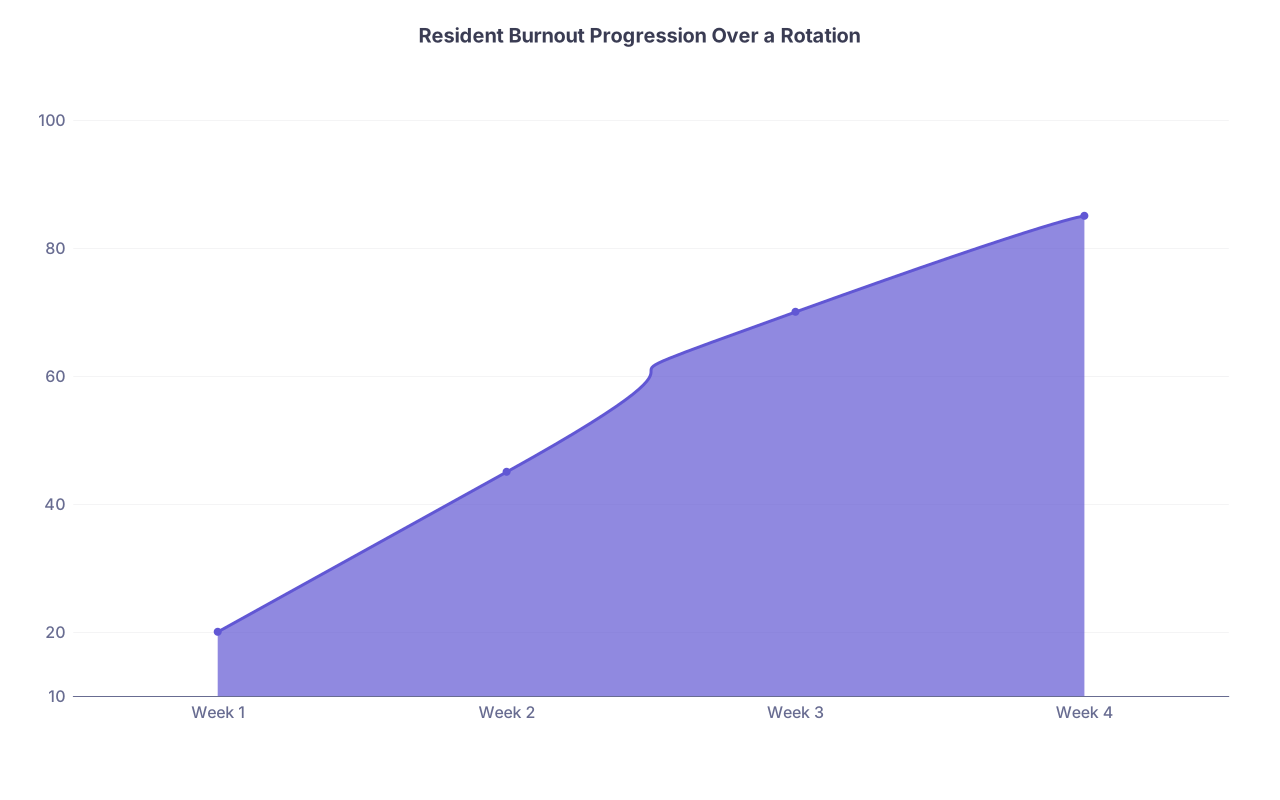
| Category | Value |
|---|---|
| Week 1 | 20 |
| Week 2 | 45 |
| Week 3 | 70 |
| Week 4 | 85 |