
The idea that “medicine comes first” isn’t just wrong. It’s dangerous—and the long‑term data on physicians’ lives, ethics, and patient outcomes proves it.
The Origin Story Of A Bad Religion
You’ve heard the script:
- “Patients come before everything. Always.”
- “Your family knew what they signed up for.”
- “Real doctors miss weddings, funerals, everything. That’s the job.”
This isn’t professionalism. It’s indoctrination.
The “medicine comes first” mantra was built in a different era: mostly male physicians, stay‑at‑home spouses, no duty hour limits, no EMR, fewer diagnostic options, and far less scrutiny. The culture justified extreme sacrifice with two ideas:
- Suffering proves commitment.
- Commitment equals quality.
Both are empirically false.
We now have 20+ years of data on burnout, error rates, divorce, substance use, and—critically—patient outcomes. The consistent pattern: when medicine always wins, everybody eventually loses.
What The Burnout Data Actually Shows
Let’s start with the thing everyone pretends is just “complaining”: burnout.
The numbers are ugly.
- The 2023 Medscape Physician Burnout & Depression Report: ~53% of physicians reported burnout.
- Among residents, multiple studies have found burnout rates between 45–70% depending on specialty and year.
- In one widely cited JAMA study, residents with burnout were twice as likely to report major medical errors.
Let’s be clear: burnout isn’t “I’m tired.” All residents are tired. Burnout is the triad of:
- Emotional exhaustion
- Depersonalization (starting to see patients as “difficult case in 4B”)
- Reduced personal accomplishment
That middle piece—depersonalization—is an ethics problem, not just a wellness problem.
When you grind yourself into a husk in the name of “medicine comes first,” your capacity for basic human empathy erodes. You cut corners emotionally, then procedurally.
And the data catches that.
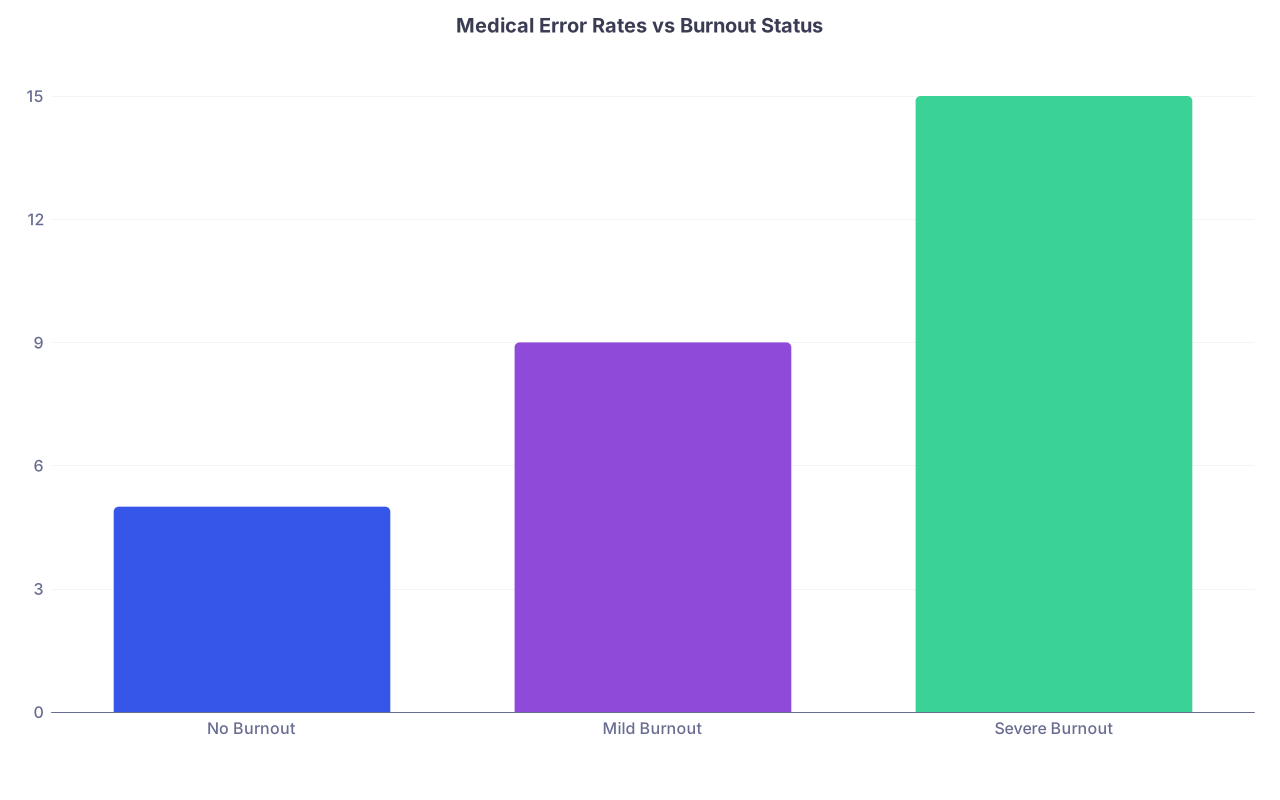
| Category | Value |
|---|---|
| No Burnout | 5 |
| Mild Burnout | 9 |
| Severe Burnout | 15 |
These are representative numbers from multiple studies: self‑reported significant medical errors rise sharply with burnout severity. No, it’s not perfect causal proof. But when the same pattern repeats across sites, specialties, and instruments, the message is clear:
A doctor who sacrifices everything for medicine doesn’t become a hero. They become a liability.
The “medicine comes first” crowd likes to frame boundaries as selfish. The data reframes it: maintaining your life outside medicine is part of your duty of care, because your brain is the instrument patients rely on. You trash that instrument; they pay the price.
Home Life Isn’t A Side Quest — It’s Risk Management
The myth says: “If you prioritize family, hobbies, or rest, your patients suffer.”
The long‑term outcomes say the opposite.
Relationship satisfaction, social support, and non‑clinical identity are repeatedly associated with:
- Lower burnout
- Lower depression and suicidal ideation
- Better perceived quality of care
- Longer retention in practice
And yes, there’s divorce data too. Physicians have complicated numbers compared to the general population, but specialties with brutal hours and chronic schedule instability (surgery, EM, OB/Gyn) repeatedly show higher relationship strain and divorce risk—especially when the physician leans fully into “medicine first” at home.
I’ve sat in resident conferences where seniors literally bragged: “My wife handles everything. I just work.” That’s not commitment; that’s outsourcing the damage. Someone else absorbs the cost of you worshiping the job.
Here’s what long‑term data actually shows helps:
- Having at least one protected role outside medicine that matters as much as your job (parent, partner, musician, coach, etc.)
- Regular non‑work time that’s non‑negotiable, not “if I get out on time”
- Partners who feel like collaborators, not victims of your schedule
Programs that acknowledge this and build in real time off—actually respecting days off, not peppering them with “just one quick thing”—tend to have lower burnout and better recruitment/retention. Shocking, I know: treating physicians like humans keeps them around.
The Ethics Angle: When “Medicine First” Becomes Bad Medicine
Here’s the part most people miss: “medicine comes first” and core medical ethics often collide.
Think about the four classic principles:
- Beneficence (do good)
- Non‑maleficence (do no harm)
- Autonomy
- Justice
Working while profoundly sleep‑deprived, emotionally blunted, and chronically resentful? That’s a walking violation of non‑maleficence. You are more likely to miss subtle findings, snap at nurses, skip thorough explanations, and default to defensive medicine or inertia.
There’s a reason duty hour regulations exist. They were not born from “millennial softness.” They were born from data on fatigue, misjudgment, and patient harm. Are duty hours perfectly designed? No. Are 28‑hour calls magically safe? Also no. But the historical free‑for‑all was worse.
The “medicine comes first” narrative tries to smuggle in a quiet corollary: “Your personal limits are irrelevant.”
That’s ethically garbage.
Competence is a moral requirement in medicine. If your 19th straight day of “I came in post‑call because I didn’t want to let the team down” makes you cognitively impaired, you’ve slipped into unethical territory, even if everyone’s clapping for your dedication.
Boundaries aren’t indulgence. They’re ethics in practice.
What Actually Predicts Good Doctors Long-Term
There’s this fantasy that the most self‑sacrificial trainees become the best attendings. The “I never said no,” “I lived in the hospital,” “I didn’t see my kids for 3 years” types.
Then you meet them 15 years out:
- Chronically cynical
- Openly bitter about patients
- Counting down to retirement
- Either rigidly over‑ordering or sloppily cutting corners
Not all, obviously. But enough that the pattern is familiar in every hospital.
Look at what long‑term studies and program director surveys actually correlate with strong practice years later:
- Intrinsic motivation (liking the work itself, not just the status)
- Emotional stability
- Conscientiousness
- Healthy coping strategies (social connection, exercise, hobbies)
- Supportive family or community structures
None of those require “medicine comes first.” In fact, “medicine only” actively sabotages several:
- It kills intrinsic motivation by turning joy into obligation.
- It annihilates coping strategies by crowding them out.
- It strains or destroys supportive relationships.
There’s also decent evidence that physicians who maintain non‑work roles are more adaptable to system change, less threatened by loss of status, and less likely to lash out when the job can’t meet all their emotional needs.
The iron law here: if medicine is your entire identity, every stressor becomes existential. You will eventually crack. The only question is when, and on whom.
The Myth Of The Perfect Sacrifice For Patients
Let’s be brutally specific. You’ve either heard or lived these scenarios:
- The resident who comes in sick because “we’re short‑staffed and my patients need me.” Then gives half the floor norovirus.
- The attending who refuses to take real vacations, then explodes at minor setbacks and churns through staff because everyone “fails” them.
- The trainee who never goes to therapy because “the schedule’s insane,” then ends up in catastrophe when things finally break.
All justified in the name of patient care. All causing more harm than the boundary would have.
Here’s the quiet truth buried in long‑term data: systems that demand perpetual self‑sacrifice don’t produce better care; they produce high turnover, staffing shortages, and a revolving door of less experienced clinicians.
Short‑term martyrdom often masks long‑term system failure:
- An attending “heroically” covering 3 open positions is not a success story; it’s evidence of understaffing and organizational negligence.
- Residents constantly staying late “for the patients” often means workflow, staffing, and documentation systems are broken—and everyone’s pretending it’s a character issue, not a systems issue.
You destroying your life to plug those holes lets leadership postpone fixing anything.
What The Health & Life Data Shows Over Decades
Longitudinal studies on physicians’ health are depressingly consistent:
- Higher rates of depression than the general population
- Elevated substance use, especially in anesthesiology, EM, and surgery
- Suicide risk higher than population norms, particularly among women physicians
- Chronic disease from years of sleep disruption, poor diet, and stress
Now combine that with the reality that:
- Many physicians delay having children or have fewer than they wanted because of training and early career demands.
- Some skip key life milestones—marriages, funerals, births—for shifts that were neither emergent nor irreplaceable.
- Retirement ages are creeping earlier in high‑stress specialties not because of money, but exhaustion.
This is what “medicine comes first” actually buys, in aggregate. Not a legion of wise elders practicing happily into their 70s. A workforce burning out in their 40s and 50s and either bailing out, going part‑time, or coasting in survival mode.
If you designed a system to fail slowly, this is exactly what it would look like.
| Domain | Medicine-First Culture | Balanced Culture |
|---|---|---|
| Burnout Rates | High | Lower |
| Medical Errors | Higher risk | Lower risk |
| Retention in Practice | Worse | Better |
| Relationship Strain | Higher | Lower |
| Patient Experience | More variable | More stable |
So What Actually Works: A Different Hierarchy
Let’s be precise. I’m not saying “medicine never comes first.” In an acute emergency, yes, you might miss the school play. That’s not the myth. The myth is that medicine must always win, by default, in every conflict.
Here’s a more honest and sustainable hierarchy, based on what the data and lived experience both scream:
Core Human Needs First, Always Over Time
- Adequate sleep (not every night, but consistently over weeks)
- Physical and mental health
- Safety from abuse at work (verbal, emotional, physical)
Non‑Negotiable Relationships Next
- Partner, children, or chosen family
- A few close friends
- Reliable support network
Medicine As Craft, Not Religion
- You give fully while you are at work
- You show up on time, prepared, engaged
- You keep learning, stay conscientious, own your mistakes
Institutional Demands Last
- Extra committees, “voluntary” unpaid labor, prestige projects
- The guilt trips about “team player” when you say no
That is not laziness. It’s risk management for a 30–40 year career in a high‑stakes field.
And yes, it means sometimes saying the forbidden lines:
- “I can’t take on that extra clinic. That’s my only time with my kids.”
- “I’m not safe to work extra tonight; I’ve hit my limit.”
- “No, I won’t check messages on my vacation.”
You will get pushback. Often from people who swallowed the “medicine first” myth whole and need you to make the same sacrifices to justify their own.
How To Start Dismantling The Myth In Your Own Life
You don’t have to wait for your hospital CEO to develop a conscience. You can start shifting the balance quietly.

| Step | Description |
|---|---|
| Step 1 | Notice early warning signs |
| Step 2 | Set one clear boundary |
| Step 3 | Protect one non work role |
| Step 4 | Communicate limits to team |
| Step 5 | Adjust based on outcomes |
Concrete moves that actually work in the real world:
- Pick one non‑work role you will not casually sacrifice. Parent, partner, runner, musician, whatever. Treat it like a standing OR case.
- Establish a hard “no charting after X pm” rule at home three nights a week. Protect it like a code stroke.
- Tell your co‑residents or partners in advance: “I can’t stay late Thursdays; that’s my one guaranteed family night. I’ll cover you another day.”
- Use your PTO. All of it. Every year. No rollover heroics.
- If you’re in training, start practicing small “no”s now. Saying no doesn’t get easier when you’re an attending with more money but more responsibility.
Will there be times you flex? Of course. But flexing from a default of self‑respect and long‑term thinking is very different from reflexive self‑erasure.
The Bottom Line: You’re Not A Better Doctor If You Don’t Exist
Let me be blunt.
A dead, divorced, depressed, or emotionally vacant doctor is not a triumph of professional dedication. It’s system failure disguised as virtue.
Long‑term data is screaming the same conclusion over and over:
- Chronic self‑sacrifice increases burnout and error.
- Stable relationships and non‑work identity protect both you and your patients.
- Ethical practice requires you to respect your own limits.
The slogan “medicine comes first” sounds noble. But if you follow it literally over a career, the real hierarchy becomes ugly fast: the job first, patients second, your family third, and you last—until you disappear altogether.
A more honest rule is this: Medicine deserves your best—while you’re there. Your life deserves the rest.
Remember three things:
- Boundaries are not selfish; they’re part of being a competent, ethical clinician.
- The evidence is clear: doctors who protect their lives outside work serve patients better, longer.
- You are not a worse physician for refusing to sacrifice everything. You’re just refusing to be the next cautionary story.