
What if the belief that “real” doctors must sacrifice their own lives for patients is not just wrong—but actually linked to worse patient outcomes?
That’s where we’re going. And the data is ugly for the martyr narrative.
The Myth of the Self-Destructing “Good Doctor”
You’ve heard the script, probably from day one of training.
“Medicine isn’t a job, it’s a calling.”
“If you’re counting hours, you’re in the wrong profession.”
“Patients come first—always.”
The subtext: if you set boundaries, sleep, have hobbies, or see your family, you’re less dedicated. Less worthy. Less of a “real” doctor.
This martyr culture is treated like a moral ideal. The hidden assumption is simple: the more you sacrifice yourself, the better your patients will do.
Outcome data says the opposite.
When you actually look at studies that track patient outcomes, medical errors, mortality, adherence, and physician performance, a very clear pattern emerges:
Burned-out, overworked, boundary-less doctors are not better doctors. They make more mistakes, communicate worse, and their patients do worse.
Let’s put some numbers on that.
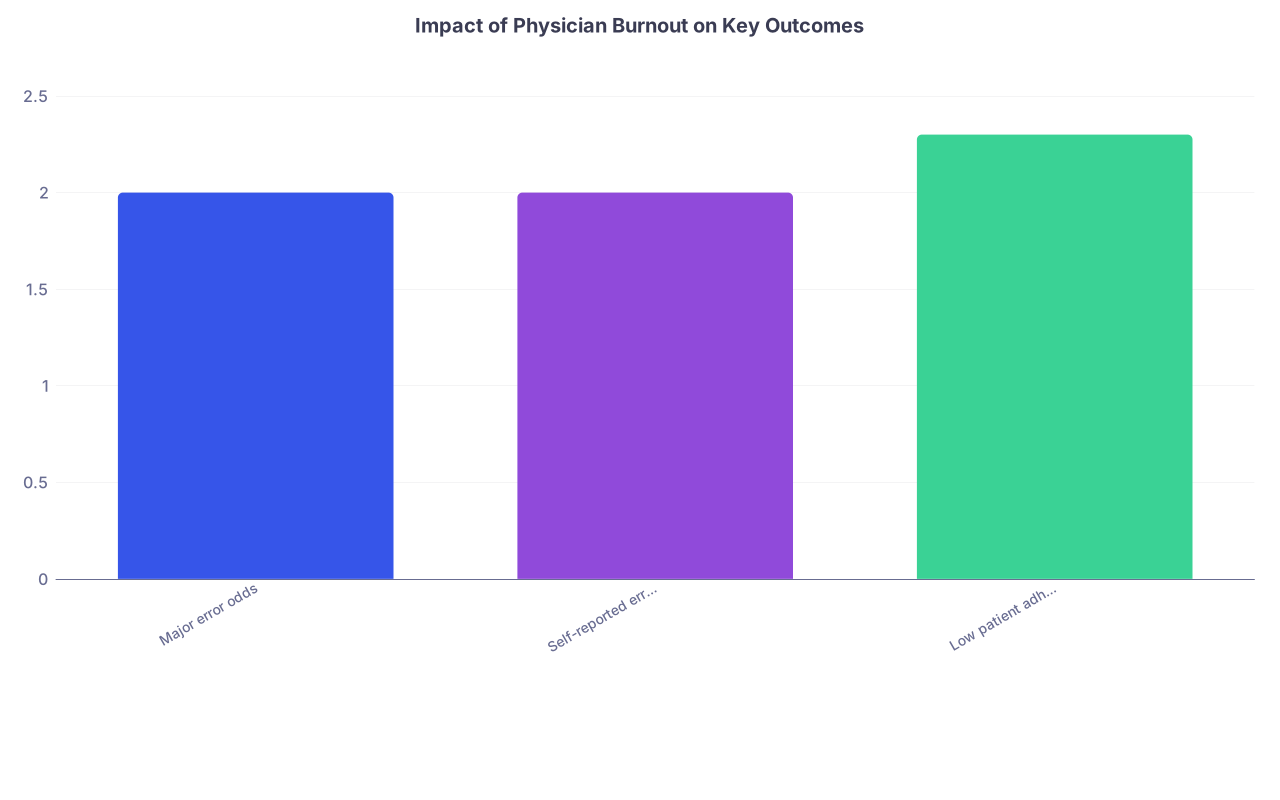
| Category | Value |
|---|---|
| Major error odds | 2 |
| Self-reported error odds | 2 |
| Low patient adherence odds | 2.3 |
Those are odds ratios from large meta-analyses: burnout roughly doubles your odds of major and self-reported errors, and is associated with about a 2.3x higher odds of low patient adherence. That “extra sacrifice” you’re supposedly making? It shows up in worse care.
What the Evidence Actually Shows About Burnout and Patient Care
You want data, not slogans. Let’s start there.
Multiple large systematic reviews and meta-analyses have tackled the link between physician burnout and quality of care. A few headline findings:
A 2018 JAMA Internal Medicine meta-analysis (over 47 studies, tens of thousands of physicians) found that burnout was associated with:
- Nearly 2x higher odds of patient safety incidents
- Nearly 2x higher odds of low professionalism
- Strong associations with lower patient satisfaction
A 2010 study in JAMA (residents) showed that depressed interns made about 6 times as many medical errors as non-depressed interns.
A 2019 meta-analysis in JAMA Network Open found that physician burnout was linked to:
- Increased medical errors
- Worse patient safety outcomes
- Reduced quality of care across multiple specialties
None of these say, “The doctors who sacrifice everything are the best.”
They say: “The doctors who are exhausted, depressed, and burned out are dangerous.”
If you were a patient choosing a surgeon, you wouldn’t think, “Give me the surgeon who hasn’t seen their family in 2 weeks and lives in a call room.” You’d want the focused, rested, emotionally stable one.
But in medicine’s culture, we pretend the opposite.
The Sleep Lie: “You’ll Function Fine on 4 Hours”
Another sacred myth: “You’ll adjust.”
“Everyone is tired.”
“You can still do safe work on 3–4 hours of call-room sleep.”
This is fantasy. Neurocognitive testing has destroyed that myth.
Sleep-deprived doctors:
- Have psychomotor performance equivalent to being legally drunk after 17–24 hours awake
- Show impaired working memory, processing speed, and decision-making
- Are more likely to make serious diagnostic and prescribing errors
Residents know this intuitively. You remember dictating a note at 4 a.m. and forgetting what room you just left. That’s not a character flaw. That’s your frontal lobe going offline.
When duty-hour reforms were introduced, were they perfect? No. Did every study show improved mortality? Also no. But:
- Multiple studies showed fewer self-reported medical errors
- Better resident well-being
- Less emotional exhaustion and depersonalization in many settings
The “iron call” generation loves to say, “We worked 120 hours a week and we turned out just fine.” Selective memory. Survivorship bias. Many didn’t “turn out fine”—they just never left, and normalized damage.
Work-Life Balance as a Professional Competency, Not a Luxury
You want the contrarian take? Here it is:
Work-life balance is not about your happiness first. It’s about your reliability as a clinician over decades.
A surgeon with a 3-year peak of “hero mode” followed by divorce, depression, and early retirement is worse for patients than a surgeon who works 30 years at 85–90% intensity, maintains mental health, and stays engaged and careful.
Look at career sustainability:
- Burnout is associated with increased intention to leave practice and actual reduction in clinical hours.
- That loss of experienced physicians destroys continuity of care.
- Systems then rely more heavily on locums, rotating staff, and overwhelmed remaining clinicians.
All of that hurts patients.
The idea that “good doctors sacrifice everything” is short-term, ego-driven thinking. It confuses visible suffering with invisible quality.
High-quality physicians over the long term typically share a few things:
- Some control over their schedule
- Time off that is actually off
- Strong relationships outside medicine
- Non-medical identities (parent, runner, musician, whatever)
Those are not indulgences. They’re protective factors for your patients.

The Ethics Trap: “Patients First” Misused as a Weapon
Here’s where this gets messy. People confuse two very different ideas:
- Patients’ interests should guide clinical decisions.
- You must always put patients above your own health, family, and sanity.
The first is ethical. The second is abusive.
Medical ethics frameworks—Beauchamp and Childress, the AMA Code—never say, “You must destroy your own life for patients.” They say:
- Do good (beneficence)
- Avoid harm (nonmaleficence)
- Respect autonomy
- Promote justice
If your exhaustion, depression, or resentment make you more likely to snap at a nurse, ignore a subtle clinical change, or rush a conversation, you’re violating beneficence and nonmaleficence. On a daily basis.
There’s also this: you have moral obligations to other people too. Partner. Kids. Parents. Friends. Yourself. Pretending that all those obligations are automatically inferior to work is not moral heroism. It’s moral laziness.
Real ethical maturity in medicine recognizes:
- You are a finite resource.
- You are responsible for stewarding that resource.
- You can’t provide optimal care if you are chronically impaired by the system and your own choices.
Boundary-setting is not selfish. It’s risk management—for your patients.
What Actually Correlates With Better Patient Outcomes?
Let’s flip this. If all-out sacrifice isn’t what makes a “good doctor,” what patterns do show up in better care?
We have pretty solid data on several drivers of better outcomes:
Effective communication
- Linked to improved adherence, fewer malpractice suits, higher satisfaction.
- Requires time, emotional bandwidth, and not being cognitively fried.
Team functioning
- Good teams with psychological safety have fewer errors and near-misses.
- Exhausted, cynical physicians destroy team morale and shut down speaking-up behavior.
Continuity of care
- Seeing the same clinician repeatedly is associated with lower mortality in primary care.
- Physicians who burn out and cut back, quit, or frequently change jobs undermine this.
Mental health of the clinician
- Depression and burnout are tied directly to errors and poor professional conduct.
- Untreated mental illness in physicians doesn’t magically spare their clinical judgment.
Work-life balance supports all of these. Chronic self-sacrifice undermines all of them.
Here’s a side-by-side, stripped of romance:
| Pattern | Likely Effect on Care |
|---|---|
| Chronic sleep deprivation | More errors, worse judgment |
| No boundaries | Resentment, poor communication |
| No time off | Emotional blunting, depersonalization |
| Sustainable schedule | More consistent, careful work |
| Protected personal time | Better focus, less irritability |
| Long-term career viability | More continuity for patients |
Remind me where in there the “sacrifice everything” model wins.
The Training Problem: We Teach Dysfunction as Virtue
The worst part is this starts early. MS3s apologizing for needing to eat. Interns bragging in the workroom: “I haven’t peed in 9 hours.” Chiefs rolling their eyes at people going home post-call “on time.”
That’s not culture. That’s pathology.
Let me spell out what actually happens:
- Students and residents internalize: If I’m suffering, I’m doing it right.
- They override basic body signals—hunger, fatigue, pain.
- They stop asking, “Is this safe?” and start asking, “Will I look weak?”
- Program leadership sometimes rewards the most self-destructive patterns as “dedication.”
Then the same institutions commission wellness committees and yoga sessions while keeping systems that make reasonable balance impossible.
You’re not crazy if this feels hypocritical. It is.

| Step | Description |
|---|---|
| Step 1 | Martyr culture message |
| Step 2 | Overwork and self neglect |
| Step 3 | Burnout and depression |
| Step 4 | More errors and poor communication |
| Step 5 | Worse patient outcomes |
| Step 6 | Guilt and pressure to work more |
The myth feeds the cycle. The data should break it.
“But My Patients Need Me” – The Ego Problem
Let me be blunt: “My patients need me” is sometimes genuine care. Sometimes, it’s ego.
You are not the only competent physician on earth. You are part of a system. Systems can and must be designed to provide continuous, safe care without any single individual destroying themselves.
When you refuse to:
- Hand off properly because you “don’t trust nights”
- Take your vacation because “my panel will suffer”
- Leave on time because “I should just finish it myself”
You’re sending two toxic messages:
- No one else is good enough for “my” patients.
- It is virtuous to run yourself into the ground.
Both are false.
High-functioning clinicians:
- Do meticulous handoffs.
- Share knowledge and responsibility.
- Train and trust their teams.
- Take their damn days off.
And outcomes in those environments tend to be better: fewer dropped balls, better staff morale, more attention from a well-rested team.

So What Does Healthy “Balance” Look Like in Medicine?
This is where people usually protest: “So you’re saying I should work 9–5 and ignore my pager?” Obviously not.
Medicine is demanding. Sick people do not respect your Google calendar. Emergencies are real.
But balance in medicine looks like this:
- You have regular, predictable time off where you’re truly off.
- You sleep most nights. Not all, most.
- You see people you care about more than once a week.
- You have at least one activity that has nothing to do with medicine.
- You say “no” to extra shifts, projects, or committees sometimes.
- You go to therapy or seek help when you’re not okay, without telling yourself you’re weak.
And yes, sometimes you stretch. You stay late for a crashing patient, you take an extra call to cover a colleague with a crisis, you read around your patients at night. But those are exceptions, not your entire identity.
Sustainable medicine is not soft. It’s disciplined.
It requires:
- Saying no to things that stroke your ego but damage your health.
- Being honest about your limits.
- Refusing to collude with a culture that romanticizes impairment.
That’s harder than bragging about how little you sleep.
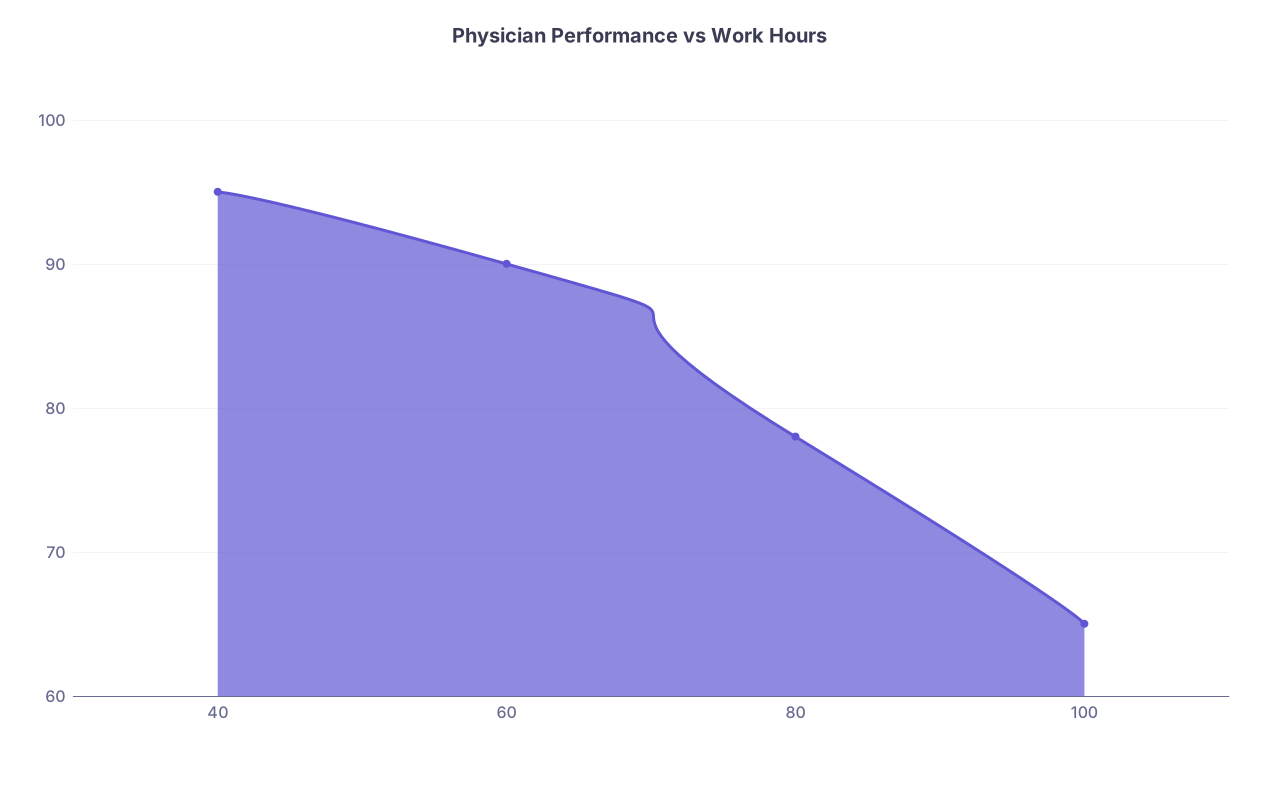
| Category | Value |
|---|---|
| 40 | 95 |
| 60 | 90 |
| 80 | 78 |
| 100 | 65 |
You won’t see an exact graph like that in a paper—it’s illustrative. But the general pattern is backed by data: after a point, more hours don’t mean more good work. They mean more errors and sloppier thinking.
FAQs
1. Isn’t some level of sacrifice just part of being a doctor?
Yes. This is not banking or consulting. You will miss some dinners, holidays, and sleep. The question is whether that sacrifice is:
- Selective, time-limited, and purposeful,
or - Chronic, identity-defining, and self-destructive.
The first is part of the job. The second degrades your clinical performance and shortens your career. The data is clear: sustained burnout and sleep loss are tied to more errors, worse communication, and higher turnover. That’s not noble. That’s harmful.
2. Won’t pushing for balance make me look weak to attendings and programs?
In some places, yes. There are still attendings who wear their trauma like a badge. But more and more, leadership quietly respects the residents and junior faculty who:
- Hand off well
- Show up consistently functional
- Are assertive but reliable
You don’t need to demand spa days. You need to set basic boundaries: take your post-call days, use your vacation, see your doctor, say no to clearly unsustainable extras. People who call that “weakness” are broadcasting their own damage, not delivering moral truth.
3. How do I push back without hurting my patients or my evaluations?
You start small and concrete:
- “I’m concerned that staying another 6 hours post-call will increase my risk of missing something important. Here’s my sign-out plan.”
- “I’m happy to help with this extra project, but I’d need protected time; otherwise my clinical work and learning will suffer.”
- “I need to schedule my own medical appointment; I’ll arrange coverage and clean handoff.”
You frame balance as a patient safety and professionalism issue, not a personal comfort issue. Because that is exactly what it is.
Two key points to walk away with:
- The “good doctor sacrifices everything” myth is not just wrong; it’s associated with worse patient outcomes via burnout, depression, and chronic sleep deprivation.
- Sustainable work-life balance in medicine is not a luxury. It is a professional obligation if you care about your patients, your colleagues, and your own long-term ability to practice safely.