
The belief that you’ll “finally rest after residency” is not just naïve. It is statistically wrong.
For most physicians, rest does not magically appear once training ends. Burnout, workload, moral distress, and work–life conflict don’t evaporate at graduation; they often crystallize into a more permanent pattern. And we’ve got decades of longitudinal data showing exactly that.
If you’re banking on some future, post-residency utopia to save you, you’re basically planning on changing nothing and expecting your life to change. That’s not a career plan. That’s a fantasy.
Let’s walk through what the data actually shows across a physician’s career — and what that means for your ethics, your relationships, and your future patients.
The Myth: “Training Is Temporary, Then It Gets Better”
You’ve heard the script:
- “Just get through residency; attending life is easier.”
- “Once you’re done with call, you’ll finally have balance.”
- “Fellowship is the last hard part. After that, it’s chill.”
This is how exhausted interns justify yet another 28‑hour call. It’s how PGY‑3s talk themselves into a brutal fellowship. It’s how people ignore early warning signs of depression, drinking, or total relational collapse.
The problem: long-term data on physicians says something very different.
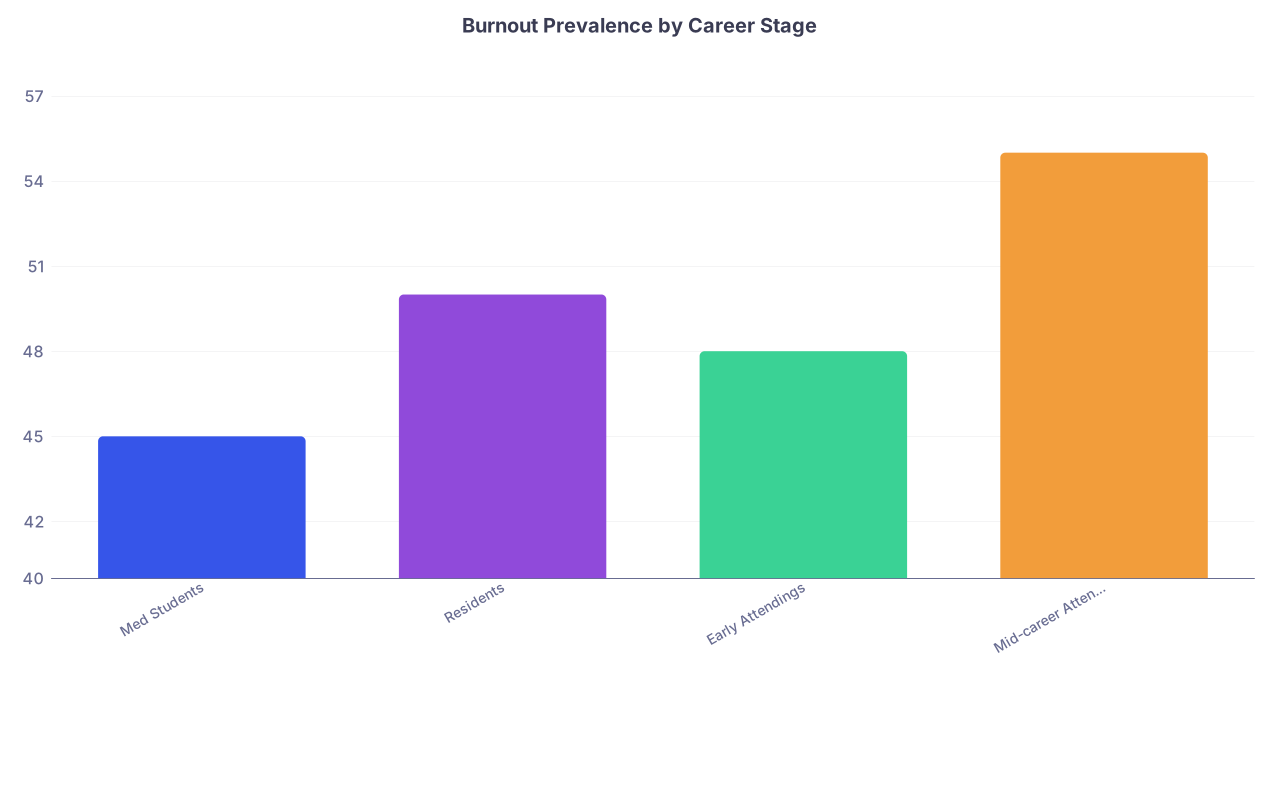
| Category | Value |
|---|---|
| Med Students | 45 |
| Residents | 50 |
| Early Attendings | 48 |
| Mid-career Attendings | 55 |
Across large national surveys (Mayo/AMA, Medscape, national resident surveys), burnout hovers around 40–60% at every stage: med school, residency, early attending, mid-career. The curve doesn’t plunge just because you get “MD, attending” on your badge.
Yes, the stressors change. But the core pattern — chronic overload, poor boundaries, institutional dysfunction — tends to follow you, unless you actively break it.
What Longitudinal Studies Actually Show
Let’s look at actual follow-the-same-people-over-time data, not vibes.
Burnout: Not a Training-Only Problem
Mayo’s multi-year physician burnout cohorts, plus large national samples, paint a very consistent picture:
- Burnout is high in residency.
- Burnout stays high in early attending years.
- For many, it increases in mid-career.
Why? Because the nature of the burden shifts:
- Residents: limited control, long hours, exam pressure.
- Early attendings: RVU targets, productivity pressure, loans, starting a family, building a reputation.
- Mid-career: leadership roles, admin work, accumulation of moral injury, aging parents, kids’ needs, plateaued autonomy.
Burnout is less about “training is hard” and more about “the system is misaligned with human limits.” You exit training, but you don’t exit the system.
Mental Health Trajectories: This Stuff Tracks
Multiple longitudinal and repeated cross-sectional studies show:
- Depressive symptoms spike in training and remain elevated in practicing physicians compared with the general population.
- Physicians have higher rates of suicidal ideation than age-matched non-physicians.
- Many who are struggling in residency don’t spontaneously recover post-graduation – they carry patterns and untreated conditions forward.
The rationalization “I’m only this stressed because I’m a resident” often serves one function: delay. Delay treatment, delay therapy, delay changing anything. That delay is how temporary coping mechanisms turn into long-term pathology.
The Hidden Shift: From Time Poverty to Moral Injury
If you think attending life is merely “less sleep-deprived residency,” you’re missing the real shift.
Residents suffer from time poverty, yes. But attendings increasingly suffer from something worse: moral injury. They know what good care looks like – and the system keeps them from providing it.
Common longitudinal themes you see cited across internal medicine, surgery, EM, and primary care data:
- Growing conflict between clinical judgment and insurer/administrator constraints.
- Increasing fractions of time spent on EMR, billing, authorizations, non-clinical trash work.
- Perception of being treated as a revenue unit, not a professional.
That’s why many early attendings will tell you something you won’t hear on recruitment day: “I’m less sleep deprived than residency, but I feel more trapped.”
So yes, maybe you’ll sleep more as an attending. But if you don’t deal with boundaries and values early, you just trade one kind of exhaustion for another.
Life Outside Work: The Longitudinal Fallout
Let’s talk about the part people hand-wave away: partners, kids, friendships, actual life.
Long-term physician cohort and survey data consistently show:
- Higher divorce rates in certain specialties (surgery, psych, EM, anesthesia historically flagged).
- Higher rates of work–family conflict than high-education non-physicians.
- Physicians frequently report postponing or forgoing children, major life events, or basic self-care due to career demands.
- Many physicians hit mid-career with serious regrets: missed time with children, broken marriages, eroded health.
And no, it doesn’t all “level out” after residency. If you learn during training that your time, body, and relationships are expendable, your first attending job will happily take full advantage of that.

You practice how you’ll live later. Residents who never learn to say no, who never protect a day off like it matters, who normalize being constantly on email — they don’t magically flip into balanced, boundary-respecting professionals. Their future contracts, roles, and expectations evolve around their existing self-abandonment.
Ethics Angle: “I’ll Fix Myself Later” Is a Risk to Patients
This isn’t just self-help talk. It’s ethical.
Medical ethics is full of big, abstract principles, but there’s a blunt practical truth under “nonmaleficence”: chronically impaired physicians hurt people.
Longitudinal findings and large surveys show associations between:
- Physician burnout and higher rates of medical error.
- Depressive symptoms and self-reported suboptimal patient care.
- Poor sleep and impaired cognitive performance, clinical reasoning, and empathy.
If your plan is “I’ll run myself into the ground for a decade, then recover,” what you are actually planning is:
- To provide care while cognitively and emotionally compromised.
- To practice for years while less attentive, less kind, more irritable, and more error-prone than you could be.
- To expose patients to a provider who is physically present and ethically half-there.
That’s not noble sacrifice. That’s a slow ethical drift.
There’s also the role-modeling problem. Trainees copy what they see. A burned-out attending who brags about “never taking a sick day” or “working through pneumonia” is teaching future doctors that self-harm is professionalism. That’s not ethics. That’s indoctrination.
The Career Trap: Your First Job Locks In the Pattern
Another myth: “I’ll just take a tough job for a few years to pay off loans, then I’ll find balance.”
Data on physician job satisfaction and mobility says: be careful.
- Many physicians stay longer than planned in their first or second job because golden handcuffs grow fast: mortgage, kids’ school, lifestyle inflation, RVU bonuses.
- The longer you’re in a dysfunctional environment, the more “normal” it feels. Your sense of what’s acceptable erodes.
- High workloads + burnout reduce the cognitive and emotional capacity needed to job search, negotiate, and transition. By the time you need to leave, you’re often too depleted to move.
So that “temporary grind” first job easily becomes your default operating system.
| Stage | Main External Stressors | Main Internal Risks |
|---|---|---|
| Residency | Hours, exams, hierarchy | Learned helplessness, self-neglect |
| Fellowship | High responsibility, low control | Narrow identity, perfectionism |
| Early Attending | RVUs, loans, admin pressures | Overwork normalization, moral injury |
| Mid-career | Leadership, family, aging | Cynicism, regret, disengagement |
If you keep telling yourself, “I’ll rest later,” later keeps moving.
The Neurobiology You’re Ignoring
Let’s talk physiology since medicine pretends everything is mental toughness.
Chronic sleep deprivation, stress, and overwork during training do not just make you tired. They reshape your brain and body systems.
Long-term elevated stress and messed-up sleep are associated with:
- Impaired executive function and memory.
- Mood disorders and anxiety.
- Cardiovascular risk, metabolic syndrome, weight gain.
- Increased substance use risk.
If your 20s and early 30s are spent teaching your nervous system that constant hyperarousal is “normal,” you’re building:
- A baseline of anxiety or numbness you stop noticing because it’s always there.
- A physiology that will require real effort and time to heal — if you ever give it the chance.
So when you say, “I’ll fix things when the schedule lightens up,” you’re betting on a nervous system that, by then, is less flexible, more rigidly wired into stress responses, and potentially addicted to stimulation or numbing behaviors.
This is why so many mid-career physicians say, “Even on vacation, I can’t relax.” That’s not personality. That’s conditioning.
What Actually Changes Your Trajectory (And What Doesn’t)
Here’s the part where people want a productivity hack. “So what’s the trick to survive training and be fine later?”
There is no trick. But there are moves that show up repeatedly in outcome differences.
Things That Do Not Reliably Work
Telling yourself “It’s just a phase.”
The longer a pattern runs, the more entrenched it becomes — both in your brain and in the expectations of people around you.Waiting until after Step/Boards/fellowship/tenure to address mental health.
Delayed care is worse care. That doesn’t stop being true when the patient is a physician.Banking on “better” institutional culture without changing your own behavior.
You carry your boundaries with you. Or you don’t.
Things That Actually Shift Longitudinal Outcomes
Patterns I’ve seen in physicians who don’t end up wrecked at 45:
Early, non-negotiable boundaries.
The resident who actually uses their vacation. Who tells their co-residents, “I don’t respond to non-urgent texts post-call.” Who doesn’t brag about drowning. These people annoy some colleagues. They also last longer.Getting treatment early instead of white-knuckling.
Therapy, meds, coaching — whatever actually addresses depression, anxiety, trauma, substance misuse. The data is not subtle: untreated mental illness ruins more careers (and lives) than treated mental illness.Choosing first jobs by values not just money or prestige.
Look for real control over schedule, sane patient loads, leadership that isn’t lying about wellness. If you walk into a place where every “happy” attending is actually a workaholic with a crumbling personal life, believe what you see, not what they say.Intentionally maintaining non-medical identity.
Hobbies, non-physician friends, community. People who keep something outside medicine are buffered against the full impact when work goes sideways.Learning to say no while you’re still a trainee.
Residents who never practice pushing back on unsafe workloads or extra unpaid tasks don’t magically develop that skill with a slightly bigger paycheck.

| Step | Description |
|---|---|
| Step 1 | Training Years |
| Step 2 | High burnout |
| Step 3 | More sustainable path |
| Step 4 | Early attending overwhelmed |
| Step 5 | Early attending selective |
| Step 6 | Trapped in bad job |
| Step 7 | Chooses aligned job |
| Step 8 | Default Pattern |
The Ethical Reframe You’re Avoiding
There’s a myth underneath the myth: that sacrificing yourself now is “for your patients” and therefore morally superior.
Reality check:
- A clinician who is chronically exhausted, cynical, or detached is not providing optimal care, no matter how many hours they log.
- A parent who is never emotionally present at home because of work “for the kids” is not actually doing their children a favor.
- A trainee who normalizes self-abuse in the name of professionalism is feeding a culture that will chew up the next generation.
Building a sustainable life during training is not selfish. It’s the only ethical way to commit to decades of clinical responsibility without harming yourself, your patients, or everyone stuck in a relationship with you.

So What Do You Do Right Now?
I’m not going to pretend you can manifest a perfect schedule in a malignant program. Some systems are bad. Some rotations are abusive. Sometimes survival is the immediate win.
But you still have leverage — not infinite, but real. If you’re in med school or residency:
Stop repeating the script. When someone says, “It’ll be fine after residency,” challenge it: “Data doesn’t really support that; we have to build good patterns now.” Say it out loud. Normalize honesty.
Pick one boundary and enforce it ruthlessly. One day off actually off. One activity per week you don’t cancel. One sleep rule you protect. You’re training your environment and your nervous system.
Treat mental health like any other health problem. If a patient had your symptoms, you’d refer them. Apply the same standard to yourself. Waiting for “later” is how conditions worsen.
Pay attention to attendings who seem genuinely well. Not fake Instagram wellness. The ones whose kids still talk to them, who have energy, who speak with some joy. Ask what they did differently at your stage. Then actually listen.
If you’re already an attending and this all sounds too familiar: it’s not too late, but the cost of change goes up over time. That’s what longitudinal data really means. The sooner you alter the slope, the less dramatic the intervention has to be.
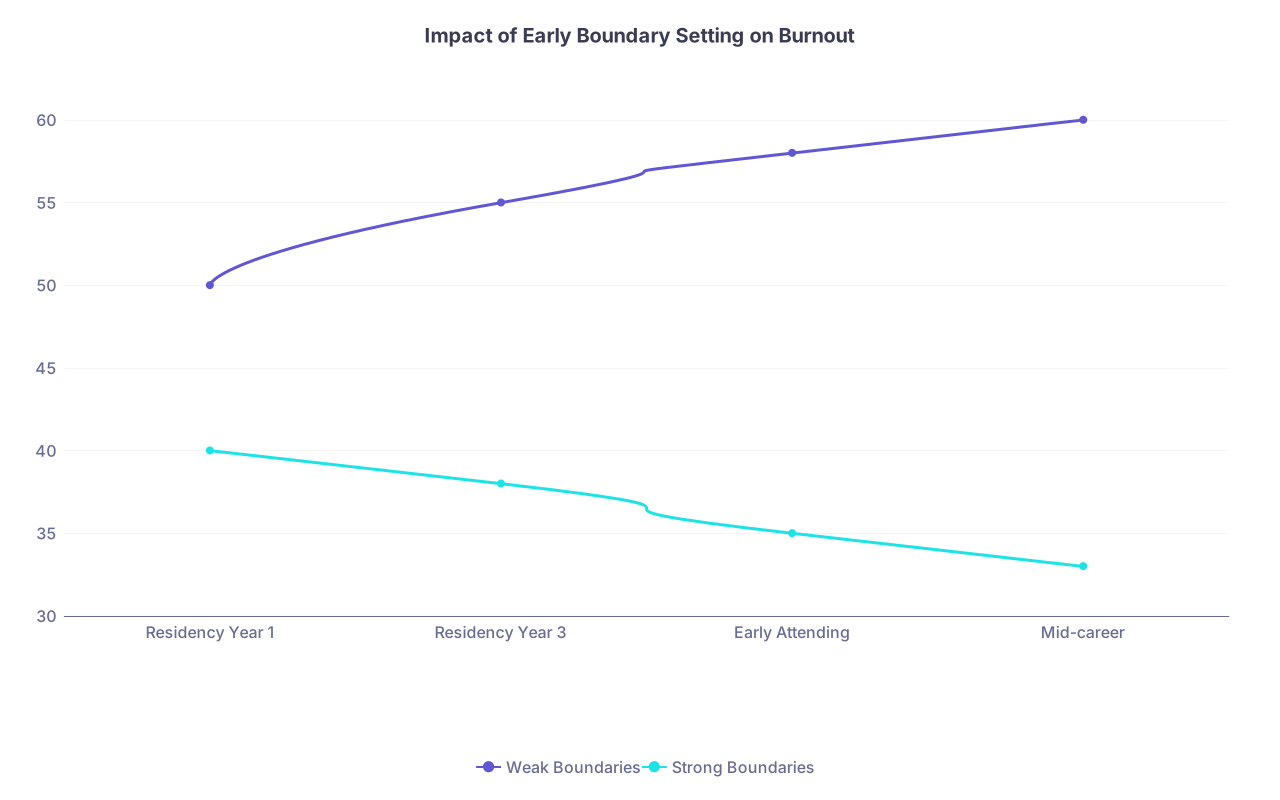
| Category | Weak Boundaries | Strong Boundaries |
|---|---|---|
| Residency Year 1 | 50 | 40 |
| Residency Year 3 | 55 | 38 |
| Early Attending | 58 | 35 |
| Mid-career | 60 | 33 |
That chart isn’t from one specific study; it’s the direction that keeps showing up across multiple cohorts: people who set limits earlier do not eliminate stress, but the trend line is different. Flatter. More survivable.
The Bottom Line
Three truths to walk away with:
Residency is not a temporary aberration; it’s the training ground for how you’ll live and practice. If you normalize self-erasure now, you embed it.
Burnout and imbalance do not magically resolve after training. Longitudinal data shows high distress across the career arc unless boundaries, values, and environments change.
Taking care of yourself now is not selfish — it’s a prerequisite for ethical, sustainable practice. Patients do not need a martyr. They need a healthy, present, clear-thinking physician.
Stop planning to rest “after residency.” Start planning how you’re going to practice medicine for 30+ years without destroying yourself or the people around you. That’s the real work–life balance question.