
The culture of “just take it” on service is broken—and you are allowed to stop cooperating with it.
If you are drowning in pages, staying two hours late every day, picking up everyone else’s slack, and silently fuming, that is not a personality flaw. That is a boundary problem in a system that quietly rewards self‑sacrifice and punishes self‑respect.
You do not fix that with “self-care” posters. You fix it with scripts, habits, and lines you refuse to cross.
This is your script book.
1. The Core Rule: Boundaries Beat Good Intentions
On‑service overload is predictable:
- Chronic understaffing
- “Just do me a quick favor” culture
- Attendings who equate martyrdom with professionalism
- Residents afraid of being labeled “not a team player”
You cannot wait for the system to be kind. It will not. You control three things:
- What you agree to
- How you say no
- How early you speak up—before you are underwater
The ethical frame matters here. Medicine loves to weaponize “patient care” to justify anything. So let’s be explicit:
- You have a duty to patients
- You have a duty to yourself
- You have a duty to your team not to become unsafe, bitter, or sloppy because you refused to set limits
Burned-out residents make more errors. That is not noble. That is dangerous.
So the question is not “Am I being selfish if I set boundaries?”
The real question is “Am I being reckless if I do not?”
2. A Simple Boundary Framework: What You Will and Will Not Do
Before we get into word‑for‑word scripts, you need a mental checklist. Otherwise you will cave every time someone looks stressed and says “can you just…”
Here is a tight, usable framework: Must / Can / Cannot
- Must do – non‑negotiable patient‑safety tasks and time‑critical care (RRTs, unstable patients, STAT orders, new sepsis, STEMI, acute mental status changes, new admission about to be bedded, etc.)
- Can do – important but schedulable work that can be redistributed, delayed, or negotiated (routine family updates, elective consults, discharge dictations when the unit is blowing up, non‑urgent messages)
- Cannot do – work that violates your duty-hour rules, your scope, or pushes you into clear unsafe territory (consistently staying >30–60 minutes beyond shift end, doing another team’s H&Ps every night, “just finishing the list” while post-call, signing orders you do not understand)
When you are overwhelmed, run new requests through this filter out loud, even briefly:
“Is this a must, can, or cannot right now?”
That one internal question makes it far easier to say no without guilt.
3. Scripts For Saying “No” Without Being a Jerk
You do not need magical charisma. You need 3–4 phrases you can say under stress without thinking.
A. To a co‑resident asking you to take extra patients
Scenario: You already have 12 patients. Senior asks if you can take “just one more.”
Script 1 – Hard boundary with safety frame
“I am at a safe limit with 12. If I take a 13th I will start compromising care for the others. We need to redistribute or get attending input.”
Script 2 – Redirect with options
“I cannot safely add another admission right now. I can help with discrete tasks—like putting in orders if you see them—but I cannot take full responsibility for another patient.”
The key: name “safe limit,” not “I am tired.” Safety is harder to argue with.
B. To an attending who keeps adding “just one more” task
Scenario: It is 5:45 pm. Your signout starts at 6:00. Attending: “Before you go, can you also call this family, place the SNF packet, and clean up those notes?”
Script – Respectful but firm
“I have 15 minutes before signout and still need to finish two critical notes and update the cross-cover. I can do one of those now. Which is highest priority? The rest will need to be handed to the night team or done tomorrow.”
Follow‑through is critical. Once they choose, you stop there.
If they push:
“If I try to do all of that now, I will be here significantly over my shift and rushing through important details. I am not comfortable with that from a safety standpoint.”
C. To a nurse with a non‑urgent request when you are in the middle of a crisis
Scenario: You are stabilizing a crashing patient. Another nurse asks you to renew a bowel regimen or sign home meds.
Script – Acknowledge, triage, promise
“I hear you. I am in the middle of a critical situation in room 14 and have to focus here. If it is not time‑sensitive, please page me again in 30 minutes, or I will circle back after we stabilize this patient.”
If it is urgent, they will say so. Then you reprioritize.
D. To a consultant pushing work back onto you inappropriately
Scenario: You consult Cards; they say, “Just order the TTE, start heparin, and we will see in the morning,” without seeing the patient.
Script – Clarify responsibility
“To make sure I am clear: you are comfortable placing these orders without seeing the patient tonight and assuming responsibility for that plan? I want that documented clearly.”
Suddenly, people remember how to come see the patient.
E. To family members when you are getting overloaded with calls
Scenario: Three different families expect long daily phone calls “whenever you have time,” and it is wrecking your afternoon.
Script – Set expectations up front
“I want to make sure you get updates, but I also want to be honest about time. On most days I can do one focused update call in the late afternoon, between 3 and 5 pm. If something urgent happens, we will call you immediately, but for routine updates, look for that afternoon call.”
And when they try to escalate:
“Right now I am taking care of another patient with more urgent needs. I will call you during the usual afternoon window today.”
4. Pre‑Shift Boundary Moves: Fix the Day Before It Breaks You
You do not wait until 4:30 pm when you are 20 notes behind to set boundaries. You start during pre‑rounds and morning huddle.
Step 1: Quick daily capacity check
Ask yourself at 7 am:
- How many active problems per patient?
- How many planned discharges?
- How many family meetings or complex tasks today?
- Any didactics or clinic that cuts your availability?
Then say it out loud in team rounds.
Script:
“I want to flag that I have two likely discharges, one family meeting at 2 pm, and clinic from 3–5 pm. That puts my real capacity lower this afternoon. If we expect new admits, we should plan who can own them.”
This is defensive medicine for your sanity.
Step 2: Hard‑wire your signout time
Pick a time that you aim to be ready for signout—30 minutes before actual signout.
Example: If protected signout is 6:00 pm, your internal “pencils down” time is 5:30 pm:
- 5:30–6:00 pm is buffer: wrap notes, clean up orders, print lists, check labs
- After 5:30, you do not start elective tasks
Script when someone asks for elective work after 5:30:
“I am in my signout prep window and need to focus on making sure the night team has clean information. If this can wait until tomorrow, I will put it on the AM to‑do list. If it is truly time‑critical, I need to adjust signout timing with the senior.”
Yes, you say that. Out loud.
Step 3: Use “bundling” to cut death‑by‑a‑thousand‑pages
Ban this habit: answering one page at a time in real time all day.
Instead, you batch non‑urgent work:
- Ask nurses and unit staff to bundle non‑urgent issues
- Designate check‑in times (“I will come through rooms 10–16 after rounds for med questions.”)
- Use EMR messaging lists or sticky notes on your brain sheet for later
Script to nursing:
“If it is urgent or about safety, please page me immediately. For non‑urgent things like bowel regimens, diet clarification, or sleeping meds, if you can note them and page me once with several items, I can address them all in one visit. That way I can spend more focused time with each patient.”
Most nurses respect this if you are consistent and responsive to the truly urgent stuff.
5. Handling the Politics: When Saying No Has Consequences
Yes, there is risk. Some seniors and attendings do not like boundaries. They prefer pliable residents.
So you need a strategy for:
- Pushback
- Retaliation through evaluations
- Passive‑aggressive comments about “work ethic”
A. Document reality like a lawyer
You are not writing a manifesto. You are creating a thin paper trail that says: “This person was overloaded and tried to fix it.”
| Time | Issue | Action Taken |
|---|---|---|
| 07:30 | Assigned 14 patients, 3 new | Raised with senior, no change |
| 14:00 | New admission + RRT on patient | Asked to redistribute, declined |
| 18:15 | Still writing notes post-signout | Logged duty-hour exception |
You can keep this in a private, secure note or email yourself using institutional systems if allowed. No patient identifiers. Just workload and your attempts to escalate.
When someone later says, “You never spoke up,” you have timestamps.
B. Escalate early, not when you are already failing
If your load is unsafe by 10 am and your senior shrugs, you do not wait until 7 pm to melt down.
Script to attending (in person if possible):
“I want to flag a patient‑safety concern. I am currently carrying 14 active patients including 3 new, with 2 possible discharges and a family meeting this afternoon. I have already raised this with [senior] and there has been no adjustment. At this level I cannot guarantee timely care or safe handoffs. I need either redistribution or help redefining priorities.”
Use the phrase “patient‑safety concern”. That phrase has weight. Use it carefully, but do not be shy when it is true.
C. When evaluations punish your boundaries
You may face vague comments like: “seemed less willing to go the extra mile” or “rigid about duty hours.”
Here is how you answer in a semi‑annual or remediation meeting:
“I take patient care very seriously and want to be clear that when I raised concerns, it was in the context of unsafe volumes or routine duty‑hour violations. I consistently completed must‑do clinical tasks and communicated proactively when I needed help. My goal is sustainability and safe practice, not doing less work than my peers.”
Then bring your log. Calm, not dramatic.
6. Ethical Backbone: Framing Boundaries as Professional, Not Selfish
You are in a profession that confuses self‑harm with virtue. You must rewire that in your own head or you will cave every time.
Here is the ethical spine you can lean on:
- Nonmaleficence applies to you. Chronic sleep deprivation, emotional trauma, and moral injury are harm. To you. To your future patients.
- Justice matters. If you silently absorb every systems failure, leadership sees no problem. The burden becomes invisible, and the next class gets the same or worse.
- Fidelity to patients includes being competent. A resident who has not eaten for 16 hours and is on hour 90 of the week is not as competent as they could be. This is not your personal weakness. It is physiology.
So when someone suggests that leaving near your actual end time or refusing a 15th patient is “unprofessional,” you can internally answer:
“No. Sacrificing safety to protect a broken workflow is unprofessional.”
You do not always say that out loud. But you operate from that truth.
7. Concrete Scripts for the Worst Situations
A. You are post‑call and being asked to “just finish” more work
Scenario: You signed out at 7 am post‑call. At 11 am, you are still in the hospital doing notes and tying up loose ends. Someone asks you to “just quickly” see a new consult because “you know the patient best.”
Script:
“I am post‑call and already significantly over my safe duty hours. I am not comfortable taking on new clinical responsibilities in this state. The day team needs to assume full responsibility for new issues.”
If they guilt trip you:
“I understand continuity is ideal. But right now this is a duty‑hour and safety boundary. I am not asking for less work overall. I am asking not to practice while impaired.”
B. Night float being crushed with cross‑cover plus admissions
Night float is boundary hell. You get:
- All cross‑cover issues
- New admits
- Endless pages from floor and ICU
You cannot “work harder” out of this. You triage.
Script to charge nurse when overwhelmed:
“I want to make sure we are safe tonight. I currently have [X] new admissions in progress and [Y] urgent cross‑cover issues, including [short list]. For non‑urgent things—like sleep aids, routine lab checks, or bowel regimens—please bundle pages and send them after midnight, or I will address them after I stabilize the sickest patients.”
If the volume is truly unsafe, you escalate to the night attending:
“I need help prioritizing. I have three active admissions, an RRT just triggered, and am getting >20 pages per hour. At this point I cannot respond safely to everything. What can we delay or redirect?”
C. Saying no to tasks outside your role or competence
Scenario: You are a PGY‑1 in IM. Nurse asks you to “just quickly” adjust the vent settings. Or you are a med student, and a resident asks you to write and sign orders.
Script 1 – For scope
“That is outside my scope of practice. I am not credentialed to do that and it would be unsafe for me to try. We need the appropriate clinician.”
Script 2 – For competence
“I have not been trained to do that independently. I can assist or observe if someone qualified is doing it, but I cannot own that decision on my own.”
That is not weakness. That is professional honesty.
8. Practical Tools To Keep You From Sliding Back
A few boring but powerful tools you should actually use:
A. A tiny “boundary checklist” on your badge card
Write on the back of a blank card or your brain sheet:
- Must / Can / Cannot
- “I am at a safe limit with…”
- “I can do one of those—what is priority?”
- “I am concerned about patient safety at this workload.”
- “That is outside my scope / training.”
When you are tired, you will not remember perfect phrasing. Read it.
B. Weekly 10‑minute review
Once a week, ask yourself:
- When did I feel resentful?
- When did I stay late and why?
- Which “yes” should have been a “no”?
- Who can I talk to about recurring overload? (Senior, chief, program director)
Then choose one recurring problem and plan exactly what you will say next time.
Not vague “I’ll speak up more.” A literal sentence.
C. Learn your program’s real thresholds
Every place has unofficial boundaries that nobody tells you:
- “Over 16 patients on the day team, chiefs start caring.”
- “Logging duty‑hour violations triggers a quiet email but no one dies.”
- “The ICU overnight cap is X unless there’s a mass casualty.”
Ask the seniors you trust:
“Real talk—what volume would you call ‘unsafe’ enough to escalate? How do you actually phrase it here?”
Steal their language. It is adapted to your culture.
9. A Visual: Where Your Time Actually Goes
Most overloaded residents underestimate how much time disappears into non‑core tasks.
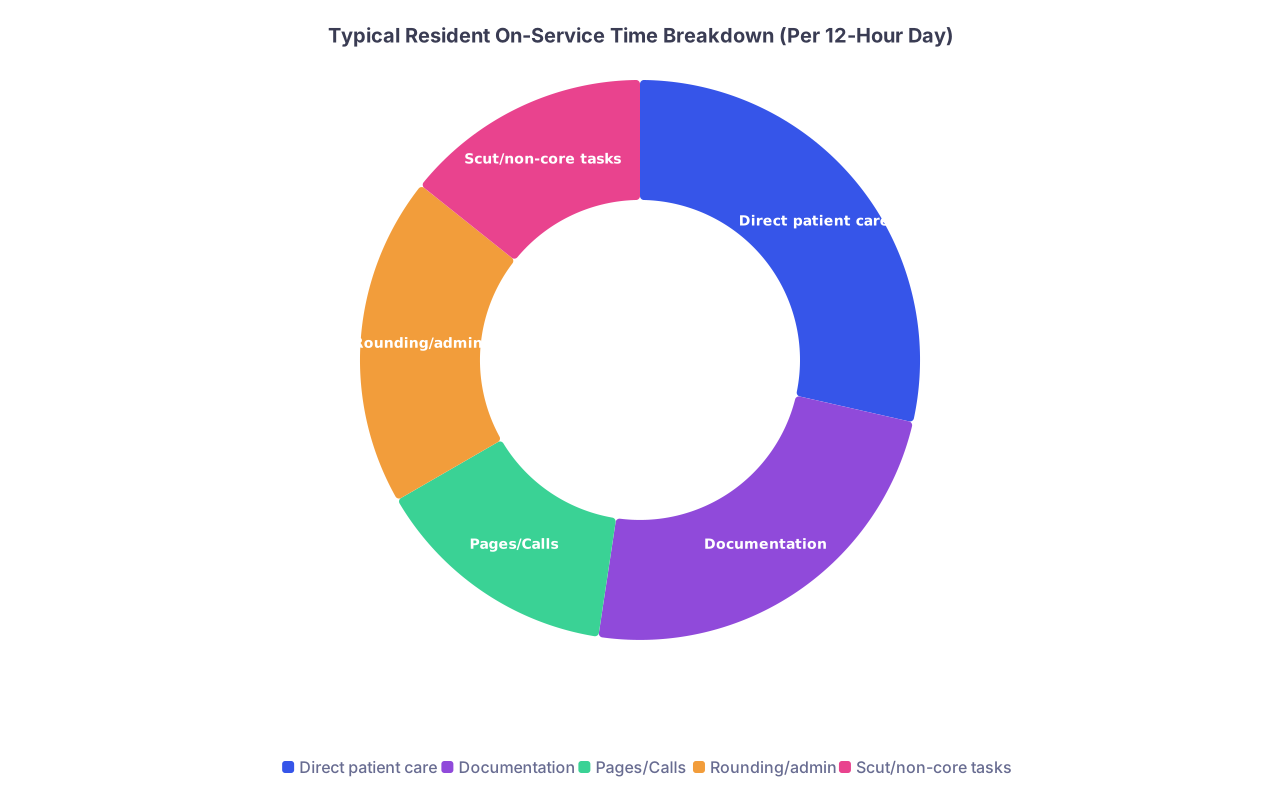
| Category | Value |
|---|---|
| Direct patient care | 180 |
| Documentation | 150 |
| Pages/Calls | 90 |
| Rounding/admin | 120 |
| Scut/non-core tasks | 90 |
That is 10+ hours of actual tracked work. Notice the “scut/non‑core” slice. That is your boundary opportunity.
10. Boundary Scripts Sorted by Stakeholder
Here is a quick reference block you can screenshot.
To Seniors
- “I am at my safe capacity with this panel. Taking more will risk delays and errors. Can we redistribute?”
- “To stay on time for signout, I need to start wrapping up now. Anything urgent still pending?”
- “I am concerned that our current volume is a patient‑safety issue. Can we loop in the attending?”
To Attendings
- “Given my current load of [X] patients and [Y] new/unstable, I can commit to doing [A] and [B] today. For [C] and [D], I will need help prioritizing or redistributing.”
- “I can either stay late to finish these non‑urgent notes or leave on time and complete them first thing in the morning. From a safety standpoint, I prefer the latter.”
To Nurses / Staff
- “If it is urgent, page me right away. For non‑urgent issues, can you please group them so I can handle several at once?”
- “I am with an unstable patient; I will get to that order in about 30 minutes if it is not critical. If it becomes urgent, please page again and mark it STAT.”
To Yourself
- “I am not lazy. I am choosing to be sustainable.”
- “If I burn out, this system will not thank me. It will replace me.”
- “Boundaries are not a luxury. They are a safety device.”
11. One More Layer: Career‑Long Boundary Strategy
You are not just surviving this month’s rotation. You are training your future self how to practice.
Residents who never learn boundaries:
- Become attendings who normalize abuse
- Accidentally model overload to students and interns
- End up bitter, cynical, and sometimes out of medicine
Residents who learn to set clean, respectful boundaries:
- Are more likely to stay clinically active long term
- Are better teachers—because they understand sustainable practice
- Are more credible when they advocate for systemic change
You are writing your professional ethic right now, whether you feel ready or not.