
The idea that you should just “push through” clinic until you collapse is lazy thinking and bad medicine. Your patients do not need a martyr; they need a clinician whose brain still works at 4:30 p.m.
You are not going to fix burnout with a yoga retreat or a mindfulness app you never open. You fix it with boring, repeatable micro-routines built into the actual chaos of clinic.
Let me show you how.
The Real Problem: Clinic Is Designed To Drain You
Clinic days feel terrible not just because you are busy, but because of how the work is structured:
- Constant task switching: portal messages, labs, refills, walk-ins, attendings, nurses, EMR alerts.
- Emotional whiplash: breaking bad news in one room, acne follow-up in the next, angry parent two rooms down.
- Zero recovery: you binge consults back-to-back, then wonder why you are fried by noon.
Your brain is not failing. The system is. But you still have to survive inside it.
The only reliable lever you control? Your micro-routines:
- 15–60 second behaviors you can repeat dozens of times a day.
- Tiny, almost stupidly small, but chained together they change how your nervous system rides the day.
- So automatic that you do them on your worst day, not just your best.
I am not talking about “take deep breaths when stressed” nonsense. I mean specific protocols timed to real clinic events: opening the chart, knocking on the door, signing orders, getting interrupted.
We will build:
- A pre-clinic launch routine (5–7 minutes).
- Doorway reset rituals (10–30 seconds between patients).
- EMR survival rules (for charting without brain melt).
- Micro-boundaries for pagers, staff, and “quick questions”.
- End-of-clinic shutdown routine so work does not bleed into your night.
You can implement most of this tomorrow.
Step 1: Pre-Clinic Launch – 7 Minutes That Change the Entire Day
If you start clinic already frazzled, the day owns you. You need a launch sequence, not a scramble.
Aim for 7 minutes before the first patient. If you are a resident, you will rarely get all 7. Fine. You can do a stripped-down 3-minute version.
1.1 The 3-Box Mental Map (2 minutes)
Pull up your schedule and sort the session into three mental “boxes”:
- Box 1 – Stable / fast: quick follow-ups, straightforward refills, simple issues.
- Box 2 – Medium complexity: chronic disease management, diagnostic uncertainty.
- Box 3 – Heavy / emotional / chaos-prone: new cancer, complex psychosocial, angry family, vague “everything hurts”.
You do not need a spreadsheet. Just scan your schedule and mark:
- “L” for likely heavy (Box 3)
- “M” for medium (Box 2)
- Nothing for light (Box 1)
Write these letters next to names on your printed list or a sticky note on your workstation.
Why it works: You stop being surprised by the hard rooms. Anticipation lets you budget energy and time.
1.2 Define a “Good Enough” Day (2 minutes)
Too many clinicians walk in with an unspoken fantasy of perfection. That guarantee of failure is exhausting.
Instead, define three concrete, achievable standards for this clinic session:
- Safety standard (non-negotiable):
“No missed red flags. All critical labs handled. Clear documentation on anything risky.” - Connection standard (minimal but real):
“Every patient gets one moment where I stop typing, look at them, and listen.” - Efficiency standard (protects your future self):
“No chart left completely untouched after the patient leaves the room. At least an outline and key elements done.”
Write your three statements on a sticky note at your desk. Look at it when you feel behind.
This shifts your brain from “I must be perfect” to “I must meet these three clear targets.” That is how you reduce cognitive load.
1.3 Pre-Clinic Body Prep (3 minutes)
Yes, your body is the hardware. If it crashes, the rest follows.
Here is a 3-minute protocol you can do in a supply room or corner:
Posture reset (45 seconds)
- Stand with your back against the wall, head touching if you can.
- Roll shoulders back and down, slight chin tuck.
- Two slow inhales through the nose, long exhale through the mouth (like fogging a mirror quietly).
Tension scan (60 seconds)
Ask three questions:- Jaw clenched? Unclench. Let your tongue rest on the floor of your mouth.
- Shoulders up by ears? Drop them.
- Hands gripping? Open and shake them out for 5 seconds.
Micro-movement (60–75 seconds)
- 10 slow calf raises holding onto the counter.
- 10 mini-squats or sit-stands from a chair.
- 10 arm circles each direction.
You are not working out. You are signaling your nervous system: “I am not trapped.”
Step 2: Doorway Rituals – Reset Between Patients Without Losing Time
The doorway is your control point. The few seconds before and after a room are where you can protect or waste your energy.
You need two rituals:
- Door-out (leaving a room)
- Door-in (entering the next room)
These take 10–20 seconds each.
2.1 Door-Out: Drop the Last Patient Before You Move On
The mistake: You leave Room 3 with your mind replaying that argument while walking into Room 4. Now patient 4 suffers, and so do you.
Here is the Door-Out sequence (pick a version that fits your style):
Standard version (10–15 seconds):
- Hand on doorknob, pause one second before turning.
- In your head, label the room with three words max:
“Grief, unrealistic expectations, refills.” (Does not matter. Just label it.) - Mentally say: “That was Room 3. Next.”
- Turn the knob, step into hallway, roll your shoulders once as you close the door.
You are physically and mentally choosing to compartmentalize. That is not cold; it is professional.
If the room was heavy (death, abuse disclosure, rage):
Add 5 seconds:
- As you close the door, very quietly exhale with a soft “hhhhh” sound, like letting air out of a tire.
- In your head: “That was hard. I did what I could with the time I had.”
This phrase prevents the emotional hangover from spilling into the next interaction.
2.2 Door-In: Arrive Like You Actually Care (Without Overgiving)
Your next patient does not deserve residue from the last 4 rooms.
Door-In sequence (10–20 seconds):
Right before your knuckles hit the door:
Single breath: In through the nose 3–4 seconds; out 4–6 seconds.
Micro-intention: Think one sentence about what you are about to do:
- “One thing I can help with.”
- “Be clear and kind, even if brief.”
- “Listen for the real concern.”
Face reset: Release your jaw, let the corner of your mouth lift slightly. Not a fake grin. Just not your chart-face.
You will feel fake the first week. Then it becomes automatic.
Step 3: EMR Survival – Micro-Routines for Charting Without Meltdown
The EMR is where clinic days go to die. You will not fix Epic. You can fix how you move inside it.
3.1 The 2-Minute “Anchor Note” Rule
After each patient, before you answer any message or respond to any interruption, you do 2 minutes on that note. Non-negotiable.
In those 2 minutes, you must capture:
- Chief complaint / HPI headline (one or two sentences).
- Key positives/negatives you will forget.
- Provisional assessment line.
- Planned labs/imaging/referrals.
It might look like this, typed in fragments:
45F here for DM2 + new foot numbness.
A1c 9.1, has not been taking metformin consistently.
Numbness plantar surface, no red flags (no incontinence, no back pain, no fever).
Likely neuropathy + med adherence issues.
Plan – reinforce meds, start gabapentin?, check B12, TSH, foot exam done normal, podiatry if worsens.
Is that pretty? No. Is it enough that Future You can finish the note at 5 p.m. without reconstructing the entire visit from dust? Yes.
This is how you stop taking 10 ghost charts home every night.
3.2 The “Single-Screen” Rule
Every time you are in the EMR, you ask: “What is the single most important screen I should be on right now?”
Rules:
- When with patient: stay on note or vitals. Do not wander into inbox.
- When in hallway: stay on notes or results. Do not “just check” new messages.
- When doing inbox: full screen inbox, no alt-tabbing to half-written notes.
Every unexpected screen switch costs energy. You cut that cost.
3.3 Quick-Click Templates That Actually Help
If your templates are novels, you are hurting yourself.
Build three tiny, targeted templates:
Normal follow-up visit skeleton
- HPI: “Follow-up for [condition]. Since last visit… [ ] Better [ ] Worse [ ] Same.”
- ROS: 3–5 relevant systems with checkboxes.
- Plan: medication section, monitoring, return time.
Results discussion visit
- HPI: “Discuss [test] from [date]. Patient aware / unaware of results. Main concern: ____.”
- Assessment: 2–3 likely interpretations.
- Plan: clearly list what changes and what does not.
High-emotion visit (bad news, chronic pain, etc.)
- HPI: “Primary concern today: ____.”
- Context: social situation, supports, key stressors.
- Assessment: “Medical factors: … / Psychological factors: …”
- Plan: what you will and will not do today.
Your micro-routine: when you open a visit, you insert one of these three, then type. Do not free-type from scratch every time.
Step 4: Energy-Protecting Boundaries That Actually Work in Clinic
Talking about boundaries is easy on podcasts. Doing it when the nurse is at your door with “just a quick question” is harder.
You need scripts. And rules.
4.1 The 30-Second Interruption Triage
Every interruption gets triaged into one of three bins:
Now (stop what you are doing):
- Airway/breathing/circulation issue, crashing patient.
- Medication error with potential serious harm.
- Security/safety concern.
Soon (finish this thought, then address):
- Nursing question blocking discharge.
- Family at front desk escalating.
- Lab critical but not immediately life-threatening in the next 5 minutes.
Later (put into your system, not your head):
- Refill questions that can wait 30–60 minutes.
- Administrative tasks.
- Non-urgent consult opinions.
You need one sentence for each category.
Scripts:
- For Now: “I am coming right now. Let me save this and walk with you.”
- For Soon: “I need 60 seconds to finish this order so I do not make a mistake, then I will come find you.”
- For Later: “This is not urgent-urgent. Can you put it in the message pool / list it on the board? I will handle it in the next 30–60 minutes.”
Say that last one verbatim three times a week, minimum.
4.2 Protecting Your Brain During Hallway “Favors”
Residents especially get crushed by “while you are here…” requests.
You need a Hallway Rule:
- You do not accept a new hallway task unless:
- You know exactly what it is.
- You either write it down or do it immediately.
Do not trust your brain. Use a card in your pocket or your phone notes app titled “TODAY – CLINIC”.
Micro-routine:
- When someone asks for something:
- Repeat it back: “You need me to refill Ms. Lopez’s lisinopril and send a message to cardiology, right?”
- Decide:
- If it is <60 seconds, do it now.
- If longer, say “I will add it to my list; I cannot do it right this second.”
- Write it down then and there on the card/app.
This is not about being controlling. It is about not pretending you will remember 12 extra tasks while 3 patients are waiting.
Step 5: Micro-Rest Without Getting Behind
You cannot go from 8 a.m. to 5 p.m. without mental micro-breaks and stay sharp. That is fantasy.
You can build rest into the cracks without adding time.
5.1 The 4x20 Rule
Aim for four 20–40 second micro-breaks every half-day. That is it.
They plug into existing transitions:
- After finishing a note.
- Waiting for a patient to undress.
- While the MA rooms the next patient.
- While the computer loads (yes, that spinny wheel is your ally).
Use one of these during each micro-break:
Option A – Visual reset
- Look at something at least 20 feet away for 20 seconds.
- Let your gaze go slightly soft.
- No phone, no screen.
This relaxes the extraocular muscles and actually reduces headache and eye strain.
Option B – Box breath (classic, but it works)
- Inhale 4 seconds → hold 4 → exhale 4 → hold 4.
- 2 cycles. Done in under 40 seconds.
Option C – Physical offload
- Lean your hands on the counter, push your hips back like a half-stretch.
- Slow shoulder roll + neck side-bend each side.
- One big yawn, even if fake. It signals your nervous system.
You will be tempted to skip these when behind. That is exactly when to do them.
Step 6: Emotional Micro-Ethics – Staying Human Without Drowning
Work–life balance in clinic is not only about time and exhaustion. It is about moral injury: the feeling you are constantly failing your patients because you do not have enough time, resources, or support.
Micro-routines help here too, or you end up numb or flooded.
6.1 One “Human Moment” Per Patient
You cannot give 20 minutes of deep empathy to every person on a packed schedule. You can do 15 seconds.
Routine:
- At some point in the visit, you stop typing. You look at the patient. You say something that acknowledges them as a person, not a problem.
Examples:
- “You have had a lot on your plate since the last time I saw you.”
- “This sounds exhausting.”
- “I am glad you told me that; people often keep that to themselves.”
That is it. You do not have to process their entire life. But that micro-connection keeps you anchored to why you are here.
6.2 Ethical Boundary Phrases for Overloaded Visits
When a visit explodes into 10 issues in 10 minutes, your ethics and your schedule collide.
You need clean phrases that respect the patient and protect you.
Use variants of:
- “We have time to do a good job on one or two things today. Which feel most important to you right now?”
- “I do not want to rush through eight issues and do a poor job. Let us focus on the top one or two and schedule follow-up for the rest.”
- “I hear that all of these matter. We will not ignore them. We just cannot safely do everything in this one visit.”
You are not “denying care.” You are refusing to do bad care quickly.
6.3 Micro-Debrief for the Morally Heavy Cases
Some consults will sit in your chest. The patient whose insurance refused the medication. The one you suspect is being abused but will not disclose. The follow-up with the metastatic scan.
Have a 60-second debrief ritual:
After the visit, step into a corner, bathroom, or quiet hallway.
In your head or quietly out loud, answer three questions:
- “What did I actually do for them today?” (be concrete)
- “What was outside my control?”
- “Is there one next step I can take or assign?”
If you have a trusted colleague or nurse, say one sentence to them:
- “Just saw a really rough case—[short description]. I did [X]. I am leaving it there for now.”
This is not therapy. It is a pressure valve.
Step 7: End-of-Clinic Shutdown – How to Stop the Day from Following You Home
If you end clinic like a car crash, you ruminate all evening and show up fried the next day.
You need a shutdown routine that takes 5–10 minutes, max.
7.1 The 3-List Closure
Before you walk out:
Unfinished charts list
- Open your patient list.
- Mark which charts are fully done, partially done, not started.
- Convert that into a written list of what is left (e.g., “3 full notes, 2 addendums, 4 quick refills”).
Unresolved medical issues list
- Scan your day mentally for any loose ends that could hurt someone if forgotten.
- Write them down: “Call back elevated K+, ensure CT ordered for Mr. X, message GI for Ms. Y.”
Tomorrow’s top three
- Look ahead to tomorrow’s session or work.
- Pick three priority tasks. Write them down for morning.
This gets the open loops out of your head into a place you can trust.
| List Type | Example Items |
|---|---|
| Unfinished Charts | 3 full notes, 2 brief addendums |
| Unresolved Issues | Call back K+ 5.9, confirm CT abdomen |
| Tomorrow's Top Three | Finish inbox, prep for tumor board, review labs |
7.2 Physical and Sensory “Exit” Cue
Your brain needs a clear “clinic is over” signal.
Micro-routine:
- After the 3-list closure, you:
- Close all EMR windows. Log out.
- Physically push your chair under the desk.
- Stand up, stretch arms overhead, slow exhale.
- Put your ID badge in your bag or pocket in a consistent way.
Optional: wash your hands slowly and deliberately once more, as a symbolic wash-off of the day.
It sounds minor. It is not. You are training your nervous system that work mode is complete.
Where These Micro-Routines Fit in a Typical Half-Day
To make this less theoretical, here is how you might distribute them during a 4–5 hour clinic block.
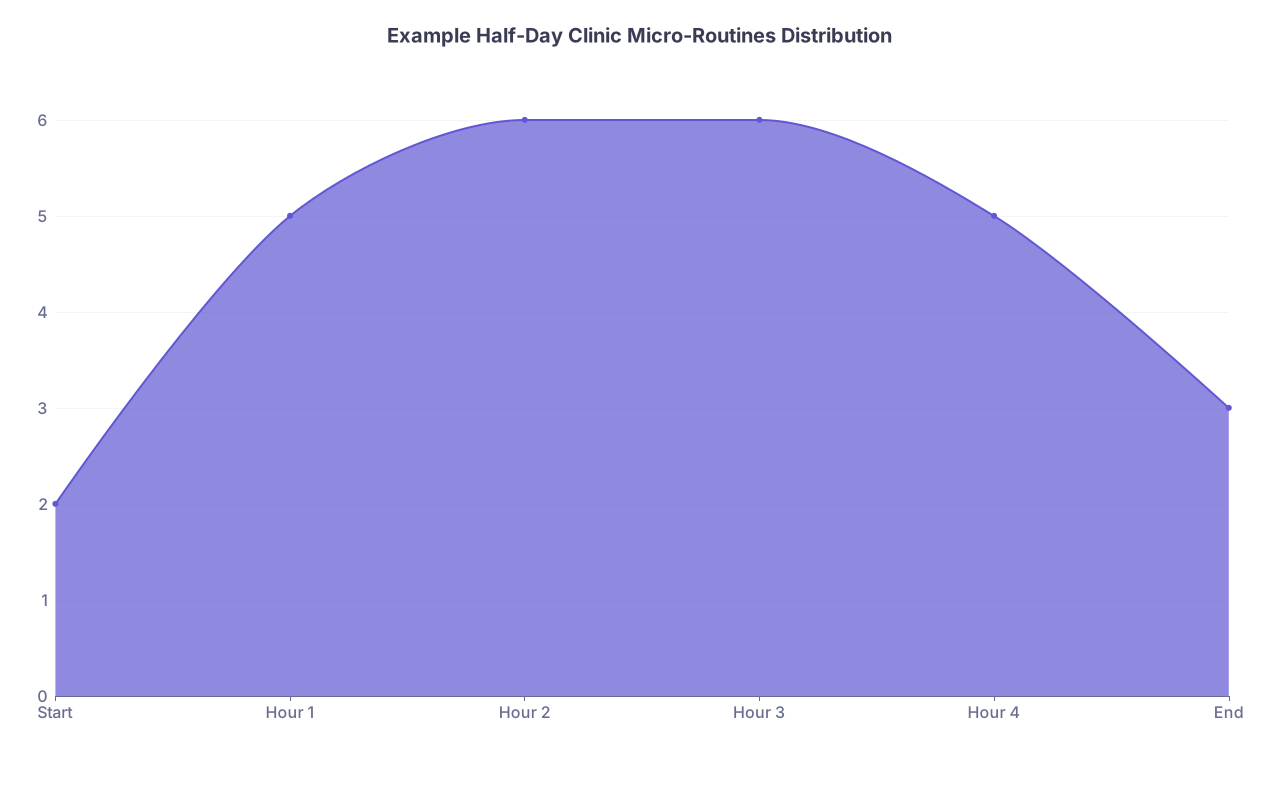
| Category | Value |
|---|---|
| Start | 2 |
| Hour 1 | 5 |
| Hour 2 | 6 |
| Hour 3 | 6 |
| Hour 4 | 5 |
| End | 3 |
- Start: 2 routines (launch + first door-in)
- Hour 1–3: 5–6 quick door rituals, micro-breaks, EMR anchors
- Hour 4: still 5 routines, protecting energy as fatigue hits
- End: 3 routines (3-list closure + exit cue + final debrief if needed)
You are not adding a new job. You are embedding micro-rules inside the day you already have.
How to Implement This Without Overhauling Your Life
You do not need all of this at once. You also will not remember all of this by tomorrow.
Here is a straightforward sequence.
Week 1: Doorway + Anchor Notes
- Pick one Door-Out phrase and one Door-In intention. Use them for every room for one half-day.
- Practice the 2-minute Anchor Note for every patient, even if you fall behind. Especially then.
Week 2: Pre-Clinic Launch
- Add the 3-box mental map and “good enough day” definition before clinic.
- Keep a sticky note with your three standards where you chart.
Week 3: Micro-Breaks + Interruption Triage
- Start the 4x20 micro-break rule. Track them with 4 tiny dots on your badge or a scrap of paper you fill in.
- Use the “Now / Soon / Later” language with staff. Expect some pushback. Be consistent anyway.
Week 4: Shutdown Routine + Emotional Debrief
- Do the 3-list closure at least 3 days this week.
- After one heavy case, try the 60-second micro-debrief.
At that point, adjust. Keep what works. Discard what feels artificial or useless.
The Ethics of Protecting Your Energy
This is not just self-help. It is ethical practice.
- A flooded, exhausted clinician misses subtle red flags.
- A resentful, overextended resident cuts corners.
- A clinician who takes everything home mentally has no long-term career.
Your duty of care includes care for your own cognitive and emotional capacity. Not as an indulgence. As standard maintenance.
A clinic day without collapse does not mean a clinic day without difficulty. It means you do not end every session feeling like you barely survived.
Now do something with this.
Open your next clinic schedule right now and do a 2-minute 3-box mental map: mark which visits will be light, medium, or heavy. Then write down three sentences that define a “good enough” day for that session. Put that paper where you will see it. That is your first micro-routine.