
The way most students “do” wellness is broken: vague intentions, random self-care, and zero structure. You need an actual plan. On one page. For this academic year.
Here is how to build it and make it stick.
Step 1: Ruthlessly Define Your Reality (15 Minutes)
Do not start with goals. Start with constraints. Your life this year is a math problem, not a vibe.
Grab a blank sheet (or open a document). Divide the top third into three quick sections:
- Non‑negotiable time blocks
- Big stressors
- Non‑negotiable values
A. Non‑negotiable time blocks
List what you cannot move this year:
- Required classes / rounds
- Clinics, labs, call schedule
- Commute
- Family obligations (childcare, elder care, etc.)
You do not need exact times yet. Just the anchors. For example:
- M–F: 7:00–17:30 – Surgery rotation
- Tu/Th: 18:00–19:00 – Family dinner
- 1–2 calls/week (24h)
Why this matters: Your wellness plan must fit around these, not compete with them. Otherwise it will die before October.
B. Big stressors
Be blunt. What actually wrecks you?
Common culprits:
- Night before exams → catastrophic anxiety
- Back-to-back 12s on wards → sleep implodes
- Feedback from attendings → spirals into shame
- Conflict with partner → nukes focus for days
- Charting backlog → Sunday panic
Write 3–5. No essays. Example:
- “Post-call days: I doom-scroll instead of sleeping, then feel worse.”
- “Exam weeks: I live on caffeine and skip every meal.”
- “I ruminate over small mistakes for days.”
C. Non-negotiable values
These are the lines you do not cross if you can help it. They anchor your ethics and your wellness.
Examples:
- “I will not lie about patient care, even to look competent.”
- “I do not sacrifice sleep to the point I am unsafe with patients.”
- “I protect one relationship (partner / child / parent) from my worst burnout patterns.”
Write 2–4. You will use these later to shape your plan.
Now you have reality on paper. Good. Most people skip this and build fantasy wellness plans. You are not doing that.
Step 2: Choose 4 Wellness Domains That Actually Matter
A one-page plan cannot handle everything. Limit yourself to four domains for this academic year.
I recommend this set for medical trainees:
- Sleep & Recovery
- Mental & Emotional Health
- Physical Health
- Relationships & Professional Integrity
If one does not fit, swap it, but keep it to four.
You are going to give each domain:
- 1 clear objective
- 2–3 measurable habits
- 1 red-flag trigger
- 1 rescue action
That is it. Tight and usable.
Step 3: Set One Objective Per Domain (Make It Concrete)
At the middle of your page, make four labeled boxes or quadrants:
- Top left: Sleep & Recovery
- Top right: Mental & Emotional Health
- Bottom left: Physical Health
- Bottom right: Relationships & Professional Integrity
Inside each, start with a one-sentence objective.
Examples:
- Sleep & Recovery: “Maintain functional, safe sleep on at least 5 nights per week, even on rotation.”
- Mental & Emotional Health: “Keep anxiety and rumination in a workable range so they do not control my behavior.”
- Physical Health: “Maintain basic fitness and energy without needing a full gym routine.”
- Relationships & Professional Integrity: “Show up as a decent human for the people I care about and act in line with my ethical standards.”
Do not wordsmith this for an hour. Write something honest and move on.
Step 4: Turn Objectives into Micro-Habits
This is where most wellness talks go fluffy. You are going specific.
For each domain, pick 2–3 habits that are:
- Tiny
- Measurable
- Rotation-proof (they can flex in busy weeks)
Domain 1: Sleep & Recovery
Bad version: “Get 8 hours.”
Better version: rotation-aware, good-enough rules.
Examples:
- Habit 1 – Minimum sleep rule: “In any 24h, I get at least 5.5 hours total, by any combination.”
- Habit 2 – Screen cutoff: “On non-call nights, no phone in bed. Screen off 30 minutes before I want to sleep.”
- Habit 3 – Post-call protocol: “When I get home post-call: shower, eat something small, sleep 3+ hours before anything else.”
Write yours in the box. Keep it brutally practical.
Domain 2: Mental & Emotional Health
You want behaviors, not “feel better.”
Examples:
- Habit 1 – 5-minute daily check-in: “Once a day I ask: What am I feeling? Where do I feel it in my body? What triggered it?”
- Habit 2 – One decompression block: “Minimum 10 minutes daily of a non-medical activity I actually enjoy (music, drawing, walking, trash TV without guilt).”
- Habit 3 – Cognitive offload: “I brain-dump worries into a notes app or notebook at least 3x/week instead of ruminating in bed.”
Domain 3: Physical Health
You are not training for a marathon during surgery rotation. You are trying not to become a stiff, inflamed zombie.
Examples:
- Habit 1 – Movement minimum: “Accumulate 20 minutes/day of walking or simple bodyweight moves, even broken up.”
- Habit 2 – Hydration rule: “Drink one full bottle of water before noon, another before 19:00.”
- Habit 3 – Food sanity: “On busy days, I still eat something with protein before 11:00 (yogurt, bar, nuts, eggs).”
Domain 4: Relationships & Professional Integrity
Combine personal life and ethical practice here. They are both about how you show up.
Examples:
- Habit 1 – Micro-connection: “Send one intentional message (text, voice note) per day to someone I care about.”
- Habit 2 – Boundaries phrase bank: “Use a pre-planned phrase when pressured into unethical corners.”
- Habit 3 – Weekly gratitude: “Once per week, tell one person (partner, nurse, classmate) something they did that I appreciated.”
For boundaries phrases, write 1–2 on your page, like:
- “I am not comfortable charting that if I did not see it myself.”
- “For my learning and for safety, can you walk me through why we are doing it this way?”
Those lines are armor when you are tired and intimidated.
Step 5: Add Red-Flag Triggers and Rescue Actions
Your plan is useless if it only functions when things are fine.
For each domain, add:
- Red flag: “When I notice X…”
- Rescue action: “…I do Y, within 24 hours.”
Be specific. Example set:
Sleep & Recovery
- Red flag: “Two nights in a row under 4 hours, or nodding off in conference.”
- Rescue action: “I schedule a 60–90 minute recovery sleep block within 48 hours and drop one non-essential task.”
Mental & Emotional Health
- Red flag: “I am replaying the same mistake or conversation for more than 24 hours.”
- Rescue action: “I write a 5-sentence ‘incident report’: what happened, what I learned, what I will do next time. Then I talk it out with one safe person.”
Physical Health
- Red flag: “Three consecutive days with no movement beyond walking between rooms, or living on coffee and snacks.”
- Rescue action: “I do one 10-minute walk, and I schedule ordering or prepping 2 protein-containing meals.”
Relationships & Professional Integrity
- Red flag: “I hear myself saying ‘I do not have time for them’ about someone who actually matters, or I catch myself hiding an error.”
- Rescue action: “I send a short message or have a 5-minute honest conversation. If ethical: I disclose or correct the error with supervision.”
Write yours directly on the page under the habits.
Step 6: Put Your Plan on One Physical (or Digital) Page
Now you consolidate.
Your one-page layout should include:
Top strip (short):
- 3–5 non-negotiable time blocks
- 3–5 big stressors
- 2–4 non-negotiable values
Middle (the bulk):
- 4 quadrants = 4 domains
- Each with:
- 1 objective sentence
- 2–3 micro-habits
- 1 red flag
- 1 rescue action
Bottom strip:
- “Absolute emergency protocol”
- Review schedule
Here is a quick comparison of where students screw this up versus what you are building:
| Approach | Typical Plan | One-Page Plan |
|---|---|---|
| Length | 3–10 pages | 1 page |
| Focus | Vague goals, aspirations | Concrete habits and triggers |
| Rotation-proof | Usually no | Yes, built around schedule |
| Crisis response | Not defined | Explicit red-flag and rescue steps |
| Review schedule | None | Weekly mini-review |
Print this page or set it as a pinned PDF on your tablet/phone. If it is buried in a folder, it does not exist.
Step 7: Add a Simple Weekly Review Ritual (10–15 Minutes)
Your plan will drift. That is normal. The fix is a recurring check-in that takes less time than scrolling Instagram.
Tie it to something that already happens:
- After Sunday dinner
- After your last shift of the week
- Right before planning your study schedule
During this review, run through:
- Score each domain from 1–5 for the week (1 = disaster, 5 = thriving).
- Circle 1 habit per domain to focus on next week.
- Note 1 micro-adjustment.
Example:
- Sleep: 3 → “I broke my own screen rule 4 nights. This week I enforce screen cutoff on 3 nights only, not all 7.”
- Mental: 2 → “I ruminated over attending feedback. Next week I use the 5-sentence incident report twice.”
- Physical: 4 → “Movement is fine. Keep same routine.”
- Relationships & Integrity: 2 → “I ignored two texts from my partner. Next week, 5-minute phone call on post-call days, even if exhausted.”
Track these scores quickly on the back of the page or in a tiny spreadsheet if you like seeing trends.
To make the cadence clearer:

| Step | Description |
|---|---|
| Step 1 | End of Week |
| Step 2 | Rate Each Domain 1 to 5 |
| Step 3 | Pick One Habit per Domain |
| Step 4 | Set One Micro Adjustment |
| Step 5 | Update One Page Plan if Needed |
| Step 6 | Place Plan Where You See It Daily |
This is not journaling. This is system maintenance.
Step 8: Create an “Absolute Emergency” Protocol
There will be weeks where your brain goes underwater. You must know, in advance, what “break glass” looks like.
At the bottom of the page, write exactly 3 steps for:
- Mental health crisis
- Ethical crisis
A. Mental health crisis
Define it concretely for you. Examples:
- Unable to sleep more than 2–3 hours for several nights.
- Persistent thoughts like “It would be easier if I just disappeared.”
- You are considering using substances just to cope or stay awake.
Your 3-step protocol might look like:
- Tell one trusted human within 24 hours (name them: partner, friend, chief resident, mentor).
- Contact professional help:
- Campus counseling number: XXX-XXX-XXXX
- Resident/faculty wellness line: XXX-XXX-XXXX
- National hotline appropriate to your country.
- Deactivate one non-essential demand for 1 week:
- Email student affairs or chief about scaling back one committee or non-critical project.
You are not weak for doing this. You are a clinician protecting your instrument: your own mind.
B. Ethical crisis
By this, I mean:
- You see or are asked to participate in something that feels wrong for patient care, safety, or honesty.
- You made an error that harms or could harm a patient and feel pressure to hide it.
- You see repeated behavior that violates your values (bullying, discrimination, lying in documentation).
Your 3-step protocol might be:
- Write down the facts privately: time, place, who, what happened, what was said and done.
- Consult one level up and one level lateral (e.g., senior resident + trusted nurse; clerkship director + advisor) within 48 hours.
- Use institutional channels if needed:
- Anonymous reporting link or hotline
- Ombudsperson
- Program director / dean’s office (if safe to access)
This is both wellness and ethics. Moral injury is a real cause of burnout. Pretending otherwise is naive.
Step 9: Make It Visible and Hard to Ignore
Stop expecting willpower to remember your plan. You are going to be tired, overworked, and distracted.
Do at least two of these:
- Print the plan and tape it inside your locker.
- Fold a copy and keep it in your white coat.
- Set a photo of it as your lock screen or home screen.
- Pin the PDF in your note-taking app and star it.
Add one 2-second trigger habit:
- “When I hang up my stethoscope at home, I glance at the plan.”
- “When I open my laptop for study, I open the plan first.”
This is how you sneak repetition into a chaotic life.
Step 10: Build a Rotation-Adjustable Version
Your year is not static. Pre-clinical, clinical rotations, electives, interviews—different beasts. Your habits need “easy,” “standard,” and “stretch” settings.
Use a tiny three-level system for each habit:
- Level 1 – Survival (worst rotation, heavy call)
- Level 2 – Baseline (normal busy weeks)
- Level 3 – Growth (lighter months, electives)
Example for Movement:
- Level 1: “5 minutes of stretching before bed.”
- Level 2: “20 minutes of walking most days.”
- Level 3: “Two 30-minute workouts per week + 20 minutes walking most days.”
On your one-pager, you do not need to write all three. Instead, add a small note at the top:
- “On heavy weeks: Level 1 version of all habits.”
- “On lighter weeks: Level 2–3.”
Then in your weekly review you decide: this coming week is Level 1, 2, or 3.
This simple scaling keeps you from the all-or-nothing trap: “If I cannot do the full workout, why bother?”
Here is how time and focus typically shift:
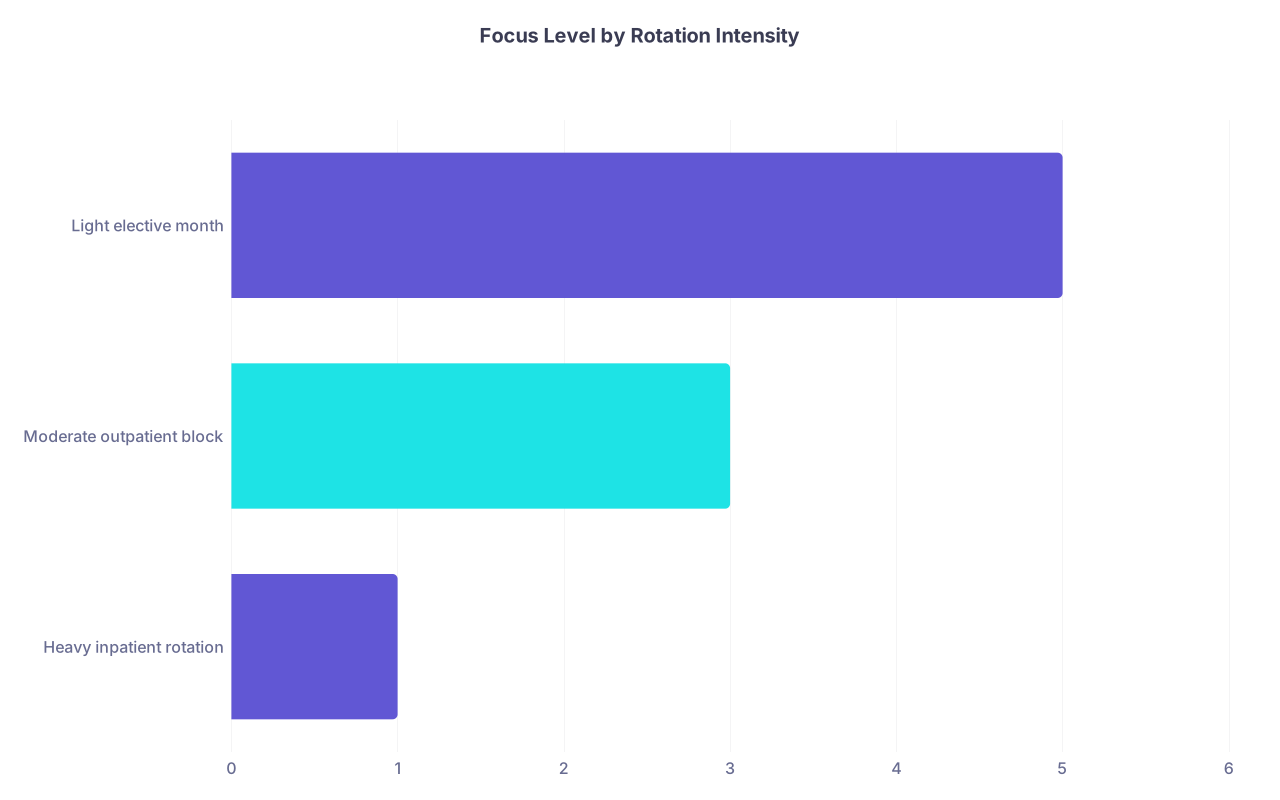
| Category | Value |
|---|---|
| Heavy inpatient rotation | 1 |
| Moderate outpatient block | 3 |
| Light elective month | 5 |
You match your habits to reality, not to some idealized studygram version of yourself.
A Concrete Example: One-Page Wellness Plan (Condensed)
To make this even clearer, here is a skeleton version you can literally copy and adapt.
Top strip
- Non-negotiables: M–F 7:00–18:00 wards; q4 call; Wed 20:00–21:00 call with partner.
- Big stressors: Night before exams, harsh feedback, conflict with attending, back-to-back call.
- Values: Do not lie in documentation. Protect sleep enough to be safe. Treat nurses and staff with respect even when I am stressed.
Sleep & Recovery
- Objective: Stay safe and functional with 5+ decent nights/week.
- Habits:
- At least 5.5 hours total sleep/24h.
- No phone in bed on 3 nights/week.
- Post-call: shower, eat, 3-hour sleep before anything else.
- Red flag: Two nights <4 hours or almost falling asleep on rounds.
- Rescue: Plan 60–90 min recovery sleep + drop one non-essential task in next 48h.
Mental & Emotional Health
- Objective: Keep anxiety and shame in a range where I can still act wisely.
- Habits:
- 5-minute check-in daily (what am I feeling, where, why).
- One 10-minute decompression activity daily.
- Brain-dump worries 3x/week before bed.
- Red flag: Same event replaying in my head for >24h.
- Rescue: 5-sentence incident report + talk to one safe person.
Physical Health
- Objective: Avoid becoming completely deconditioned.
- Habits:
- 20 minutes walking/day, can be split.
- One full bottle of water before noon and before 19:00.
- Protein before 11:00 even on busy days.
- Red flag: 3 days with no purposeful movement and surviving on coffee/snacks.
- Rescue: 10-minute walk + order/prep 2 real meals.
Relationships & Professional Integrity
- Objective: Stay connected to my people and my ethics.
- Habits:
- One intentional message/day to someone I care about.
- Use phrase bank when something feels off:
- “I am not comfortable documenting that if I did not see it.”
- “Can we review the rationale? I want to understand for safety.”
- Weekly gratitude to one person.
- Red flag: Avoiding partner/friend for >48h or tempted to hide an error.
- Rescue: 5-minute honest check-in + escalate ethical concerns up one level.
Bottom strip
- Emergency – Mental: Tell [Name], contact counseling at XXX-XXX-XXXX, drop one non-critical commitment for 1 week.
- Emergency – Ethical: Document facts; talk to senior + one lateral (nurse/peer); use institutional reporting if unresolved.
- Review: Sunday night, 10 minutes. Rate domains 1–5, choose one focus habit per domain.
That is your template.
FAQ (Exactly 4 Questions)
1. What if I already feel too overwhelmed to even make this plan?
Then you cut it down further. Start with one domain only: Sleep & Recovery. Write:
- 1 objective
- 2 habits
- 1 red flag
- 1 rescue action
That is it. Once you run that for two weeks, add Mental & Emotional Health, and so on. You do not need the perfect plan to start; you need a tiny working version.
2. How is this different from just “being more disciplined”?
Discipline without structure is just guilt. This plan:
- Accepts your actual schedule and stressors.
- Pre-defines small, specific behaviors.
- Builds in red-flag and rescue steps so “failure” triggers adjustment, not shame.
You are not trying to white-knuckle a new personality. You are installing a simple operating manual for this year’s version of you.
3. What if my rotation or attending makes some habits impossible?
You downgrade to Level 1 versions on those weeks. If even that is impossible, your only job is to:
- Notice which domain is collapsing.
- Activate the rescue action, even once.
There will be blocks where “survival mode” is the correct choice. Use your weekly review to ramp back up when the rotation allows.
4. How does this tie into my professional ethics, not just self-care?
Burnout is not only about being tired. It is about feeling you are acting against your own values. This plan explicitly integrates:
- Sleep and mental stability so you can make sound clinical decisions.
- Boundaries phrases for ethical pressure.
- A protocol for when you see or commit something wrong.
Your wellness is not a separate hobby from your professionalism. It is the infrastructure that keeps your clinical judgment and moral compass intact.
Take one sheet of paper (or open a blank document) right now and draw those four quadrants. Fill in just Sleep & Recovery and Mental & Emotional Health today. Do not overbuild; get a working draft on the page before you go to bed tonight.